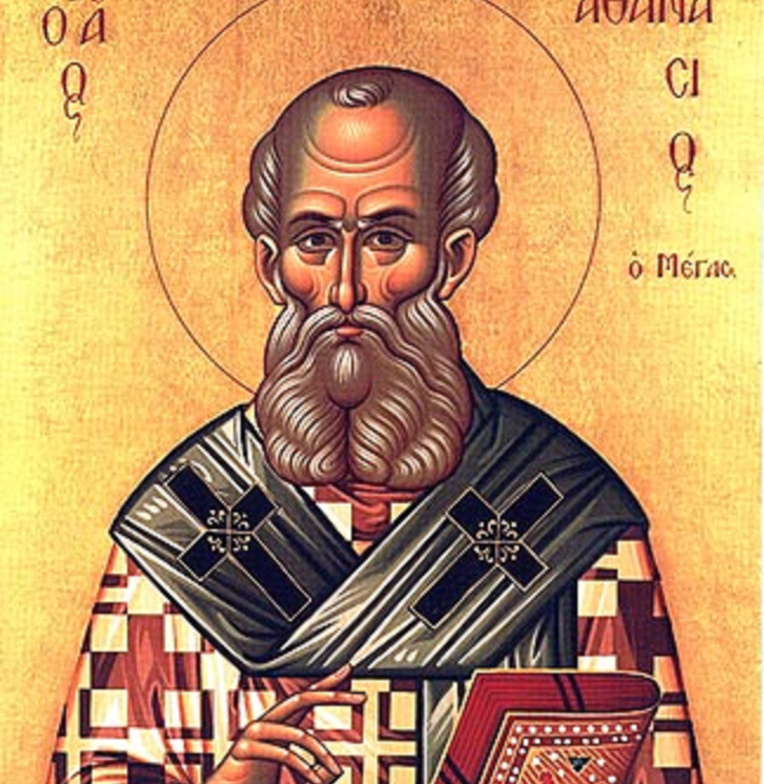
Prescriptions from the Doctors of the Church: Saint Athanasius (c. 296–May 2, 373)

Saint Athanasius is one of the thirty-six saints who are Doctors of the Church. The Doctors of the Church are renowned for their holiness and also for their important teachings. Using the doctor metaphor, we can say that in a sense each Doctor of the Church gives us a “prescription” for spiritual growth. Saint Athanasius’ particular prescription for holiness can help us be courageous and strong in our love for Jesus in the midst of life’s challenging situations.

As a young man, Athanasius spent some time with Saint Anthony of the Desert to learn the ways of the spiritual life. That formation served him well, for Athanasius became one of the most important defenders of the Christian faith at a time when the early Church was finding a way to teach clearly about who Jesus is. Athanasius accompanied Bishop Alexander of Alexandria to the Council of Nicea in 325. The Council upheld the divinity of Jesus Christ and condemned Arianism, the false teaching that Jesus was not divine. Despite the Council’s clear teaching, Arianism spread widely, especially because it was supported by the emperors.

In 328, Athanasius became bishop of Alexandria. He constantly struggled to uphold the true teaching about Jesus Christ. Four emperors exiled Athanasius five times, for a total of seventeen years. Athanasius spent years in hiding from his enemies who wanted him dead. Even when it seemed as if Arianism could triumph in the Church, Athanasius never gave up. He wrote important theological works, including De Incarnatione, (On the Incarnation of the Word), and a biography of Saint Anthony, which helped Christian monasticism to grow. In 381, after Athanasius’ death, the Council of Constantinople reaffirmed that Jesus is fully human and fully divine.

Athanasius’ prescription: Jesus is both God and man. Put him in charge of your life!

Athanasius spent much time in exile and suffering because of his tenacity in upholding the truth about Jesus Christ: he is fully divine and fully human. In Athanasius’ day, Arianism had spread widely and had many influential supporters in both the Church and the government. At that time, the emperors often meddled in Church affairs and this imperial support for Arianism was hard to overcome. Athanasius had so much opposition in upholding the truth of the Catholic faith that he was often described as Athanasius contra mundum (Athanasius against the world.)

Why did he insist on upholding his position? Because it was the truth of the Catholic faith, not just some idea that Athanasius had. What was at stake? To deny the truth of the divinity of Jesus Christ would have meant rejecting the Catholic faith. It would have meant there was no redemption, because if Jesus was not divine his death on the cross could not have saved us. Saint Paul wrote this in regard to the resurrection:
If there is no resurrection of the dead, then Christ has not been raised; and if Christ has not been raised, then our proclamation has been in vain and your faith has been in vain.. . .  If Christ has not been raised, your faith is futile and you are still in your sins” (1 Cor 15:13-14, 17). If Christ is not divine, then we are still in our sins. That is why the divinity of Christ is so crucial.

On a practical level, what does this mean for us?

It means that we must place Christ at the center of our lives, and believe in the teaching of the Catholic Church that Jesus is both God and man. It means growing in union with Jesus by prayer, the sacraments and good works—knowing that whatever we do to another, we do it to Jesus (see Mt. 25). It means reading the Gospel and meditating on what Jesus said and did. It means completely entrusting ourselves to him, knowing that we are in his safe hands.

Some practical things to do:

  • Honor the divinity of Christ by making a holy hour at church in front of the tabernacle.
  • Honor the holy Name of Jesus by always using it in a respectful way, never as a swear word.
  • Pray for persecuted Christians around the world.

Prayer

Saint Athanasius, you dedicated your whole life to preaching the true faith about Jesus Christ, that he is fully divine and fully human. Despite all the opposition you endured you clung to the truth and never stopped proclaiming it. Help us to have a deep faith and to be fully Catholic in our way of thinking despite all the errors that are so prevalent in our own time. Pray that we will have the light and courage to proclaim the truth like you did.

Feast: May 2

Patron: Theologians, those who uphold the truth of the Christian faith

A selection from Saint Athanasius

But for the searching of the Scriptures and true knowledge of them, an honorable life is needed, and a pure soul, and that virtue which is according to Christ; so that the intellect guiding its path by it, may be able to attain what it desires, and to comprehend it, in so far as it is accessible to human nature to learn concerning the Word of God. For without a pure mind and a modelling of the life after the saints, a man could not possibly comprehend the words of the saints. For just as if a man wished to see the light of the sun, he would at any rate wipe and brighten his eye, purifying himself in some sort like what he desires, so that the eye, thus becoming light, may see the light of the sun. Or it is as if a person would see a city or country, he at any rate comes to the place to see it. Thus he who would comprehend the mind of those who speak of God must needs begin by washing and cleansing his soul, by his manner of living, and approach the saints themselves by imitating their works. Then, associated with them in the conduct of a common life, he may understand also what has been revealed to them by God. Thenceforth, as closely knit to them, he may escape the peril of the sinners and their fire at the day of judgment. He will thus receive what is laid up for the saints in the kingdom of heaven, which eye has not seen, nor ear heard, neither have entered into the heart of man, whatsoever things are prepared for them that live a virtuous life, (see 1 Cor 2:9). They will then love our God and Father, in Christ Jesus our Lord: through whom and with whom be to the Father himself, with the Son himself, in the Holy Spirit, honor and might and glory for ever and ever. Amen.

From On the Incarnation, no. 57, as found here: https://www.newadvent.org/fathers/2802.htm

By Sr Marianne Lorraine Trouvé, FSP

Examen on Gratitude

Place yourself in the presence of the Lord and pray for enlightenment. Relax. Breathe deeply. Run quickly over the past few hours or days, allowing your real feelings to surface about the events that have been part of your life, the feelings you’ve buried so that you could make it through the day.

Pay attention to the way in which the Lord has been present to you. Where have you felt drawn to the Lord or moved to gratitude? Where have you met the Lord when you felt afraid … misunderstood … tempted … relieved … happy? Turn to the Lord with gratitude.

Choose one incident or reaction that stands out particularly for you at this time and which is still not settled for you. Recall to mind the details of the incident and its context, the people involved, and how you feel about it.

Read in the Bible the Curing of the Ten Lepers (Luke 17:11-19)

Allow Jesus to reach out to you in your deepest need, communicating to you his care and his power healing.

Now on his way to Jerusalem, Jesus traveled along the border between Samaria and Galilee. As he was going into a village, ten men who had leprosy met him. They stood at a distance and called out in a loud voice, “Jesus, Master, have pity on us!”

When he saw them, he said, “Go, show yourselves to the priests.” And as they went, they were cleansed.

One of them, when he saw he was healed, came back, praising God in a loud voice. He threw himself at Jesus’ feet and thanked him—and he was a Samaritan.

Jesus asked, “Were not all ten cleansed? Where are the other nine? Has no one returned to give praise to God except this foreigner?” Then he said to him, “Rise and go; your faith has made you well.”

This healing story of Jesus is different from many of his other miracles because the Lord is not actually physically present when the lepers are healed. They were walking to see the priests, as Jesus had instructed, when they were made clean. Caught up in the joy of their miracle, all but one of the lepers continued on their way to live a new life of health.

This situation is easily relatable. How often we pray, asking God for a special favor or grace, knowing that we greatly need it. Then, once we receive it, we start living our new life of grace, forgetting to thank God for empowering us to live each moment.

Read through this passage again, recalling the incident you chose for your examen.

As you think about the situation or reaction you brought to this examen, do you see that God gave you any grace in that moment? How did you react? Did you go about living with the new grace as though nothing had happened, or did you turn around to praise God?

Gratitude is essential for the Christian life and for maintaining a relationship with God. God gives grace to sustain you in each moment; when you recognize and thank God for the gift of his love, you are filled with the joy and peace of knowing that you are his beloved son or daughter. How do you feel when someone sincerely thanks you for something you have done for them? How could your relationship with God grow through expressing gratitude for his gifts?

God’s great love for you is made manifest in the experiences of your life. As you make this examen, the Lord is right now moving your heart toward gratitude.

Spend some time talking over with the Lord what you are learning and experiencing. With simplicity express your sorrow for any lack of gratitude in your life and your gratitude for any movements you sense toward greater gratitude through God’s grace.

Identify one step toward becoming a more grateful person that you want to take going forward, a step that is actually possible for you. Pray for the grace to be a more grateful person.

Image by marthaartess from Cathopic

Examen on Serenity

Place yourself in the presence of the Lord and pray for enlightenment. Relax. Breathe deeply. Run quickly over the past few hours or days, allowing your real feelings to surface about the events that have been part of your life, the feelings you’ve buried so that you could make it through the day.

Pay attention to the way in which the Lord has been present to you. Where have you felt drawn to the Lord or moved towards serenity? Where have you met the Lord when you felt afraid … misunderstood … tempted … relieved … happy? Turn to the Lord with gratitude.

Choose one incident or reaction that stands out particularly for you at this time and which is still not settled for you. Recall to mind the details of the incident and its context, the people involved, and how you feel about it.

Read in the Bible Jesus’ Praise of the Father (Matt. 11:25-30)

Allow Jesus to speak directly to you, allowing him to know your heart in a more intimate way.

At that time Jesus said, ‘I thank you, Father, Lord of heaven and earth, because you have hidden these things from the wise and the intelligent and have revealed them to infants; yes, Father, for such was your gracious will. All things have been handed over to me by my Father; and no one knows the Son except the Father, and no one knows the Father except the Son and anyone to whom the Son chooses to reveal him.
‘Come to me, all you that are weary and are carrying heavy burdens, and I will give you rest. Take my yoke upon you, and learn from me; for I am gentle and humble in heart, and you will find rest for your souls. For my yoke is easy, and my burden is light.’ (Matt. 11:25-30)


Jesus speaks and praises the Father, acknowledging that he has done many unexpected things. God’s love knows no bounds. Sometimes we might have regrets, anxieties, or other forms of suffering that prevent us from accepting Christ’s invitation to find rest for our souls. Jesus does not condemn anyone for struggling with their burdens or for becoming tired from carrying them. He simply lovingly invites anyone who is exhausted from the journey to stop, look to him, and rest.

Notice that Jesus is speaking directly to you. He is saying, “Come to me, all of you.” Jesus sees who you are and loves you intimately. There is no need to hide any part of yourself; you are free to truly be you in his presence.

Read the passage again, imagining Jesus looking at you with great love and speaking these words to you. What burden does he invite you to bring to him? What is it that you desire to learn from Jesus?

Jesus wants to share your burdens. As you reflect upon the incident you chose for your examen, think about what would happen if you invited him into your heart to see your daily struggles. Christ can carry them for you. Will you accept his invitation to find rest?

God’s great love for you is made manifest in the experiences of your life. As you make this examen, the Lord is right now moving your heart toward serenity.

Spend some time talking over with the Lord what you are learning and experiencing. With simplicity express your sorrow for times when you have resisted serenity in your life and your gratitude for any movements you sense toward greater peace through God’s grace.

Identify one step toward becoming a more serene person that you want to take going forward, a step that is actually possible for you. Pray for the grace to be a more serene person.

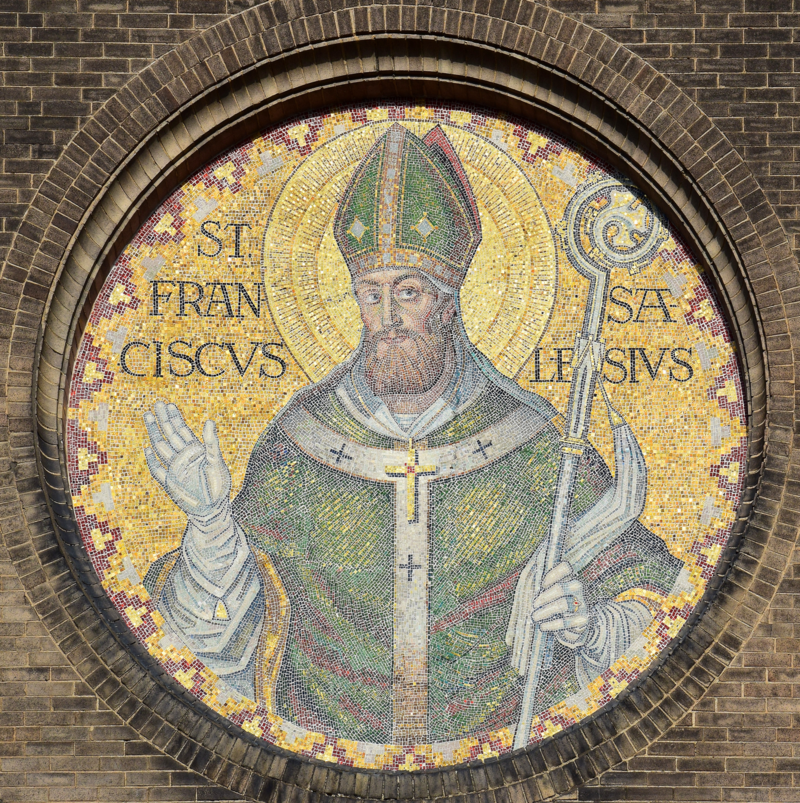
Prescriptions from the Doctors of the Church: Saint Francis de Sales (August 21, 1567 – December 28, 1622)

Francis was born the eldest in a wealthy noble family in the Savoy region of France. His father was a severe man who hoped Francis would pursue a career in public service. Francis greatly desired to be a priest but, knowing his father’s desires, he patiently waited to reveal his vocation to his family. Soon after acquiring his doctorate at the prestigious University of Padua, a relieved Francis was able to obtain permission from his father to become a priest.

Not long after he was ordained in 1593, Francis was sent to the Chablais region to reconvert an area that had fallen under Calvinist control. He embraced this work with fervor despite difficult conditions and an initial lack of success. Francis wrote leaflets on the faith for distribution to the people. These were recopied by hand. In 1602, Francis was consecrated bishop of Geneva. With his characteristic determination and gentleness, Francis preached many eloquent sermons, taught catechesis, wrote countless letters, and worked to educate the laity and priests of his diocese.

In 1604, Francis met a young widow, Jane Frances de Chantal. A spiritual friendship developed between the two saints and was the source of fruitfulness both in their lives and in the Church. Together, they founded the Visitation Order of women religious. After working tirelessly his entire life, Francis died and was buried, at his request, at the convent of the Visitations nuns.

Saint Francis de Sales’ prescription: Evangelize with gentleness, humility, and simplicity.

Francis de Sales is known as “the gentleman saint” because he was gentle with people and showed great humility and delicacy in speaking with others. By nature he was inclined to anger but he worked on himself so much that his gentleness and kindness overcame his anger. He wanted to win people back to the Catholic faith and to do this he always used kindness. He didn’t engage in debates or harangue people. When he was working in the Calvinist area of the Chablais, sometimes his life was in danger because the people were so opposed to the Catholic Church. But through it all Francis managed to keep calm and reach out with humility.

At a certain point he decided it might be more effective to write pamphlets, and he wrote many of them explaining the Catholic faith and its teachings. Little by little these had an effect and people started to return to the Catholic faith. Francis always welcomed them back with great kindness and his gracious manner attracted people.

He was also convinced that holiness is for everyone and he was a great spiritual director. His book An Introduction to the Devout Life is still a best-selling volume for lay people who want to grow in holiness. His other best seller, Treatise on the Love of God, is a long work that goes into great detail about how we can love God in our lives.

We can learn a lot from Francis about effective evangelization. Today the internet can be an excellent tool to use in evangelizing, but too often it degenerates into angry debates that don’t help anyone. Francis can teach us a lot about how to evangelize in a way that attracts people instead of driving them away.

Some practical things to do:

  • Examine the way you typically interact with others on the internet, especially if you use it to evangelize. Are there some ways you can follow Francis’ lead in order to win people over?
  • Pray for missionaries throughout the world.
  • Think of small ways you can evangelize among your friends. For example, you might try inviting someone to go to Mass with you, or to pray the rosary together.

Prayer

Saint Francis de Sales, please pray that I may grow in humility and faith so that, like you, I can give my entire life to God. Amen.

Feast: January 24
Patron: Writers, confessors, the deaf, journalists, the press, teachers

Selection from the writings of Saint Francis de Sales

Devotion is suitable to all sorts of vocations and professions.

In creation God commanded the plants to bring forth fruits, each one according to its kind; even so he commands all Christians, which are living plants of the Church, to bring forth their fruits of devotion, each one according to his quality and vocation. Devotion ought to be differently exercised by the prince, by the gentleman, by the tradesman, by the servant, by the widow, by the married person: and not only so, but the practice also of devotion must be accommodated to the health, the capacity, the employment, and the obligations of each one in particular.

For would it be fit for a bishop to be as retired as a Carthusian, and for married people to store up no more wealth than a Capuchin, for a working person to spend all day in church like a monk, and the religious continually exposed to all the exterior exercises of charity for the service of his neighbor as a bishop, would not this devotion be ridiculous, preposterous, and insupportable? This fault, nevertheless, happens very often, and the world, which does not, or will not discern any difference between real devotion and the indiscretion of those who pretend to be devout, blames and murmurs at it, which cannot remedy such disorders.

No, Philothea, devotion prejudices nothing when it is true, but rather makes all things perfect. The bee draws honey from flowers without hurting them, leaving them as entire and fresh as it found them; but true devotion goes yet farther, for it does not injure any calling or employment, but, on the contrary, adorns and beautifies all. . . .

Wherever we are, we can and ought to aspire to a perfect life.

From An Introduction to the Devout Life (Part I, Chapter 3)

(Taken from public domain edition found on the internet (published in Dublin in 1885): https://archive.org/details/an-introduction-to-the-devout-life/page/n3/mode/1up?view=theater

Image credit: RickMorais, CC BY-SA 4.0 https://creativecommons.org/licenses/by-sa/4.0, via Wikimedia Commons

Examen on Joy

Place yourself in the presence of the Lord and pray for enlightenment. Relax. Breathe deeply. Run quickly over the past few hours or days, allowing your real feelings to surface about the events that have been part of your life, the feelings you’ve buried so that you could make it through the day.

Pay attention to the way in which the Lord has been present to you. Where have you felt drawn to the Lord or moved to joy? Where have you met the Lord when you felt afraid … misunderstood … tempted … relieved … happy? Turn to the Lord with gratitude.

Choose one incident or reaction that stands out particularly for you at this time and which is still not settled for you. Recall to mind the details of the incident and its context, the people involved, and how you feel about it.

Read in the Bible Jesus Appears to Seven Disciples (John 21:1-14)

Allow Peter to lead you to the joy of encountering Jesus.

After these things Jesus showed himself again to the disciples by the Sea of Tiberias; and he showed himself in this way. Gathered there together were Simon Peter, Thomas called the Twin, Nathanael of Cana in Galilee, the sons of Zebedee, and two others of his disciples. Simon Peter said to them, ‘I am going fishing.’ They said to him, ‘We will go with you.’ They went out and got into the boat, but that night they caught nothing.


Just after daybreak, Jesus stood on the beach; but the disciples did not know that it was Jesus. Jesus said to them, ‘Children, you have no fish, have you?’ They answered him, ‘No.’ He said to them, ‘Cast the net to the right side of the boat, and you will find some.’ So they cast it, and now they were not able to haul it in because there were so many fish. That disciple whom Jesus loved said to Peter, ‘It is the Lord!’ When Simon Peter heard that it was the Lord, he put on some clothes, for he was naked, and jumped into the lake. But the other disciples came in the boat, dragging the net full of fish, for they were not far from the land, only about a hundred yards off.


When they had gone ashore, they saw a charcoal fire there, with fish on it, and bread. Jesus said to them, ‘Bring some of the fish that you have just caught.’ So Simon Peter went aboard and hauled the net ashore, full of large fish, a hundred and fifty-three of them; and though there were so many, the net was not torn. Jesus said to them, ‘Come and have breakfast.’ Now none of the disciples dared to ask him, ‘Who are you?’ because they knew it was the Lord. Jesus came and took the bread and gave it to them, and did the same with the fish. This was now the third time that Jesus appeared to the disciples after he was raised from the dead. (John 21:1-14)

This Gospel scene begins with a quite distressing scenario. The disciples are still mourning Jesus’ death when Simon Peter decides that he wants to go fishing to try to cope. Some of the other disciples go with him, surely because none of them wants to be alone. And, in their dark period of mourning, not only are they without their Lord, but they cannot even catch fish.

Read the passage again, paying particular attention to what happens when Simon Peter hears that it is the Lord on the shore. In a single moment, their total darkness is transformed into total light, as they bring in an enormous catch of fish and their hope is restored. Allow the joy of the scene to enter into your heart.

The Christian life is filled with joy because it is filled with Christ’s love. Of course, this does not mean that the Christian life is not difficult, but instead that the struggles and challenges that Christians face are joined to the joy of Christ’s presence. When Peter saw the Lord, he jumped into the water and swam to greet him, filled with joy and excitement. Everything seems unimportant compared to the joy of being in the presence of Jesus.

As you reflect upon the incident that you chose for your examen, pay attention to where God is present. Allow this knowledge of his presence to fill you with joy. What would it be like to savor the joy of ordinary moments in your day? How can you share this joy of knowing God’s love with others?

God’s great love for you is made manifest in the experiences of your life. As you make this examen, the Lord is right now moving your heart toward joy.

Spend some time talking over with the Lord what you are learning and experiencing. With simplicity express your sorrow for any lack of joy in your life and your gratitude for any movements you sense toward greater joy through God’s grace.

Identify one step toward becoming a more joyful person that you want to take going forward, a step that is actually possible for you. Pray for the grace to be a more joyful person.

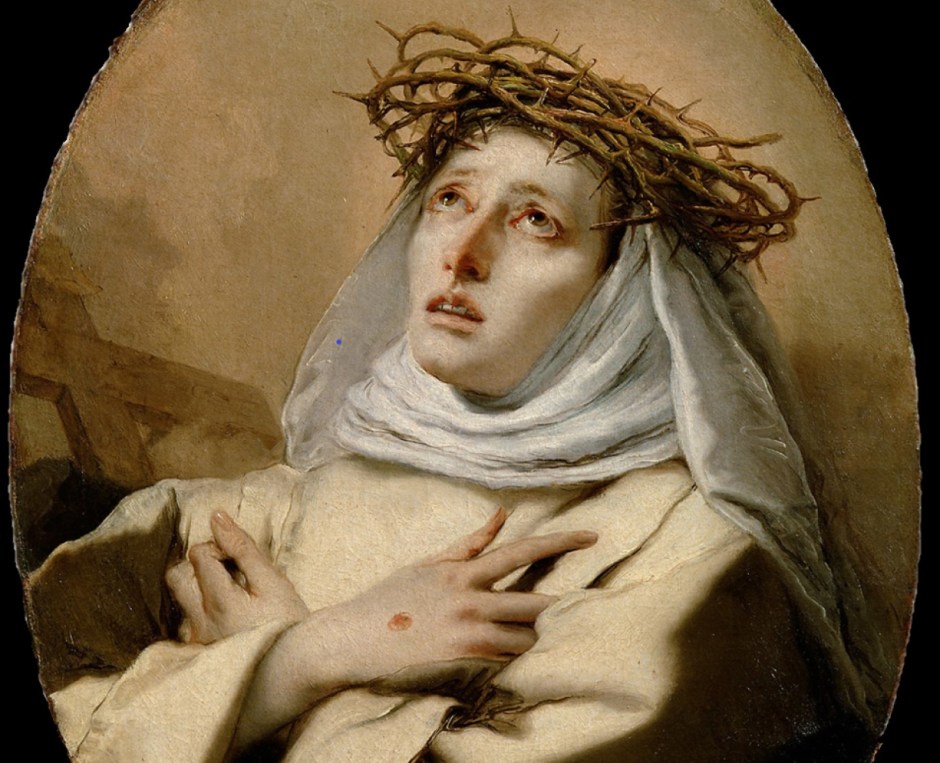
Prescriptions from the Doctors of the Church: Saint Catherine of Siena (March 25, 1347-April 29, 1380)

Saint Catherine of Siena is one of the thirty-six saints who are Doctors of the Church. The Doctors of the Church are renowned for their holiness and also for their important teachings. Using the doctor metaphor, we can say that in a sense each Doctor of the Church gives us a “prescription” for spiritual growth. Saint Catherine’s particular prescription for holiness will help be more focused on the important things in life.

Catherine Benincasa was the twenty-fourth of twenty-five children born to her parents, though only about half survived childhood. From a young age, Catherine had mystical visions and felt drawn to give her entire life to God. But her parents had other plans. When they began to arrange a marriage for her, Catherine resisted and took up extreme ascetical practices to demonstrate her firm resolve. Her parents eventually gave up and Catherine became a Dominican tertiary, living the Dominican spirituality within her family home.

For three years, Catherine lived in silence and solitude in a cell in her family home. After a mystical experience of union with Jesus, Catherine felt called to leave solitude and began aiding the ill and serving the poor. Gradually, she began to receive attention for her holiness and requests for advice from many prominent people. She dictated at least fifteen letters to Pope Gregory XI, insisting that he move back to Rome from Avignon—and he eventually relented. Around this time, Catherine began work on her Dialogues, the book of her meditations and revelations. Catherine died in Rome after a three-month illness. She was only thirty-three. She was canonized in 1461 and named a Doctor of the Church in 1970.

Catherine of Siena’s prescription: Think often about your salvation! Salvation comes through the blood of Christ.

Catherine reportedly died while saying “Blood! Blood! Blood!” It was a word she used often, over 1800 times in her writings. In using it she was thinking of the blood of Christ. The salvation of souls was of paramount importance to Catherine, and she knew that we are saved through the blood of Christ. She emphasized blood so that people would think about salvation more. She also stressed the reception of Christ’s blood in the sacrament of the Eucharist. Blood represents life, food, communion with Christ and with each other, and grace. It is a very rich concept and stands at the foundation of Catherine’s spiritual teaching.

Her love for Jesus spilled over into love for other people. Catherine could be found nursing the sick, feeding the hungry, teaching others about the great love God has for them. Because of her extreme penances, Catherine might seem odd or strange. Her mystical prayer life contained many visions and supernatural experiences. But she always insisted that apparitions don’t make a person holy; only love does. While she was deeply involved in working for the reform of the Church and in helping others, she never let go of the ultimate goal: salvation. And that salvation comes through the blood of Christ.

Some practical things to do:

  • Pray for the salvation of all people. Keep in mind especially those people who are wandering far away from God.
  • Pray the Divine Mercy chaplet, which is a way of praying by offering the blood of Jesus to the eternal Father. Here are instructions on how to pray it.
  • Perform one of the spiritual or corporal works of mercy as a way of showing love toward others.

Prayer

Saint Catherine, in your life you did unusual penances and experienced mystical phenomena. But that’s not what made you a saint. You became a saint because of your great love, love for Jesus first of all and then love of your neighbor. You  spent yourself in works of charity to aid the poor and the outcasts. Pray for us that we too might spend ourselves in love of neighbor by seeing Jesus in each person whom we meet. Help us to be authentic witnesses of the joy of the Gospel.

Feast: April 29
Patron: Italy, Europe, nurses and the sick; against fire, sexual temptation, illness, miscarriages

Selection from the writings of Saint Catherine

Eternal God, eternal Trinity, you have made the blood of Christ so precious through his sharing in your divine nature. You are a mystery as deep as the sea; the more I search, the more I find, and the more I find the more I search for you. But I can never be satisfied; what I receive will ever leave me desiring more. When you fill my soul I have an even greater hunger, and I grow more famished for your light. I desire above all to see you, the true light, as you really are.

I have tasted and seen the depth of your mystery and the beauty of your creation with the light of my understanding. I have clothed myself with your likeness and have seen what I shall be. Eternal Father, you have given me a share in your power and the wisdom that Christ claims as his own, and your Holy Spirit has given me the desire to love you. You are my Creator, eternal Trinity, and I am your creature. You have made of me a new creation in the blood of your Son, and I know that you are moved with love at the beauty of your creation, for you have enlightened me.

Eternal Trinity, Godhead, mystery deep as the sea, you could give me no greater gift than the gift of yourself. For you are a fire ever burning and never consumed, which itself consumes all the selfish love that fills my being. Yes, you are a fire that takes away the coldness, illuminates the mind with its light and causes me to know your truth. By this light, reflected as it were in a mirror, I recognize that you are the highest good, one we can neither comprehend nor fathom. And I know that you are beauty and wisdom itself. The food of angels, you gave yourself to man in the fire of your love.

You are the garment which covers our nakedness, and in our hunger you are a satisfying food, for you are sweetness and in you there is no taste of bitterness, O triune God!

From the Dialogue on Divine Providence, chapter 167

By Sr Marianne Lorraine Trouvé, FSP

Image Credit: Giovanni Battista Tiepolo via Wikimedia Commons