
When You Want to Shout at Jesus (Mt 15:21-28)

Jesus left that place and went away to the district of Tyre and Sidon. Just then a Canaanite woman from that region came out and started shouting, “Have mercy on me, Lord, Son of David; my daughter is tormented by a demon.” But he did not answer her at all. And his disciples came and urged him, saying, “Send her away, for she keeps shouting after us.”  (Mt 15:21-28)

Have you ever shouted at Jesus? If you have, it was probably in the secret of your room, quietly in your heart, or in your car with the windows rolled up. More than likely none of us would want to be found running down the road screaming at Jesus, even if we were just trying to get his attention….

The Greek word for “shouting” used in v. 22 and 23 is slightly different, but indicates that the woman was emotionally screaming, continuously wailing, creating a clamorous spectacle of herself. And the disciples were not happy. Let’s get rid of her! She is attracting the wrong type of attention!

Friends of mine found themselves in tears one Sunday after Mass, asking for their pastor’s prayers before a very important immigration meeting. I have been reduced to quiet tears as an expression of my inner wailing, tears that are the beginning, the first steps, the sure indication of faith.

The Canaanite mother cries out: “Have mercy on me, Lord, Son of David; my daughter is tormented by a demon.” The very fact that she calls Jesus the Son of David indicates her firm hope and faith in him as Messiah. Later, as she kneels before Jesus in conversation with him, she shows a simple, humble trust that even a crumb of Jesus’ mercy would be sufficient to heal her daughter. The “crumb” reminds me of the mustard seed, or the smallest faith that could move a mountain. This woman’s inner strength, rooted in maternal love and faith, overcomes every obstacle and obtains what she needs: her daughter’s healing. “Let it be done for you as you wish.”

Jesus doesn’t refer to her persistent pleas and loud gestures of need when he heals her daughter. He refers only to her faith. He does for her what her faith requests and to the extent that her faith believes that he will do for her what she requests. A succinct, well-known line attributed to St. John of the Cross sums up this truth: “God gives in the measure that we expect of him.”

Sometimes we ask too little.

Teresa of Avila reminds us: “You pay God a compliment by asking great things of him.” There are three other maxims from this great saint that help put this into context: “To reach something great, you must go to great lengths.” To become wholly conformed to God’s love in every situation of our lives will require quite a bit of energy and interior work, some tears, persevering waiting in humble faith, and perhaps some suffering. “In prayer, we are like a child who talks with its father.” And, as we grow in maturity and holiness—just as the Canaanite woman progressed from clamorous wailing to get Jesus’ attention to kneeling before him in utter humility and faith—in the end, “The soul is satisfied with nothing less than God.”

What will you ask God for today?

Photo Credit: Jean Germain Drouais, Public domain, via Wikimedia Commons

Praying with this Passage of Scripture

Lectio Divina is a way of listening to God as he speaks in his Word. It is a practice of communicating with God through Scripture and attending to God’s presence and what he wishes to tell us. In this slow and prayerful reading of the Word of God, we allow ourselves to be transformed by the Spirit who forms us into the image of Christ. There are four movements in Lectio Divina: Read (lectio), Meditate (meditation), Pray (oratio), Contemplate (contemplation).

Begin by finding a still space to pray. Breathe deeply and become quieter within. Abandon any agenda, worries or thoughts you bring to this prayer and entrust these things to the merciful care of God. Ask for the grace to be receptive to what God will speak to you through this Scripture reading. Grant me, Jesus Divine Master, to be able to know the mysteries of the kingdom of God and your unfathomable riches. Grant that your word penetrate my soul; guide my steps, and brighten my way till the day dawns and darkness dissipates, you who live and reign forever and ever Amen.

Read (lectio)
Begin by slowly and meditatively reading your Scripture passage out loud. Listen for a particular word or phrase that speaks to you at this moment and sit with it for a time.

Pray (oratio)
Read the text a third time. Listen for what God is saying to you. Speak heart to heart with God. Notice the feelings that this conversation with God raises up within you. Share with God what you notice about your response to this conversation. You may wish to return to repeating the phrase quietly and gently, allowing it to permeate you more and more deeply.

Contemplate (contemplatio)
Read the text a final time. Now be still and rest in God’s embrace. Ask God to give you a gift to take with you from this prayer. You might ask God if he is inviting you to do some action, for instance, make some change in your thoughts, attitudes or reactions, in the way you speak or how you treat others. Thank God for this gift and invitation as you conclude your prayer.

Caught Up in the Nets of God’s Mercy (Mt. 13:47-53)

 “Again, the kingdom of heaven is like a net that was thrown into the sea and caught fish of every kind; when it was full, they drew it ashore, sat down, and put the good into baskets but threw out the bad. So it will be at the end of the age. The angels will come out and separate the evil from the righteous and throw them into the furnace of fire, where there will be weeping and gnashing of teeth.” (Mt. 13:47-53)

“So it will be at the end of the age….” But for now, the kingdom of heaven is a net that is cast wide, thrown into the sea, and fish of every kind find themselves caught in it.

At the end of the age there will be a sorting out, a division, a separation, a judgment….

But for now, you and I and all of us are being drawn together into the mystery of the Kingdom, God’s reign breaking into the world.

This passage makes it sound like there’s one net, perhaps one great experience by which all of us find ourselves caught up in God’s great loving gift of salvation.

But how we know that these moments of being captivated by Love Incarnate and Beauty and Goodness and Truth are like personalized and precious pearls. A million ways in which Jesus knocks on a million hearts…. His request for our attention…. The hope that we will return his advances…. The desire that we will cast ourselves into his arms with the relief of discovering that we are cared for by an ever provident God….

Augustine described his own encounter with the Kingdom this way in his Confessions: “You were within me, but I was outside. You called, you shouted, and you broke through my deafness. You flashed, you shone, and you dispelled my blindness. You breathed your fragrance on me; I drew in breath and now I pant for you. I have tasted you, now I hunger and thirst for more. You touched me, and I burned for your peace.” (Book X)

Unlike Augustine, I don’t have one dramatic encounter with God who “broke through my deafness.” Instead, probably like you, I can recount an endless string of small ways in which he has broken into my life: in tragic moments and in grateful ones, while overcome by nature’s beauty and quietly absorbed with God’s glory at Mass, when life seemed boring and sad and when it burst with adventure. Small though they may be, they are continuous, and the more I notice them and am grateful for them, the more he reciprocates with gifts of more presence.

Being taken up in the nets of the Kingdom stretches us, astounds us, changes us.

Take some time today to remember how you have been caught up in the nets of God’s mercy. Perhaps using each of your senses, you can deepen your gratitude for what you have known in God’s presence: what you have seen, what you have heard, what you have tasted, what you have touched. And, like Augustine, give thanks!

Image credit: Photo by Matea Gregg on Unsplash

Praying with this Passage of Scripture

Lectio Divina is a way of listening to God as he speaks in his Word. It is a practice of communicating with God through Scripture and attending to God’s presence and what he wishes to tell us. In this slow and prayerful reading of the Word of God, we allow ourselves to be transformed by the Spirit who forms us into the image of Christ. There are four movements in Lectio Divina: Read (lectio), Meditate (meditation), Pray (oratio), Contemplate (contemplation).

Begin by finding a still space to pray. Breathe deeply and become quieter within. Abandon any agenda, worries or thoughts you bring to this prayer and entrust these things to the merciful care of God. Ask for the grace to be receptive to what God will speak to you through this Scripture reading. Grant me, Jesus Divine Master, to be able to know the mysteries of the kingdom of God and your unfathomable riches. Grant that your word penetrate my soul; guide my steps, and brighten my way till the day dawns and darkness dissipates, you who live and reign forever and ever Amen.

Read (lectio)
Begin by slowly and meditatively reading your Scripture passage out loud. Listen for a particular word or phrase that speaks to you at this moment and sit with it for a time.

Pray (oratio)
Read the text a third time. Listen for what God is saying to you. Speak heart to heart with God. Notice the feelings that this conversation with God raises up within you. Share with God what you notice about your response to this conversation. You may wish to return to repeating the phrase quietly and gently, allowing it to permeate you more and more deeply.

Contemplate (contemplatio)
Read the text a final time. Now be still and rest in God’s embrace. Ask God to give you a gift to take with you from this prayer. You might ask God if he is inviting you to do some action, for instance, make some change in your thoughts, attitudes or reactions, in the way you speak or how you treat others. Thank God for this gift and invitation as you conclude your prayer.

When You Think About Your Life, Remember This

It all depends on how you look at things.

That quiet, perhaps dark, place inside can seem frightening or lonely. A place to be avoided. Our guarded parts might scramble to keep us from going there. You know the drill: grab another cup of coffee. Check out the news. Scroll through our Instagram feed. Take a walk. Pull out the remote.

But it all depends on how you look at things.

In the desert, Moses saw a bush burning. Not consumed. A curious site. From God’s perspective it was his glory bursting into the life of someone he loved, a way to get his attention, an encounter between divinity and humanity, the beginning of what would be the ongoing exodus from our places of slavery, you and I. A sign to all of us forever that God’s glory is everywhere, just below the surface of what we think we know.

It all depends on how we see things.

So that inside place that presents us with silent empty waiting, what appears to us to be the fullness of sorrow, hurt, or failure within our hearts is but a fear that comes from non-familiarity with our own reality as God’s image and likeness. Memories of deprivation projected into the future.

We forget we are that burning bush. We forget we are God’s glory. That parts of us are just not sure how to rest in this place burning with his presence, the abundant loving that waits for us to have the courage to approach, to trust. It is the invitation and the reaching out of God’s everlasting loving us. But it just looks like a bush. Like something missing in our life.

Sometimes our expectations blind us to divine action and the burning bush becomes simply another curious site we wander by.

Thomas Merton described this inner space within each of us in these words which have always felt so real and so true:

“At the center of our being is a point of nothingness which is untouched by sin and by illusion, a point of pure truth, a point or spark which belongs entirely to God, which is never at our disposal, from which God disposes of our lives, which is inaccessible to the fantasies of our own mind or the brutalities of our own will. This little point of nothingness and of absolute poverty is the pure glory of God in us. It is so to speak His name written in us, as our poverty, as our indigence, as our dependence, as our sonship.

It is like a pure diamond,
blazing with the invisible light of heaven.


It is in everybody, and if we could see it we would see these billions of points of light coming together in the face and blaze of a sun that would make all the darkness and cruelty of life vanish completely … I have no program for this seeing. It is only given. But the gate of heaven is everywhere.”

Thomas Merton (On Christian Contemplation, page 41)

So when you think about your life remember, it all depends on how you look at it!

Image by Karen .t from Pixabay

Teach Me, O Lord, the Way of a Listening Heart (Mt 12:46-50)

While he was still speaking to the crowds, his mother and his brothers appeared outside, wishing to speak with him. [Someone told him, “Your mother and your brothers are standing outside, asking to speak with you.”But he said in reply to the one who told him, “Who is my mother? Who are my brothers?”And stretching out his hand toward his disciples, he said, “Here are my mother and my brothers. For whoever does the will of my heavenly Father is my brother, and sister, and mother.” (Mt 12:46-50)

This moment in the Gospel, where Jesus is told, “Your mother and your brothers are standing outside, asking to speak to you” (cf. Matthew 12:46-50), serves as a pivotal hinge in the narrative arc.  It stands as an important lesson, an invitation, even a raising of Mary his mother as the exemplar of his followers. It stands between the mounting hostility in chapter 12 and the turn toward veiled teaching in parables in chapter 13.

The earlier part of chapter 12 is overshadowed by encounters with those who question his authority, even saying he is from Beelzebub, and then seek to find a way to get rid of him. As Jesus begins to present the mystery of the Kingdom through parables in chapter 13 he begins by clearly distinguishing between those whose heart is open and ears ready to hear, and those whose heart is closed and who are not ready to listen to him.

The scribes and Pharisees are not merely confused; they are closed. Their accusation that Jesus casts out demons by the prince of demons reveals a heart not only unwilling to believe, but determined not to be unsettled, a closing out of whatever would question them, unsettle them, require them to change mind and heart. It is the refusal to allow light to penetrate darkness. It is a certainty built on self-sufficiency, a defensiveness that refuses the vulnerability required to receive revelation. In chapter 13 in the disciples there is mystery, insight, trust, waiting upon the Lord, obedience, the seeking to change and to listen and to believe.

In between these two there is this lovely reference to Mary. The mother who heard the message of the angel and the will of God. The woman of yes who believed, changed her plans, and gave herself over entirely to what God wanted: Behold I am your handmaid. She is not named here, but she is present as a quiet figure of faith—the woman who responded to God not with defense or self-justification, but with an open heart: “Behold, I am the handmaid of the Lord.” Her yes was not loud, not showy. It was the kind of yes that echoes through silence. It was the yes of trust in mystery.

She is the mother who didn’t always understand, but kept all things in her heart, pondering them, awaiting the will of God to be shown to her.

She is the mother who followed Jesus, listening to his words. I often imagine her in the evening reflecting upon what she had heard that day from the lips of her Son. In a way, the parables reflect in the disciples Mary’s own journey: the quiet reception of truth, the pondering, the willingness to live with mystery until God makes it clear.

She is the mother who would eventually stand beneath the cross in a cruel ”yes” that made her like her Son who emptied himself out entirely to bring us into his own relationship of sonship of the Father.

Are we willing to listen, ponder, and let God unsettle our carefully constructed certainties?

Teach me, O Lord, the way of a listening heart.
In the moments where I am defensive, soften me.
In situations in which I cling to certainty, gently unsettle me and call me to something more.
Where I am afraid of change, give me courage to trust your plan and your love.
Let my heart be like Mary’s—open, pondering, obedient.
May I be your disciple, and with your mother’s help, do, daily, the will of the Father.

Amen.

Photo Credit: Denys Calvaert, Public domain, via Wikimedia Commons

Praying with this Passage of Scripture

Lectio Divina is a way of listening to God as he speaks in his Word. It is a practice of communicating with God through Scripture and attending to God’s presence and what he wishes to tell us. In this slow and prayerful reading of the Word of God, we allow ourselves to be transformed by the Spirit who forms us into the image of Christ. There are four movements in Lectio Divina: Read (lectio), Meditate (meditation), Pray (oratio), Contemplate (contemplation).

Begin by finding a still space to pray. Breathe deeply and become quieter within. Abandon any agenda, worries or thoughts you bring to this prayer and entrust these things to the merciful care of God. Ask for the grace to be receptive to what God will speak to you through this Scripture reading. Grant me, Jesus Divine Master, to be able to know the mysteries of the kingdom of God and your unfathomable riches. Grant that your word penetrate my soul; guide my steps, and brighten my way till the day dawns and darkness dissipates, you who live and reign forever and ever Amen.

Read (lectio)
Begin by slowly and meditatively reading your Scripture passage out loud. Listen for a particular word or phrase that speaks to you at this moment and sit with it for a time.

Pray (oratio)
Read the text a third time. Listen for what God is saying to you. Speak heart to heart with God. Notice the feelings that this conversation with God raises up within you. Share with God what you notice about your response to this conversation. You may wish to return to repeating the phrase quietly and gently, allowing it to permeate you more and more deeply.

Contemplate (contemplatio)
Read the text a final time. Now be still and rest in God’s embrace. Ask God to give you a gift to take with you from this prayer. You might ask God if he is inviting you to do some action, for instance, make some change in your thoughts, attitudes or reactions, in the way you speak or how you treat others. Thank God for this gift and invitation as you conclude your prayer.
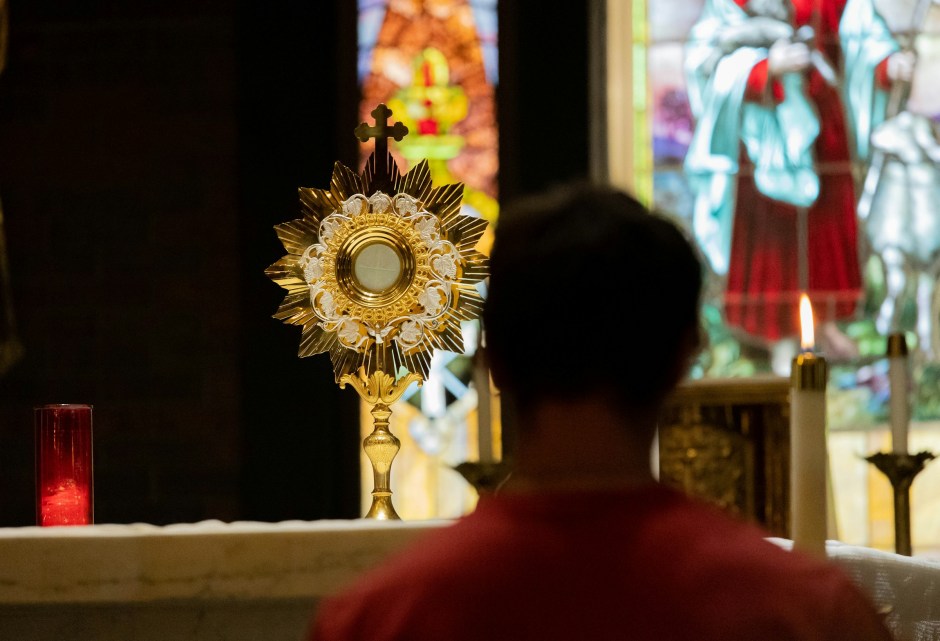
Give Yourself Permission To Take Two Minutes

“O God, you are my God—it is you I seek; for you my body yearns; for you my soul thirsts…”
— Psalm 63:1

When your heart feels parched, tired, or dry….
When you feel set aside, alone, unseen…
your instinct might be to fold inside, withdraw, remove yourself to the sidelines where you can watch the world go by…

Sometimes, the greatest gift you can give yourself is permission to notice. Take two minutes of attention. With no agenda to fix or solve anything.

Two minutes to notice what is stirring within you, and to hand the burden gently to the Risen Christ who holds you tightly in the core of your being… to the One who will never let go of the one he loves…

Every handing over brings you closer to him as he takes it from your hands, as he holds your hands, as you tell him what is in your heart as you carry this burden.

Your restlessness isn’t a failure. It’s a quiet tug inviting you back to him.

It starts with just two minutes of quiet attention.

Photo by Md Mahdi on Unsplash

Why Christ Is Worth Your Whole Heart (Mt 10:37-42)

“Whoever loves father or mother more than me is not worthy of me; and whoever loves son or daughter more than me is not worthy of me;and whoever does not take up the cross and follow me is not worthy of me. Those who find their life will lose it, and those who lose their life for my sake will find it. Whoever welcomes you welcomes me, and whoever welcomes me welcomes the one who sent me. Whoever welcomes a prophet in the name of a prophet will receive a prophet’s reward; and whoever welcomes a righteous person in the name of a righteous person will receive the reward of the righteous; and whoever gives even a cup of cold water to one of these little ones in the name of a disciple—truly I tell you, none of these will lose their reward.” (Mt 10:37-42)

These are the last two paragraphs of the Mission Discourse which takes up all of chapter 10 in the gospel of Matthew. If we look at the whole chapter as one unit, we could hear Jesus saying to us:

I’m sending you out, giving you authority to be in the world an extension of the mission you have seen Me carrying out: proclaiming that the Kingdom of heaven is at hand, healing, curing, raising the dead, driving out demons, teaching, loving, forgiving (v. 1, 7)

BUT…

You will find it no easier than I…. If they have called me Beelzebul, then they will also call you this (v. 25).

REMEMBER THIS…

Everyone who acknowledges Me before others I will acknowledge before My heavenly Father (v. 32).

This is the end, the telos, what it is that we look forward to: a relationship—to stand before the heavenly Father with and in Christ!

SO…

Don’t control things by packing up everything so you can rely on material things for your safety. Don’t move around trying to find the best situation for yourselves according to who will care for you the best. Don’t plan ahead for your defense (v. 9-23).

And then three times Jesus says:

Do not be afraid of them (v. 26, 28, 31). I am inviting you into a relationship. I am a link, in a sense, that brings you into direct relationship with the Father who loves you and cares for you more than the sparrows. Others—mother, father, siblings—may reject you when you enter into a relationship with Me, but my Father will never leave you without his help.

AND YOU TOO ARE A LINK NOW FOR OTHERS…

Be a strong link. Align yourself with Me. Do not grasp onto and preserve your identity, control, security, or self-centered desires pursued on your own terms. Instead, lose your life for My sake (v. 39), surrendering it in trust and obedience, giving up your own agenda to follow Me. Take the risk to love Me and trust Me. Only I can give you eternal life.

When you do this, you become a link for others to come to Me. When they receive you, they receive Me, and when they receive Me, they receive the one who sent Me (v. 40). Even if they just give you a dixie cup filled with cold water, this kindness to you will link them to Me (v. 42).

What does this look like in practice?

Élisabeth Leseur was a French laywoman whose diary and sacrificial love played a pivotal role in transforming her atheist husband, Félix Leseur, into a Catholic—and eventually a priest. Her husband, who aggressively promoted atheism, often mocked his wife and attempted to undermine her faith. She responded not with anger, but with quiet, patient love and prayer. She maintained a secret diary over many years, in which she recorded spiritual reflections and offered prayers for her husband’s conversion—offering her suffering for his soul.

As she suffered from cancer, Elisabeth wrote a final note to Félix predicting his eventual conversion:

“In 1905 I begged Almighty God to send me sufferings with which to pay the price of your soul… The day I die, that price will be paid… Greater love no woman hath than this…”

After her death in 1914, Félix discovered her diary and writings. He was deeply moved by the depth of her faith, love, and self-sacrifice. His heart gradually began to change, and a  pilgrimage to Lourdes, made with the intent of disproving miracles, became the turning point of his spiritual journey. In 1917 he embraced Catholicism, joined the Dominicans, and was ordained a priest six years later.

Élisabeth Leseur’s cause for beatification was opened in 1934. She is a Servant of God.

You too are one of these links—connecting others to Jesus and his Father. Your story will look very different, your choices your own as Jesus leads you, and with you as a link in the world, Jesus is still able to walk about reaching others and bringing them into his relationship with the Father.

You too are commissioned by Jesus. Who is waiting for you to become this link for them?

Photo credit: Photo by Kaboompics.com

Praying with this Passage of Scripture

Lectio Divina is a way of listening to God as he speaks in his Word. It is a practice of communicating with God through Scripture and attending to God’s presence and what he wishes to tell us. In this slow and prayerful reading of the Word of God, we allow ourselves to be transformed by the Spirit who forms us into the image of Christ. There are four movements in Lectio Divina: Read (lectio), Meditate (meditation), Pray (oratio), Contemplate (contemplation).

Begin by finding a still space to pray. Breathe deeply and become quieter within. Abandon any agenda, worries or thoughts you bring to this prayer and entrust these things to the merciful care of God. Ask for the grace to be receptive to what God will speak to you through this Scripture reading. Grant me, Jesus Divine Master, to be able to know the mysteries of the kingdom of God and your unfathomable riches. Grant that your word penetrate my soul; guide my steps, and brighten my way till the day dawns and darkness dissipates, you who live and reign forever and ever Amen.

Read (lectio)
Begin by slowly and meditatively reading your Scripture passage out loud. Listen for a particular word or phrase that speaks to you at this moment and sit with it for a time.

Pray (oratio)
Read the text a third time. Listen for what God is saying to you. Speak heart to heart with God. Notice the feelings that this conversation with God raises up within you. Share with God what you notice about your response to this conversation. You may wish to return to repeating the phrase quietly and gently, allowing it to permeate you more and more deeply.

Contemplate (contemplatio)
Read the text a final time. Now be still and rest in God’s embrace. Ask God to give you a gift to take with you from this prayer. You might ask God if he is inviting you to do some action, for instance, make some change in your thoughts, attitudes or reactions, in the way you speak or how you treat others. Thank God for this gift and invitation as you conclude your prayer.