“The Meaning of the World is Love”

Love—God—is not only the Creator of the world. Love is the Design that God gave the world. The dance of love within the persons of the Trinity overflowed into the world so that all who believe and love would be drawn into trinitarian life. As Hans Urs von Balthasar would put it: “The meaning of the world is love” (Heart of the World, 203, quoted in The Meaning of the World Is Love).

God is Love. He is the ecstasy of Love, overflowing outside himself, enabling creatures to share in his life. “God also goes out of himself … when he captivates all creatures by the spell of his love and his desire . . .” (Dionysius the Areopagite, Divine Names, IV,13 [PG 3,712]). (Olivier Clement, The Roots of Christian Mysticism, pg 22)

Our life has meaning only when we are lovers patterned after the divine Design of selfless giving of ourselves to the other.

My mom made most of our clothes when we were growing up. We used to love going to the store to choose patterns for our clothes that she would sew herself. Once my mom let me cut the fabric for my new dress. She showed me how to carefully follow the paper pattern she had pinned to the material. The dress would only truly fit me well if I was faithful to the pattern, to the design that the creator of the pattern had in mind.

God has made everything for love

Following the divine Design of the way God loves is the only way that we will flourish as humans. God invited us from the very beginning into intimate communion with himself. Julian of Norwich wrote: “He has made everything which is made for love,” and we could say for eternal loving communion with himself!

When we separated ourselves from him in the Fall, “God so loved the world that he gave his only Son, so that everyone who believes in him might not perish but might have eternal life” (Jn. 3:16).

Jesus emptied himself in order to dwell among us. He showed us how to love by loving us. “He loved his own in the world and he loved them to the end” (Jn. 13:1), offering his very life for our salvation. Teaching us that this is the design of love we each must follow if we are enter into divine communion in the mystery of eternal love, Jesus said: “No one has greater love than this, to lay down one’s life for one’s friends” (Jn 15:13).

This love is real.

This love costs.

This love is deadly serious.

In these days of tensions and war I have been thinking of how this love can be lost in the static of war when we take sides against the enemy who is committing atrocious injustices and horrors against innocent people.

“You have heard that it was said, ‘You shall love your neighbor and hate your enemy.’ But I say to you, love your enemies, and pray for those who persecute you, that you may be children of your heavenly Father, for he makes his sun rise on the bad and the good, and causes rain to fall on the just and the unjust. For if you love those who love you, what recompense will you have?” (Mt 5:43-47).

How do we love in a time of war?

Fr. Andriy Zelinskyy, SJ, chief military chaplain of the Ukrainian Greek Catholic Church, said in an interview with The Pillar that war is unlike any other human experience—and the challenge for a soldier is to hold on to his humanity.

When I read these words, something shifted inside me. A pastor’s “main task is always to preserve what is God’s in man. And, accordingly, to protect the humanity of each soldier.” 

I have witnessed myself being dragged into the conflict via the filter of the media. Sometimes as I read the news, I don’t like what I am being manipulated into feeling and thinking. I sense spiritually that I am being “infected with hatred,” as Fr. Andriy Zelinskyy states later in his interview, for the media has its own agenda which can reach deep into the minds and hearts of even the most casual viewer.

After the beginning of Russia’s open invasion in February, the Ukrainian Greek Catholic Church’s Department of Military Chaplaincy issued the “Catechism of a Christian Soldier.” This Catechism helps “the Christian soldier not to become infected with hatred but to focus on the struggle. This struggle helps us protect life, especially those who cannot do it on their own. In other words, the Christian warrior must be armed above all else with his noble mission,” Fr. Zelinskyy explained. This is very different, he states, from the intentions of the “oppressor.”
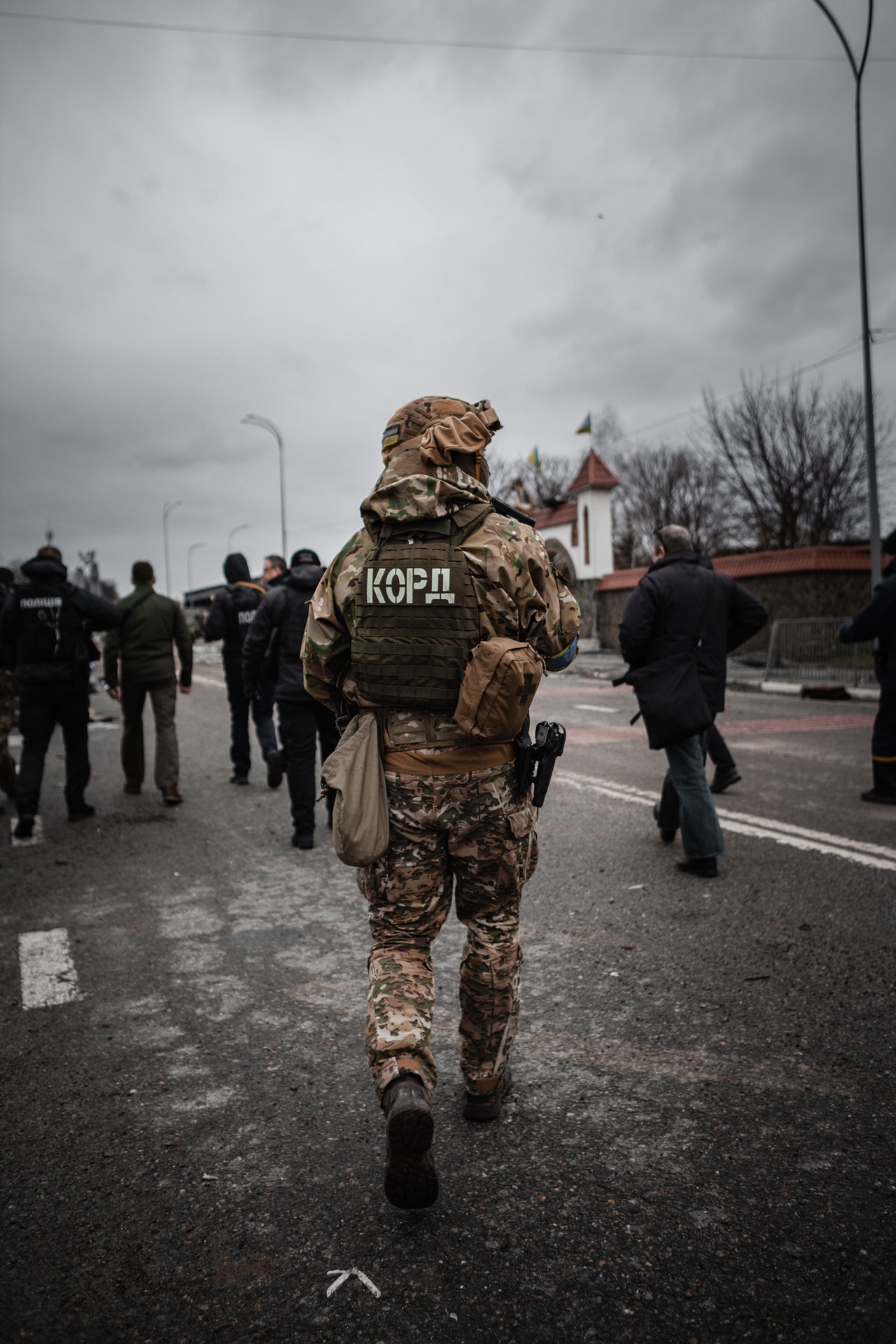
“The soldier remains a human being who, while preserving his freedom, remains responsible for his actions. Our purpose is not to destroy life but to protect it. These are two very different goals. The Christian warrior takes up arms to protect himself, his loved ones, and life itself. This is where the Catechism begins – with a reminder that the legitimate defense of life is not only a possibility but a duty of the Christian. God has called me to life and, accordingly, in doing God’s will, I should protect it and protect the lives of others.”

Those who stand against the tide of love

“Worldly being is destined to be harbored in divine being.” This is von Balthasar’s way of reminding us that Love has made us and love is our destiny, God’s infinite and loving giving of himself to us that we might live in the state of eternal loving self-gift as does the Trinity itself.

“To close ourselves off is to go against the very law of being that underpins us” (You Crown the Year with Your Goodness, 149). Those who stand up against love, those who are the oppressors, who refuse the impulse of divine loving, will be swept away in the dustbins of history.

“Whoever loves is obeying the impulse of life in time; whoever refuses to love is struggling (uselessly) against the current” (Heart of the World, 27).

“Love is never defeated.” St. John Paul II

The other day as I cursorily read the headlines on the news gathered together on my browser—news about the Ukraine war, political news, personal news about people’s lives and deaths, fearful news about the financial future, news that had previously infected me with anxiety or moved me to resentment and anger—something set me free from that all that. Yes, these things matter.

It all matters.

All of these people matter.

All of the prospects for the future matter.

All these countries matter.

I knew, however, that at that moment I had been set free from the particular news items on the page before me to inhabit the reality of love that surrounds and holds all the tragedy and joy of the world: the reality of divine love, God’s love that is the meaning of the world, the design of the world.

Each person, each country was playing out in their lives and decisions a drama of love: they were either overflowing with love, sacrificing themselves out of love, or resisting and refusing to love with all the horror this creates for others.

Love made us. Love keeps us. Love is the design of the world, the only meaning of our lives.

By God’s love, I could, at last, contemplate everything in love, even evil. As St John Paul II said to us: “There is no evil to be faced that Christ does not face with us. There is no enemy that Christ has not already conquered. There is no cross to bear that Christ has not already borne for us and does not now bear with us.”

During the summer of 1940, Caryll Houselander along with everyone else in Britain was preparing for a coming German invasion. There was preparing the First Aid post and exhausting days of training for nursing tasks for which she felt unequal. Caryll increasingly reflected on the upcoming atrocity of wartime as a participation in the Passion of Christ. When the war was declared the previous September, she had written to a friend:

“I do feel we’ve just got to shut our eyes and dive in this sea of Christ, dive with the trust of people who can’t swim and yet go straight into the dark water.” Later in her reflection printed in The Grain Magazine, she wrote: “Because He has made us ‘other Christs,’ because His life continues in each one of us, there is nothing that any one of us can suffer which is not the Passion He suffered.” (I would say, that Christ continues to suffer the Passion today through us, the members of his Mystical Body and his presence in the world.)

Nevertheless, even though Caryll was able to lift the horror of war with her spiritual reflections, she was not immune from fear and anxious thoughts. She tried to build up her courage and get rid of her anxiety. However, one day she realized that this wasn’t going to work. She wrote to a friend, “What God is asking of me to do, for suffering humanity, is to be afraid, to accept it, and put up with it.” Later she wrote regarding this realization:

“I felt that God had put His hand right down through all the well upon well of darkness and horror between Him and me and was holding the central point of my soul; and I knew that however afraid I was then, it would not, even could not, break me.”

Love is worth living for

In a sermon preached to students at Oxford in the autumn of 1939, C. S. Lewis asked the question of why the students of Oxford should take an interest in the placid occupations of philosophy, science, history, “when the lives of our friends and the liberties of Europe are in the balance? Is it not like fiddling while Rome burns?”

We could ask ourselves of what use love is when whole countries, all of Europe, the streets of American cities, and indeed our very schools where children seek to learn are being torn apart by the horror of violence, racism, and war? Is love of any use when others are on the front lines defending life, justice, and freedom?

In this sermon, C. S. Lewis pointed out that the war makes unmistakably clear “the sort of universe in which we have all along been living, and must come to terms with it. If we had foolish un-Christian hopes about human culture, they are now shattered. If we thought we were building up a heaven on earth, if we looked for something that would turn the present world from a place of pilgrimage into a permanent city satisfying the soul of man, we are disillusioned, and not a moment too soon.”

Keeping abreast of the news can be disheartening. Sometimes I feel guilty if I am not thinking, praying, and keeping front and center before my mind and heart the tragedies of our day. However, C.S. Lewis reminds me that though we may need to die for our country—and that one’s country is worth dying for—it is not worth, in an exclusive sense, living for. It is love that we must live for, even though we each at different times may be called to give our life to obtain peace and freedom and life for another, and even a whole country.

I must prepare to love. If I love in grand ways or in little, it matters not.

“Love is the end to which I have been created,” wrote Carlo Caretto. “Jesus died to teach us how to love: ‘Love one another as I have loved you’ (Jn. 13:14). He died for love.”

Our life has meaning only when we are lovers patterned after the divine Design of selfless giving of ourselves to the other.

It is said that when St. John the Apostle was carried out to the community to tell them about Jesus and preach to them, he only had one thing to say, one sentence, one invitation, Let us love one another.

Sisters and brothers, let us love one another.

Image credit: Photo by Markus Spiske: https://www.pexels.com/photo/crowd-on-the-street-holding-placards-with-message-11622842/


Want a way out of a troubled heart? Do this

Lord, don’t hold back your tender mercies from me!

The headlines are ripping apart my heart, Lord.

For troubles surround me—
    too many to count!

Missiles and abuse and injustice and outbursts of anger and scathing online comments and polarization and war and shootings on our streets and in our schools and mass graves of indigenous children….

Let your unfailing love and faithfulness always protect us.

Lord, the troubles in our world crowd out the peace in our hearts. Anxiety takes over. Sleepless nights. And worry. And feeling alone, isolated, powerless.

Lord, don’t hold back your tender mercies from me.
    Let your unfailing love and faithfulness always protect me.
For troubles surround me—
    too many to count!

Ps 40: 11-12

My dear friends, Saint Paul described the troubles he found himself in with words like these: “troubles press in on us on every side,” “we are perplexed,” “hunted down,” “knocked down,” “our bodies are dying” (cf. 2 Cor 4:8-9, 16).

Can you relate? Stop right now and jot down a few words to describe how you are feeling about the world and your life right now.

I think Saint Paul had it right when he said he felt as though he was holding within himself a great treasure. He described it as the “glory of God seen in the face of Jesus Christ.” But from his own experience, Paul knew himself to be a very fragile, easily breakable, not too sturdy clay jar. That’s all he was: a clay jar. Nothing spectacular. No fine china. Just a regular drinking glass that could easily be broken. Something that didn’t even amount to much.

Pause here. How would you describe the treasure you are holding within you? When you describe yourself what would be your words for “clay jar” or “fragile vessel”?

Precisely because Paul knew himself to be a fragile vessel carrying a great treasure, he knew that it wasn’t all up to him. In fact, very little was up to him. It was God who had formed him in the womb, who had called him to be Jesus’ follower, who had given him a mission, who had announced to him that he would have much to suffer in carrying out the task he had been given, who was with him all the way, directing and guiding his steps, who forgave him, made things right when he got them wrong, stood by him to the end…

That’s why when Paul looked at his troubles he could say: “We are pressed on every side by troubles, but we are not crushed. We are perplexed, but not driven to despair. We are hunted down, but never abandoned by God. We get knocked down, but we are not destroyed. … Though our bodies are dying, our spirits are being renewed every day (2 Cor 4:8-9, 16). 

Where have you personally experienced or heard about in another’s life how God saves people from being crushed? How he never abandons his children? How he renews the spirit even as the body suffers? Talk to God about this experience or share it with someone else.

Saint Paul knew clearly the power of God because as a Jew he often prayed with Psalm 40:

I waited patiently for the Lord to help me,
    and he turned to me and heard my cry.
He lifted me out of the pit of despair,
    out of the mud and the mire.
He set my feet on solid ground
    and steadied me as I walked along.
He has given me a new song to sing,
    a hymn of praise to our God.
Many will see what he has done and be amazed.
    They will put their trust in the Lord.

Psalm 40: 1-3

I posted three articles to invite you to soak in this amazing treasure of God-with-us in the midst of all the world’s current troubles and whatever you may be dealing with in life right now:

The Meaning of the World is Love: “I knew, however, that at that moment I had been set free from the particular news items on the page before me to inhabit the reality of love that surrounds and holds all the tragedy and joy of the world: the reality of divine love, God’s love that is the meaning of the world, the design of the world. Each person, each country was playing out in their lives and decisions a drama of love: they were either overflowing with love, sacrificing themselves out of love, or resisting and refusing to love with all the horror this creates for others. Love made us. Love keeps us. Love is the design of the world, the only meaning of our lives. As St John Paul II said to us: “There is no evil to be faced that Christ does not face with us.”

How to Bear the Fruit of Christ in Your Life: “In those raging days as I struggled to align my dreams with God’s dreams for me, I learned that Jesus wants us to share our weaknesses and struggles with him, not hide them. It became clear to me that Jesus is not afraid of the mess we try to conceal from others and even ourselves. Jesus is the doctor who can heal us when we are unable to help ourselves when our lives or relationships are riddled with the consequences of our passionate outbursts or resentments at what our life has become. Each time we receive the Bread of Life, Jesus comes to give new meaning to our fragilities. He reminds us that in his eyes we are more precious than we think.”

Maintaining Peace when Worries Overwhelm You: “Jesus promises: ‘Close your eyes and let yourself be carried away on the flowing current of my grace; close your eyes and do not think of the present, turning your thoughts away from the future just as you would from temptation. Repose in me, believing in my goodness, and I promise you by my love that if you say ‘You take care of it,’ I will take care of it all; I will console you, liberate you and guide you.’”

My friends, we can be of great courage, for as Saint Paul, the apostle who lived through great troubles and tribulation, has testified: “For our present troubles are small and won’t last very long. Yet they produce for us a glory that vastly outweighs them and will last forever! So we don’t look at the troubles we can see now; rather, we fix our gaze on things that cannot be seen. For the things we see now will soon be gone, but the things we cannot see will last forever” (2 Cor 4: 8-9, 16-18).

Image credit: Photo by Ray Bilcliff: https://www.pexels.com/photo/antelope-canyon-arizona-1533512/

We are not prisoners of our past (Horizons of the Heart 6)

The grace we are asking of God: To believe that we need God to free us from our own sorrow and regrets in order to love God entirely and to live a new life in Christ.

Horizons of the Heart: Horizons of the Heart is a weekly retreat-in-life inspired by the Spiritual Exercises of St Ignatius from my thirty-day Ignatian retreat in 2022. See an index for the whole series.

The everyday road of life is littered with disappointment. Sometimes the greatest of these is the disappointment we have in ourselves.

After a difficult year, I knew I had unearthed so many lost pieces of myself. I felt like even though I seemed to have had it all together, I suddenly was discovering in this year that too much of my ambition was dust in the wind. I felt like I needed to get away, to hide, to nurse back to health the broken fragments of my self. I could almost hear God saying, “Okay. That’s a great idea. I have just the thing for your healing.”

Shortly after, my sister called me up on a Friday evening to tell me that Dad was in the hospital and Mom, who suffers with Alzheimer’s, needed someone to stay with her. I was on a plane early Sunday morning and God’s great idea for my healing began.

Having lived in a large community and been involved in mainly an online evangelization ministry I was completely out of my element. My parents both were depending on whatever I could be for them in those difficult days, and I found that parts of my heart, having long lain dormant, were beginning to awaken. Something changed in me as the first couple of weeks turned into the five months I lived in their living room. Love was the only important thing in that precious appointment with grace. “Isn’t it always that way?” God whispered.

Stage 2 of God’s great idea: move into a Pauline community closer to my parents for a while. I’ve never felt so loved and cared for as I began anew for the second time in less than six months. I brought my one suitcase, moved into the guest room, and made do with what I had with me as I began a new adventure. “It isn’t about what you have, know, or accomplish, my Child,” God pointed out. “See how simple it can be?”

And finally, I ended up on my thirty-day retreat four short months later. So gently on those blessed days did Jesus my King begin to pick up the fragments of my soul and hold them in his healing hands. What I could not hold together, all the ways I felt ugly, regretful, lost, he made beautiful in his hands.

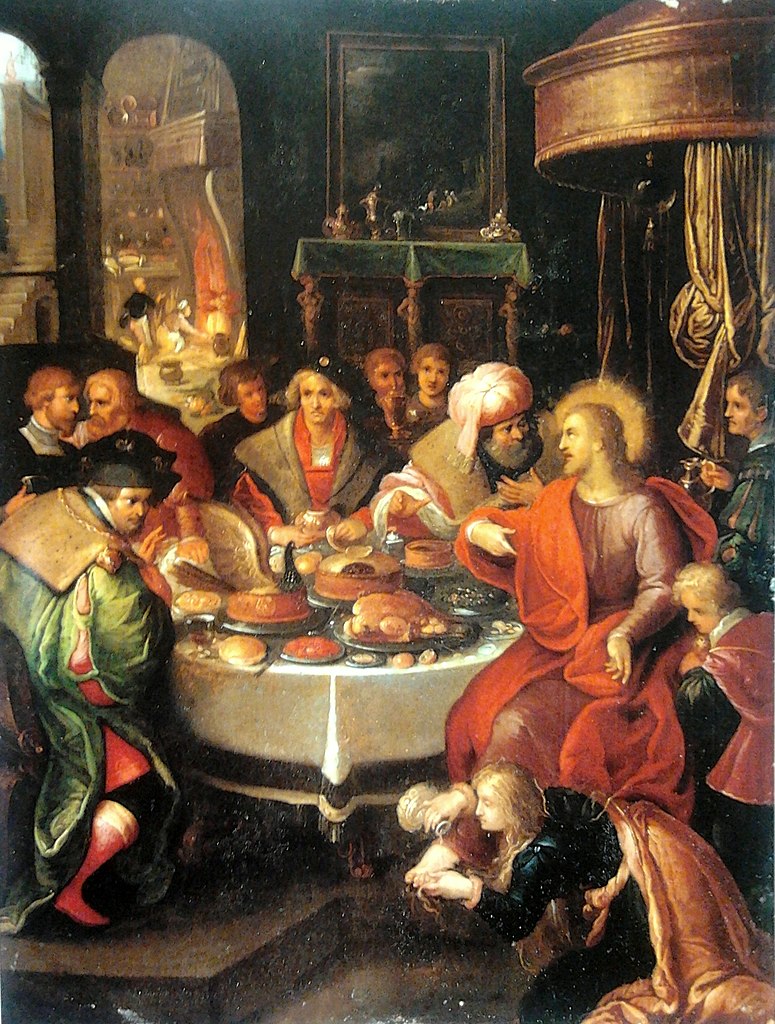
And there’s a story that Luke tells us in the seventh chapter of his Gospel about another woman Jesus made beautiful from the inside out. He restarted her life. He claimed her for himself. He made her new.

The woman was waiting for Jesus in one of the homes of the Pharisees who had invited Jesus to have dinner with him and his friends.

When I think of this woman, I imagine her standing on the edge of the dining room, quietly absorbed in her own thoughts and memories. This woman, through the influence of Jesus, had somehow already attained repentance and faith. And here she was. Waiting. Waiting to see once again the one who had saved her.

For her a lifetime of ugliness, hurt and self-hate, a lifetime of rolling dark clouds with never a promise of sunlight, flowers forever crushed, was now over! Finished at last! She still couldn’t believe it.

She pictured again to herself the face of the One who had given her hope. The One who had truly saved her from herself, rescued her from the trap of evil in which she had been caught. She was waiting for the young rabbi to arrive, almost oblivious of the others in the room who were also expecting Jesus’ arrival. I wonder if he will remember me, she wondered. She almost wept in gratitude as she recalled her meeting with Jesus, the moment of forgiveness. She caught herself…. This was not the place. She was the sinner known to everyone in the town. She was the one people talked about, avoided, looked down on, judged, excluded.

Have you been there, my friend?

The young rabbi who had been invited to the dinner at Simon the Pharisee’s house entered the room. There was a deadening silence. She looked around startled. There were no marks of hospitality. Custom required a kiss, but none was given. No washing of the hands and feet. No greetings of respect. Something was wrong. How could they treat Jesus this way, she wondered.

Jesus stopped, seeming to sense that there was more to this dinner than he had been told when he was invited. Slowly he looked around the room, wondering if there was anyone there that he knew.

Will he remember the moment he saved me? What if he has forgotten me? The thought pierced her heart.

She held her breath as his eyes rested on each person there that night for dinner. Finally, at last, his eyes rested on her across the room. Jesus stopped.

I always hold my breath at this point in the story. Will he remember me? I wonder. Me, with my broken heart. With my regrets. With the messy mistakes and uncertain steps.

A great smile broke across his face: both for the woman in the Gospel of Luke’s story and for me. He knows me, her heart sang. He can pick out my face in a crowd. I’m not a number to him. I mean something to him.  

In that smile there was a connection between two spirits, a memory, a secret, joy given and received.

Jesus sees me and he sees you, the beautiful gift of the Creator, the one he has saved with his own blood, the soul he has filled and sanctified with his Spirit.

Psalm 45

Listen, daughter, and pay careful attention:
    Forget your people and your father’s house.
Let the king be enthralled by your beauty;
    honor him, for he is your lord….

In prayer one day, I entered what was for me a “sacred space.” I pictured a great cathedral filled with angels. Mary was at my side, and on the other side was my guardian angel. The Archangel Michael dominated the space, as he stood from floor to ceiling, guarding and protecting the honor of God. In this holy space, I reflected on certain relationships, ministries, expectations that hadn’t panned out the way I had hoped. They hadn’t given me the success I craved. They hadn’t left me with that glittering self-image I felt I needed in order to be happy. Eventually, I walked to the door of this great cathedral and said goodbye to them. I let them go. All of them. Every last one of them. They were such paltry, silly things in comparison to the grandeur of my Father’s house and my relationship with the King, my Lord. As I turned around to return to the step before the sanctuary, I felt an overwhelming desire to cast myself prostrate before the only One who saves, who overwhelms me with tenderness, who WANTS me, and who makes me beautiful in his eyes.

…All glorious is the princess within her chamber;
    her gown is interwoven with gold.
In embroidered garments she is led to the king;
    her virgin companions follow her—
    those brought to be with her.
Led in with joy and gladness,
    they enter the palace of the king. (Psalm 45:12ff. NIV)

We each have things that we regret. Maybe I’m not such a great manager. Or I feel like I’ve not been there the way I wanted to be for my family because of health issues. Perhaps I realize I’ve tried out a ministry and others do it better than I. I never got that promotion that would have made a big difference for my family. I’ve made decisions through which I’ve lost prestige, financial security, options. It could be that I just wonder if I do anything right.

The most beautiful thing was not that Jesus remembered the woman before he had healed her. No. This beautiful woman “who was the sinner of the town” saw that Jesus remembered only the woman he had created by his act of forgiveness.

She knew then, in a flash of joy, that her past was gone.

Only her new identity existed in Jesus’ eyes. From now on she was the woman who was the work of his hands, the gift of his love, with a future built only and forever on his mercy.

We are not prisoners of our past. We are not chained by our brokenness.

The woman bent low in an act of reverence and utter gratitude to wash Jesus’ feet with the only thing she had: washing his feet with her tears and drying them with her hair. Then she kissed Jesus’ feet in a striking expression of affection and deep veneration.

Jesus says over her: “The one who has been forgiven much loves much” (Lk 7:47). You can hear these words addressed to you.

You are forgiven. Everything is forgotten. Whatever it was that broke you in the past, it is washed away. Whatever you hope is never found out, it is no more.

Jesus re-creates us and then remembers only what he has made us to be in his love. His dying love. His life poured forth for you and for me.

In gratitude, right now, love him.

Jesus, like a mighty Champion you rode your chariot from the rising of the sun to the furthest end of the sky.

Psalm 113

From the rising of the sun to the place where it sets,
    the name of the Lord is to be praised.

The Lord is exalted over all the nations,
    his glory above the heavens.
Who is like the Lord our God,
    the One who sits enthroned on high,
who stoops down to look
    on the heavens and the earth?

He raises the poor from the dust
    and lifts the needy from the ash heap;
he seats them with princes,
    with the princes of his people.

Come to Me, Jesus says tenderly. Come to Me and I—the Mighty Champion—will refresh you…. I who bore your pain, was scourged, mocked, humiliated, crowned as a King in mockery, crushed to the dust beneath the weight of your sin…

Come to Me and I will refresh you, I will love you, I will start again with you, I will make you new (cf. Matthew 11:28).

Image Credit: Feature image: Photo by Robert Lukeman on Unsplash; Frans Francken the Younger, Public domain, via Wikimedia Commons; Photo by Girl with red hat on Unsplash; Photo by Mohamed Nohassi on Unsplash

Sift through your options selflessly, honestly, obediently

“Have you never read this?” There is a touch of irony in Jesus’ words in today’s Gospel as he responded to the Pharisees who rebuked his disciples for plucking grain on the Sabbath. Jesus began his response to the Pharisees with the words “Have you never read this?” precisely because these leaders prided themselves upon their knowledge of the Scriptures.

“Have you never read this?” They had read, Jesus intimated, but had not read to understand. They had not read with soft hearts. They, perhaps unconsciously, had read to verify their own positions, their already determined conclusions. They had understood, or misunderstood, the Word of the Lord to confirm their own word to their own benefit.

How many times Jesus could say these words to me, “Kathryn, have you never read this? Have you not yet understood my heart? Are you still so undiscerning of what truly gives me joy, what pleases me the most?”

I remember as a young sister that being on time for meals, which meant arriving early and waiting prayerfully to say the meal blessing, was an important custom and expectation in our community. There are many values enshrined in this practice: respect for the community, obedience to the will of God as indicated by the schedule, taking one’s rest prayerfully. However, one day on my way to dinner I noticed a sister forty years my senior unloading a car by herself. I hesitated because to assist her would mean that I would arrive late to dinner. Making a quick decision, I stopped to assist her. There were two goods, two values at stake: punctual obedience and generous service. I chose the value of generous service at that moment, regardless of what others would think of my walking in late to dinner.

This certainly was a decision of little consequence, and doubtless you have been faced with many situations of more grave import in your own life. But this Gospel helps us sift through our options more selflessly, honestly, obediently.

Let’s look more closely at the Gospel. The Pharisees objected to Jesus that his disciples by plucking the grain were “working,” a kind of reaping, and therefore it should be avoided as it was considered working on the sabbath day. Jesus responded to the Pharisees: Have you not read how David and his followers went to the tabernacle at Nob near Jerusalem and asked bread of the priests there. There was no bread available there except for the twelve old loaves of showbread which were prescribed to be eaten only by the priests. The priests, in mercy, gave this bread to the hungry men, as Jesus himself in his mercy did not stop his disciples from plucking the grain along the side of the path. And have you not read, Jesus continues, that on the Sabbath, the busiest day in the week for the priests, they themselves break the rules of the Sabbath in order to carry out the functions of worship in the Temple. The commandment of God to keep holy the Sabbath didn’t refer to all work universally, Jesus intimated, but work for worldly gain.

“I desire mercy, not sacrifice,” Jesus says at the end of this reading. In this Gospel passage today it is clear that Jesus was not using this phrase to justify behavior that was wrong. Instead he used Scripture itself to show the Pharisees how their understanding of the Law in its more complex and cohesive sense was inadequate. He called them to a greater and more inward sense and assimilation of the heart of the Law not to a lesser one. And, indeed, he called his own disciples to such higher standards in the Sermon on the Mount. “You have heard it said…but I say to you.”

Jesus makes clear that he didn’t come to relax the commandments of the Law, to negate them in favor of something new that would make it easier for his disciples. Rather, he pointed out on a number of occasions that the teachers of the Law had missed the point. And that is what we need to be attentive to. Often the phrase “it is mercy God desires, not sacrifice” is thrown out in a conversation to justify not keeping God’s law. God understands and has mercy. He doesn’t really expect us to keep his law. After all, he is so merciful….  So let’s not expect someone to obey the call to discipleship with all its consequences. That clearly is not what God in his mercy expects of us. That, however, is clearly not what Jesus was saying in the context of this Gospel passage. Jesus loved each one who came to him, with great patience and mercy, and at the same time invited them to become “perfect just as your heavenly Father is perfect” (Mt 5:48).

“Have you never read this?” Or if you have, have you missed the point? We don’t want to miss the point. Going back to my example above, communion of life and charity is the point of community life. At that moment, communion and charity was greater served by my stopping to help a sister unload a car than by my walking past her to be with my sisters at prayer before the meal. Though I “broke,” so to speak, one rule, I lived it inwardly in my service to the sister who needed assistance. If instead, I had stopped to offer assistance because I thought it was stupid to have to keep rules and I had been looking for a chance to act as a free agent and to cherish my own self-importance or greater enlightenment, even if I had justified my action with the words of the Lord himself: “it is mercy I desire and not sacrifice,” I would have missed the point. I would have misused the words of Wisdom itself to justify my own selfish autonomy and resistance to authority. And in the end, it would be I myself who would have suffered from my own self-will, my hardened positions, even if justified by the words of the Lord himself.

Image Credit: Loli Casaux via Cathopic

Lectio Divina on Genesis 12

The Lord had said to Abram, “Go from your country, your people and your father’s household to the land I will show you.

“I will make you into a great nation,
    and I will bless you;
I will make your name great,
    and you will be a blessing.
I will bless those who bless you,
    and whoever curses you I will curse;
and all peoples on earth
    will be blessed through you.”

So Abram went, as the Lord had told him….

Abram worshipped the God who was known in the East as El. Creator of all, El was the Eternal, the Mighty, the Highest God. God calls on Abram, living with his father Terah and his wife Sarai in Haran, a city in upper Mesopotamia, to leave his country, his people, his father’s house and go to a land that he would be shown. God makes a covenant with Abram, promising to make Abram’s descendants into a great nation. Abram obeys and trusting in the promise made to him, sets out on the word of the Lord.

On the surface, in a quick reading, this seems like it was a great opportunity for Abram. He just had to go and he would be given a country and prosperity.

But…

Go where?…

God said to Abram, “Go to a land I will show you.”

That is, walk into the unknown, into the darkness, into the uncontrollable, into trust….

Do you trust ME, God was saying? Do you trust ME enough to leave your homeland and go to a country I will give you, where I will bless you, where you will be the father of many nations?

In this scriptural meditation, we will reflect on what made it possible for Abraham to trust God and put his entire future in God’s hands.

The Lord had said to Abram, “Go from your country, your people and your father’s household to the land I will show you.

“I will make you into a great nation,
    and I will bless you…”

Abram heard the voice of God calling him to leave everything he knew, the place that was safe, all that was calculable and to travel to this “somewhere” that he would be shown. It would be a place of God’s choosing. A place prepared for him in God inestimable and unfathomable plans.

And Abram went. Why? He was going to the land that God would show him. This God who called him was real.

Abram put his future into God’s hands. As Joseph Ratzinger says in his book Faith and the Future, “He had met God and placed all his future in God’s hands; he dared to accept a new future that began in darkness.”

Pause: when have you been forced or invited to walk into a future that was not bright with hope? That wasn’t clear and certain? That was shrouded in darkness and that depended upon another? That depended entirely on God? Joseph Ratzinger states that Abraham could do this because “he had met God and placed all his future in God’s hands.” It is a daring move to respond to the invitation of God when we meet him, when we discover that God is too real to ignore, when we are certain that God is calling us somewhere we aren’t sure we want to go….

Abram went trusting in the word of God that had come to him. He asked no proof, no guarantee, he just went.

The future that God was proposing took precedence over what he had achieved and accumulated in the present. He had settled down, quite a wealthy man. He was set for life.

And at this moment, precisely when he thought he was set for the rest of his life, God said to him, “Abram, get up and leave all of this and go to a place that I will show you.”

God opens up for us a limitless horizon

At times our present rhythms of life, our current goods we’ve amassed, our personal relationships we’ve settled into can imprison us. When God calls us, and he does, he opens up for us a limitless horizon, a horizon that can only be calculated by the infinite God who holds it in his hand.

Abram, by leaving his present life and walking into the adventure of an unknown future discovered his true destiny, his authentic identity, the reason he was put on this earth, the place he was to play in the drama of salvation history.

We are citizens of heaven

Abraham is a man on the way, on God’s way, a stranger wherever he goes.

“By faith he made his home in the promised land like a stranger in a foreign country; he lived in tents, as did Isaac and Jacob, who were heirs with him of the same promise. For he was looking forward to the city with foundations, whose architect and builder is God. And by faith even Sarah, who was past childbearing age, was enabled to bear children because she considered him faithful who had made the promise” (Hebrews 11:9-11).

The author of the Letter to the Hebrews encourages us who walk on this earth to yet long for a better country—a heavenly one (cf. Hebrews: 11:15). “For here we do not have an enduring city, but we are looking for the city that is to come” (Hebrews 13:14).

Pause: we are citizens of earth and citizens of heaven. How would remembering this help you as you walk through the transitions of your life. All of us are called to leave our “homeland” many times. Each time the voice of God is speaking to us of a future of hope. He is gradually helping us emerge into our true identity and reach our final destiny.

St. Paul writes about people whose minds are set on earthly things. And he reminds the Philippians: “But our citizenship is in heaven. And we eagerly await a Savior from there, the Lord Jesus Christ, who, by the power that enables him to bring everything under his control, will transform our lowly bodies so that they will be like his glorious body” (Philippians 3:19-21).

I have to admit that in those circumstances, both happy and difficult, in which I need to leave where I’ve been to move to where I am meant to be as I walk into the future, my focus is too much on what I’m leaving, what I no longer have, what could happen, what I can’t control. What Abraham teaches me is that he went because he trusted that the God who promised his future was real and trustworthy. He trusted a YOU not a future goal. He deemed that God was able to provide for him all that he needed in order to fulfill his promises. Indeed, the most important thing is to comprehend that faith is always faith in a YOU before it is a faith in a series of beliefs.

Deepening your reflection:

  • How does Abraham give you courage as you walk through your life?
  • What does it mean to you to be a citizen of heaven?
  • In what ways does God want to meet you today?

Photo Credit: Image by kien virak from Pixabay

You are so important to the Divine Physician

Today’s Gospel reading is from the beginning of chapter 9 of the Gospel of Matthew. Let’s take two steps back and get some perspective on where this healing narrative falls in the development of Matthew’s Gospel.

We know that Matthew gives us the beautiful Sermon on the Mount in chapters 5 and 7 of his Gospel. Beginning in chapter 8 and carrying through chapter 9 we are caught up in the love of the heart of the Divine Physician.

First, he healed a man with leprosy: “If you are willing you can make me clean.” “I am willing, be clean!” Jesus said (cf. vs. 1-2).

Next the Divine Physician heals the servant of the centurion from afar because of the centurion’s great faith (vs. 5-13).

After the healing of Peter’s mother-in-law, a great crowd descended on the house begging Jesus to drive out evil spirits and heal the sick. Jesus healed all who came to him. Then he got into a boat with his disciples, and he calmed a great storm. Their hearts were filled with awe. Jesus is Master of the powers of nature, of evil, and of sickness (vs. 14-16, 23-27).

Chapter 8 ends with Jesus healing two men possessed by demons, sending them into a large herd of pigs. Then we are told that the whole village came out to see what was going on and pleaded with him to leave. The joy and awe that has surrounded Jesus’ healing is met here with rejection and expulsion (vs. 28-34),

 So Jesus entered a boat to cross to the other side.

At this point we come to today’s Gospel in which Jesus forgives a paralytic of his sins and then heals him, “Rise, pick up your stretcher, and go home.”  The crowds are in awe, but the scribes accuse him of blaspheming. It is becoming more and more clear that we must make a choice regarding Jesus.

Tomorrow’s Gospel will be the calling of a tax collector, a sinner, Matthew. Tax collectors worked for the foreigners who ruled over the Jews, so this made them traitors. They weren’t paid a wage by the Romans, but were expected to take extra money and keep some for themselves. They were hated and considered sinners. And yet this one sinner “got up and followed” Jesus immediately when he said to him, “Follow me.” We then see Jesus entering into the community of tax collectors and sinners, eating with them, because “the sick” “need a physician” (Mt 9:9-13).

The story of the paralytic should wake us up to the decision we each need to make. Where is it that you need forgiveness? What has paralyzed you? Are your limbs lifeless because you have used them in your own pursuits rather than the will of God? Sin is more than just a failing. In little ways, or in grave, sin distances us from God. Sin makes us spiritually weak. We are so important to God, so dear and precious to the Father, that he sent his Son to heal us. Jesus came to call us out of all that holds us back from giving ourselves completely and in trust to God. The Son of God enters into communion with us, the community of sinners, and he says, “Stand up, pick up your mat, and be healed.” And then he says, “Follow me.”

Where is Jesus today asking you to follow him?

Photo Credit: © José Luiz Bernardes Ribeiro / CC BY-SA 3.0