What only a child could believe

In the liturgy on this third day of the Advent-Christmas season, the Church expands our hearts to take in the length and breadth and height and depth of God’s love in Christ. We are immediately reminded, as we pull out our nativities and advent wreaths and Christmas decorations, as we make our lists for Christmas gift-giving and party-throwing, that the birth of Christ brings eternity into time such that time now has meaning only in light of the Kingdom of Love that will last forever and ever. It is the Last Day of the Old Creation and the First Day of the New Creation. It is about the Day that we await with ardent hearts and fervent longing: the return of Christ.

On that day…
the wolf shall be a guest of the lamb,
and the leopard shall lie down with the kid.

We will see this gentle image on the Christmas cards we receive and send, but how much more do we long in our hearts for this Peace that we have not yet experienced. There is too much “harm and ruin” in the world, shattering our hearts and hopes and security and trust.

But there it is. Isaiah has foretold it. It shall be. On that day there shall be no harm or ruin on all my holy mountains; for the earth shall be filled with the knowledge of the Lord, as water covers the sea.

In today’s world, who can believe this? Who can believe that a tiny Child, the Son of God, who lived but thirty-three years two thousand years ago in a small and poor countryside could be about such a Kingdom, could bring about such a Peace.

Only a child.

We cannot stand with our hands at our sides waiting for this consummation beyond time of Isaiah’s joyful prophecy to be bestowed upon us. We have no reason to throw up our hands and cry out that things are getting worse and that the birth of God on earth has not brought about the kingdom of love that he preached.

The Gospel passage today follows immediately upon the return of the seventy disciples who had been sent out two by two to proclaim that the kingdom of God is at hand. Notice. They were not to proclaim that if people changed their lives and listened to them that the kingdom would come. They weren’t announcing that the kingdom would arrive as the result of a perfectly executed evangelization plan. No. It was a simple message. The kingdom is at hand. It is here. It is now.

So powerful was this message that Jesus told them that as a result of their preaching this message he had seen Satan fall like lightning from the sky.

At that moment, Jesus rejoiced in the Holy Spirit and said,
“I give you praise, Father, Lord of heaven and earth,
for although you have hidden these things
from the wise and the learned
you have revealed them to the childlike.” 

It is only the childlike who can continue to announce the arrival of the kingdom of love in a world filled with insecurity, violence, and even hate. With even greater mystery than his sending the seventy-two disciples out to preach the kingdom, Christ continues in the Catholic Church to send out the “seventy-two” to preach the kingdom. He continues today to live and love and speak just as truly as when two thousand years ago he called to himself twelve apostles, preached throughout Galilee, and healed and reconciled and prayed and loved. Christ makes use of the Church so that the work he began in his lifetime might endure until the Second Coming. It is we today who are sent to announce that the kingdom is at hand.

Who can believe this?

Only a child.

If we try to make sense of it, we will not be able to. If we try to explain the existence of evil in the world in relation to Isaiah’s prophecy, it will not be possible. 

God has hidden these things from the wise and the learned. If we want to believe we must receive the revelation that the Father wishes to give to us. To receive it, we must be childlike.

Saint John Paul II helps us see that being childlike is not being naïve. It is believing that the Word of God has the last word in history. He stated on the World Day of Prayer for Peace in 1978: “We find, in Christ, a hope. Setbacks cannot render vain the work of peace, even if the immediate results prove to be fragile, even if we are persecuted for our witness in favor of peace. Christ the Savior associates with his destiny all those who work with love for peace…. Do not be afraid to take a chance on peace, to teach peace. The aspiration for peace will not be disappointed for ever. Work for peace, inspired by charity which does not pass away, will produce its fruits. Peace will be the last word of History.”

Image by Jeff Jacobs from Pixabay 

The people were hanging on Jesus’ every word

“Every day he was teaching…all the people were hanging on his words” (Luke 19: 47-48).

Jesus, the Word who became flesh and dwelt among us, is our Teacher and Master.  Every day we need to hear the Lord speaking. Every day we need the direction only Jesus can give. Every day society needs to be reorganized and renewed according to the words of life from the Lord of Life. Every. Day.

“Every day he was teaching…all the people were hanging on his words.”

Some days might seem to us to be too busy, too crazy, to take time to read God’s Word found in the Bible. But every day that Jesus was on this earth he taught us. God himself learned to speak in our faltering language about our very creaturely struggles, addressing our profound weakness and glaring needs for healing. He whom the angels praise with song and glory humbled himself to become a man in order to teach us, to save us, to reconcile us with the Father that we might live forever in heaven.

When Jesus ascended into heaven 2000 years ago, did his teaching end? Were we to hear his voice no more? That beloved voice that spoke to us the truth, that comforted and challenged, that proclaimed words of healing and forgiveness and courage? That voice that touched individual lives in ever so profound ways. Where can we encounter Jesus today in order to hear his voice as he speaks to us personally?

Pope Francis, in his document Desiderio Desideravi, wrote that every word, every gesture, every glance, every feeling of Jesus reaches us through the Eucharist, through the celebration of all the sacraments. It is in the Eucharist and the sacraments that we encounter Jesus. It is there that we hear him. It is there that we experience how he sees us, what he thinks about us, what he feels toward us (cf. n. 11).

It is when we receive Jesus in Communion that the events narrated in the Gospel become present to us today. When we have received Jesus in the Eucharist, when we are before him in adoration, Pope Francis helps us understand how Jesus and his teaching become present. There in prayer in the real presence of Jesus, we can each say: “I am Nicodemus, the Samaritan woman at the well, the man possessed by demons at Capernaum, the paralytic in the house of Peter, the sinful woman pardoned, the woman afflicted by hemorrhages, the daughter of Jairus, the blind man of Jericho, Zacchaeus, Lazarus, the thief and Peter both pardoned. The Lord Jesus who dies no more, who lives forever with the signs of his Passion continues to pardon us, to heal us, to save us with the power of the sacraments. It is the concrete way, by means of his incarnation, that he loves us” (n. 11).

St Ephrem helps us reflect more deeply on this when he says: “O Lord, we cannot go to the pool of Siloam to which you sent the blind man. But we have the chalice of your Precious Blood, filled with life and light. The purer we are, the more we receive.”

“Every day he was teaching…all the people were hanging on his words.”

A friend once told me about her young nephew asking her why the people in the Church were processing to the altar. What was it all about? he wanted to know. She explained that they were receiving Jesus himself in the Eucharist. He thought about that for a few moments and then he asked her, “If that is really true, then why doesn’t everyone look happy?”

These words come back to me often. As a Daughter of St. Paul I have received holy Communion and made an hour of Eucharistic adoration every day for the past 49 years. There are times when I’m distracted, tired, preoccupied, or just “not present.” It is at these times that we can recall that the people of Judea were hanging on Jesus’ every word! And I, we, have the immense privilege to be able to receive the gift Jesus gave us at the Last Supper: himself. He wanted to stay with us always: to teach us every day, to love and forgive us, heal and transform us. The Eucharist is real, it is really the body and blood, soul and divinity of Jesus Christ. In receiving the Eucharist we receive from Jesus healing and health. He teaches us and heals our sins and our ills and feeds our body and our soul. The Eucharist is life. The Eucharist brings us eternal life.

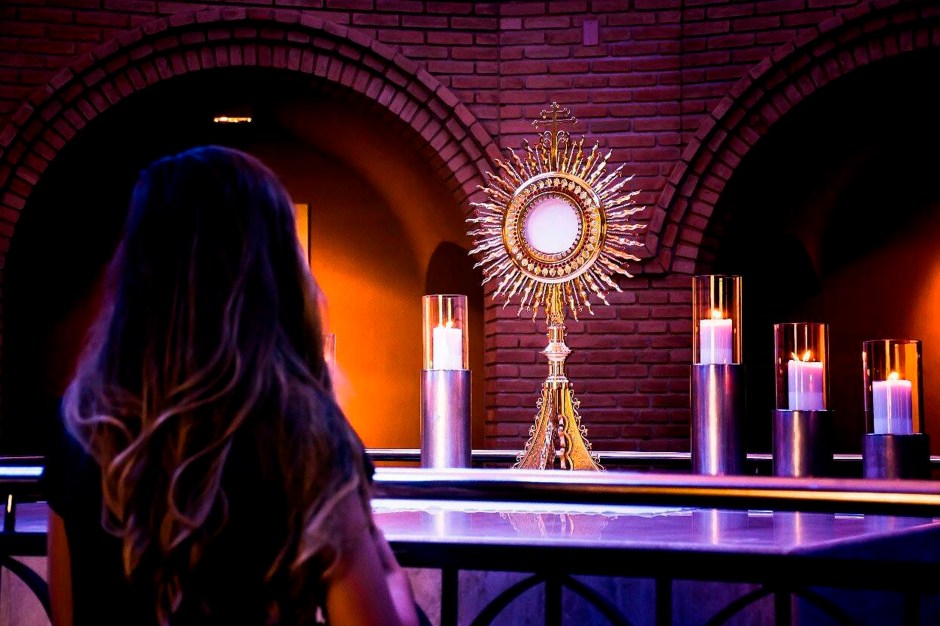
Let us, therefore, hang on Jesus’ every word. Let us approach the altar with joy and thanksgiving. Let us reserve our hearts for him through a gentle asceticism which makes room for his glory in our lives. Let us keep Jesus company in the Eucharist whenever we are able. Even if we can’t pray in a Eucharistic chapel, in spirit we can always prostrate ourselves before Jesus in the Tabernacles of the world in adoration and thanksgiving, ready to hear what he desires to say to us.

Let us hang on Jesus’ every word.

Image Credit: Érica Viana via Cathopic

Will we risk being changed forever? (Luke 12:54-59)

In the seventh grade, I did my first large paper. The topic was how to predict the weather. To this day I can recall how to forecast the weather from simple observation. Before the days when we could switch on the Morning News to find out the weather or check a weather app, our ancestors used their senses. For example, the leaves of maple and oak trees react to the sudden increase in humidity prior to heavy rain and often turn upward. When the wind is switching back and forth, leading clouds to move in different directions across the sky, we can be sure that weather changes are on the way.

Of course, we all know the rhyme: “Red sky at night, sailor’s delight. Red sky in morning, sailor’s take warning.”

Despite the fact that we often bemoan how inaccurate the weather reports can be, we still check the weather regularly and make our decisions about travel and clothing accordingly.

In today’s Gospel, Jesus spoke some direct and challenging words to the crowds. “You know how to interpret the appearance of the earth and the sky, why do you not know how to interpret the present time?”

Was Jesus trying to shake up the crowd so they would learn more and think about things more clearly? Even though I remember some of that science paper from seventh grade, I am famous for going out ill prepared for the weather. I forget to bring an umbrella. I put on a sweater instead of a coat. You get the idea. Is this because I don’t have any idea how to look out the window, check an app, or find the 10-day weather forecast online? I know how to do all these things. I’m just scatter-brained when it comes to the weather.

Jesus, in the same way, didn’t diagnose the crowds as not understanding what was happening “in the present time.” It’s not that the people couldn’t figure out that Jesus was the Messiah, that all the prophesies pointed to him, that he spoke with an authority that even the religious leaders didn’t have. Instead, Jesus called them “hypocrites.” We call someone a hypocrite who knows what is right or true but lives in denial of what they know to be right and true. Jesus was saying to them that just as they could interpret the signs of the earth and sky and forecast the weather, they did understand that he had come from God (so much so that the leaders determined very quickly they needed to kill him). They understood, but they were not willing to acknowledge and to accept he had been sent by God. To accept Jesus as the Messiah, to sit at his feet as Mary, to follow him closely as the Twelve, to be personally transformed by his parables and teachings and invitations to conversion like Zacchaeus would change them forever. This they could not accept.

There is certainly not much damage that will happen from walking in the rain without an umbrella or getting chilly because I didn’t check in advance how cold it really was outside. More serious, however, is not living what I know, acting on what I believe, choosing what has been chosen by God for me. The rest of this Gospel reading clearly lays out the risk of hypocrisy, of being too lazy to care about living the Gospel, of being too absorbed with the things of this earth that the Lord takes second place in our interests and in our love.

I don’t believe Jesus spoke these words to the crowd with harshness or anger. The heart of the Master was too great, his love for them and for us is a love that led him eventually to the cross for our salvation. I hear in his words a determined effort to make them see what is right before their eyes. How many times Jesus has to shake us up, remind us of what we know, and then prod us  forward to accept what he is revealing to us that we might allow our life to be changed.

Jesus, I commit my entire self to you, every moment of my life, every breath, every thought, every desire, every word, every action. Break through my ignorance, my blindness, my unwillingness. Attract me so strongly to yourself that in a short time I will find myself renewed, created anew, transformed in surprising ways. Amen.


Praying with this passage of Scripture

Lectio Divina is a way of listening to God as he speaks in his Word. It is a practice of communicating with God through Scripture and attending to God’s presence and what he wishes to tell us. In this slow and prayerful reading of the Word of God, we allow ourselves to be transformed by the Spirit who forms us into the image of Christ.

There are four movement in Lectio Divina: Read (lectio), Meditate (meditation), Pray (oratio), Contemplate (contemplation).

Begin by finding a still space to pray. Breathe deeply and become quieter within. Abandon any agenda, worries or thoughts you bring to this prayer and entrust these things to the merciful care of God. Ask for the grace to be receptive to what God will speak to you through this Scripture reading. Grant me, Jesus Divine Master, to be able to know the mysteries of the kingdom of God and your unfathomable riches. Grant that your word penetrate my soul; guide my steps, and brighten my way till the day dawns and darkness dissipates, you who live and reign forever and ever Amen.

Read (lectio)
Begin by slowly and meditatively reading your Scripture passage out loud. Listen for a particular word or phrase that speaks to you at this moment and sit with it for a time.

He said to the crowd: “When you see a cloud rising in the west, immediately you say, ‘It’s going to rain,’ and it does. And when the south wind blows, you say, ‘It’s going to be hot,’ and it is. Hypocrites! You know how to interpret the appearance of the earth and the sky. How is it that you don’t know how to interpret this present time.

“Why don’t you judge for yourselves what is right? As you are going with your adversary to the magistrate, try hard to be reconciled on the way, or your adversary may drag you off to the judge, and the judge turn you over to the officer, and the officer throw you into prison. I tell you, you will not get out until you have paid the last penny.”


Meditate (meditatio) – Read the same passage a second time. As you re-engage the text, let the word or phrase that stood out become your invitation to speak from your heart with God who wishes to share his heart with you. Allow this word or phrase to wash over you and permeate your thoughts and feelings. You may wish to repeat this phrase quietly and gently for a period of time.

Pray (oratio) – Read the text a third time. Listen for what God is saying to you. Speak heart to heart with God. Notice the feelings that this conversation with God raises up within you. Share with God what you notice about your response to this conversation. You may wish to return to repeating the phrase quietly and gently, allowing it to permeate you more and more deeply.

Contemplate (contemplatio)
Read the text a final time. Now be still and rest in God’s embrace. Ask God to give you a gift to take with you from this prayer. You might ask God if he is inviting you to do some action, for instance, make some change in your thoughts, attitudes or reactions, in the way you speak or how you treat others. Thank God for this gift and invitation as you conclude your prayer.

Photo Credit: Pixabay

Do you think I have come to establish peace on the earth? (Luke 12:49-53)

Do you think that I have come to establish peace on the earth?

The angels sang at Jesus’ birth: “Glory to God in the highest and on earth peace to those on whom his favor rests” (Luke 2:14). When we celebrate the Feast of Christmas, the birth of the Incarnate Word, God-with-us, we depict it with beautiful nativity scenes, a lone star radiant in the peaceful night sky, simple shepherds worshipping the newborn King of kings and Prince of Peace laying in a manger. It is only those who participate at Mass on weekdays who immediately get plunged in division. Starting on December 26, the Mass celebrates a number of individuals who paid the price for their faith in Christ with their very life. Saint Stephen is martyred, the Holy Innocents are silent witnesses with their death to the birth of the Son of God, and Saint Thomas Becket who engaged in conflict with Henry II, King of England, over the rights and privileges of the Church is murdered in Canterbury Cathedral by followers of the king.

To be a disciple of Jesus is to be invited to martyrdom either through the giving of one’s life for one’s belief in Christ or through the living of one’s life out of one’s belief in Christ and adherence to his teaching.

Do you think that I have come to establish peace on the earth? No, I tell you, but rather division.

This word of the Savior is foreboding. This division sets people against one another. It certainly is easy to brush this aside as we hear the examples given by the Lord himself: father against son and son against father, mother against daughter and daughter against mother and so forth. Someone who has followed her faith at the cost of acceptance within her own family, however, will not read those lines so glibly. I’m thinking of Saint Elizabeth Ann Seton.

Elizabeth Ann Bayley was born in New York City to a prominent Episcopal family on August 28, 1774. After seven happy years of marriage to William Magee Seton, her husband became very ill with tuberculosis. She travelled with him to Italy hoping to find a cure, but he died there in 1803. While in Italy, Elizabeth discovered Catholicism through the kindness of friends who offered her comfort as she grieved her husband’s death, inviting her to Mass with them. A year later in New York, Elizabeth officially converted to Roman Catholicism. Her choice to convert resulted in three years of financial struggle and social discrimination. She opened a boarding house for boys, but when the students’ parents discovered that she was Catholic they removed their sons from her house. Two years later she was invited to move to Baltimore with her family and to open a school for girls. Women began to join her work and, after moving to Emmitsburg, Maryland, she founded the Sisters of Charity of St. Joseph, the first congregation of women religious in the United States.

Do you think that I have come to establish peace on the earth? No, I tell you, but rather division.

Each of us is called to this living martyrdom, for the Lord we follow died, out of amazing love for us, on the Cross. We are worth that much in God’s eyes that he calls us to a heroic living (and sometimes dying) in imitation of our Savior. This division to which Jesus calls us may be as simple as not contributing to slander or it may be as consequential as walking away from a potential financial windfall that is at the expense of some group “on the peripheries.” It could be quiet decisions made in private or could entail very public statements. I think of Saint Francis of Assisi who renounced his wealth and his inheritance to follow the call of God to rebuild his Church. Summoned by his father before the Bishop to account for bolts of cloth he had sold for the poor, Francis famously removed his garments and gave them to his father saying, “Until now I have called you my father on earth. But henceforth I can truly say: Our Father who art in heaven.”  Francis renounced the considerable wealth of his family to embrace the life of poverty and joy to which he was called.

Today you may wish to consider: Where does the division established by Christ cut through your career? Your relationships? Your life as a Christian?

Praying with this Passage of Scripture

Lectio Divina is a way of listening to God as he speaks in his Word. It is a practice of communicating with God through Scripture and attending to God’s presence and what he wishes to tell us. In this slow and prayerful reading of the Word of God, we allow ourselves to be transformed by the Spirit who forms us into the image of Christ. There are four movements in Lectio Divina: Read (lectio), Meditate (meditation), Pray (oratio), Contemplate (contemplation).

Begin by finding a still space to pray. Breathe deeply and become quieter within. Abandon any agenda, worries or thoughts you bring to this prayer and entrust these things to the merciful care of God. Ask for the grace to be receptive to what God will speak to you through this Scripture reading. Grant me, Jesus Divine Master, to be able to know the mysteries of the kingdom of God and your unfathomable riches. Grant that your word penetrate my soul; guide my steps, and brighten my way till the day dawns and darkness dissipates, you who live and reign forever and ever Ame

Read (lectio)
Begin by slowly and meditatively reading your Scripture passage out loud. Listen for a particular word or phrase that speaks to you at this moment and sit with it for a time.

“I have come to bring fire on the earth, and how I wish it were already kindled! But I have a baptism to undergo, and what constraint I am under until it is completed! Do you think I came to bring peace on earth? No, I tell you, but division. From now on there will be five in one family divided against each other, three against two and two against three. They will be divided, father against son and son against father, mother against daughter and daughter against mother, mother-in-law against daughter-in-law and daughter-in-law against mother-in-law.”

Meditate (meditatio) – Read the same passage a second time. As you re-engage the text, let the word or phrase that stood out become your invitation to speak from your heart with God who wishes to share his heart with you. Allow this word or phrase to wash over you and permeate your thoughts and feelings. You may wish to repeat this phrase quietly and gently for a period of time

Pray (oratio) – Read the text a third time. Listen for what God is saying to you. Speak heart to heart with God. Notice the feelings that this conversation with God raises up within you. Share with God what you notice about your response to this conversation. You may wish to return to repeating the phrase quietly and gently, allowing it to permeate you more and more deeply.

Contemplate (contemplatio)
Read the text a final time. Now be still and rest in God’s embrace. Ask God to give you a gift to take with you from this prayer. You might ask God if he is inviting you to do some action, for instance, make some change in your thoughts, attitudes or reactions, in the way you speak or how you treat others. Thank God for this gift and invitation as you conclude your prayer.

Photo Credit: Amorsanto via Cathopic

You will show me the path of life (Eccl 2:1-11)

Recently I spent an hour with one of my dear friends. The room was quiet as we spoke together. Now in her eighties, she is no longer able to walk about freely and falls are frequent. She told me that her memory is going, making it difficult to carry on a conversation for very long since the topic quickly vanishes from her mind.

Together we gazed out of her large window at the beautiful trees that grew in the front yard. With a sigh we both realized that Jesus was beginning to take her into the wilderness of his Heart, that place of unknowing where we all are eventually invited to restfully trust in him as he leads us to glory.

But as it is written:

‘What eye has not seen, and ear has not heard,
    and what has not entered the human heart,
    what God has prepared for those who love him’” (1 Corinthians 2:9 NABRE).

Questions about life’s meaninglessness, about the way in which our days pass like vapor, about how all that we do and accomplish seems to vanish without a trace as we age, these burden not just the heart of Qoheleth in today’s first reading, but at certain points in our lives these questions haunt us too. I once heard that the book of Ecclesiastes identifies the question to which the whole of Revelation is the answer. In this quickly changing world, all that our life has been seems to slip through our fingers, and our heart longs for life, true life, life that is a treasure that neither moth nor rust can destroy.

“You will show me the path to life,
    abounding joy in your presence,
    the delights at your right hand forever” (Psalm 16:11).

Both Paul in his First Letter to the Corinthians and the Psalmist see life as a great river rushing toward a goal prepared for us by God where we will find joy and delight at his right hand forever. How different is this message from the distressing observations of Ecclesiastes in our First Reading today:

“One generation passes and another comes,
but the world forever stays.
The sun rises and the sun goes down;
then it presses on to the place where it rises.
Blowing now toward the south, then toward the north,
the wind turns again and again, resuming its rounds.
All rivers go to the sea,
yet never does the sea become full.
To the place where they go,
the rivers keep on going” (Eccl 1:4-7)

There is something cyclical in this description of continual, unending, “coming and going” of things. In this reading there is no sense of the enduring, of divine gift and guidance and mission, of an end which has been ordained for all things by God. Instead, the more things change, as the saying goes, the more things stay the same, endlessly repeating to seemingly no purpose.

Today many experience life in this way. Not being grounded in the fertile soil of God’s action and love, much of what constitutes activity in our world seems to have no real meaning. I believe that during the pandemic many began to feel this way. The tasks they had been doing in their jobs were now no longer satisfying to them, no longer seemed purposeful, no longer worth devoting their whole life to. They began to seek something more meaningful to do with their careers.

It is ultimately only God who truly defines us and the purpose of our lives, their unending purpose.

This discouraged sigh of Qoheleth whose voice we hear in Ecclesiastes may escape also now and then from your heart. However, Saint Paul encourages you not to give in to this sense of futility and hopelessness. Instead, take on Paul’s own strength, faith, and hope when he cries out, “I am confident of this, that the one who began a good work in you will continue to complete it until the day of Christ Jesus” (Phil 1:6 NABRE).

Praying with this passage of Scripture

Lectio Divina is a way of listening to God as he speaks in his Word. It is a practice of communicating with God through Scripture and attending to God’s presence and what he wishes to tell us. In this slow and prayerful reading of the Word of God, we allow ourselves to be transformed by the Spirit who forms us into the image of Christ. There are four movements in Lectio Divina: Read (lectio), Meditate (meditation), Pray (oratio), Contemplate (contemplation).

Begin by finding a still space to pray. Breathe deeply and become quieter within. Abandon any agenda, worries or thoughts you bring to this prayer and entrust these things to the merciful care of God. Ask for the grace to be receptive to what God will speak to you through this Scripture reading. Grant me, Jesus Divine Master, to be able to know the mysteries of the kingdom of God and your unfathomable riches. Grant that your word penetrate my soul; guide my steps, and brighten my way till the day dawns and darkness dissipates, you who live and reign forever and ever Amen

Read (lectio)
Begin by slowly and meditatively reading your Scripture passage out loud. Listen for a particular word or phrase that speaks to you at this moment and sit with it for a time

I said to myself, “Come now, I will test you with pleasure to find out what is good.” But that also proved to be meaningless. “Laughter,” I said, “is madness. And what does pleasure accomplish?” I tried cheering myself with wine, and embracing folly—my mind still guiding me with wisdom. I wanted to see what was good for people to do under the heavens during the few days of their lives.

I undertook great projects: I built houses for myself and planted vineyards. I made gardens and parks and planted all kinds of fruit trees in them. I made reservoirs to water groves of flourishing trees. I bought male and female slaves and had other slaves who were born in my house. I also owned more herds and flocks than anyone in Jerusalem before me. I amassed silver and gold for myself, and the treasure of kings and provinces. I acquired male and female singers, and a harem as well—the delights of a man’s heart. I became greater by far than anyone in Jerusalem before me. In all this my wisdom stayed with me

I denied myself nothing my eyes desired;
I refused my heart no pleasure.
My heart took delight in all my labor,
and this was the reward for all my toil.
Yet when I surveyed all that my hands had done
and what I had toiled to achieve,
everything was meaningless, a chasing after the wind;
nothing was gained under the sun. (Eccl 2:1-11

“You will show me the path to life,
abounding joy in your presence,
the delights at your right hand forever” (Psalm 16:11)

Meditate (meditatio) – Read the same passage a second time. As you re-engage the text, let the word or phrase that stood out become your invitation to speak from your heart with God who wishes to share his heart with you. Allow this word or phrase to wash over you and permeate your thoughts and feelings. You may wish to repeat this phrase quietly and gently for a period of time

Pray (oratio) – Read the text a third time. Listen for what God is saying to you. Speak heart to heart with God. Notice the feelings that this conversation with God raises up within you. Share with God what you notice about your response to this conversation. You may wish to return to repeating the phrase quietly and gently, allowing it to permeate you more and more deeply.

Contemplate (contemplatio)
Read the text a final time. Now be still and rest in God’s embrace. Ask God to give you a gift to take with you from this prayer. You might ask God if he is inviting you to do some action, for instance, make some change in your thoughts, attitudes or reactions, in the way you speak or how you treat others. Thank God for this gift and invitation as you conclude your prayer.

Photo Credit: Negative Space via Pexels.com

Jesus is always passing by (Mt 9:9-13)

“As Jesus passed by, he saw a man named Matthew. He said to him, ‘Follow me.’”

In the Gospel passage that recounts the calling of the tax collector, Matthew Jesus shows us that he is where we are. Whether we are living a holy life, struggling with temptations inundating us like a hurricane, or lost in the mire of vice or sin, Jesus is always passing by.

Jesus is not passing by intent on avoiding us. He is passing by in order to see us, to show us that we are seen with the eyes of respect and love. Jesus sees us, as we most deeply are. He delights in us, for he has made all things good.

There are many reasons why I want to avoid your gaze, Jesus. I don’t feel worthy. I don’t know how to respond to you. I’m afraid. But here you are, passing by, seeing me as you saw Matthew.

I can imagine Matthew with either an arrogant gaze—by which he defended himself from the hatred of his fellow countrymen—or a defensive, sullen, withdrawn attitude as he isolated himself from their disdain. Jesus looked into Matthew’s eyes, eyes that had known only rejection from others, and for the first time Matthew knew that someone truly saw him. Someone had seen his wounds, his fears, his desires, his folly, his sin, and his potential.

You saw him, Lord Jesus, and you called him by name and you invited him to live in your presence. You wanted him to be both your disciple and your apostle. In following you, Matthew was to embark on the adventure of metanoia and mission, to proclaim your glory to the world. In fact, he did both immediately.

“And [Matthew] got up and followed him. While he was at table in his house, many tax collectors and sinners came and sat with Jesus and his disciples.”

The rich young man had walked away sad, unable to really give himself over to the following of Christ. Matthew, on the other hand, jumped up, immediately corresponding to the grace of his call. To the one who had really seen him—who did not consider simply that he had betrayed his people by extorting their money and overcharging their taxes—to this Lord and Master he entrusted his whole life.

This one loving look of the Savior that expressed a commitment to his dignity and a willingness to care about him, changed his life forever.

Pope Francis in his peace message published on December 17, 2021, invited us to have the eyes of Christ for each other. He called it the “culture of care.”

“The culture of care … calls for a common, supportive and inclusive commitment to protecting and promoting the dignity and good of all, a willingness to show care and compassion, to work for reconciliation and healing, and to advance mutual respect and acceptance…. May we never yield to the temptation to disregard others, especially those in greatest need, and to look the other way; instead, may we strive daily, in concrete and practical ways, to form a community composed of brothers and sisters who accept and care for one another.”

When I am hurt or angry, I have to admit my eyes are not caring. My gaze can be arrogant or withdrawn or sullen. Jesus’s gaze alone restores to us the joy of life, the kind of happiness that radiates from our soul through our eyes. When you see a person perfectly at peace or someone who spends a lot of time in prayer, you can see that radiance, that happiness. Their eyes have a depth to them that cannot be fathomed.

Allow Jesus today to see you as he passes you by. He is there to call you again and again to follow him. When you have followed him, turn then to cast eyes of concern and respect and acceptance on your brothers and sisters. For it may be that they will only know the gaze of the Lord through your eyes, and his gentle compassion through your words.

Praying with this passage of Scripture

Lectio Divina is a way of listening to God as he speaks in his Word. It is a practice of communicating with God through Scripture and attending to God’s presence and what he wishes to tell us. In this slow and prayerful reading of the Word of God, we allow ourselves to be transformed by the Spirit who forms us into the image of Christ.
There are four movement in Lectio Divina: Read (lectio), Meditate (meditation), Pray (oratio), Contemplate (contemplation).

Begin by finding a still space to pray. Breathe deeply and become quieter within. Abandon any agenda, worries or thoughts you bring to this prayer and entrust these things to the merciful care of God. Ask for the grace to be receptive to what God will speak to you through this Scripture reading. Grant me, Jesus Divine Master, to be able to know the mysteries of the kingdom of God and your unfathomable riches. Grant that your word penetrate my soul; guide my steps, and brighten my way till the day dawns and darkness dissipates, you who live and reign forever and ever Amen.

Read (lectio)
Begin by slowly and meditatively reading your Scripture passage out loud. Listen for a particular word or phrase that speaks to you at this moment and sit with it for a time.

As Jesus went on from there, he saw a man named Matthew sitting at the tax collector’s booth. “Follow me,” he told him, and Matthew got up and followed him.

While Jesus was having dinner at Matthew’s house, many tax collectors and sinners came and ate with him and his disciples. When the Pharisees saw this, they asked his disciples, “Why does your teacher eat with tax collectors and sinners?”

On hearing this, Jesus said, “It is not the healthy who need a doctor, but the sick. But go and learn what this means: ‘I desire mercy, not sacrifice.’ For I have not come to call the righteous, but sinners.”


Meditate (meditatio) – Read the same passage a second time. As you re-engage the text, let the word or phrase that stood out become your invitation to speak from your heart with God who wishes to share his heart with you. Allow this word or phrase to wash over you and permeate your thoughts and feelings. You may wish to repeat this phrase quietly and gently for a period of time.

Pray (oratio) – Read the text a third time. Listen for what God is saying to you. Speak heart to heart with God. Notice the feelings that this conversation with God raises up within you. Share with God what you notice about your response to this conversation. You may wish to return to repeating the phrase quietly and gently, allowing it to permeate you more and more deeply.

Contemplate (contemplatio)
Read the text a final time. Now be still and rest in God’s embrace. Ask God to give you a gift to take with you from this prayer. You might ask God if he is inviting you to do some action, for instance, make some change in your thoughts, attitudes or reactions, in the way you speak or how you treat others. Thank God for this gift and invitation as you conclude your prayer.


Photo Credit: Wilfredo Mendoza via Cathopic