New Year’s Resolutions: Take advice from the 3 Kings

January 1.

Resolution time. New Year. New you. New …

The making of New Year’s resolutions is about 4,000 years old. The ancient Babylonians were the first to hold recorded celebrations for the new year (which for them was in mid-March when the crops were planted). Besides the twelve-day religious festival, they crowned a new king at the beginning of the new year or reaffirmed loyalty to their reigning king, and made promises to their gods to pay their debts and return anything they had borrowed from others. The Babylonians believed if they kept their word they would be favored by the gods. Julius Caesar established January 1 as the beginning of the new year circa 46 B.C. The calendar month January was named for Janus, a two-faced god who looked backwards into the past year and forwards into the future. The Romans offered sacrifices to the deity and made promises of good conduct the year to come.

Our popular New Year’s resolutions aren’t far removed from these ancient practices. I don’t know about you, but the practice of New Year’s resolutions is not that helpful for me, and judging by the abundant blog posts that come out at this time of year, it doesn’t seem that constructive a practice for a lot of people.

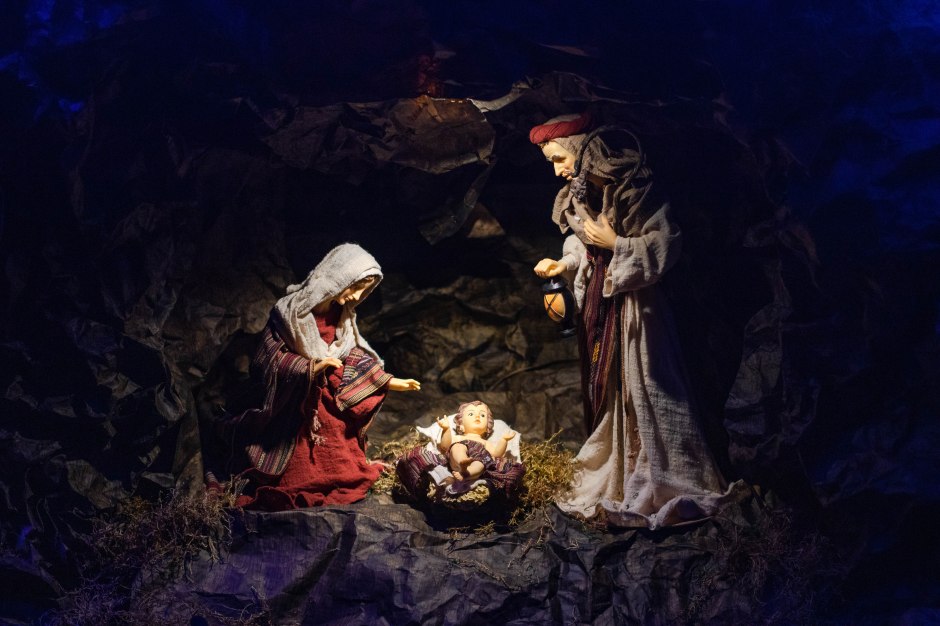
So this year I turned to the three kings who followed a star to the crib of the King of kings for advice on how to step into the new year 2021. The magi are identified as Melchior who hailed from Persia, Gaspar (also called “Caspar” or “Jaspar”) from India, and Balthazar from Arabia. The three kings were religious scholars, revered Babylonian astronomers and astrologists. They studied the stars and planets, interpreting the meaning behind cosmic events. The appearance of the “star”—or the alignment of the planets in the heavens as we experienced on December 21— must have been rare and visually spectacular, and it would have been a clear message for the Magi. These things could certainly lead our magus to conclude that a Jewish king had been born. So off they went to speak with Herod.

We could say that these “wise men from the east,” entered into a new chapter of their lives when they observed the astronomical event in the heavens that has been called the Christmas star.

As they watched the heavenly bodies align in so striking a manner, they knew that they were called not just to observe the heavens, but be aroused to action, to follow, to be changed by what would be their part in salvation’s story centered around the newborn King of kings.

These three wise men had to “resolve” to pay attention to this new sign in the heavens.

They had to decide to take a long journey which meant leaving behind comfort, control, their plans, their companions and servants, their work, life as they knew it.

They had to choose to de-center their life from themselves in order to re-center it on this newborn King who was seeking them. (We popularly speak of them seeking the Christ Child, and in some ways they were, but the presence of the Christmas star was indication that the Christ wanted them to be there at his birth. He was seeking them first.)

They had to acknowledge they didn’t entirely know the meaning of this star and where they would find this newborn King, and they stopped in at Herod’s palace for help finding the way. How careful must we be whom we ask for help in understanding and responding to God’s invitations in our life.

They had to choose to de-center their life from themselves in order to re-center it on this newborn King who was seeking them.

This journey without directions and clear destination seems to be the way God works. In the Bible (and in my own life), God seems to relish sending people on journeys without saying exactly where they were going or how to get there or what they would find when they arrived or what they should be doing when they reached their destination or what would happen after the journey. Think Abraham, Moses, Isaiah, Jeremiah, Paul…

When I think “star in the heavens,” I picture one of those Hollywood biblical extravaganzas. After all this was a great astrological event that had been foretold in the Scriptures…. But the Star led to something, Someone very small. It led to a tiny family who didn’t even have a decent place to stay. A group of shepherds showed up for the event of this birth. “In Christ’s day, shepherds stood on the bottom rung of the Palestinian social ladder. They shared the same unenviable status as tax collectors and dung sweepers.” Hardly did it match the prophecy of the Messiah’s birth:

‘And you, O Bethlehem in the land of Judah,
    are not least among the ruling cities[c] of Judah,
for a ruler will come from you
    who will be the shepherd for my people Israel.’

This year, as I think about the days and months to come, as I think about the next stage of my life’s journey I don’t want it to be my journey, a journey that emerges from the center that is “me, myself, and I.” O Lord, decenter me I pray.

Here are five things I am taking from the story of the Magi from the East as I make my “resolutions” for the New Year.

First, don’t make resolutions. The three kings from the east didn’t decide that they were tired of their life and it might be a great idea to seek for God in some new way by following a star. No. They were sought out by the Star, invited to submit to God’s plan for them.

Second, keep your eyes open. The Star, the messenger of how God is seeking you, is already on the horizon. Like the three kings, you need to be watching the heavens for signs of the Star that will take you anew, on your knees, to bow before the Infant King.

Third, welcome obscurity, chaos, darkness, confusion, uncertainty, not knowing. It sounds like the pandemic all over again. However, these are elements of the spiritual life that we can’t get away from. In our younger years we take control and establish ourselves in careers, dreams, families, spiritual goals. We know. And all this is right for that age. In our middle years, however, God gently undoes all of this to draw us away from what we’ve built up in order to find him in the small village of Bethlehem. Then we learn that we do not know. And how blessed is this not knowing.

Fourth, believe that the star will lead you to God. No matter what we think we find at the end of our journey, God leads us to himself. The three kings brought with them gold, frankincense and myrrh, costly gifts for someone who was King, God, and Priest. At the end of their journey they found a baby in a poor village. And yet they worshipped. We too will see with our eyes things and people and events that are poor, not-good-enough, broken, vulnerable. Disguises of the Almighty, of Infinite Love. It is precisely here that God makes himself known. Allow yourself to be led deeper into Mystery. Into the Sacred.

The end of our journey of sanctification is to become like God through grace, what some ancients have called “deification.” How much more rewarding.

Fifth, expect clues for your new life to be given you along the way. The wise men were warned in a dream not to return to Herod but to go home by another route. Once our hearts have been re-centered on God, our lives will be lived from another divine Source. This shift is more important than the flexing of our moral muscles in resolutions to become a better person. The end of our journey of sanctification is to become like God through grace, what some ancients have called “deification.” How much more rewarding.

I would like to close with the second verse of one of my favorite Christmas carols: Sleep on, Little King. It is an English translation of an Italian carol with the tune Ninna, Nanna. Since we are a congregation with Italian roots, the song was probably translated by our sisters many years ago, so you most likely haven’t heard this carol. So here is the second verse:

Wonder of wonders,
Myst’ry of mysteries,
Upon the heart of the young Virgin Mother
Rests the Maker of all the world.
God’s eternal Word
Reunites man with the Father;
His love is revealed—
The hills rejoice, all nature sing,
The angels’ “glory” rings forth.

Shepherds called to the side of the manger
Kneel in adoration and wonder.
Kingly gifts by the nations are brought;
The world surround His throne—
O come let us adore.

You have come to love and to save,
Come to lead us all in Your way.
Sleep on, my Jesus, sleep on, my Lord.

Image credit:

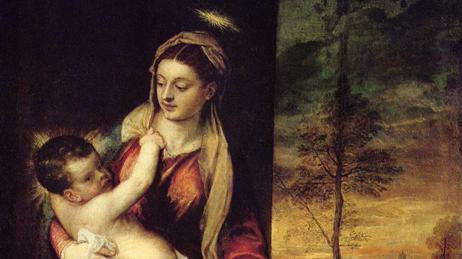
Matthias Stom: Konungarnas tillbedjan. NM 1792; public domain
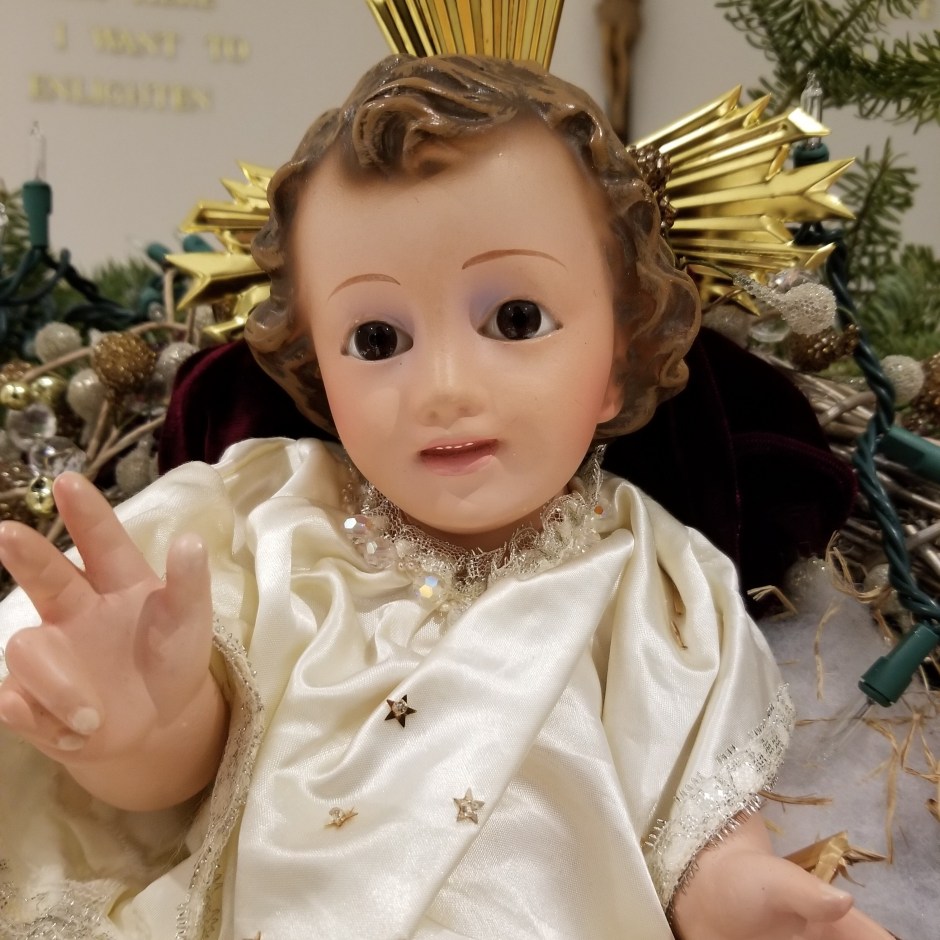
2021: Take the risk to trust a Baby!

One of my favorite Christmas movies from my childhood is the 25-minute animated version of The Little Drummer Boy.

My sister and brother and I wept at the beginning of the movie as his family was taken from him when bandits burned down his house and again at the end of the movie when at last he stood before the King of Kings with his lamb which had been run over by a Roman chariot. I’m thinking that this isn’t too different from our Christmas experience this year….

In both cases, Aaron, the little drummer boy, had to step out and risk. He had to walk into the desert vastness with only the music of his little drum and his three animal friends. And he had to take the leap of faith to trust a baby with one of his most cherished friends, his lamb Baba.

We’re kind of in the same situation this year. We have to walk into the desert’s uncertainty as we turn the calendar year, and we have to trust a Baby to mend what’s now broken in our lives.

Go to him. Look upon the newborn King. These were the words of one of the Magi who figures in the story. He is not able to heal Baba. Only Jesus.

Only Jesus can truly bind our wounds, wipe away our tears, and encourage our hearts.

It has struck me in these days that every person in the Bible who looked to God for refuge had to step out in faith. Mary and Joseph had to travel to Bethlehem on the eve of Baby’s birth. They had to trust that the little outside stable would be sufficient for the King of Kings. They had to get up and leave to save their lives and the life of the Child. Prophets and kings and ordinary people who were called by God to somehow point to, protect, or proclaim Jesus the Messiah had to step out in faith in the midst of danger. Think of Moses, Jeremiah, King David, Zechariah, Peter, John, Paul….

So as we contemplate vaccines and masks and quarantines and loss and grief in 2021, it is true that Jesus will save us, but he will call us to step out in faith…

  • to believe in the life he has won for us
  • to believe he will walk on water to find us when we are in a storm
  • to believe that our citizenship is in heaven
  • to believe that we carry within us the Light that can illuminate the way forward
  • to believe that if we go to Jesus, as did so many in the pages of the Gospel, we will find the Shepherd of our soul who will lead us home and the Master who loves us forever.

Merry Christmas and Happy New Year!

I hope you enjoy this beautiful meditation on the Little Drummer Boy:

In this Christmas season, enter into the Mystery of the Incarnation in this Eucharistic Hour of Adoration.

I recently have come across this beautiful music created by siblings. In Harpa Dei’s music videos we hear the quiet but true message of Christmas. In this Advent refrain, sung in different languages we treasure with the early Christians this prayer in the New Year: Maranatha. Come, Lord Jesus come!

Finally, this is a Christmas concert by the group Harpa Dei. As you listen to each of the carols sung in a different language, you may feel the urgency of the Spirit that all may be united, that all may be one, that all may flourish together, that we all may be in 2021 sisters and brothers. Let the Spirit pray in and through you as you enjoy their concert.

How To Bless Your Christmas Tears: Podcast

https://www.podbean.com/media/share/pb-xz2hb-f5f745

This year’s Christmas season is not laden with the expectations of extended family celebrations, festive Christmas meals, and open doors to visitors come to share the joy of the days of rest and peace that fill the Christmas season.

Pandemic loss and grief weigh upon these Christmas days and bring shadows to our hearts.

Maybe we feel empty. Like the world has stopped. Worry for the future seeps into the celebration of God-with-us who was born among us…. And…where is he for me? Now?

Your heart’s cry, whatever it may be, let it blend with the wail of the Infant King that midnight at his birth.

Photo Credit: Image by RitaLaura; Cathopic

How to Bless Your Christmas Tears

This year’s Christmas season is not laden with the expectations of extended family celebrations, festive Christmas meals, and open doors to visitors come to share the joy of the days of rest and peace that fill the Christmas season.

Pandemic loss and grief weigh upon these Christmas days and bring shadows to our hearts.

Maybe we feel empty. Like the world has stopped. Worry for the future seeps into the celebration of God-with-us who was born among us…. And…where is he for me? Now?

Your heart’s cry, whatever it may be, let it blend with the wail of the Infant King that midnight at his birth.

At birth a baby wails if they are not reunited with their mother after a few seconds. They cry because they may be bruised and sore from the trauma of birth. Perhaps they are cold. “Crying is the key to life,” one doctor said as he described the big difference from when baby is delivered to when she takes her first cry. When they’re born, they appear lifeless and purple. But when they make that first cry, the baby goes from being purple to pink, and they start moving, even opening their eyes for the first time. “It truly is a miracle!”

We all have been bruised by this year. Our hearts are sore from the trauma of loss and constant fear of an unseen enemy that can cause the death of loved ones. We have been isolated from anyone who has been our support in life. We’ve lost jobs, money, business, opportunities, graduations, weddings….

Crying is the key to life.

In the days after Christmas, allow your tears to mingle with the Infant’s cry. Throughout his life Jesus cried. He wept at the tomb of Lazarus. He wept over Jerusalem. He wept in the Garden of Gethsemane. And I’m sure he wept when he met his mother after the resurrection. Tears are a part of hoping.

My heart’s pain becomes focused when I cry. Finding someone to receive my tears is really important, even if it is a simple phone call to someone who will understand.

Tears say, “I acknowledge that this hurts. These tears cleanse and heal my heart’s brokenness and sorrow. They make way for the miracle of life, new life, new hope, renewal.” Jesus’ tears were shed at moments when the birth of renewal was underway: new life for Lazarus, entering into the drama of the passion as he wept over Jerusalem, the new life that would emerge from the passion into resurrection….

At every moment Jesus is working something new upon the face of the earth. The Holy Spirit is even at this moment being poured out upon all peoples.

Jesus’ human tears shed at moments of disappointment, grief, and fear, kept him steady and present in the emptiness of all that was missing and all that he was living. Tears keep us from running away. Tears help us bridge isolation as we reach out to another or allow us to hold the pain of someone else.

Tears keep us present until the dawn begins to break. They make sure we don’t miss the inflow of compassionate relief that gives us rest after the bitterness of our weeping. They force us to reach out to someone who at that moment is standing in the dawn and able to offer to us a few words that like a life raft carry us to safety.

So this Christmas, if tears are there waiting to be shed, let them mingle with the tears of Jesus who is our God-with-us. Reach out to another as you enter your sorrow. Be patient as the darkness of a cloudy night gives way to the first break of a tentative dawn’s beauty. Step into the newness that only faith acknowledges. God is at work in whatever you are living, that whatever is taking over your life is momentarily about to give way to God’s new power in your life.

After all, life, I believe, really is a miracle!

How we know when God is doing something new: A Meditation on St Joseph

https://www.podbean.com/media/share/pb-h3ngb-f5692e

As we journey into the new year I’ve been thinking a lot about St Joseph. He is a “star” in the Christmas narrative, leading Mary to Bethlehem for the census. He protected her on that blessed night when the Savior of the world was born in a stable in the midnight dark.  Joseph stands out again as he saves the day, whisking Mary and Jesus off to Egypt and safely out of the clutches of Herod, who attempted to kill the baby.

Perhaps from the perspective of our eternal reward we’ll see how we too were the amazing actors in a moment of history—large or small—upon which the future of others rested.

But as Joseph trudged away from Nazareth I think he wasn’t imagining himself in any saintly celebrity status.

He was leaving his plans, his preparations for the Messiah’s birth, his workshop and place in Nazareth as the village carpenter. He was leaving behind his family, his support, his home, his synagogue. He left everything he had known, built, and shared for so many years of his life: the self he knew, the role he played in the community, his place in the larger family.

He walked into silence, mystery, glory…

Every Word He Speaks… Advent Hope

The readings of Advent are filled with hope. Today, the liturgy of the Church invites us to ponder the word of the Lord through His prophet Isaiah: 

“Thus says the Lord, your redeemer … 
[I] teach you what is for your good, 
and lead you on the way you should go. 
If you would hearken to my commandments, 
your prosperity would be like a river, 
and your vindication like the waves of the sea …” (Is 48:17-18)

God wants our good. Every word He speaks invites us to taste His goodness and unite our wills to His, so that we might become who we are: children of a Father who is Goodness Himself. 

We need to hear this word daily. We need our Father to teach us, not through weekly or even daily “classes” but as only God can teach: from within. The Holy Spirit, alive in us, rejoices at the presence of the Word of God, just as St. John the Baptist, filled with the Holy Spirit, leapt for joy at the presence of Christ in Elizabeth’s womb. The more we place ourselves in contact with God’s living Word—in Scripture, in the Church, and in the circumstances of our daily life—the more the Holy Spirit will convict us of “the way we should go” in response to this Word.

As long as God is our teacher and His Spirit is directing our steps, there is so much to hope for! We are on a journey toward heaven, our eternal “good.” As we continue our Advent pilgrimage and look ahead to Christmas and the new year, let us resolve to keep placing ourselves in the school of the Word of God, perhaps with a book of daily reflections or a liturgical reading guide to help us. Let us renew our trust in God who “directs all things according to our good,” which is nothing less than union with Himself.

Guest Post by Sr Amanda Detry, FSP