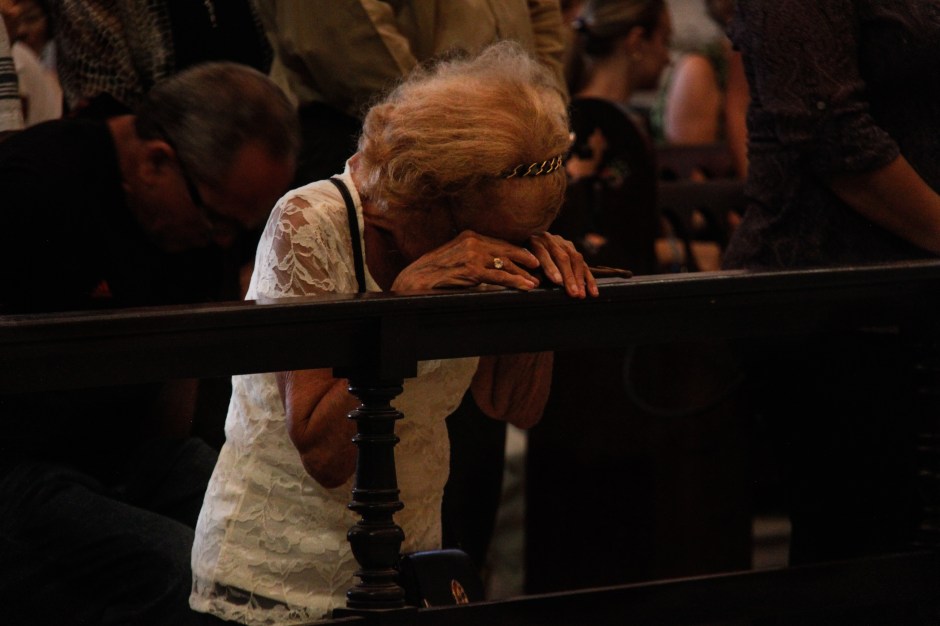
You have suffered a long time

I am in one of those years where everything about life is being undone and redone, unmade and remade, unsung and resung, stopped and started, forgotten and remembered, cast down and lifted up. A year when everything is out of my control. A year blessed, so blessed, and yet so frighteningly raw.

When was the last time you had a year like this? I read somewhere that a person’s identity is refashioned several times in their adult life.

That’s the thing about understanding that there is a map to life, an expected set of transitions that are usually sparked by daily occurrences that aren’t quite pleasant. When you realize that they are a normal part of holiness, you know where to start to find the way through them.

This morning in confession, Jesus (through the voice of the confessor) finally heard and responded to the innermost cry of my heart. No mere moralizing, and preaching, explaining and psychologizing…the fallback responses when people can’t quite see their way to the person but stop short with managing what they think is the problem. (How often I do this to others!)

Instead, Father said simply this,

“You have suffered a long time.
This is an important transition in your life.
Live it in expectancy, the anticipation of where Jesus will be leading you next.
Ask for the gift of discernment.”

Once you are seen, heard, once someone reaches into your heart with true care, you have the key to emerge from whatever pain is entangling you. And you can put order to your soul.

Here are three things that can help put order to your soul.

Let Jesus love you.

Pray simply in a soul-shepherding contemplative method. For example, in a quiet place, slowly, resting in the Lord, pray:

  • To you, Lord Jesus, I lift my soul…
  • To you, Lord Jesus, I am lifted up.
  • To you, Lord Jesus.
  • Lord Jesus.
  • To you.
  • Lift my soul
  • Lift my soul to you
  • In you, Lord Jesus, I am lifted up.
  • Lord Jesus
  • Lord Jesus
  • Lord Jesus…

Write a letter to yourself from God.

Go about this simply. On a piece of paper or in a journal begin, “Dearest child (or your name, or little girl, or my favorite one, etc. naming the way God speaks to you with endearment, or the way you desire to hear him address you.). I see you… (write what God sees and notices about you in your difficult transition or situation.) I get it (God says) that you are trying to…. I like this about you, my child, right here in the midst of this predicament…. When I see you this way I smile.

Then respond to God with whatever you feel you need. What you don’t understand. What you wish he would do or answer or change. How he would be with you….

Finally thank God for his kindness to you from the beginning of time to this very day.

Choose the meaning you are going to assign to the situation or struggle you are living.

When we are a little clearer, when our soul has been shepherded by God and we are freer from the entanglements of passions and thoughts, we get to assign the meaning we want to give to what is happening to us. Short phrases dropped into the heart can help here: Blessed be God in his gifts. God is coming. God knows what he is doing and I praise him for all he does in my life.

At the end of the day, this day which started with such a stormy soul-wrenching sorrow, I feel that I can embody dignity, compassion and tenderness. First for myself, for all the ways I’m not enough, for all the ways I struggle because of illness and trauma, for all the unanswered and unanswerable questions. And then for others. May I extend a culture of tender care in every way, at all times, with everyone.

Thanks for joining me on the journey!
Sr Kathryn

Photo Credit: Cathopic: Yandry Fernández Perdomo

When the earth shatters seeds grow

This past weekend we learned of a terrible event that happened back in late November, when Ethiopian Orthodox Christians gathered for a festival along with others seeking refuge from the ongoing fighting in the Tigray region. Eritrean soldiers arrived at the monastery and opened fire, killing over 70 people. Other recent news including the killing of 18 protesters in the military crackdown in Myanmar.

And then I read a third article, in which I learned that laboratories across Africa and Southeast Asia stand ready to manufacture vaccines to meet a global shortfall—but the patent holders are unwilling to share crucial information that could save hundreds of thousands of lives.

I have to tell you this, my friends: I read all these stories and my Lent just broke open. What can I think, or say, or even pray in the face of such pain?

I have to take refuge in the cross, in Jesus on the cross, at that execution place where this season is leading us. Jesus knew. Jesus knew what would be in the hearts of all these victims. Even more than that, he knew what would be in the hearts of all these perpetrators. And his heart went out—to all of them.

I’m not a gardener, but many of my sisters are. What I have learned from them is that when the earth shatters—a little bit—seeds can find soil in which to grow. When our humanity shatters, when our hearts shatter, then there is a place for God’s love to enter and take root and flourish. It’s difficult not to focus on the wound that shattered the heart, even the wounds that shattered Jesus’ body, but behind all the pain is God’s intentionality. We are wounded, we are suffering, we are victim and perpetrator, but we can all be redeemed. We can all enter the Kingdom. Jesus knew all humanity’s cruelty and selfishness—and died for us anyway.

That is where Lent is headed, where Lent has always been headed: to the cross. The world is just making it a major point, this week, to remind us of that.

Blessings,
Sr Kathryn

God at the Center: Guest Post

I want to talk about a journey, our journey to God. In some ways, that’s what Lent is: a journey through 40 days of anticipation to the cross and then through to the resurrection.

In the early Middle Ages Christians were encouraged to make a special journey, a pilgrimage to the Holy Land. One of the reasons for the Crusades was to protect pilgrims. But most people didn’t have the means or the ability to make such a difficult journey, and so a substitute had to be found.

That substitute was the labyrinth.

In 325 A.D. Christians placed a labyrinth on the floor of their church. Although Christians must have been using the labyrinth earlier, this is the first historical record we have of the Christian use of the labyrinth. Since that time labyrinths have been prayed, studied, danced, traced and drawn as Christians sought to use this spiritual tool to draw closer to God.

Using a labyrinth involves moving one’s body and opening one’s heart to Jesus. All you

have to do is follow the path and you will find the center. A “typical” labyrinth experience involves preparing oneself at the threshold, following the single path to the center, spending time in the center, following the same pathway out the threshold, and then responding to the experience.

Maze or Labyrinth?

We often use the words “maze” and “labyrinth” to mean the same thing, but they’re very different. A maze is a puzzle filled with dead ends, with the idea you’ll get lost a few times; a labyrinth has one circuitous path that brings you unerringly to the center.

A labyrinth is the ideal metaphor for our journey. It presents a long, sometimes frustrating path but if we stay on it, if we persevere, we reach the center. We reach God.

Why do it now? Just as on Monday we talked about incorporating fasting into our spiritual lives, so too can we incorporate labyrinth prayers into our prayer lives.

There are many ways to pray with a labyrinth. We’ll talk about them after the video.

Even if you don’t live near a full-sized labyrinth, you can still use one for prayer by simply printing it out on paper:

You probably can think of ways you can use this design in prayer. I’ll suggest a few more:

1)  Ask God a question as you enter the path. Then, as you walk slowly through the twists and turns, listen for an answer. Let your steps and your silence invite the presence and guidance of God.

2)  Start your journey to the center with confession (you may want to visualize your sins being left behind with every step you take). When you reach the center, journey out with affirmation (perhaps visualizing yourself picking things up or putting things on–like the righteousness of Christ, the smile of the Father, the purity of the Holy Spirit, etc.). Pause at the exit and give thanks for your cleansing journey.

3)  Recite a breath prayer as you navigate the labyrinth, perhaps praying a different prayer on each leg or quadrant of your journey. (Breath prayers are short phrases that lend themselves to repetition: Lord, have mercy. When I am afraid, I trust you. Not my will, but yours. Say the word. Lord Jesus Christ, Son of God, have mercy on me, a sinner. Holy Wisdom, guide me.)

4)  Lay down your burdens as you walk to the center of the labyrinth (perhaps marking your labyrinth with the symbols of what you’re letting go). In the center, pause to thank God for taking your burdens on himself. Then count your blessings and give thanks on the journey to the exit.

The word “labyrinth” isn’t anywhere in the Bible, but themes of following God’s way,

spiritual journeys, and enjoying God’s presence—all central to labyrinth experiences—are throughout Scripture. Two additional verses that can be used while praying the labyrinth are, “You show me the path of life. In your presence there is fullness of joy”

(Psalm 16:11), and Jesus’ words, “I am the way, the truth and the life…” (John 14:16).

Has anyone here ever had an experience with a labyrinth? Is it something you might like to try?

by Jeannette de Beauvoir

Image Credit: Bas Gerring at Pexels