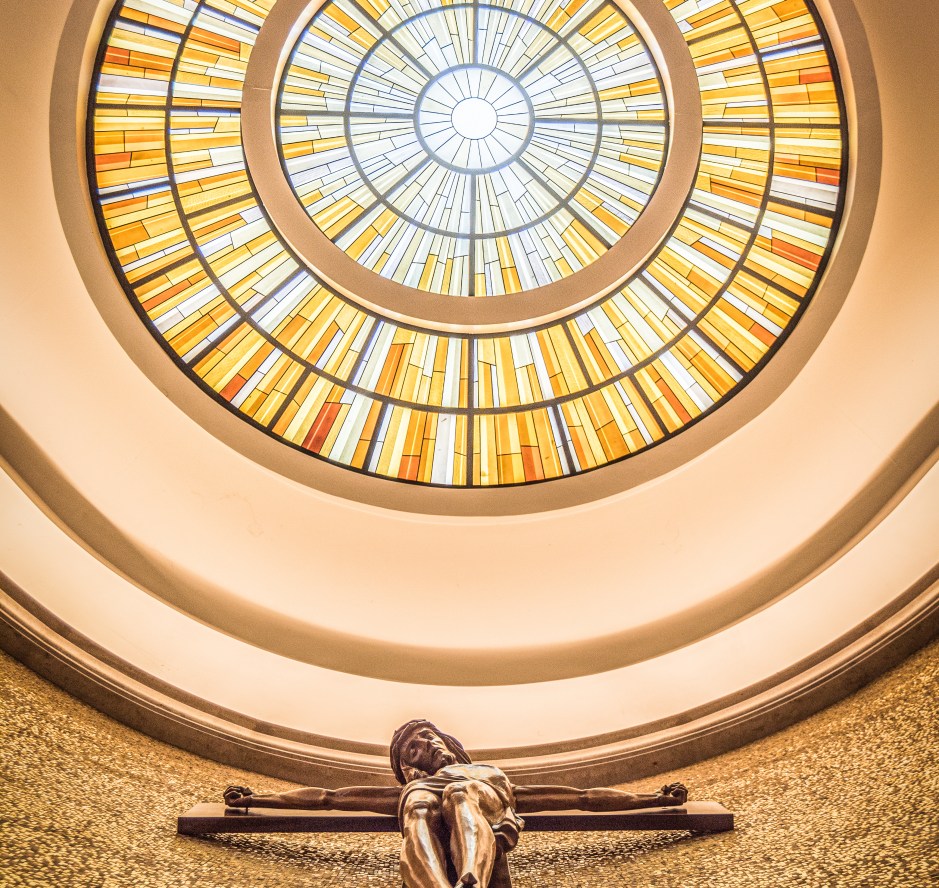
O Love! O Kiss! O Lamb of sacrifice….

O Love, O divine Kiss of the Father and the Son,

            offer to my Sovereign, King and Master,

            the humiliation he endured

            on the way to his cruel execution

                        —O God! to put Sovereign Love to death!—

            …milling crowds, jeering, conjecturing, pontificating

            …leaders planning and scheming what would be better for the people

                        —and how right they were—

                        the people who knew better…

                                    who stripped away the flowers and fruits

                                                so fragile and tender

                                                            he had cultivated with

                                                            Sacred Hands

                                                            to his Father’s glory.

                        putting a hard stop to his mission

                                    now stamped with the verdict “Failure”

                                                to be uprooted

                                                            and eliminated from the land.

I hold to my breast, O Love, the

            lamb of sacrifice, shivering in the

            cold of a Bethlehem’s night….

                        “Are you willing to walk

                                    my way,

                                                set up your home in my broken Heart

                                                enflesh the Father’s Truth…as I.

O Kiss – O Love!

Offer to the Father

            the love of my Sovereign Lord and Master

            the force of his surrendered determination

                        to obey

                        to trust

                        to permeate the darkness of no return.

            to be counted as stupid,

                        useless, a danger to the establishment….

and he opened not his mouth.

                                    he handed himself over to his Abba.

I hold to my breast the Lamb of God

            who takes away the sins of the world.

            Mary hands him to me

                        for comfort

                                    He knows

                                                Compassion in His Eyes.

                                                            Radiant white

                                                                        cover my struggling

                                                                        heart-candle’s flame

                                                                                    flickering in the winds….

“I make you white as fresh-fallen snow.”

Stations of the Cross: finding peace in inner turmoil

The Stations of the Cross are a beloved prayer, a way for us to meditate on the mystery of God’s love for us in Jesus. In praying the Stations we journey with Jesus, we look at him, love him, and he looks at us and loves us.

I wrote this set of Stations based on the different cognitive distortions that cause us such mental and emotional turmoil. I find that praying myself into the life and death of Jesus is a powerful way to reframe, renew, and transform the weaknesses of my mind and heart. Somehow whenever I pray these Stations I finish clearer, more open to God’s love, more a channel of God’s love in what had been before an impossible situation. May it do the same for you.

These are based on the Stations of the Cross included in my book Surviving Depression: A Catholic Approach.

Sr Kathryn

Joseph Moments

Today is the Solemnity of St Joseph, the husband of Mary, the man who is called “just.” To call a person “just,” is like saying “he who is virtuous in all things.” Joseph was faithful to listening and responding to the voice of God. He was courageous in carrying out his yes.

To be “virtuous in all things” makes me visualize a day-by-day, moment-by-moment ascent of a mountain range of choices, trials, unexpected changes, upset plans, new discoveries and challenging opportunities. Every aspect of Joseph’s life could be said to be an unexpected, upset, redirected, turned around…mystery.

Do you have these Joseph moments in your life?

Moments like moving, changing jobs, starting out on your own….

Saying goodbye at the moment when a loved one or friends walks into eternity….

Discovering that what you thought was true about someone actually wasn’t…

Being challenged to consider a vocation or ministerial possibility for which you don’t feel prepared…

Having to enter into a situation that compromises what others think of you without the luxury of explaining or defending yourself…

Trying hard to do what needs to be done only to have the plans completely changed for an unknown reason, leaving you only with the faith that God is still here whatever happens…

Joseph moments.

Stay close to Joseph in order to in all things live virtuously.

Joseph will inspire you to silence so that you will hear your angels when God sends you direction for your life.

Joseph will give you the courage of discernment and prudence so that you can listen for God’s voice alone and set aside all the other voices of self-interest, entitlement, or fear.

Joseph will show you the wisdom of openness to change so that you can show up fully and responsibly for your vocation as it unfolds throughout the years of your life.

Joseph will bless you with the trust needed to witness to your faith that God is at work in whatever confusion or reversal life may throw your way.

Joseph will remind you again and again that all his preparations for the birth of the Son of God went to naught as he left for Bethlehem during a census and fled to Egypt to escape the jealous wrath of King Herod. He surrendered all that was his and provided for the Holy Family “on the fly,” so to speak, so that we would know that it is God who does all things, and everything God does he does well. When things fall apart on our end, the failure simply manifests what God had intended all along. Joseph’s story was an endless discovery and embrace of the mystery of God’s plan for him and Jesus and Mary. This father of the Holy Family willingly leaned into mystery no matter what the cost to himself rather than relinquish the vocation given him.

Joseph moments. Our lives are full of them. May this great saint help us be faithful in all things.

Photo Credit Cathopic: Vanesa Guerrero, rpm

Mary, Cause of Our Joy

“And why has this happened to me, that the mother of my Lord comes to me? For as soon as I heard the sound of your greeting, the child in my womb leaped for joy” (Lk 1:43–44).

Word of Elizabeth to Mary

Mary, the Virgin-Mother Who Brings Us Joy

It would be a truism to say that everybody wants to be happy. Who doesn’t desire happiness? Yet at times it is so hard to find. But Mary can show us the way to be happy.

One of Mary’s titles is “Cause of Our Joy.” Why do we call her that? How does Mary bring us joy? To see why, let’s re-read the beautiful Gospel account of the Annunciation to Mary:

In the sixth month the angel Gabriel was sent by God to a town in Galilee called Nazareth, to a virgin engaged to a man whose name was Joseph, of the house of David. The virgin’s name was Mary. And he came to her and said, “Greetings, favored one! The Lord is with you.” But she was much perplexed by his words and pondered what sort of greeting this might be. The angel said to her, “Do not be afraid, Mary, for you have found favor with God. And now, you will conceive in your womb and bear a son, and you will name him Jesus. He will be great, and will be called the Son of the Most High, and the Lord God will give to him the throne of his ancestor David. He will reign over the house of Jacob forever, and of his kingdom there will be no end.” Mary said to the angel, “How can this be, since I am a virgin?” The angel said to her, “The Holy Spirit will come upon you, and the power of the Most High will overshadow you; therefore the child to be born will be holy; he will be called Son of God. And now, your relative Elizabeth in her old age has also conceived a son; and this is the sixth month for her who was said to be barren. For nothing will be impossible with God.” Then Mary said, “Here am I, the servant of the Lord; let it be with me according to your word.” Then the angel departed from her (Lk 1:26–38).

When Gabriel greets Mary, he tells her to rejoice. “Greetings,” used in the translation above, doesn’t express the wonderful richness of the actual Greek word, chaire, which literally means “rejoice!” The angel is bringing Mary good news, which will make her happy. God has chosen her for a special mission—so special, in fact, that it is completely unique in the history of the human race. God asked Mary to become the mother of his own Son.

But notice that even before the angel gets to that part, he tells Mary to rejoice because “the Lord is with you.” God was already present in Mary through grace, which is a wonderful reason to rejoice. Through the gift of grace, the Holy Trinity, Father, Son, and Holy Spirit, was already dwelling in Mary’s soul.

Yet the news would get even better.

God was proposing an invitation to Mary. He was asking her to become the mother of his Son. God wanted to take on flesh and become a man—if Mary would agree to accept this important role of motherhood. Mary only had one question: How would it happen since, as she said, “I know not man”?

Gabriel told her that the Holy Spirit would overshadow her and bring about this conception in a miraculous way—Mary would remain a virgin—because the holy child to be born would be the Son of God. Gabriel’s words were enough for Mary. Immediately she accepted God’s invitation: “Here am I, the servant of the Lord; let it be with me according to your word.” And the Incarnation happened.

Mary shows us how to have a happy life

How do we know that Mary accepted God’s invitation with joy? We can say this because the word used in the Gospel—genoito—indicates it. Scripture scholars tell us that this word is in a form that expresses a desire, in fact an ardent desire or a joyful willingness to take on a task.* The entire account of the Annunciation, from the opening word “Rejoice!” to Mary’s joyful acceptance, is filled with a spirit of joy and happiness.

What stands out most in the Annunciation is how willing Mary was to make a gift of herself to God. She offered herself with joy, and this meant specifically that she offered the gift of her virginity.

It’s hard for us to understand how radical her gift was, because she lived in a culture where marriage was prized above all, and virginity offered to God was not an option for a young Jewish girl. So why did Mary accept so readily? It could only be because somehow the Holy Spirit gave her the light to understand. It happened because Mary had a relationship with the Holy Spirit.

Mary was full of joy

Joy is one of the fruits of the Spirit: “The fruit of the Spirit is love, joy…” (Gal 5:22). So we can be sure that Mary, being so open to the Spirit, was full of joy. And Mary was free from sin, the source of sadness. Saint Thomas reminds us: “Sadness, as an evil or vice, is caused by a disordered love for oneself, which … is the general root of all vices” (Summa Theol., II-II, q. 28, a. 4, ad 1; see I-II, q. 72, a. 4). Notice that Saint Thomas isn’t saying that love for oneself is wrong, but a disordered love for oneself is. That’s the kind of love that makes us seek our own good at the expense of others.

Mary wasn’t like that at all. The Gospel of Luke goes on to tell us that once Mary had heard from the Angel Gabriel that Elizabeth was in need, Mary hurried to help her, putting her cousin’s needs ahead of her own. And when she visited her relatives, she brought joy not only to Elizabeth but also to the baby in her womb:

In those days Mary set out and went with haste to a Judean town in the hill country, where she entered the house of Zechariah and greeted Elizabeth. When Elizabeth heard Mary’s greeting, the child leaped in her womb. And Elizabeth was filled with the Holy Spirit and exclaimed with a loud cry, “Blessed are you among women, and blessed is the fruit of your womb. And why has this happened to me, that the mother of my Lord comes to me? For as soon as I heard the sound of your greeting, the child in my womb leaped for joy.” (Lk 1:39–44)

John leaped in the womb; he danced for joy at the sound of Mary’s voice. She bore within her the presence of the unborn Christ as the source of joy. John was destined to be a prophet, also filled with the Holy Spirit. This beautiful scene of the Visitation tells us that somehow Mary’s fullness of grace, along with the joy it brought her, can be communicated to others. Her voice was like a spark that ignited a fire in John, and that fire would burn in his prophetic words calling the people to repentance. The fire had its source in the Holy Spirit, of course, but Mary was the kindling that the Holy Spirit used.

Just as she did for John, Mary can kindle in us the fire of God’s love and the dance of joy. Mary shows us that doing God’s will is not drudgery or, worse yet, an enslavement. Instead, it is the breath of fresh air that lifts us up and carries us along so that we can fly straight to God: “Those who wait for the Lord shall renew their strength, they shall mount up with wings like eagles, they shall run and not be weary, they shall walk and not faint” (Is 40:31).

What lesson can we draw for our own lives?

Mary teaches us that the way to be happy is to make a joyful gift of ourselves to God and to others. The details of how we do that are different for each person. God calls each of us to our own unique vocation. Most people live out this vocation in the beauty of marriage and family life. God calls others to a form of consecrated life, to continence “for the sake of the kingdom.” Whatever our vocation, we will find happiness to the degree that we make a gift of ourselves to others and do God’s will. Then we, too, can joyfully say with Mary, “Here am I, the servant of the Lord; let it be with me according to your word.”

*For details on this, see Mary in the Mystery of the Covenant, Ignace de la Potterie, trans. Bertrand Buby, New York: Alba House, 1992.

Photo Credit: Luis Ángel Espinosa

Guest Post: Our Second Pandemic St. Patrick’s Day

It was just over a year ago that the first Covid-19 lockdown began. I remember, because for the first time in years I’d decided to cook a St. Patrick’s Day dinner for a small group of friends. I ended up making little packages of the dinner and leaving them on people’s doorsteps instead!

So much has happened this year, and it’s somehow appropriate to turn to the saint whose feast day fell at such a significant time in our lives. Because, in one sense, he’s been with us all along—throughout this plague year, and well before it.

Today most people associate St. Patrick with banishing snakes from Ireland or using shamrocks to teach the Trinity. Those are nice stories, but that’s all they are—stories. Yet the real Patrick’s life and faith and work were much more compelling than any of the legends that have sprung up around him. In fact, his life provides an inspiring lesson in God’s grace and mercy.

Captured as a teenager, Patrick was sold into slavery in Ireland, where he worked as a shepherd (his companions, we are told, were Cold and Hunger), and became a Christian. He escaped to Britain, but after 25 years God sent him back to Ireland to convert and minister to his former captors.

Patrick served in regions of Ireland where outsiders had never traveled, bringing a new way of life to a violent, war-oriented pagan culture. “Daily I expect to be murdered or betrayed or reduced to slavery if the occasion arises,” he wrote. “But I fear nothing, because of the promises of heaven.” What a sentiment for our times, as the pandemic continues to claim lives all around us!

I fear nothing, because of the promises of heaven.

There is a lot we can learn this year from Patrick’s story. He wasn’t afraid to try and change what was wrong with the culture. He taught that women were not a commodity, but that they had choices for their lives. He advocated reading and learning in a culture that clung to superstition. He was one of Christianity’s first outspoken opponents of slavery.

There is also comfort we can draw this year from Patrick’s story. This has not just been a pandemic year for us: the earth has been rocked with civil unrest, with the breakdown of structures we once thought permanent, with wild economic disparities throughout the world. Patrick’s Ireland was perceived pretty much as the end of the earth: the collapsing Roman Empire meant many people believed civilized society was drawing to a close. That feels familiar, doesn’t it? Yet Patrick’s story tells us clearly that no matter what empires might come and go, no matter how barbaric the civilizations around us may seem, the Word of God endures it all. Like the forgotten Irish people, we are all worthy to be saved.

A tenth-century manuscript in Dublin is known as St. Patrick’s Breastplate—a suit of armor, as it were, for going out into the world. Patrick didn’t actually write it, but its protective words echo his faith and are particularly relevant to us in March of 2021:

I bind unto myself today
the strong Name of the Trinity
by invocation of the same,            
the Three in One and One in Three

The prayer goes on for several stanzas, and concludes with:

Christ be with me, Christ within me,
Christ behind me, Christ before me,
Christ beside me, Christ to win me,
Christ to comfort and restore me.
Christ beneath me, Christ above me,
Christ in quiet, Christ in danger,
Christ in hearts of all that love me,
Christ in mouth of friend and stranger.


I bind unto myself the Name,
The strong Name of the Trinity;
by invocation of the same,
the Three in One, and One in Three,
of Whom all nature hath creation,
eternal Father, Spirit, Word:
Praise to the Lord of my salvation,
salvation is of Christ the Lord.

This Lent, this St. Patrick’s Day, this time of turmoil and uncertainty might be a good time to include the St. Patrick’s Breastplate prayer in our daily routines. It is a prayer of protection, a prayer of faith, and ultimately a prayer of joy in our salvation.

And we can all use a little joy right now.

by Jeannette de Beauvoir

Photo Credit: bobosh_t AKA “Father Ted” on Flickr, Christ the Saviour Church