
While he was still speaking to the crowds, his mother and his brothers appeared outside, wishing to speak with him. [Someone told him, “Your mother and your brothers are standing outside, asking to speak with you.”But he said in reply to the one who told him, “Who is my mother? Who are my brothers?”And stretching out his hand toward his disciples, he said, “Here are my mother and my brothers. For whoever does the will of my heavenly Father is my brother, and sister, and mother.” (Mt 12:46-50)
This moment in the Gospel, where Jesus is told, “Your mother and your brothers are standing outside, asking to speak to you” (cf. Matthew 12:46-50), serves as a pivotal hinge in the narrative arc. It stands as an important lesson, an invitation, even a raising of Mary his mother as the exemplar of his followers. It stands between the mounting hostility in chapter 12 and the turn toward veiled teaching in parables in chapter 13.
The earlier part of chapter 12 is overshadowed by encounters with those who question his authority, even saying he is from Beelzebub, and then seek to find a way to get rid of him. As Jesus begins to present the mystery of the Kingdom through parables in chapter 13 he begins by clearly distinguishing between those whose heart is open and ears ready to hear, and those whose heart is closed and who are not ready to listen to him.
The scribes and Pharisees are not merely confused; they are closed. Their accusation that Jesus casts out demons by the prince of demons reveals a heart not only unwilling to believe, but determined not to be unsettled, a closing out of whatever would question them, unsettle them, require them to change mind and heart. It is the refusal to allow light to penetrate darkness. It is a certainty built on self-sufficiency, a defensiveness that refuses the vulnerability required to receive revelation. In chapter 13 in the disciples there is mystery, insight, trust, waiting upon the Lord, obedience, the seeking to change and to listen and to believe.
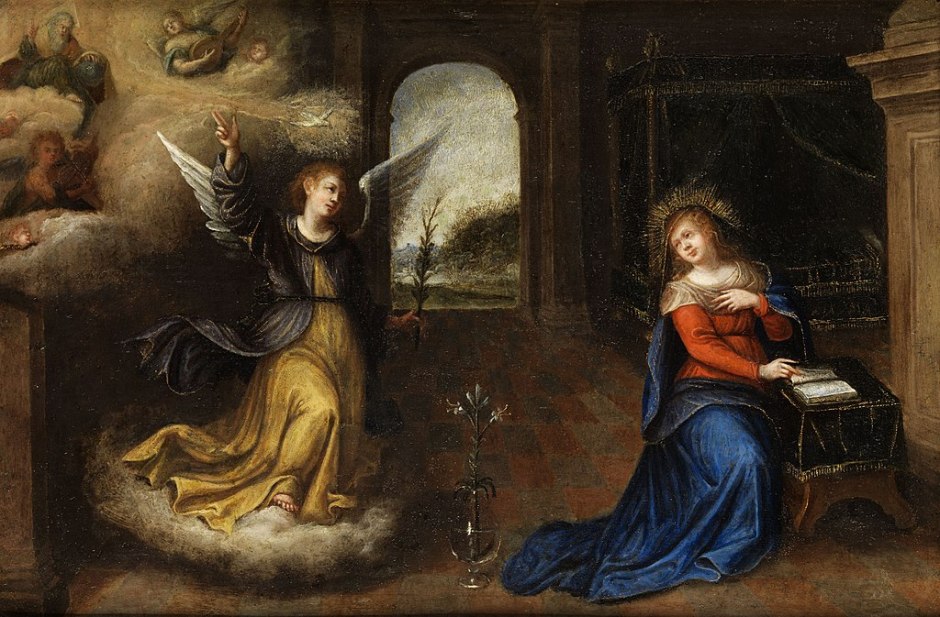
In between these two there is this lovely reference to Mary. The mother who heard the message of the angel and the will of God. The woman of yes who believed, changed her plans, and gave herself over entirely to what God wanted: Behold I am your handmaid. She is not named here, but she is present as a quiet figure of faith—the woman who responded to God not with defense or self-justification, but with an open heart: “Behold, I am the handmaid of the Lord.” Her yes was not loud, not showy. It was the kind of yes that echoes through silence. It was the yes of trust in mystery.
She is the mother who didn’t always understand, but kept all things in her heart, pondering them, awaiting the will of God to be shown to her.
She is the mother who followed Jesus, listening to his words. I often imagine her in the evening reflecting upon what she had heard that day from the lips of her Son. In a way, the parables reflect in the disciples Mary’s own journey: the quiet reception of truth, the pondering, the willingness to live with mystery until God makes it clear.
She is the mother who would eventually stand beneath the cross in a cruel ”yes” that made her like her Son who emptied himself out entirely to bring us into his own relationship of sonship of the Father.
Are we willing to listen, ponder, and let God unsettle our carefully constructed certainties?
Teach me, O Lord, the way of a listening heart.
In the moments where I am defensive, soften me.
In situations in which I cling to certainty, gently unsettle me and call me to something more.
Where I am afraid of change, give me courage to trust your plan and your love.
Let my heart be like Mary’s—open, pondering, obedient.
May I be your disciple, and with your mother’s help, do, daily, the will of the Father.
Amen.
Photo Credit: Denys Calvaert, Public domain, via Wikimedia Commons

Praying with this Passage of Scripture
Lectio Divina is a way of listening to God as he speaks in his Word. It is a practice of communicating with God through Scripture and attending to God’s presence and what he wishes to tell us. In this slow and prayerful reading of the Word of God, we allow ourselves to be transformed by the Spirit who forms us into the image of Christ. There are four movements in Lectio Divina: Read (lectio), Meditate (meditation), Pray (oratio), Contemplate (contemplation).
Begin by finding a still space to pray. Breathe deeply and become quieter within. Abandon any agenda, worries or thoughts you bring to this prayer and entrust these things to the merciful care of God. Ask for the grace to be receptive to what God will speak to you through this Scripture reading. Grant me, Jesus Divine Master, to be able to know the mysteries of the kingdom of God and your unfathomable riches. Grant that your word penetrate my soul; guide my steps, and brighten my way till the day dawns and darkness dissipates, you who live and reign forever and ever Amen.
Read (lectio)
Begin by slowly and meditatively reading your Scripture passage out loud. Listen for a particular word or phrase that speaks to you at this moment and sit with it for a time.
Pray (oratio)
Read the text a third time. Listen for what God is saying to you. Speak heart to heart with God. Notice the feelings that this conversation with God raises up within you. Share with God what you notice about your response to this conversation. You may wish to return to repeating the phrase quietly and gently, allowing it to permeate you more and more deeply.
Contemplate (contemplatio)
Read the text a final time. Now be still and rest in God’s embrace. Ask God to give you a gift to take with you from this prayer. You might ask God if he is inviting you to do some action, for instance, make some change in your thoughts, attitudes or reactions, in the way you speak or how you treat others. Thank God for this gift and invitation as you conclude your prayer.
 Touching the Sunrise