
Sparrows, in the biblical sense, are birds of freedom. Israel has long been a home for sparrows; the earliest fossil remnants of house sparrows anywhere in the world were found in Israel in caves in the Carmel Mountain range near Haifa and also in caves near Bethlehem, just to the South of Jerusalem.
Sparrows don’t live in deserts or deserted places and they don’t migrate. Instead they plaster mud nests in the Temple eves near the altar. They are swift in flight and it is impossible to retain them in captivity. Sparrows are songbirds and utter a sweet, slow note that is pleasing to the ear (contrasted with the harsh and incessant chatter of other birds in biblical times such as the swift).
O Lord my God, my heart and soul, like the sparrow, cry out for you! (see Psalm 84)
Most likely we rarely pay attention to the common sparrow. Birds with more flashy colors and extravagant markings are more likely to be photographed and shared. Yet Jesus chose the sparrow, not the parrot or the ostrich or the blue jay, to convince us that God will take good care of us:
“Are not two sparrows sold for a penny? And not one of them will fall to the ground without your Father’s will. But even the hairs of your head are all numbered. Fear not, therefore; you are of more value than many sparrows” (Mt 10:30-31).
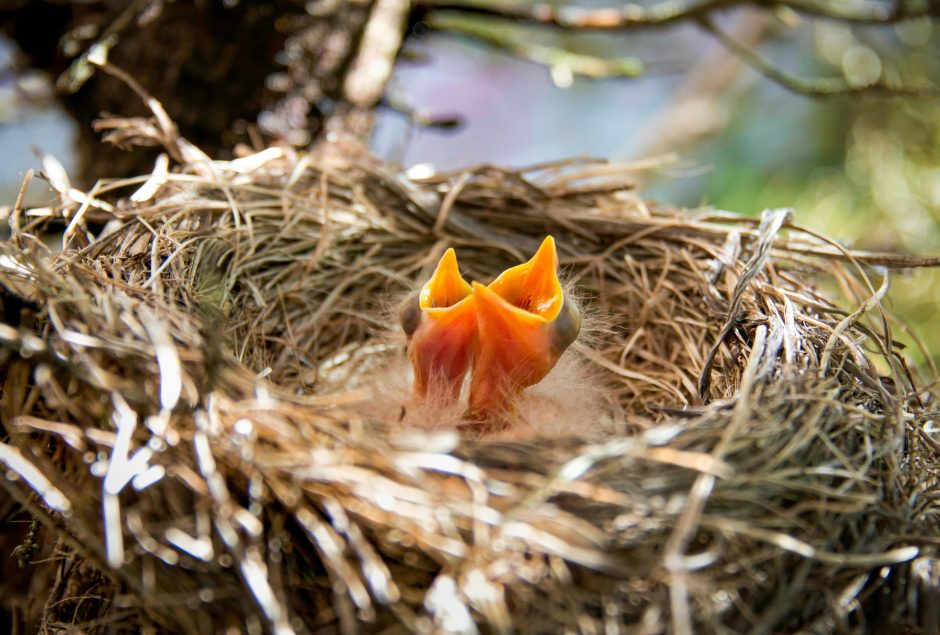
As children, my sister and brother and I loved watching a nest full of newly hatched chicks. Whenever my mother discovered one she would call us over to carefully peek inside. Newly hatched songbirds are blind, featherless, and helpless. Immediately after hatching, these types of birds can do little more than open their mouths to beg for food. The hungrier they are the louder they cry and the more they open up their beaks. For the first two to three weeks of life they remain in the nest and the parents feed them every fifteen minutes during the day. At first the chicks cannot control their own body temperature and must be constantly kept warm by their parents. While the mother and father are searching for food and flitting back and forth to their nest, they are also watching for predators. As the newly hatched chicks eat almost constantly during the day for the first ten days or so their growth rate is incredible.
“Are not two sparrows sold for a penny? And not one of them will fall to the ground without your Father’s will. But even the hairs of your head are all numbered. Fear not, therefore; you are of more value than many sparrows.”
“Acknowledge your hunger and cry out to the Lord…”
You’ve probably seen nests packed tightly with baby chicks, their heads held up high, cheeping loudly, with their mouth open as wide as possible, showing off the interior of their brightly colored mouth. The inside of a baby’s mouth is called a “gape,” and red, orange, yellow, and pink are common gape colors. The chick gaping with a wide-open beak and the high-contrast colors trigger something in the parents who are biologically wired to put food into gaping mouths. The hungrier the baby birds are, the more enthusiastically they beg for food, and they don’t stop cheeping until they are full and satisfied. The parents only stop feeding the chicks when all of them are sitting quietly in the nest at the end of the day.
These days I live in a convent in a city, so birds’ nests are not something I ever see. But I do build my own “nest,” so to speak, near the altar of the Lord of hosts, in the convent chapel. There is the place where we can all open our mouths and tell the Lord of our hunger to know him, our hunger for life, our hunger for eternity. Like the baby birds, I am learning to never stop begging to be fed.
How lovely is your dwelling place,
O Lord of hosts!
My soul longs, indeed it faints
for the courts of the Lord;
my heart and my flesh sing for joy
to the living God.Even the sparrow finds a home,
and the swallow a nest for herself,
where she may lay her young,
at your altars, O Lord of hosts,
my King and my God.
Happy are those who live in your house,
ever singing your praise (Psalm 84:1-4).
One thing that will help you become the Child you are…
God has made us for himself. He is providing for us, nourishing us, protecting us, warming us, delighting us… As long as we keep our hearts open, begging for him and his life, we will receive all he is giving us.
What gets in the way of this inbuilt hunger for God? For each of us there would be a different list. One of the habits in the following list might be on yours: hours of scrolling through social media feeds, trying to do what only God can do, attempting to change people around you instead of changing yourself, numbing habits, grasping for empty fillers like higher salaries, success, possessions, status… When we are satisfied with what can never satisfy us….
One thing we can do to increase our hunger for God is to avoid these ultimately unsatisfactory fillers and meditate instead on these famous words of St. Augustine who said:
“You have made us for yourself, O Lord, and our heart is restless until it rests in you.
“Who will grant it to me to find peace in you? Who will grant me this grace, that you should come into my heart and inebriate it, enabling me to forget the evils that beset me and embrace you, my only good? What are you to me? Have mercy on me, so that I may tell. What indeed am I to you, that you should command me to love you, and grow angry with me if I do not, and threaten me with enormous woes? Is not the failure to love you woe enough in itself?
Alas for me! Through your own merciful dealings with me, O Lord my God, tell me what you are to me. Say to my soul, I am your salvation. Say it so that I can hear it. My heart is listening, Lord; open the ears of my heart and say to my soul, I am your salvation. Let me run towards this voice and seize hold of you. Do not hide your face from me: let me die so that I may see it, for not to see it would be death to me indeed.”
St. Augustine’s Confessions (Lib 1,1-2,2.5,5: CSEL 33, 1-5)
Image credit: Photo by Mohan Nannapaneni
 Touching the Sunrise
Beautiful reflection on sparrows, such an inspiration, I loved it ❤️ awesome
LikeLike