
Six days before the Passover Jesus came to Bethany, the home of Lazarus, whom he had raised from the dead. There they gave a dinner for him. Martha served, and Lazarus was one of those at the table with him. Mary took a pound of costly perfume made of pure nard, anointed Jesus’ feet, and wiped them with her hair. The house was filled with the fragrance of the perfume. But Judas Iscariot, one of his disciples (the one who was about to betray him), said, “Why was this perfume not sold for three hundred denarii and the money given to the poor?” (He said this not because he cared about the poor, but because he was a thief; he kept the common purse and used to steal what was put into it.) Jesus said, “Leave her alone. She bought it so that she might keep it for the day of my burial. You always have the poor with you, but you do not always have me.”
John 121-11
For 40 days of the sacred season of Lent, we have been renewing and purifying our hearts, practicing self-denial and imitating God in his kindness by sharing with those who are in need, practicing virtue and fasting, overturning what the Preface for the First Sunday of Lent calls, “all the snares of the ancient serpent.”
Today, as we step over the threshold into the holiest of weeks, we encounter Mary of Bethany, her sister Martha, and their brother Lazarus. The Church puts the breaks on our preparation so that we may turn our gaze to Jesus, so that we may learn to serve him, and love him, and console him, and surrender to him.
There is a silence and calm inside this little home of Martha, Mary, and Lazarus. Outside the crowds are milling about and the rumbling of trouble is growing louder because of the raising of Lazarus. Around the family table, instead, there is an emotional connection only found among friends. Step into Holy Week by stopping in the house of Bethany.
Martha is quietly providing for Jesus and his band of apostles. Unruffled by the demands placed on her as hostess, and also quietly confident in Jesus as the Resurrection and the Life, she finds a prayerful peace within her loving service of the Friend who has meant so much to her.
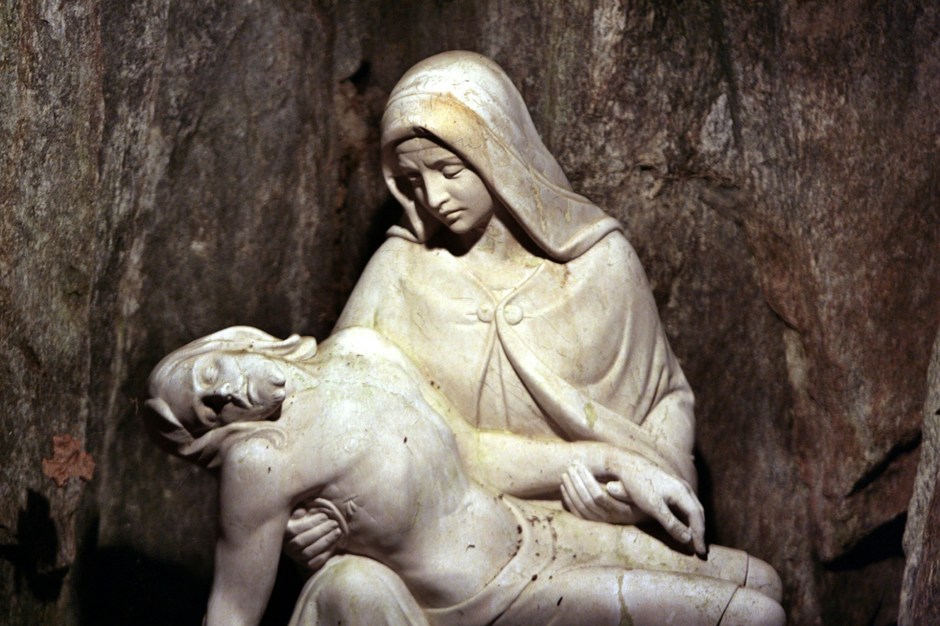
Mary breaks a jar of costly nard and anoints the feet of Jesus. She had purchased the perfume with all the resources she had. Drying her Lord’s feet, not with a towel, but with her hair, she gave to him all she was. Nard is a powerful fragrance used in preparation for burial. When applied to the skin or hair, its scent would fill an entire house and the aroma would remain for weeks. In a few days time, Jesus would be arrested, brought before the Sanhedrin, mocked and scourged and crowned with thorns, condemned by Pilate and crucified on Calvary. With every breath Jesus took, the fragrance of Mary’s anointing reminded him of her love for him. When he was alone in prison, when he sat on a mock throne and received the jeering of the guards who robed him in purple as they pressed thorns into his head, as he struggled and stumbled to Calvary, the scent of Mary’s loving gift of pure nard remained with him as a comfort. He knew he was not alone. Even as he died, he knew that she loved him, and that countless souls through history would, like Mary, seek to love and console him.
Lazarus, called out from the tomb four days after his death, sat beside Jesus. He knew that many were believing in Jesus now because of this miracle, and he realized that others wanted Jesus dead because of him. Perhaps he felt confused about what he should feel. Nevertheless, Lazarus remained at table with Jesus, staying near him, supporting him in any way he could.
So as you begin this Holy Week and you turn your gaze to Jesus, take a moment of peaceful prayer. Are you like Martha with her quiet service? Like Mary with her extravagant love? Like Lazarus, remaining near him? Or is there another way in which you are with Jesus this year as you enter Holy Week?
Photo by David Trinks on Unsplash

Praying with this Passage of Scripture
Lectio Divina is a way of listening to God as he speaks in his Word. It is a practice of communicating with God through Scripture and attending to God’s presence and what he wishes to tell us. In this slow and prayerful reading of the Word of God, we allow ourselves to be transformed by the Spirit who forms us into the image of Christ. There are four movements in Lectio Divina: Read (lectio), Meditate (meditation), Pray (oratio), Contemplate (contemplation).
Begin by finding a still space to pray. Breathe deeply and become quieter within. Abandon any agenda, worries or thoughts you bring to this prayer and entrust these things to the merciful care of God. Ask for the grace to be receptive to what God will speak to you through this Scripture reading. Grant me, Jesus Divine Master, to be able to know the mysteries of the kingdom of God and your unfathomable riches. Grant that your word penetrate my soul; guide my steps, and brighten my way till the day dawns and darkness dissipates, you who live and reign forever and ever Amen.
Read (lectio)
Begin by slowly and meditatively reading your Scripture passage out loud. Listen for a particular word or phrase that speaks to you at this moment and sit with it for a time.
Pray (oratio)
Read the text a third time. Listen for what God is saying to you. Speak heart to heart with God. Notice the feelings that this conversation with God raises up within you. Share with God what you notice about your response to this conversation. You may wish to return to repeating the phrase quietly and gently, allowing it to permeate you more and more deeply.
Contemplate (contemplatio)
Read the text a final time. Now be still and rest in God’s embrace. Ask God to give you a gift to take with you from this prayer. You might ask God if he is inviting you to do some action, for instance, make some change in your thoughts, attitudes or reactions, in the way you speak or how you treat others. Thank God for this gift and invitation as you conclude your prayer.
Image: Myriams-Fotos; pixabay.com
 Touching the Sunrise
Great insight. Thank you!
Sent from Yahoo Mail for iPhone
LikeLike