

The grace we are asking of God: a deeply felt awareness of how God in all of history and most powerfully in the Word made flesh draws us into the unfolding of the mystery of his love which always is extravagant and which is ever seeking to save us. We desire that in doing this we enter into a process of healing and conversion that we might love Jesus and follow him more intentionally, completely, and wholeheartedly.
Horizons of the Heart is inspired by the Spiritual Exercises of St Ignatius and my own notes from my thirty-day Ignatian retreat in 2022.
Entering into Prayer
Offer your prayer to God, desiring that in every way it will give him glory.
Enter into one of the moments where the Gospels record Jesus praying to his Father. For instance, Jesus retiring to the mountains and spending the night in prayer. Draw near Jesus, perhaps kissing the ground upon which he is kneeling.
Imitate as nearly as you can the spiritual sensitivity of Jesus, the Word of God made flesh, in his all-night vigil before the Father… his posture… his grateful amazement… his return gift to his Father of complete surrender to him.
Assume the same posture, the same way of being, with all the way it spills over into your spiritual senses. “Taste” the sweetness of this gaze between Jesus and the Father. “Delight” in the divine communication of love that never ends between Father and Son….
End with gratitude, the gratitude Jesus shows his Father.
Entering the Story
Recall or determine what passage of the Gospel you will be using for your meditation. Take a few moments to center all your senses on the way one person or group is personally experiencing a single moment of this Gospel passage. Do you personally resonate with this experience in some situation or aspect of your life?
Ask for what you desire.
Read the passage from the Gospel. Focus on the moment of the engagement with Jesus. What is the person (or group) experiencing.
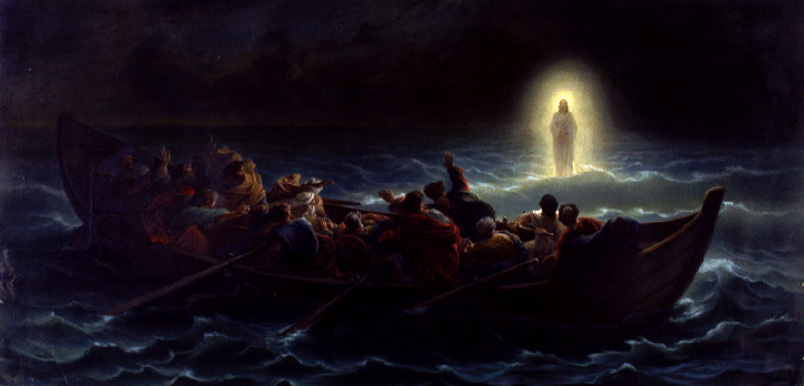
When evening came, his disciples went down to the sea, got into a boat, and started across the sea to Capernaum. It was now dark, and Jesus had not yet come to them. The sea became rough because a strong wind was blowing. When they had rowed about three or four miles, they saw Jesus walking on the sea and coming near the boat, and they were terrified. But he said to them, “It is I; do not be afraid.” Then they wanted to take him into the boat, and immediately the boat reached the land toward which they were going (John 6: 16-21).
Enter more deeply into the experience of the disciples as you feel inspired. Here is a possible thread you could follow:
The apostles were terrified. They were accomplished fishermen, but the Sea of Galilee was known for storms that arose without warning, putting small boats in danger of capsizing. These storms resulted from differences in temperatures as well as the differences in height between the seacoast and the mountains beyond. This resulted in strong winds that would drop to the sea, funneling through the hills creating violent results. Because the Sea of Galilee was shallow the waters could be “whipped up” more rapidly than deeper water, creating violent waves that put even larger boats at risk.
Yes. The apostles were terrified. Look, listen, taste, touch, smell that terror. What do you see? Grown men crying out, rushing around, depending on themselves to do something to save themselves. What do you hear? The disciples crying out in fear, their cries lost on the wind, as they faced death and loss. You taste the terror of men losing control of the situation, tossed about by the winds of nature.
Immersing yourself in Jesus
Re-read the passage from the Gospel, noticing how Jesus experienced that moment, how he sensed it with all his bodily as well as emotional, mental, intuitive, and spiritual senses.
How is Jesus experiencing this moment? Don’t come up with an intellectual answer. Abide, instead, with the Word. Remain within Jesus and his experience. Allow him to reveal to you how he is most deeply experiencing his relationship with the disciples in this moment.
This may take you in any number of directions. In this passage Jesus is showing me he had this stance toward his disciples: no matter how hard they try, they cannot save themselves.
Revisit the narrative, using “the five senses of the imagination.”
Antonio Guillén helps us deepen this in this way:
Now it is no longer a matter merely of seeing and listening to the scene with the imaginative senses of sight and hearing. At this stage, all the other bodily senses come into play in one’s imagination: ‘to smell and taste with the senses of smell and taste the infinite gentleness and sweetness’, so that one touches with the sense of touch, ‘embracing and kissing the place where these persons tread and sit’ (Exx 124–125). This prayer becomes more a matter of the senses and feelings, and thereby emotionally more constant. (Imitating Christ our Lord with the Senses: Sensing and Feeling in the Exercises, The Way, Jan/April 2008).
In this passage, I was given to “taste” Jesus’ stability and power. I found myself bowing before him as my clothes and hair were whipped by the waves and rain. There I kissed his feet. Here there was a strange quietness, even in the midst of turbulence and danger. I “touched” clearly, how Jesus was more powerful than any storm. I felt immersed in his stability, as firm as a rock, in the midst of everything happening on the Sea of Galilee at that moment: the storms, the cries of fear on the part of the disciples, their terror at losing everything, even life itself. Jesus’ words: “It is I, do not be afraid,” were like incense, a sweet-smelling fragrance.
Entering still deeper into the mystery of Christ, allow your heart to taste, to smell, to touch the infinite gentleness and sweetness of Jesus. Allow your spirit to soak up what has been felt and known in this contemplative prayer.
As you do this your mind’s activity will fade into the background, and the mystery you are intuitively contemplating will begin to take over and engulf you, planting within your spirit an inner knowledge of the Lord.
You will at some point begin to intuitively sense the difference between the way Jesus spontaneously feels, speaks, and acts in a situation and the way you yourself feel, speak, and act in similar situations in your own life.
Antonio Guillén continues:
Thus as we pray, we allow the mystery of the life of Christ, which has become connatural with us and present…, to take over and engulf us. No one would deny that this exercise—something at the intuitive and not cognitive level—impregnates the soul and establishes firmly that ‘inner knowledge of the Lord.’ For now the senses and feelings have taken on the same orientation as the reason and the affective will, ‘a more intimate assimilation of what has been contemplated, a sort of impregnation, the spirit’s soaking up what has already been felt’—‘that I might the better love and follow him’ (Exx 104).
Growing in Perfect Understanding
Explore the two ways of experiencing this one situation: the way of the disciples and the way of Jesus. We are also in the same type of stormy situations and have a choice about the way we will live through them: as the disciples or as Jesus.
The disciples in this story experienced terror. They did not experience Jesus’ presence. They felt alone. They had no trust or confidence. They were without hope.
Their experience is a window into what Ignatius called “spiritual desolation.” St. Ignatius describes desolation as, “darkness of soul, disturbance in it, movement to low and earthly things, disquiet from various agitations and temptations, moving to a lack of confidence, without hope, without love, finding oneself totally slothful, tepid, sad as if separated from one’s Creator and Lord.” Spiritual desolation is fundamentally a movement away from feeling the reality of the presence of God.
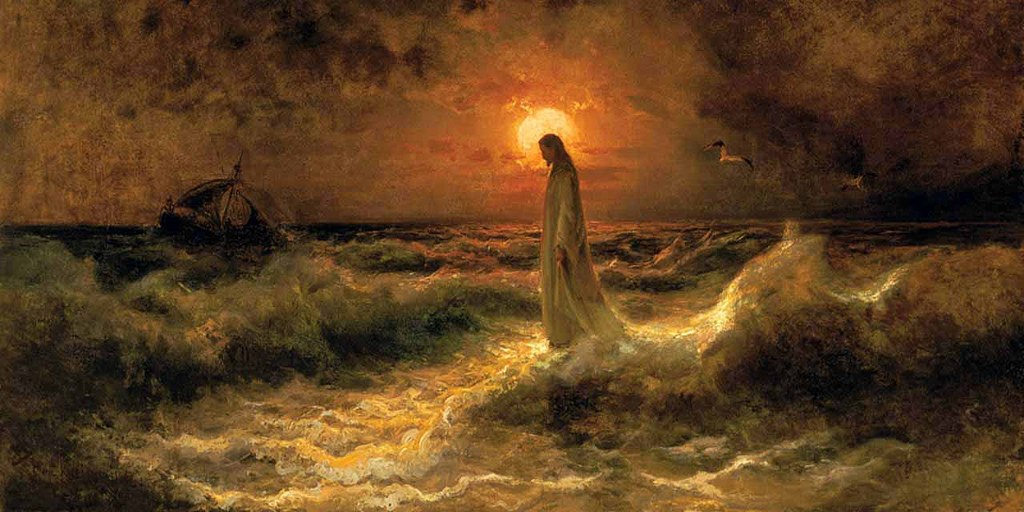
Now enter into your experience of Jesus in this same situation. In my case, it was an experience of stability and power, the firmness of the rock that is attributed to God alone, and that nothing in this world can move. There was a sense of God’s nearness, an increase in faith.
This experience is a window into what Ignatius called “spiritual consolation.” t. Ignatius said consolation is when, “Some interior movement in the soul causes the soul to come inflamed with love of its Creator and Lord,” it is when the soul strives to love no created thing more than the Creator of all. Saint Ignatius also calls consolation, “Every increase of hope, faith, and charity, and all interior joy that calls and attracts the soul to heavenly things and to salvation.”
Take a few moments to reflect upon how right now you can find yourself in such “storms” in your life: in relationships, reversals of fortune, accusations and misunderstanding, losses, illness. Our first reaction may be to cry out in terror, and that is perfectly understandable. If we remain here, however, we are experiencing only our fear with no real means of dealing with it, just like the disciples. When we move from terror into the stability and power of Jesus who is in the storm but not affected by the storm, greater than the storm, walking on the waves created by the storm, we discover how he reveals his presence to us, “It is I, do not be afraid.” The decisions we make from this space are truly wise, inspired, and blessed.
This prayer changes the way we perceive and experience reality. We learn how to be in Jesus and to imitate him in the way he experienced every aspect of human need and desire…
We reach more perfect understanding when we take quality time to feel with Jesus, as he reveals himself, looking and hearing, touching and tasting, in the Gospel Word. Contemplating Jesus becomes the path to imitating Jesus.
Rest in that awareness as Jesus helps you to resonate with what he resonates with. As you enter into his feelings and the way he uses his senses, you will gradually lose interest in your own spontaneous reactions, defenses, and self-promotions. Jesus will bring you to his way by attraction, sweetness, and beauty. He will make you feel safety, belonging, and hope.
“To educate our senses and feelings, to become imbued with his way of being and feeling, of resonating with everything that made him resonate, of abhorring everything that he abhorred, of reacting to things and to people as he sed to react, to spontaneously (the goal) feel with Jesus—to be more like him [than ourselves]…” (Imitating Christ our Lord with the Senses: Sensing and Feeling in the Exercises: Antonio Guillen (The Way, 47/1-2, Jan/April 2008), 225-241).
A gift to take with you
Allow an image or object that encapsulates all these experiences to form in your mind. Take some time to speak with God about the meaning or significance of this object.
Ask Mary, Joseph and Jesus to show you one specific gift they wish to give you. Receive it and remain in stillness and quietly relaxed presence under the influence of the Holy Spirit.
Reviewing the Graces of Prayer
When you finish praying, write down the main gifts and discoveries from this time of intimate contemplation. What is one concrete thing you can do to solidify these gifts in your life.
Image credit: Yousef from Unsplash
 Touching the Sunrise
I can’t wait to try this. Great idea for a meditation. I’ll start with the Road to Emmeaus. Thank you.
LikeLike