Sometimes I get snagged by what I would call, for me, over-following the news, reading different angles, commentaries, opinions…. I like to figure things out. It’s like a puzzle, a divine puzzle: What is God doing and what is going to happen and what does it all mean…. I found this from the Prelate of Opus Dei, Fernando Ocáriz, in a letter issued March 10, 2025. In his latest pastoral letter, the prelate of Opus Dei, Monsignor Fernando Ocáriz, reflected on how Christians should live joyfully in the context of “difficult times.” This reminded me to live on the level of faith even as I tread with my brothers and sisters through the chaos of these difficult days:
These are difficult times in the world and in the Church. Actually, in one way or another all times have had their lights and shadows. For this reason it is especially necessary to foster a joyful attitude. Always and in every circumstance we can and should be happy, because this is what our Lord wants: “that my joy may be in you, and that your joy may be full” (Jn 15:11). He said this to the apostles and, in them, to all of us who would come afterwards. Therefore “joy is a condition proper to the life of the children of God.”[1]
This joy in the Lord is the joy of faith in his fatherly love: “Cheerfulness is a necessary consequence of our divine filiation, of knowing that our Father God loves us with a love of predilection, that he welcomes us, helps us and forgives us. Remember this and never forget it: even if it should seem at times that everything is collapsing, nothing is collapsing at all, because God does not lose battles.”[5]
Nevertheless, in the face of difficulties or suffering, our personal weakness can cause this joy to wane, especially because of a possible weakness at those times of our faith in God’s omnipotent love for us. “A child of God, a Christian who lives by faith, can suffer and cry; he or she may have reasons to be sorrowful, but never to be sad.”[6] And therefore in order to foster, or recover, joy, it is good to renew the conviction of our faith in God’s love. This conviction enables us to say with St. John: “We have come to know and believe the love God has for us” (1 Jn 4:16).
Faith tends to express itself, in one way or another (with words or without words), in prayer. And with prayer comes joy, because “when a Christian lives by faith, with a faith that is not merely a word, but a reality expressed in personal prayer, the certainty of divine love is manifested in joy, in interior freedom.”[7]
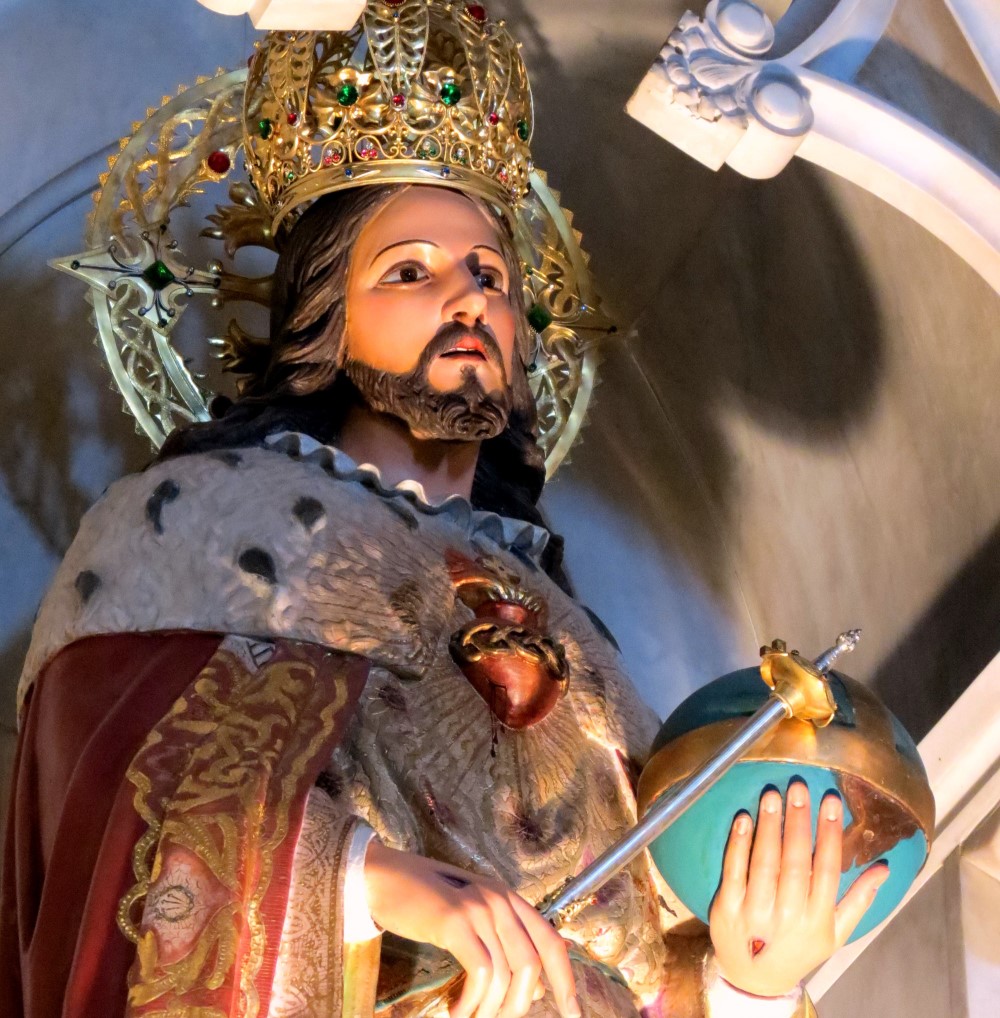
Today, the Feast of Christ the King of the Universe, my community and I went to the Cathedral of St Thomas More for Mass. Since it was the first time I had been there after a recent renovation I walked around the church, looking at the new statues and stained glass windows…and there were a lot of them!
On the level of soul, of presence, of awareness of what is most real, I had this sense that when we are in a church, when we are immersed in the divine action of the liturgy, we are in a different world, there, surrounded by the saints and angels, offered by Christ to the Father. In the world, yes, this world, but also in the Kingdom of the Father.
So I simply want to share some antiphons from Morning Prayer today in the Liturgy of the Hours, a reflection from various homilies of Pope Benedict, and a few phrases of the hymns we sang. I’m hoping that somehow they will share with you the profound sense of Christ the King by which we can make sense of life and history, a profound sense that we are already in that kingdom won by him that:
he might present to the immensity of [God’s] majesty an eternal and universal kingdom, a kingdom of holiness and grace, a kingdom of justice, love and peace. (From the Preface)
A man will come whose Name is the Dayspring; from his throne he will rule over all; he will speak of peace to the nations.
From Pope Benedict:
Jesus of Nazareth is so intrinsically king that the title “King” has actually become His name. By calling ourselves Christians, we label ourselves as followers of the King.
The King is Jesus; in Him God entered humanity and espoused it to Himself. This is the usual form of the divine activity in relation to mankind. God does not have a fixed plan that He must carry out; on the contrary, He has many different ways of finding man and even of turning his wrong ways into right ways.
The feast of Christ the King is therefore not a feast of those who are subjugated, but a feast of those who know that they are in the hands of the one who writes straight on crooked lines.
The Lord will give him power and honor and kingship; all peoples, tribes, and nations will serve him.
In this final Sunday of the liturgical year, the Church invites us to celebrate the Lord Jesus as King of the Universe. She calls us to look to the future, or more properly into the depths, to the ultimate goal of history, which will be the definitive and eternal kingdom of Christ. He was with the Father in the beginning, when the world was created, and he will fully manifest his lordship at the end of time, when he will judge all mankind.
From the hymn Crown Him with Many Crowns: Crown him the Lord of peace, Whose pow’r a scepter sways From pole to pole, that wars may cease, Absorbed by prayer and praise…
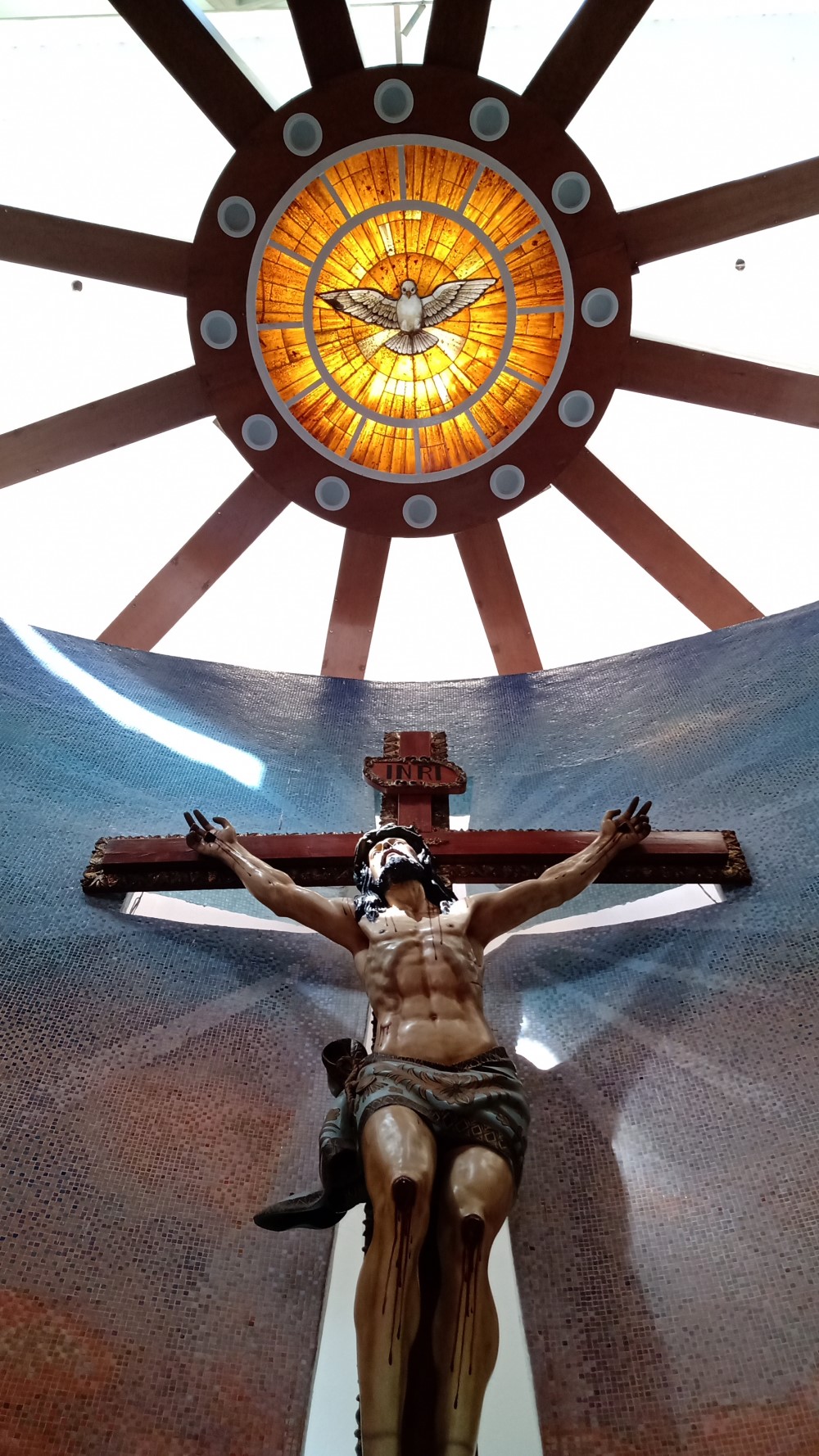
The Cross is the “throne” where he manifested his sublime kingship as God Love: by offering himself in expiation for the sin of the world, he defeated the “ruler of this world” (Jn 12: 31) and established the Kingdom of God once and for all. It is a Kingdom that will be fully revealed at the end of time, after the destruction of every enemy and last of all, death (see 1 Cor 15: 25-26). The Son will then deliver the Kingdom to the Father and God will finally be “everything to everyone” (1 Cor 15: 28).
From the hymn: Rejoice the Lord Is King: His Kingdom cannot fail, He rules o’er earth and heav’n. The keys of death and hell Are to our Jesus giv’n.
The way to reach this goal is long and admits of no short cuts: indeed, every person must freely accept the truth of God’s love. He is Love and Truth, and neither Love nor Truth are ever imposed: they come knocking at the doors of the heart and the mind and where they can enter they bring peace and joy. This is how God reigns; this is his project of salvation, a “mystery” in the biblical sense of the word: a plan that is gradually revealed in history.
From the Preface for the Feast of Christ the King:
For you anointed your Only Begotten Son, our Lord Jesus Christ, with the oil of gladness as eternal Priest and King of all creation, so that, by offering himself on the altar of the Cross as a spotless sacrifice to bring us peace, he might accomplish the mysteries of human redemption, and, making all created things subject to his rule, he might present to the immensity of your majesty an eternal and universal kingdom, a kingdom of holiness and grace, a kingdom of justice, love and peace.
INTERCESSIONS Let us pray to Christ the King. He is the firstborn of all creation; all things exist in him. May your kingdom come, O Lord
Christ, you are our savior and our God, our shepherd and our king. – lead your people to life-giving pastures.
Good Shepherd, you laid down your life for your sheep. – rule over us, and in your care we shall want for nothing.
Christ, our redeemer, you have been made king over all the earth. – restore all creation in yourself.
King of all creation, you came into the world to bear witness to the truth. – may all men and women come to acknowledge your primacy in all things.
Christ, our model and master, you have brought us into your kingdom. – grant that we may be holy and blameless before you this day.