Christmas: Unconditional Love. Period.

It was a moment that I knew He saw me. He knew me. He loved me.

It wasn’t in a chapel.

It wasn’t when I was praying.

It wasn’t when I was reading a spiritual book.

It was an unexpected moment that He found me and showed me His unconditional love in a way I could receive it and consciously make it mine.

Homework filled my days as I pursued graduate theological studies and I had volunteered to take care of the switchboard on a quiet Saturday afternoon. I was immersed in reading Augustine’s commentary on the Gospel of John.

This great disciple of Jesus, convert, and Doctor of the Church described his weakness. I suddenly knew mine. It was honest. It was raw. It was such a relief to finally name it and own it.

In a flash, I felt like there was someone else in the room. Looking up, I saw no one.

My eyes returned to the page and I continued reading. Once more the piercing sense of being seen with a gentle and compassionate gaze overwhelmed me. This time I knew the eyes, the presence, was deeply established within me, pouring out over my inner landscape.

And the words…

The voice…

“I don’t care if you ever beat this temptation. If you look at me and let me keep looking at you, that’s all I care about. I love you.”

Decades later I inserted this spiritually disruptive event—disruptive in a sacred and healing way—into a book I was writing. My editor still in her twenties or early thirties flagged it as “impossible” and “against Church teaching.” “We need to repent before we hear those words….”

Maybe so, I thought, but I can’t doubt—nothing could make me ever question—that I had heard His voice.

The Full Extent of Our Misery

Today I found a similar story in a book I’m reading for Advent, Do Not Judge Anyone: Desert Wisdom for a Polarized World: Desert Wisdom for a Polarized World, by Isaac Slater, OCSO. In his chapter on Mercy he recounts how the Japanese poet Ryokan had been asked by his sister to give advice to his nephew who was squandering the family’s money. Ryokan went to his sister’s home and stayed three days and said nothing. On the day he left he stood on the porch, called for his nephew, and asked him to tie the strings of his straw sandals. His sister, standing behind the screen, thought that finally he was going to give her son some stern advice. But there were no words. No reproaches. No pleading. Instead, as his nephew bent to tie his sandals he felt something wet on his neck. Surprised, he looked up and saw Ryokan’s eyes full of tears. “At that moment he felt repentance for his wrongdoings. Ryokan stood up and left without a word” (page 13-14).

Slater reflects on the interplay between repentance and mercy:

“Sin can only be known in the moment it’s forgiven. Otherwise we could never bear to face it squarely. It’s the awareness of the full extent of our misery in the same moment that we realize we are loved, unconditionally, just as we are. Knowing we are loved just as we are, while seeing keenly and with fresh eyes the nature of our fault, is what prompts us to want to change, from within and freely. Only when we know that we don’t need to change in order to be loved do we want to change…not to earn what’s already been freely given but from gratitude” (Slater, page 14).

The other day I witnessed a conversation. As a woman told a humorous story, she made a side comment to a priest sitting next to her. It was something about confession or an excuse around the event she was relaying. The priest didn’t miss a beat. He shrugged and said simply,

“There is nothing that we can do to make God love us more. There is nothing we can do to make God love us less.”

Love Reached Down to Us

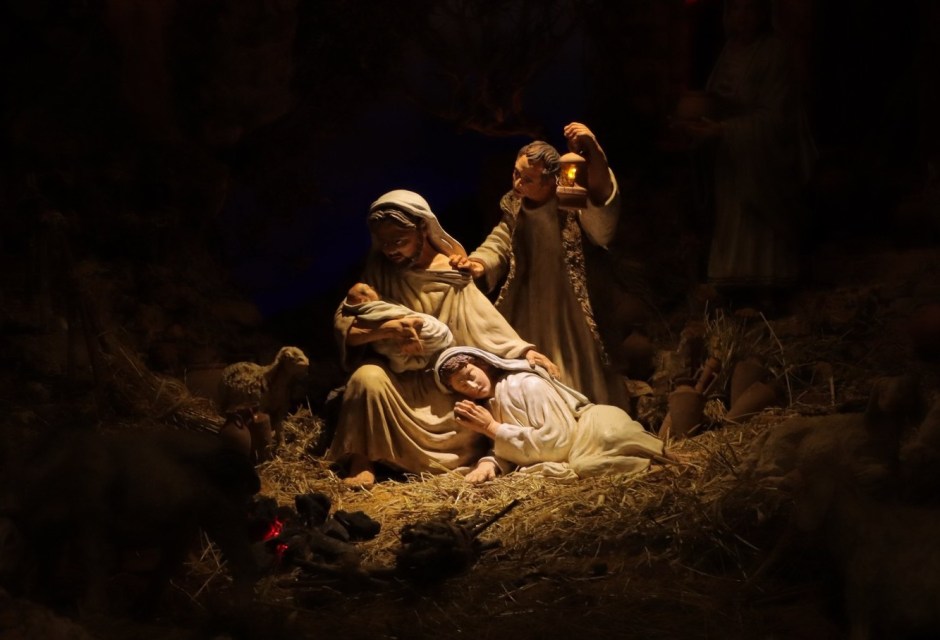
At Christmas we remember and ponder how Love reached down to us, leaping down, reaching down into the deep waters to draw us out and set us free. In the Resurrection we learn that this divine Love is stronger than death and that nothing in the humble obscurity of our existence can put out the fire in the heart of the Trinity. Nothing we could do, even crucify the Lord of Glory, could overpower what stands as the meaning of the world: relationship. We were created by God in relationship with him, we were pursued, even after we rejected this communion, by the God who wanted us still as his own. The purpose of Jesus’ life and of his death and resurrection was to reveal the unswervability of God being for us and pitching his tent among us in order to fulfill God’s ultimate desire to bring us and the whole creation into God’s communion of forever and unending love.

The Christmas story is about much more than a memory or a re-telling. Once grasped it becomes our story, the history of a Love that forms our identity, establishes our purpose, points us to our destiny, and fills us with joy.

This unconditional love Is the only reason for our existence. Period.

Take a deep breath!

September—the month where the summer’s lush fullness is traded for autumn’s sharp clarity. When restless winds tug at the trees, reminding us that the vibrant colors of the fall are around the corner. School starts and summer’s freedom is replaced by the challenge and excitement of new things to learn, to explore, to become. Vacation months give our spirits a bit of space to breathe more deeply, before we pick up again the weight and concern of burdens of a world that feels turbulent and stretched thin.

We can’t forget how to breathe.

We can’t forget that we’re standing right in the middle of God’s great story.

The apostles—not unlike us—felt nervous and frightened and frustrated, when they weren’t able to see beyond their own strength, their own solutions to problems, their own abilities, and what they had at hand. Whether they were trying to figure out how to feed five thousand people with five loaves of bread, or straining to pull the oars in the midst of a storm that struck terror in their hearts, Jesus helped them gently learn: You cannot do it alone. Without me you can do nothing. I am here. I love you. And I will take care of you. And I will provide for you. And I will protect you.

That’s been sitting with me. The apostles couldn’t fix the hunger of the crowd, and they couldn’t calm the storm at sea. And I realize: I can’t fix my family, our culture, or the world. Neither can you. But we can turn to Jesus, who is Life itself, and who meets us with abundance when we’ve reached our limits.

The saints remind us that the quality of our days isn’t determined by the times we live in, but by the way we live them. Or as Pope Leo recently said, quoting St. Augustine, “Let us live well and the times will be good. We are the times.”

I believe this is a moment of awakening—a time to choose joy, to walk in holiness, and to let Christ’s light shine through us. These are hopeful times, because Christ is with us. To be Catholic right now means carrying him into the world, not with our own strength, but with his life flowing through us.

So don’t forget how to breathe as the pace picks up in these weeks.

Sr Kathryn

“Like a little child, I keep myself”: Retreat Reflection

I was building a sandcastle.

Jesus was running along the beach, throwing sand up into the air.

I was serious.

Jesus was laughing.

I was facing away from the ocean and the sunshine, busy with my project in the sand, my face in shadow.

Jesus gazed into the horizon, his face lit by the sun, as he sat in awe at the edge of the water.

Retreat always begins with a “before,” and ends with an “after.”

In my inspired imagination, as I prayed on the first day of my 8-day annual retreat this year, Jesus showed me that my “before”—my approach to life as a responsible and serious project-conscious adult—was no longer satisfying me. And he showed me in prayer that what he wanted for me was “delight,” his way of both delighting in the Father’s love for him and knowing that he was the delight of his Father.

In Psalm 131 there is this lovely line in the Jerusalem Bible translation: “Like a little child, so I keep myself.”

As I watched the ocean gently wash away the cares of the very important work of creating my sandcastle, Jesus helped me to feel on every level of my being what I have been created for: to be a child of the Father, as he himself is the Child of the Father. In fact, Jesus’ urging us to lay aside our self-importance to become like little children is rooted in his very way of life. Jesus wanted me to feel what he felt going about his life on this earth, what he felt in prayer on the mountains, connecting with his Father, indeed, what he feels before the Father for all eternity.

Hans Urs von Balthasar wrote in the book Unless You Become Like a Child that as a grown man, Jesus never leaves the “bosom of the Father.” His identity is inseparable from his being a Child in the bosom of the Father. In one place in the book he imagines the child Jesus becoming conscious of the world around him … “When the Mother awakens him, the opening up of the whole horizon of reality is experienced not only as something holy but as the realization that in the depths of this opened fullness of being there radiates the personal Face of his Father, personally turned toward him.”

Jesus draws us in prayer to sit beside him as he gazes into the Face of his Father who is “personally turned toward him,” personally turned toward us. This is the one thing necessary, this sitting, this receiving, this allowing oneself to be seen, to be loved. It is this that Mary had discovered and Martha’s heart—and mine—still yearned to know.

There are many things in our lives that frighten us into hiding from love, that paralyze parts of us so that we are hesitant to open up to receive the welcoming smile of God and of others. Retreats are often the long stretch of quiet healing that make it possible for us to accept being loved.

After all, Jesus was showing me, isn’t that what a tiny child longs for, needs, depends on, and trusts in? No matter what has happened in our lives, the eternal Father’s love heals and holds us until we are warmed with the gaze of his Face and are confident in the strength of his tender care for us.

Jesus didn’t ask us to be smart, accomplished, successful, organized. Nowhere in the Gospel do we find him suggesting that anything depends on us alone, especially this very important work that we were invited to share: the salvation of the world. There is only an insistence on spiritual childhood, this transformation of heart and mind made possible through the grace of the Holy Spirit.

“The child has time to take time as it comes, one day at a time, calmly, without advance planning or greedy hoarding of time. Time to play, time to sleep. He knows nothing of appointment books in which every moment has already been sold in advance.” Instead, every moment “we should receive with gratitude the full cup that is handed to us … And only with time of this quality can the Christian find God in all things, just as Christ found the Father in all things.”

This is my “after,” the gift of my retreat, the first day of the rest of my life. This is the joy Jesus has desired for me to know, the delight that is now mine forever.

Image credit: Christ with Martha and Maria by Henryk Siemiradzki, 1886 via Wikimedia, in the public domain.

Lectio Catolica: Living in Joy in Difficult Days

Sometimes I get snagged by what I would call, for me, over-following the news, reading different angles, commentaries, opinions…. I like to figure things out. It’s like a puzzle, a divine puzzle: What is God doing and what is going to happen and what does it all mean…. I found this from the Prelate of Opus Dei, Fernando Ocáriz, in a letter issued March 10, 2025. In his latest pastoral letter, the prelate of Opus Dei, Monsignor Fernando Ocáriz, reflected on how Christians should live joyfully in the context of “difficult times.” This reminded me to live on the level of faith even as I tread with my brothers and sisters through the chaos of these difficult days:

These are difficult times in the world and in the Church. Actually, in one way or another all times have had their lights and shadows. For this reason it is especially necessary to foster a joyful attitude. Always and in every circumstance we can and should be happy, because this is what our Lord wants: “that my joy may be in you, and that your joy may be full” (Jn 15:11). He said this to the apostles and, in them, to all of us who would come afterwards. Therefore “joy is a condition proper to the life of the children of God.”[1]

This joy in the Lord is the joy of faith in his fatherly love: “Cheerfulness is a necessary consequence of our divine filiation, of knowing that our Father God loves us with a love of predilection, that he welcomes us, helps us and forgives us. Remember this and never forget it: even if it should seem at times that everything is collapsing, nothing is collapsing at all, because God does not lose battles.”[5]

Nevertheless, in the face of difficulties or suffering, our personal weakness can cause this joy to wane, especially because of a possible weakness at those times of our faith in God’s omnipotent love for us. “A child of God, a Christian who lives by faith, can suffer and cry; he or she may have reasons to be sorrowful, but never to be sad.”[6] And therefore in order to foster, or recover, joy, it is good to renew the conviction of our faith in God’s love. This conviction enables us to say with St. John: “We have come to know and believe the love God has for us” (1 Jn 4:16).

Faith tends to express itself, in one way or another (with words or without words), in prayer. And with prayer comes joy, because “when a Christian lives by faith, with a faith that is not merely a word, but a reality expressed in personal prayer, the certainty of divine love is manifested in joy, in interior freedom.”[7]

Meditation: Already in Christ’s Kingdom

Dear Friends,

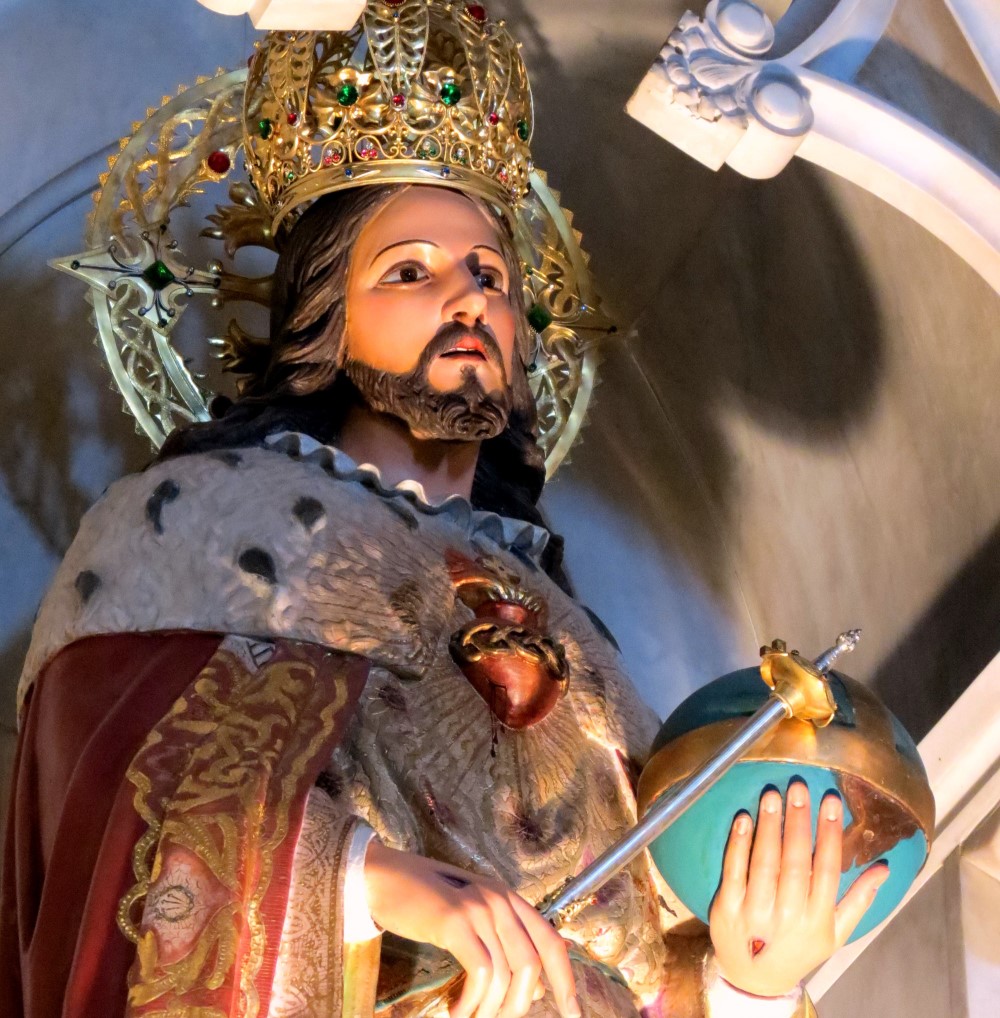
Today, the Feast of Christ the King of the Universe, my community and I went to the Cathedral of St Thomas More for Mass. Since it was the first time I had been there after a recent renovation I walked around the church, looking at the new statues and stained glass windows…and there were a lot of them!

On the level of soul, of presence, of awareness of what is most real, I had this sense that when we are in a church, when we are immersed in the divine action of the liturgy, we are in a different world, there, surrounded by the saints and angels, offered by Christ to the Father. In the world, yes, this world, but also in the Kingdom of the Father.

So I simply want to share some antiphons from Morning Prayer today in the Liturgy of the Hours, a reflection from various homilies of Pope Benedict, and a few phrases of the hymns we sang. I’m hoping that somehow they will share with you the profound sense of Christ the King by which we can make sense of life and history, a profound sense that we are already in that kingdom won by him that:

he might present to the immensity of [God’s] majesty
an eternal and universal kingdom,
a kingdom of holiness and grace,
a kingdom of justice, love and peace. (From the Preface)

A man will come whose Name is the Dayspring; from his throne he will rule over all; he will speak of peace to the nations.

From Pope Benedict:

Jesus of Nazareth is so intrinsically king that the title “King” has actually become His name. By calling ourselves Christians, we label ourselves as followers of the King.

The King is Jesus; in Him God entered humanity and espoused it to Himself. This is the usual form of the divine activity in relation to mankind. God does not have a fixed plan that He must carry out; on the contrary, He has many different ways of finding man and even of turning his wrong ways into right ways.

The feast of Christ the King is therefore not a feast of those who are subjugated, but a feast of those who know that they are in the hands of the one who writes straight on crooked lines.

The Lord will give him power and honor and kingship; all peoples, tribes, and nations will serve him.

In this final Sunday of the liturgical year, the Church invites us to celebrate the Lord Jesus as King of the Universe. She calls us to look to the future, or more properly into the depths, to the ultimate goal of history, which will be the definitive and eternal kingdom of Christ. He was with the Father in the beginning, when the world was created, and he will fully manifest his lordship at the end of time, when he will judge all mankind.

From the hymn Crown Him with Many Crowns:
Crown him the Lord of peace,
Whose pow’r a scepter sways
From pole to pole, that wars may cease,
Absorbed by prayer and praise…

The Cross is the “throne” where he manifested his sublime kingship as God Love: by offering himself in expiation for the sin of the world, he defeated the “ruler of this world” (Jn 12: 31) and established the Kingdom of God once and for all. It is a Kingdom that will be fully revealed at the end of time, after the destruction of every enemy and last of all, death (see 1 Cor 15: 25-26). The Son will then deliver the Kingdom to the Father and God will finally be “everything to everyone” (1 Cor 15: 28).

From the hymn: Rejoice the Lord Is King:
His Kingdom cannot fail,
He rules o’er earth and heav’n.
The keys of death and hell
Are to our Jesus giv’n.

The way to reach this goal is long and admits of no short cuts: indeed, every person must freely accept the truth of God’s love. He is Love and Truth, and neither Love nor Truth are ever imposed: they come knocking at the doors of the heart and the mind and where they can enter they bring peace and joy. This is how God reigns; this is his project of salvation, a “mystery” in the biblical sense of the word: a plan that is gradually revealed in history.

From the Preface for the Feast of Christ the King:

For you anointed your Only Begotten Son,
our Lord Jesus Christ, with the oil of gladness
as eternal Priest and King of all creation,
so that, by offering himself on the altar of the Cross
as a spotless sacrifice to bring us peace,
he might accomplish the mysteries of human redemption,
and, making all created things subject to his rule,
he might present to the immensity of your majesty
an eternal and universal kingdom,
a kingdom of holiness and grace,
a kingdom of justice, love and peace.

INTERCESSIONS
Let us pray to Christ the King. He is the firstborn of all creation; all things exist in him.
                              May your kingdom come, O Lord

Christ, you are our savior and our God, our shepherd and our king.
 –  lead your people to life-giving pastures.

Good Shepherd, you laid down your life for your sheep.
 – rule over us, and in your care we shall want for nothing.

Christ, our redeemer, you have been made king over all the earth.
 – restore all creation in yourself.

King of all creation, you came into the world to bear witness to the truth.
 – may all men and women come to acknowledge your primacy in all things.

Christ, our model and master, you have brought us into your kingdom.
 – grant that we may be holy and blameless before you this day.