Guest Post: Our Second Pandemic St. Patrick’s Day

It was just over a year ago that the first Covid-19 lockdown began. I remember, because for the first time in years I’d decided to cook a St. Patrick’s Day dinner for a small group of friends. I ended up making little packages of the dinner and leaving them on people’s doorsteps instead!

So much has happened this year, and it’s somehow appropriate to turn to the saint whose feast day fell at such a significant time in our lives. Because, in one sense, he’s been with us all along—throughout this plague year, and well before it.

Today most people associate St. Patrick with banishing snakes from Ireland or using shamrocks to teach the Trinity. Those are nice stories, but that’s all they are—stories. Yet the real Patrick’s life and faith and work were much more compelling than any of the legends that have sprung up around him. In fact, his life provides an inspiring lesson in God’s grace and mercy.

Captured as a teenager, Patrick was sold into slavery in Ireland, where he worked as a shepherd (his companions, we are told, were Cold and Hunger), and became a Christian. He escaped to Britain, but after 25 years God sent him back to Ireland to convert and minister to his former captors.

Patrick served in regions of Ireland where outsiders had never traveled, bringing a new way of life to a violent, war-oriented pagan culture. “Daily I expect to be murdered or betrayed or reduced to slavery if the occasion arises,” he wrote. “But I fear nothing, because of the promises of heaven.” What a sentiment for our times, as the pandemic continues to claim lives all around us!

I fear nothing, because of the promises of heaven.

There is a lot we can learn this year from Patrick’s story. He wasn’t afraid to try and change what was wrong with the culture. He taught that women were not a commodity, but that they had choices for their lives. He advocated reading and learning in a culture that clung to superstition. He was one of Christianity’s first outspoken opponents of slavery.

There is also comfort we can draw this year from Patrick’s story. This has not just been a pandemic year for us: the earth has been rocked with civil unrest, with the breakdown of structures we once thought permanent, with wild economic disparities throughout the world. Patrick’s Ireland was perceived pretty much as the end of the earth: the collapsing Roman Empire meant many people believed civilized society was drawing to a close. That feels familiar, doesn’t it? Yet Patrick’s story tells us clearly that no matter what empires might come and go, no matter how barbaric the civilizations around us may seem, the Word of God endures it all. Like the forgotten Irish people, we are all worthy to be saved.

A tenth-century manuscript in Dublin is known as St. Patrick’s Breastplate—a suit of armor, as it were, for going out into the world. Patrick didn’t actually write it, but its protective words echo his faith and are particularly relevant to us in March of 2021:

I bind unto myself today
the strong Name of the Trinity
by invocation of the same,            
the Three in One and One in Three

The prayer goes on for several stanzas, and concludes with:

Christ be with me, Christ within me,
Christ behind me, Christ before me,
Christ beside me, Christ to win me,
Christ to comfort and restore me.
Christ beneath me, Christ above me,
Christ in quiet, Christ in danger,
Christ in hearts of all that love me,
Christ in mouth of friend and stranger.


I bind unto myself the Name,
The strong Name of the Trinity;
by invocation of the same,
the Three in One, and One in Three,
of Whom all nature hath creation,
eternal Father, Spirit, Word:
Praise to the Lord of my salvation,
salvation is of Christ the Lord.

This Lent, this St. Patrick’s Day, this time of turmoil and uncertainty might be a good time to include the St. Patrick’s Breastplate prayer in our daily routines. It is a prayer of protection, a prayer of faith, and ultimately a prayer of joy in our salvation.

And we can all use a little joy right now.

by Jeannette de Beauvoir

Photo Credit: bobosh_t AKA “Father Ted” on Flickr, Christ the Saviour Church

God has never given up on us and never will

Hosea in chapter 14 depicts the heart of salvation history. Despite our wanderings and wailings and wonderings, even after our fickleness, our refusals and our settled decisions to do things our way or to just not do things at all, God has never given up on us and never will. God will not let us go. Our Lover is faithful and his love can be trusted. The marriage holds. We are still his.

We remember that in earlier more tumultuous chapters of the prophet Hosea’s story, he was commanded to go and love a woman who is beloved of a paramour…, even as the Lord loves the people of Israel, though they turn to other gods (3:1).

Isaiah realizes how useless is its own self-sufficiency in relying on Assyria and the horses of war, their calling god the idols which their hands have crafted. They are nothing without the God who made them and who loves them. God loves Israel, and us, with a love that is tender. The words Hosea uses for this love are emotional words that expresses a father’s or a mother’s tender affection.

I too have faithlessly wandered from the One who has loved me, literally, unto death. And tender has been his search for me wherever I have taken refuge to escape the demands of the relationship he has initiated with me. I am weak. I am poor. I am incurable. And I know beyond a shadow of doubt after so many attempts to improve this relationship on my own terms that it is only God who heals me, who loves me, as he revived and reconciled Israel to himself.

The images that Hosea uses to describe what God brings about in the life of his loved one are images of nature at the fullness of its beauty and bounty. They are images of the bountiful Giver of goodness, images of freshness, stability, and vigor:

I will heal their defection, says the LORD,
    I will love them freely;
    for my wrath is turned away from them.
I will be like the dew for Israel:
    he shall blossom like the lily;
He shall strike root like the Lebanon cedar,
    and put forth his shoots.
His splendor shall be like the olive tree
    and his fragrance like the Lebanon cedar.
Again they shall dwell in his shade
    and raise grain;
They shall blossom like the vine,
    and his fame shall be like the wine of Lebanon (Hosea 14:4-7).

No god that I craft with my own hands, my mental acumen, or my gifted ability will ever compare with the endless River of living love that is my God. I am the loved one and now my Lover waits upon my word. What will be response? What will be yours?

What a perfect reading halfway through Lent. Pope Francis in his straightforward and sincere homily on Ash Wednesday 2021 sums it up this way: “Return to me, he says, with all your heart. Lent is a journey that involves our whole life, our entire being. It is a time to reconsider the path we are taking, to find the route that leads us home and to rediscover our profound relationship with God, on whom everything depends. Lent is not just about the little sacrifices we make, but about discerning where our hearts are directed. This is the core of Lent: asking where our hearts are directed.”

Image by Jill Wellington from Pixabay

My Friend, Mary Magdalene

I won’t deny it: I am friends with many saints, not just a few. But there are some saints with whom I have a very particular relationship and who have mentored me throughout my life. One of these is St. Mary Magdalene.

I discovered her when I was a teenager, reading the Gospel attentively for the very first time. I had read the Gospel stories before and heard them at Mass, however with little understanding and probably little attention. But when I entered the convent as a young teenager, the Gospels suddenly became alive for me, drawing me into the life of Jesus and his followers.

There was just one problem: As I read through Matthew and Mark, it seemed like the “chosen ones” were men – with the exception, of course, of the Blessed Virgin Mary. Then I began reading Luke’s Gospel account and there she was, a woman among women followers: Mary Magdalene. Yes, I had encountered her in Matthew and Mark, but not like this! Here it was clear: she followed Jesus and ministered to Him – in many ways just like the apostles. “Soon afterward he went on through cities and villages, proclaiming and bringing the good news of the kingdom of God. And the twelve were with him, and also some women who had been healed of evil spirits and infirmities: Mary, called Magdalene, from whom seven demons had gone out, …and many others, who provided for them out of their means” (Lk 8:1-3).

Finally! Women who traveled with Jesus and the twelve as He went through cities and villages, and the first among them was Mary Magdalene. I began to look for her in the Gospel accounts. I started praying to her, carrying on conversations with her, asking that she teach me to be a faithful follower of Jesus.

I wondered about the seven demons (I knew I had a few of my own!), but those had been driven out by Jesus and that was the only part of the story that I needed to know, which is why the Gospel doesn’t elaborate. Jesus drives out demons and heals: all demons, all illnesses.

As I collected and pieced together the bits and pieces of data that the Gospels provide on Mary Magdalene, I stood amazed before this strong woman disciple of Jesus. After Luke’s introduction, the next mention of her is again with Jesus’ Mother and the other women at the foot of the cross (Jn 19:25), when most of the men – John excepted – had abandoned their Master. I can only imagine the strength it took to remain there, listening to the taunts and the blasphemies, taking in the barbaric torture and the agony of Jesus, hearing His heartrending last words. Still she did not flee. Her presence and the presence of the women, Mary Most Holy, and the youngest disciple were one of the few consolations Jesus had in His darkest hour.

Mary Magdalene is still there as the Lord’s body is removed from the cross and laid in the tomb (Lk 23:50-56). And even when most of the others go home, Mary Magdalene takes up her station opposite the tomb and keeps vigil (Mt 27:61).

When my own father’s life ended suddenly and tragically through suicide (because of depression caused by a cancer medication), this dear Saint was with me throughout the suffering and the grief. With Mary Most Holy she stayed with me, silently comforting and showing me how to grieve. She had always been a “best friend” saint, but now she became a “soul-sister” saint. 

Mary Magdalene was the first to discover the empty tomb (Jn 20:1-2). More loss. Now she had nothing physical to hang on to, not even a tomb where she could go and pray. Her tears (Jn 20:11-13) showed me that I could honor my own bereavement and the deep loss I felt, with the tears I tried so desperately to keep back.

Mary Magdalene’s tears showed me that I could honor my own bereavement and the deep loss I felt, with the tears I tried so desperately to keep back.

Through her own story, my sister-saint showed me something else: namely, that Jesus is with us amid our suffering, even when we don’t recognize Him (see Jn 20:14-16). He is gentle and tender, listening, caring, moving according to our rhythm and readiness, reaching out and calling us by name. He says our name like no other can say it. The very sound of His voice brings comfort and healing.

It wasn’t the first time Jesus had healed Mary Magdalene and it probably wasn’t the last. Each healing brought with it a call (see Jn 20:17-18). This time the call was astounding! Jesus commissioned Mary to be the Apostle to the apostles, bringing them the stupendous news of His resurrection and His forthcoming ascension! It was totally unimaginable – a woman as the first witness of Jesus’ resurrection and the Apostle sent to the Twelve!

This is the woman who has inspired and mentored me throughout the whole of my long religious life. I encountered her 58 years ago in 1963, my first year in the convent. She has been a faithful friend and confidant ever since – in sorrow and in joy, in mission and in my relationship with Jesus. Mary Magdalene is like a prism reflecting for me the life and presence of Jesus, her Lord and mine.  

I believe that it’s not we who choose the saints, but the saints who choose us. Which saints have chosen you? May they accompany you throughout this graced Lenten season.

United in Jesus our Master and Lord
and in His saints,

Sr. Mary Leonora, fsp

You have suffered a long time

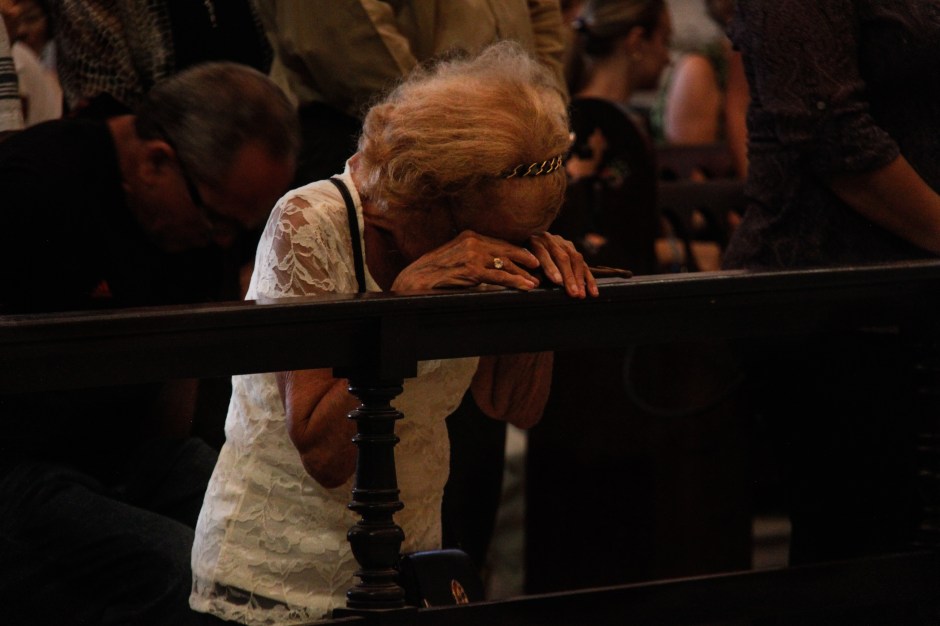
I am in one of those years where everything about life is being undone and redone, unmade and remade, unsung and resung, stopped and started, forgotten and remembered, cast down and lifted up. A year when everything is out of my control. A year blessed, so blessed, and yet so frighteningly raw.

When was the last time you had a year like this? I read somewhere that a person’s identity is refashioned several times in their adult life.

That’s the thing about understanding that there is a map to life, an expected set of transitions that are usually sparked by daily occurrences that aren’t quite pleasant. When you realize that they are a normal part of holiness, you know where to start to find the way through them.

This morning in confession, Jesus (through the voice of the confessor) finally heard and responded to the innermost cry of my heart. No mere moralizing, and preaching, explaining and psychologizing…the fallback responses when people can’t quite see their way to the person but stop short with managing what they think is the problem. (How often I do this to others!)

Instead, Father said simply this,

“You have suffered a long time.
This is an important transition in your life.
Live it in expectancy, the anticipation of where Jesus will be leading you next.
Ask for the gift of discernment.”

Once you are seen, heard, once someone reaches into your heart with true care, you have the key to emerge from whatever pain is entangling you. And you can put order to your soul.

Here are three things that can help put order to your soul.

Let Jesus love you.

Pray simply in a soul-shepherding contemplative method. For example, in a quiet place, slowly, resting in the Lord, pray:

  • To you, Lord Jesus, I lift my soul…
  • To you, Lord Jesus, I am lifted up.
  • To you, Lord Jesus.
  • Lord Jesus.
  • To you.
  • Lift my soul
  • Lift my soul to you
  • In you, Lord Jesus, I am lifted up.
  • Lord Jesus
  • Lord Jesus
  • Lord Jesus…

Write a letter to yourself from God.

Go about this simply. On a piece of paper or in a journal begin, “Dearest child (or your name, or little girl, or my favorite one, etc. naming the way God speaks to you with endearment, or the way you desire to hear him address you.). I see you… (write what God sees and notices about you in your difficult transition or situation.) I get it (God says) that you are trying to…. I like this about you, my child, right here in the midst of this predicament…. When I see you this way I smile.

Then respond to God with whatever you feel you need. What you don’t understand. What you wish he would do or answer or change. How he would be with you….

Finally thank God for his kindness to you from the beginning of time to this very day.

Choose the meaning you are going to assign to the situation or struggle you are living.

When we are a little clearer, when our soul has been shepherded by God and we are freer from the entanglements of passions and thoughts, we get to assign the meaning we want to give to what is happening to us. Short phrases dropped into the heart can help here: Blessed be God in his gifts. God is coming. God knows what he is doing and I praise him for all he does in my life.

At the end of the day, this day which started with such a stormy soul-wrenching sorrow, I feel that I can embody dignity, compassion and tenderness. First for myself, for all the ways I’m not enough, for all the ways I struggle because of illness and trauma, for all the unanswered and unanswerable questions. And then for others. May I extend a culture of tender care in every way, at all times, with everyone.

Thanks for joining me on the journey!
Sr Kathryn

Photo Credit: Cathopic: Yandry Fernández Perdomo