“Have you never read this?” There is a touch of irony in Jesus’ words in today’s Gospel as he responded to the Pharisees who rebuked his disciples for plucking grain on the Sabbath. Jesus began his response to the Pharisees with the words “Have you never read this?” precisely because these leaders prided themselves upon their knowledge of the Scriptures.
“Have you never read this?” They had read, Jesus intimated, but had not read to understand. They had not read with soft hearts. They, perhaps unconsciously, had read to verify their own positions, their already determined conclusions. They had understood, or misunderstood, the Word of the Lord to confirm their own word to their own benefit.
How many times Jesus could say these words to me, “Kathryn, have you never read this? Have you not yet understood my heart? Are you still so undiscerning of what truly gives me joy, what pleases me the most?”
I remember as a young sister that being on time for meals, which meant arriving early and waiting prayerfully to say the meal blessing, was an important custom and expectation in our community. There are many values enshrined in this practice: respect for the community, obedience to the will of God as indicated by the schedule, taking one’s rest prayerfully. However, one day on my way to dinner I noticed a sister forty years my senior unloading a car by herself. I hesitated because to assist her would mean that I would arrive late to dinner. Making a quick decision, I stopped to assist her. There were two goods, two values at stake: punctual obedience and generous service. I chose the value of generous service at that moment, regardless of what others would think of my walking in late to dinner.
This certainly was a decision of little consequence, and doubtless you have been faced with many situations of more grave import in your own life. But this Gospel helps us sift through our options more selflessly, honestly, obediently.
Let’s look more closely at the Gospel. The Pharisees objected to Jesus that his disciples by plucking the grain were “working,” a kind of reaping, and therefore it should be avoided as it was considered working on the sabbath day. Jesus responded to the Pharisees: Have you not read how David and his followers went to the tabernacle at Nob near Jerusalem and asked bread of the priests there. There was no bread available there except for the twelve old loaves of showbread which were prescribed to be eaten only by the priests. The priests, in mercy, gave this bread to the hungry men, as Jesus himself in his mercy did not stop his disciples from plucking the grain along the side of the path. And have you not read, Jesus continues, that on the Sabbath, the busiest day in the week for the priests, they themselves break the rules of the Sabbath in order to carry out the functions of worship in the Temple. The commandment of God to keep holy the Sabbath didn’t refer to all work universally, Jesus intimated, but work for worldly gain.
“I desire mercy, not sacrifice,” Jesus says at the end of this reading. In this Gospel passage today it is clear that Jesus was not using this phrase to justify behavior that was wrong. Instead he used Scripture itself to show the Pharisees how their understanding of the Law in its more complex and cohesive sense was inadequate. He called them to a greater and more inward sense and assimilation of the heart of the Law not to a lesser one. And, indeed, he called his own disciples to such higher standards in the Sermon on the Mount. “You have heard it said…but I say to you.”
Jesus makes clear that he didn’t come to relax the commandments of the Law, to negate them in favor of something new that would make it easier for his disciples. Rather, he pointed out on a number of occasions that the teachers of the Law had missed the point. And that is what we need to be attentive to. Often the phrase “it is mercy God desires, not sacrifice” is thrown out in a conversation to justify not keeping God’s law. God understands and has mercy. He doesn’t really expect us to keep his law. After all, he is so merciful….So let’s not expect someone to obey the call to discipleship with all its consequences.That clearly is not what God in his mercy expects of us. That, however, is clearly not what Jesus was saying in the context of this Gospel passage. Jesus loved each one who came to him, with great patience and mercy, and at the same time invited them to become “perfect just as your heavenly Father is perfect” (Mt 5:48).
“Have you never read this?” Or if you have, have you missed the point? We don’t want to miss the point. Going back to my example above, communion of life and charity is the point of community life. At that moment, communion and charity was greater served by my stopping to help a sister unload a car than by my walking past her to be with my sisters at prayer before the meal. Though I “broke,” so to speak, one rule, I lived it inwardly in my service to the sister who needed assistance. If instead, I had stopped to offer assistance because I thought it was stupid to have to keep rules and I had been looking for a chance to act as a free agent and to cherish my own self-importance or greater enlightenment, even if I had justified my action with the words of the Lord himself: “it is mercy I desire and not sacrifice,” I would have missed the point. I would have misused the words of Wisdom itself to justify my own selfish autonomy and resistance to authority. And in the end, it would be I myself who would have suffered from my own self-will, my hardened positions, even if justified by the words of the Lord himself.
The Lord had said to Abram, “Go from your country, your people and your father’s household to the land I will show you.
“I will make you into a great nation, and I will bless you; I will make your name great, and you will be a blessing. I will bless those who bless you, and whoever curses you I will curse; and all peoples on earth will be blessed through you.”
So Abram went, as the Lord had told him….
Abram worshipped the God who was known in the East as El. Creator of all, El was the Eternal, the Mighty, the Highest God. God calls on Abram, living with his father Terah and his wife Sarai in Haran, a city in upper Mesopotamia, to leave his country, his people, his father’s house and go to a land that he would be shown. God makes a covenant with Abram, promising to make Abram’s descendants into a great nation. Abram obeys and trusting in the promise made to him, sets out on the word of the Lord.
On the surface, in a quick reading, this seems like it was a great opportunity for Abram. He just had to go and he would be given a country and prosperity.
But…
Go where?…
God said to Abram, “Go to a land I will show you.”
That is, walk into the unknown, into the darkness, into the uncontrollable, into trust….
Do you trust ME, God was saying? Do you trust ME enough to leave your homeland and go to a country I will give you, where I will bless you, where you will be the father of many nations?
In this scriptural meditation, we will reflect on what made it possible for Abraham to trust God and put his entire future in God’s hands.
The Lord had said to Abram, “Go from your country, your people and your father’s household to the land I will show you.
“I will make you into a great nation, and I will bless you…”
Abram heard the voice of God calling him to leave everything he knew, the place that was safe, all that was calculable and to travel to this “somewhere” that he would be shown. It would be a place of God’s choosing. A place prepared for him in God inestimable and unfathomable plans.
And Abram went. Why? He was going to the land that God would show him. This God who called him was real.
Abram put his future into God’s hands. As Joseph Ratzinger says in his book Faith and the Future, “He had met God and placed all his future in God’s hands; he dared to accept a new future that began in darkness.”
Pause: when have you been forced or invited to walk into a future that was not bright with hope? That wasn’t clear and certain? That was shrouded in darkness and that depended upon another? That depended entirely on God? Joseph Ratzinger states that Abraham could do this because “he had met God and placed all his future in God’s hands.” It is a daring move to respond to the invitation of God when we meet him, when we discover that God is too real to ignore, when we are certain that God is calling us somewhere we aren’t sure we want to go….
Abram went trusting in the word of God that had come to him. He asked no proof, no guarantee, he just went.
The future that God was proposing took precedence over what he had achieved and accumulated in the present. He had settled down, quite a wealthy man. He was set for life.
And at this moment, precisely when he thought he was set for the rest of his life, God said to him, “Abram, get up and leave all of this and go to a place that I will show you.”
God opens up for us a limitless horizon
At times our present rhythms of life, our current goods we’ve amassed, our personal relationships we’ve settled into can imprison us. When God calls us, and he does, he opens up for us a limitless horizon, a horizon that can only be calculated by the infinite God who holds it in his hand.
Abram, by leaving his present life and walking into the adventure of an unknown future discovered his true destiny, his authentic identity, the reason he was put on this earth, the place he was to play in the drama of salvation history.
We are citizens of heaven
Abraham is a man on the way, on God’s way, a stranger wherever he goes.
“By faith he made his home in the promised land like a stranger in a foreign country; he lived in tents, as did Isaac and Jacob, who were heirs with him of the same promise. For he was looking forward to the city with foundations, whose architect and builder is God. And by faith even Sarah, who was past childbearing age, was enabled to bear children because she considered him faithful who had made the promise” (Hebrews 11:9-11).
The author of the Letter to the Hebrews encourages us who walk on this earth to yet long for a better country—a heavenly one (cf. Hebrews: 11:15). “For here we do not have an enduring city, but we are looking for the city that is to come” (Hebrews 13:14).
Pause: we are citizens of earth and citizens of heaven. How would remembering this help you as you walk through the transitions of your life. All of us are called to leave our “homeland” many times. Each time the voice of God is speaking to us of a future of hope. He is gradually helping us emerge into our true identity and reach our final destiny.
St. Paul writes about people whose minds are set on earthly things. And he reminds the Philippians: “But our citizenship is in heaven. And we eagerly await a Savior from there, the Lord Jesus Christ, who, by the power that enables him to bring everything under his control, will transform our lowly bodies so that they will be like his glorious body” (Philippians 3:19-21).
I have to admit that in those circumstances, both happy and difficult, in which I need to leave where I’ve been to move to where I am meant to be as I walk into the future, my focus is too much on what I’m leaving, what I no longer have, what could happen, what I can’t control. What Abraham teaches me is that he went because he trusted that the God who promised his future was real and trustworthy. He trusted a YOU not a future goal. He deemed that God was able to provide for him all that he needed in order to fulfill his promises. Indeed, the most important thing is to comprehend that faith is always faith in a YOU before it is a faith in a series of beliefs.
Deepening your reflection:
How does Abraham give you courage as you walk through your life?
What does it mean to you to be a citizen of heaven?
Today’s Gospel reading is from the beginning of chapter 9 of the Gospel of Matthew. Let’s take two steps back and get some perspective on where this healing narrative falls in the development of Matthew’s Gospel.
We know that Matthew gives us the beautiful Sermon on the Mount in chapters 5 and 7 of his Gospel. Beginning in chapter 8 and carrying through chapter 9 we are caught up in the love of the heart of the Divine Physician.
First, he healed a man with leprosy: “If you are willing you can make me clean.” “I am willing, be clean!” Jesus said (cf. vs. 1-2).
Next the Divine Physician heals the servant of the centurion from afar because of the centurion’s great faith (vs. 5-13).
After the healing of Peter’s mother-in-law, a great crowd descended on the house begging Jesus to drive out evil spirits and heal the sick. Jesus healed all who came to him. Then he got into a boat with his disciples, and he calmed a great storm. Their hearts were filled with awe. Jesus is Master of the powers of nature, of evil, and of sickness (vs. 14-16, 23-27).
Chapter 8 ends with Jesus healing two men possessed by demons, sending them into a large herd of pigs. Then we are told that the whole village came out to see what was going on and pleaded with him to leave. The joy and awe that has surrounded Jesus’ healing is met here with rejection and expulsion (vs. 28-34),
So Jesus entered a boat to cross to the other side.
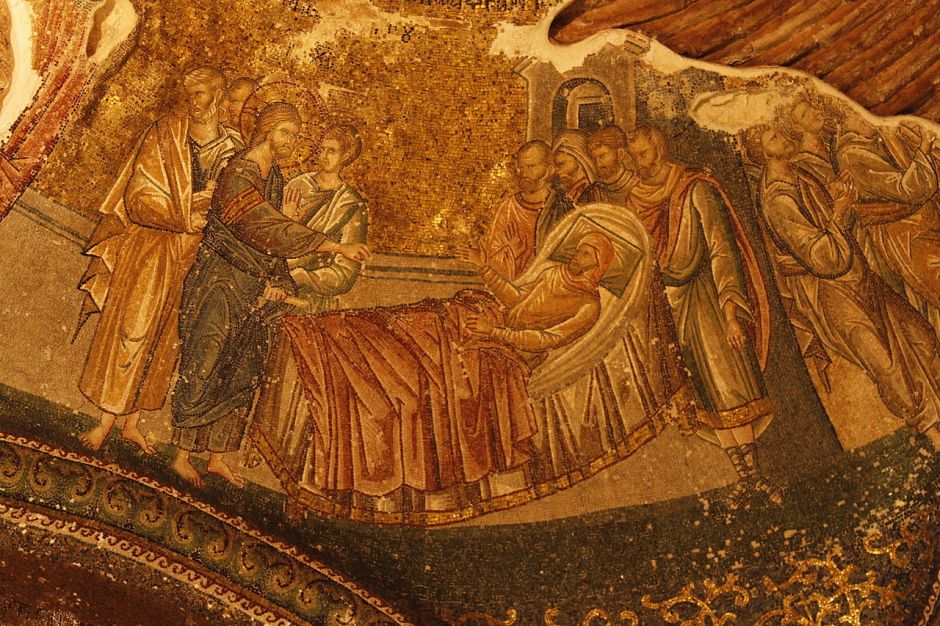
At this point we come to today’s Gospel in which Jesus forgives a paralytic of his sins and then heals him, “Rise, pick up your stretcher, and go home.” The crowds are in awe, but the scribes accuse him of blaspheming. It is becoming more and more clear that we must make a choice regarding Jesus.
Tomorrow’s Gospel will be the calling of a tax collector, a sinner, Matthew. Tax collectors worked for the foreigners who ruled over the Jews, so this made them traitors. They weren’t paid a wage by the Romans, but were expected to take extra money and keep some for themselves. They were hated and considered sinners. And yet this one sinner “got up and followed” Jesus immediately when he said to him, “Follow me.” We then see Jesus entering into the community of tax collectors and sinners, eating with them, because “the sick” “need a physician” (Mt 9:9-13).
The story of the paralytic should wake us up to the decision we each need to make. Where is it that you need forgiveness? What has paralyzed you? Are your limbs lifeless because you have used them in your own pursuits rather than the will of God? Sin is more than just a failing. In little ways, or in grave, sin distances us from God. Sin makes us spiritually weak. We are so important to God, so dear and precious to the Father, that he sent his Son to heal us. Jesus came to call us out of all that holds us back from giving ourselves completely and in trust to God. The Son of God enters into communion with us, the community of sinners, and he says, “Stand up, pick up your mat, and be healed.” And then he says, “Follow me.”
Horizons of the Heart: Horizons of the Heart is a weekly retreat-in-life inspired by the Spiritual Exercises of St Ignatius from my thirty-day Ignatian retreat in 2022.See an index for the whole series.
The grace we are asking of God: To have the courage to trust in God entirely for this life and the next, to become a child and to receive his blessing.
In the opening days of any retreat, I feel that God is shaking me loose from all that binds me to the earth. I see this spiritual dynamic in the story of the rich young man who approached Jesus, a potential disciple. “Good master,” he asked, “what must I do to inherit eternal life?”
Probably we all have the same question. “How do I get to heaven?” “How do I know I will be saved?” “What do I need to do in my life to be a saint?” These are some of the questions we bring with us to a retreat experience.
Before exploring Jesus’ response to the young man, however, I’d like to contemplate with you the passage that appears in the Gospel of Mark immediately prior to the account of the rich young man. In Mark 10, beginning with verse 13, we read the account of Jesus and the children.
People were bringing little children to him in order that he might touch them; and the disciples spoke sternly to them. But when Jesus saw this, he was indignant and said to them, ‘Let the little children come to me; do not stop them; for it is to such as these that the kingdom of God belongs. Truly I tell you, whoever does not receive the kingdom of God as a little child will never enter it.’ And he took them up in his arms, laid his hands on them, and blessed them. (NRSV)
I’ve read this passage a thousand times, as no doubt have you. It was only when I read these verses in the Passion Translation that I began to wonder what it was to be a child. The juxtaposition of this story of Jesus and the children with Jesus and the story of Jesus and the rich young man helped me to begin to reflect more deeply.
What does it mean to become a child?
In the Passion Translation, verse 15 reads like this: “Listen to the truth I speak: Whoever does not open their arms to receive God’s kingdom like a teachable child will never enter it.”
Listen to the truth I speak. Jesus is teaching us something important. Truly I tell you. Listen up. Amidst all of the voices attempting to teach us with their opinions and agendas and emotional reactions, Jesus says quietly, “Listen to the truth that I speak.”
Receive. Children are not in the position to earn their own keep. They receive everything from those who care for them. They even received their very life (as all of us have). In the innocence, fragility, and dependence of a child, our own absolute creaturely dependence, connection, and relationship to God for our very existence become apparent to us. We are all children before God, for we are all created by his very hands.
What are we receiving as a child? God’s Kingdom. The kingdom of God is a gift that God desires to give us, is ready to give us.
What does receiving this gift depend on? The Passion Translation interestingly adds the word teachable as an attribute of a child. A child needs to learn everything through experience and through the teaching of others who are older and wiser than they. They have no real knowledge and experience of their own. In fact their every reaction is based on their sensitivity and emotions, rather than on principle.
This is where I began to get a little uncomfortable. Teachable.
Pause. What makes me teachable? First, I would need to know I need to learn something that I can’t figure out myself, receive something I can’t give myself. Second, I would need to want to learn or receive this gift of wisdom. Third, I would need to place myself in the position of a learner, in humble submission of mind, will, sensibilities, affections, desires, and imagination. Fourth, I would need to know how to listen and have the patience to grow in knowledge and experience through the work of a teacher who would be the one to determine the times and the seasons for my growth. Fifth, I would need to practice and persevere in this practice. Finally, I would need to remain ever grateful to my teacher, not appropriating to myself what I had received or falsifying it to flatter my own pride and self-love.
Jesus lays his hand on each child and blessed each one. GIFT.
The young-man-in-a-hurry
The story of the rich young man is a perfect foil to the narrative of Jesus blessing the children.
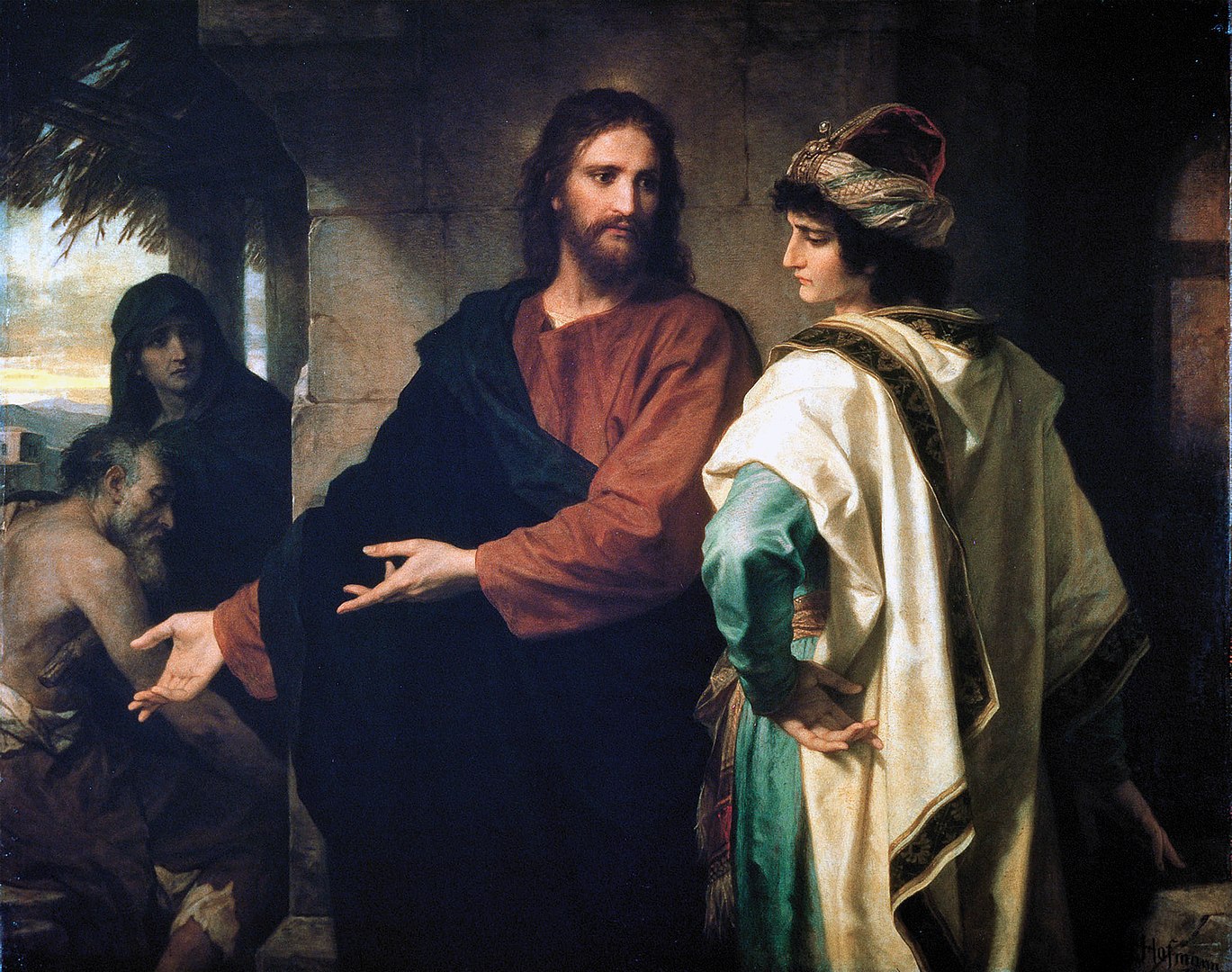
As he was setting out on a journey, a man ran up and knelt before him, and asked him, “Good Teacher, what must I do to inherit eternal life?” Jesus said to him, “Why do you call me good? No one is good but God alone. You know the commandments: ‘You shall not murder; You shall not commit adultery; You shall not steal; You shall not bear false witness; You shall not defraud; Honor your father and mother.’” He said to him, “Teacher, I have kept all these since my youth.” Jesus, looking at him, loved him and said, “You lack one thing; go, sell what you own, and give the money to the poor, and you will have treasure in heaven; then come, follow me.” When he heard this, he was shocked and went away grieving, for he had many possessions. (Mk 10:17-23 NRSV)
After the almost pastoral vision of Jesus with the children, this man punctuates the Scriptures with his haste. As Jesus begins a journey, he runs up, casts himself on his knees before Jesus, and blurts out, “Good Teacher, what must I do to inherit eternal life.” I am made almost uncomfortable by the urgency with which the young man made a display of himself.
Close your eyes and picture this scene…. What does it make you feel? Uneasy? Does its very unpredictability create uncertainty in you? Contrast this with the sense you have from being with the children who are at play.
This young-man-in-a-hurry calls Jesus a Teacher. “Good Teacher, what must I do to inherit eternal life?”
Having contemplated Jesus’ praise of the teachable child, this address of Jesus as a Teacher is the key that can help us unlock the complexities in this eager youth’s soul.
Is he as “teachable” as a child? He certainly realizes there is something he doesn’t know that he is hoping Jesus can tell him so he can achieve his goal. “What must I do to inherit eternal life.”
What one thing. The young man is looking for just one thing that will open up the whole treasure house to him. We might think also of Mary at Jesus’ feet: “Only one thing is necessary….”
Am I required to do. There must be one more thing that he hasn’t done because he realizes he hasn’t captured his prize! I. Required. To do. These are not the words of Gift. They are not the attitudes and aptitudes of a child. Of a teachable child. Of someone who realizes his complete dependence on God for everything.
These are not the words of blessing, as Jesus blessed the children before he left. He did not require anything of them to receive this blessing. Holiness was not something for them to do, but to receive.
The young man, although he was asking Jesus for the key to eternal life, was assuming it was something he had to do through his own power. Eternal life, he assumed, would depend on how well he did it.
To gain. Eternal life, for this young man, was another thing to gain, to conquer, to achieve, to accumulate perhaps for his own benefit.
In a footnote for verse 22 in the Passion Translation, the Greek word that identifies this man as very wealthy implies that he was a landowner.
Having land or property, a house or mansion, gives one a sense of stability, security and status. Being a “landowner,” particularly a very wealthy one, would give a person significant independence and autonomy, prestige and power in the community. Often what a rich person builds on land they own or how they develop their property becomes a monument to themselves and makes a public statement since it becomes clear to others that they can afford this extravagance.
A child has none of this security. A child plays.
Jesus says to this very rich landowner with love, “Sell it all. Give it away to those who can’t thank you. Like a child, toss it all to the wind. Then come back to me and become my follower. Be someone who needs to receive as I receive everything from the Father, to be taught as I receive everything I say from my Father, who has given up status as I gave up mine when I was born on this earth, is homeless as I who have nowhere to lay my head. Become a child as I am a Child, Son of my Father.”
To become a child is to become like Jesus
Jesus shows us himself how to become a child. How to receive. How to let go and give up and sell all and lose everything for the sake of the Kingdom. Paul paints a picture of Jesus as our model for becoming a child in his letter to the Philippians:
“Do nothing from selfish ambition or conceit, but in humility regard others as better than yourselves. Let each of you look not to your own interests, but to the interests of others. Let the same mind be in you that was in Christ Jesus,
who, though he was in the form of God, did not regard equality with God as something to be exploited, but emptied himself, taking the form of a slave, being born in human likeness. And being found in human form, he humbled himself and became obedient to the point of death— even death on a cross.
Therefore God also highly exalted him and gave him the name that is above every name, so that at the name of Jesus every knee should bend, in heaven and on earth and under the earth, and every tongue should confess that Jesus Christ is Lord, to the glory of God the Father” (Phil. 2:3-11 NRSV).
Indeed, unless we become as children, Jesus has told us, unless we become like him in every way, we will not enter into eternal life. Jesus was giving the rich young man the key for which he was looking.
Pause. Is there a place in your life in which Jesus is asking you if you will say YES to having no stability, no security, no status, no independence, no ability to create self-made monuments…. A place where he is calling you to become a child. To trust. To play. To depend. No doubt these opportunities for becoming a child may seem small, somewhat trivial. Yet, at the same time, we may feel them deeply. This is what makes it so hard to say this YES even if we know that God loves us and that we are secure in handing ourselves over to his care like a child. When God comes close to us, he lets us see more clearly that everything else is paltry beside his glory.
Saint Mary of Jesus Crucified was born in Galilee in 1846. Little Mariam felt the attraction of God’s love for her, particularly when she spent time in the beauty of the nature that was all around her. One day she heard within her spirit God’s promise to her: “Behold everything fades away, but if you want to give me your heart, I shall remain with you always.”
Behold, everything fades away. All that we build for ourselves fades away. All that we accumulate. All that we achieve. All. Everything. Only God remains. Only God remains with us always.
Let us allow Saint Elizabeth of the Trinity to guide us in prayer in this journey to becoming more and more a teachable child.
Saint Elizabeth of the Trinity, Discalced Carmelite in Dijon France canonized October 16, 2016, shares a spirituality that is remarkably similar to her contemporary Saint Thérèse of Lisieux. She is most known for her Prayer to the Trinity. One of the paragraphs of this prayer can become the source of deeper contemplation this week:
O Eternal Word, Word of my God, I want to spend my life in listening to You, to become whollyteachable that I may learn all from You. Then, through all nights, all voids, all helplessness, I want to gaze on You always and remain in Your great light. O my beloved Star, so fascinate me that I may not withdraw from Your radiance.
Come before Jesus as a child, asking for his blessing, the one thing you are required to do. Ask for the gift of YES in those areas of your life in which you find it most difficult to turn everything over to him. Instead of seeking that last one key to your holiness, tell Jesus instead, “Jesus, you take care of it. I trust you. Have your way with my life even in this. I love you.”
Photo Credit: Photo by Sachin C Nair: https://www.pexels.com/photo/waterfalls-during-sunset-954929/; Jesus Blessed the Children: Howe, Henry, 1816-1893, publisher; Howe, Henry, 1816-1893, copyright claimant; Middleton, Elijah C., publisher; Middleton, Elijah C., copyright claimant, Public domain, via Wikimedia Commons; Jesus and the Rich Young Man: Heinrich Hofmann, Public domain, via Wikimedia Commons; Jesus is Worth Everything: Photo by Emma Shappley on Unsplash
“What then will this child be?” How many parents, marveling at the mystery of their newborn nestled in their arms have asked the same question. “What will this child be?”
We are certain that God has a plan for great people who populate the pages of Scripture and have an important part to play in the story of salvation. We can think of Moses, and Jeremiah, and Peter, and Mary, and Paul. We can imagine the divine plan prepared for them which unfolded day by day in their life. When we read the narrative of their response to God who called them for a specific purpose, we might be a little bit in awe of how God used them and how clearly he loved them. Maybe even a bit jealous. “That could never be me.”
Today is the feast of one of these “greats” of salvation history: the birth of John the Baptist. The mystery and the miracles that surrounded his birth indicate how important he was as a hinge between the Old Testament prophets and the arrival of the Messiah. The Baptist’s austere life and courageous preaching when he became an adult confirm the divine predilection God had for this child.
He truly could say with the words of the responsorial psalm today:
Truly you have formed my inmost being; you knit me in my mother’s womb. I give you thanks that I am fearfully, wonderfully made; wonderful are your works. My soul also you knew full well; nor was my frame unknown to you When I was made in secret, when I was fashioned in the depths of the earth.
These words of the psalm came spontaneously to my mind one difficult yet amazing day 40 years ago. I remember it so clearly. I was sitting on the side of my bed in the hospital after having suffered a stroke. On that day, I was finally able to stand up with the help of two of the nurses. How marvelous! How amazing is the human body! We are truly “fearfully, wonderfully made,” and how “wonderful are your works,” O God. Look, today I can stand!
Whether we are the greatest prophet who ever lived as was John the Baptist, or someone sitting on the side of a hospital bed struggling to stand up for the first time in a week, God has a plan for our life.
Remember, you are important to God and play a vital role in the story of salvation.
In your mother’s womb God loved you more than your own parents. He created you as a unique expression of his image and his glory.
Surely, the hand of the Lord was with you, and he continues to be with you each day of your life. As the courageous and difficult life of St. John the Baptist reveals, in both happy times and in paths filled with shadows, on mountain tops and in the deepest of valleys, you are fulfilling the very special purpose for which you alone were created. It is only as we wander through these ups and downs of life, faithful to allowing God to have his way with us, that we discover truly who we were made to be.
The grace we are asking of God: To have confidence in the way God accepts us even in our sin, to believe in his path for us that weaves its way through forgiveness and mercy, and to have the courage to turn to the One who alone can give us all we need instead of trying to fix ourselves.
Horizons of the Heart: Horizons of the Heart is a weekly retreat-in-life inspired by the Spiritual Exercises of St Ignatius from my thirty-day Ignatian retreat in 2022.See an index for the whole series.
There is a mysterious passage in the book of Jeremiah:
“My people have committed two sins: They have forsaken me, the spring of living water, and have dug their own cisterns, broken cisterns that cannot hold water” (2:13).
Jesus, the spring of Living Water, watches us as we so often dig our own cisterns, our own wells, from which we hope to draw water that will satisfy our thirst, make us happy, give us life, at least a tolerable life on this earth. In the Gospel of John, we meet the woman in Samaria who was just such a woman. To tell you the truth, so am I.
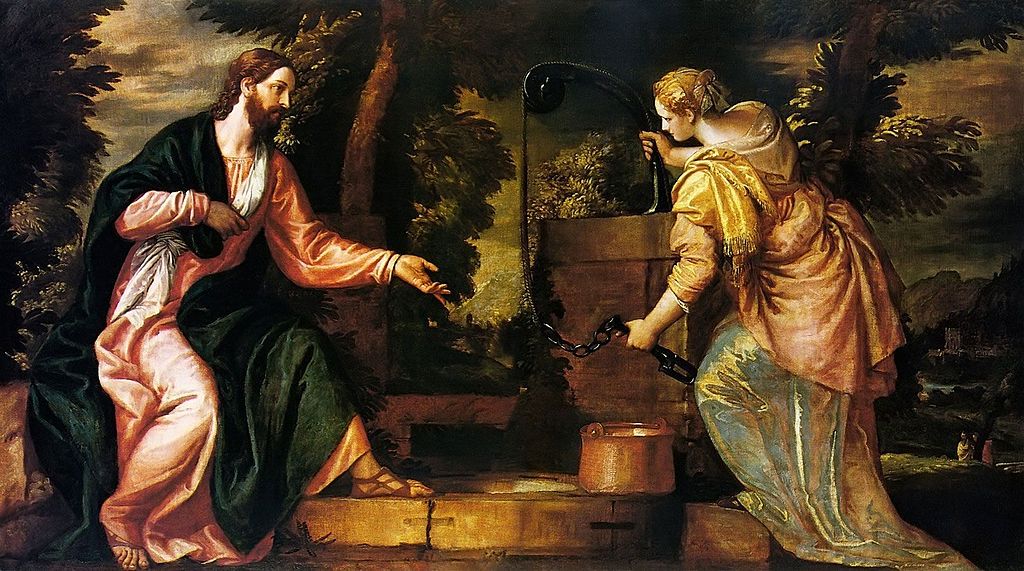
Paolo Veronese (1528–1588) via wikimedia
The Samaritan woman is the woman of the tryst with Jesus. A tryst is defined as “a private romantic rendezvous between lovers.” The story of Jesus’ meeting with this woman is just such a story of love, of romance in the highest degree. Her story is the story of the romance of the heart of God: “Yes, she has forsaken me, yes, she has dug her own cisterns, yes, her attempt at managing things to create happiness out of her broken cistern has failed, yes she is unhappy, and a thousand times YES, I the Living Water am thirsting for her love.”
Before her rendezvous with Jesus how many things had this woman tried to get her life right, she the woman of five husbands, of failed love, of broken marriages? That is the way of us humans. We think we have to find our own water, dig our own wells, and provide for all our own needs.
Then in a flash. In an epiphany. When she saw herself through the eyes of God. When she knew herself suddenly to be truly valued and eternally infinitely unconditionally loved by this man sitting on the side of the well, this man who knew her whole story and loved her anyway.
I prayed Psalm 103 as the Samaritan woman may have prayed it after this life-changing tryst with the Lord.
From the depths of my being I will praise him. I will never ever forget his acts of kindness to me. He forgave me, cured me, redeemed me from the abyss. He crowned me with his faithful love and contented me with good things. He made me young again!
Jesus was eager to forgive me. He sought me out. He was waiting for me in my shame.
The Lord is tenderness, pity, rich in faithful love and slow to anger. He didn’t treat me as my sins deserve nor repay me as befitted my offense. He is a faithful lover. He treated me with the tenderness of a good father for his beloved child. He threw my faults away so I could see them no more. He remembered I was made of dust.
Though I bloom today and as soon as the wind blows I am gone, Jesus’ faithful love is from eternity and for ever! (cf. Psalm 103)
Juan Pablo Arias via Cathopic
Jesus, the one who sought out this woman whose heart was broken by forsaken lovers, this Jesus who sought her out, seeks out you and me.
The Samaritan woman no doubt had tried to get her life straightened out, at least enough to make a respectable presentation in the village. Wouldn’t you? I would. I do!
Self-improvement can be truly helpful, but it is love that heals. It is a Lover who knows all we can become if we but take some time for this romantic rendezvous with him. It is not just his teaching, his words. It is the look of the Lover, the look of Jesus, that unsettles us.
The grace is in the present moment of tryst with Jesus. Jesus sees us and wants us to return his gaze with love. Even with all the fumbling in that long conversation in the fourth chapter of John, the Samaritan woman teaches us the attitude to have before Jesus who is asking also for a drink:
Listen to him Enter into conversation with him Allow yourself to be moved by his presence.
Jesus is sitting at the well of your daily life. He says to you also, “I am thirsty. Give me a drink.” Where is he? you might be thinking. I assure you, just as Jesus planned that meeting with the suffering woman of Samaria, probably for days ahead of that meeting organizing things to be there for her at just the right time when she would arrive, Jesus is doing the same for you.
So expect him.
Tell Jesus you are expecting him and ask him to clearly show himself to you this day.
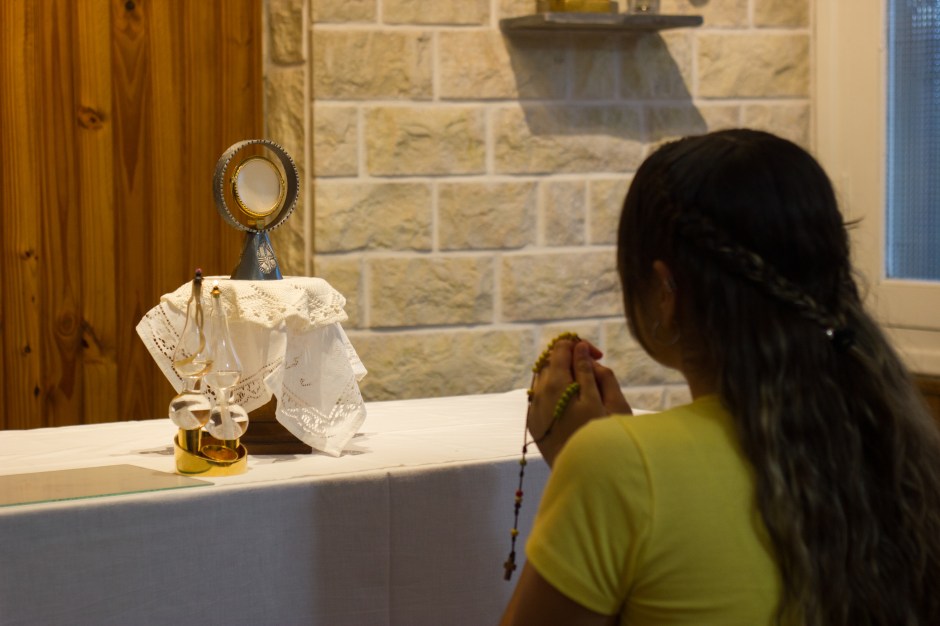
Pay attention to the ways you are internally moved unexpectedly. Perhaps it is the conversation with a friend, something you hear on the radio or see around you, a passage you read in Scripture, or the sense of how you feel touched with God’s presence in Eucharistic adoration…
Stay with these moments and allow yourself to be unsettled by Jesus’ presence, by his gaze as it rests on you.
Allow Jesus to touch you deeply, to draw you out of yourself and away from the poison of your past and the delusion of your broken wells. Jesus knows your story so be honest with him about it. Talk to him about all you have experienced. Jesus loves you so much. He desires you to know how much his Father loves you.
Believe he has a path for you still.
Most importantly, receive the moment of revelation. Epiphany. Not a message of how much better you are or will be. No. The revelation he gave to the Samaritan woman is what your heart longs for: “The one you are looking for? I am he.” The one you are seeking for. The one who will satisfy you completely. The one who will fill your heart in every way. This one whom you are looking for. I. Am. He.”
Underneath all the things you long for, all the ways you wish were different, underneath all your plans for the future, there is a greater desire and more urgent longing that will truly satisfy you.
“I am he. I am the one you are looking for. I am the one who saves, redeems, forgives, and makes new. I am he.”
Francisco Xavier via Cathopic
Look into his eyes as did the Samaritan woman. To those who met Jesus, his eyes conveyed immediately that he could be trusted. You too can trust Jesus with yourself, your past, your present, your future. You can trust him because he loves you. He plans these trysts with you each day so that you will know just how much he loves you.
Pray Psalm 103 as an act of faith, a prayer for gratitude.
The Gospel of John tells us little about the Samaritan woman after this tryst with Jesus except that she rushed back to her village and told her neighbors to come with her to meet this man who told her everything she had ever done:
Then, leaving her water jar, the woman went back to the town and said to the people, “Come, see a man who told me everything I ever did. Could this be the Messiah?” They came out of the town and made their way toward him.
…Many of the Samaritans from that town believed in him because of the woman’s testimony, “He told me everything I ever did.” So when the Samaritans came to him, they urged him to stay with them, and he stayed two days. And because of his words many more became believers.
They said to the woman, “We no longer believe just because of what you said; now we have heard for ourselves, and we know that this man really is the Savior of the world.”
This woman of Samaria evangelized the people of her village on the basis of her great joy in what he had done for her. After Jesus ascended into heaven, tradition holds that she evangelized in Carthage and Rome and died as a martyr in the first persecution under Nero. Tradition also gives us her name: Photina which means Enlightened. In the Preface for the Third Sunday of Lent, the Sunday on which the Gospel of the Samaritan woman is read, the Church refers to light as fire, a fire that burned, a fire Jesus kindled in her which was so great she was propelled to share it:
“For when he asked the Samaritan woman for water to drink, he had already created the gift of faith within her and so ardently did he thirst for her faith, that he kindled in her the fire of divine love.”
ahgomaaz via Pixabay
The Samaritan woman found herself that day on the threshold between her past and her future, both of which Jesus knew all about. Both of which Jesus cared about. All of which Jesus provided for.
Each meeting, each tryst we have with Jesus is a moment of grace. These trysts are thresholds or frontiers that divide two different stages of life, rhythms, atmospheres, dreams for who we are and could be.
There are some important questions we can ask ourselves here on this threshold with Jesus. I take these from John O’Donohue, Irish poet and author, in his book To Bless the Space Between Us. “At any time you can ask yourself: At which threshold am I now standing? At this time in my life, what am I leaving? Where am I about to enter? What is preventing me from crossing my next threshold? What gift would enable me to do it?”
To what new frontier in your life does Jesus bring you? Wonderful questions we can reflect on. Where am I standing today between the past and the future? What am I leaving behind? What is Jesus calling me to leave behind? What is he giving me the grace to leave behind? How is he freeing me? What frontier, what new horizon am I about to enter? Where is he calling me to? What gift is he giving me?
As I stand on this threshold between the past and the future, I might feel resistance. I might feel discouragement. I might feel weakness. I might feel “I don’t want to!”
What is preventing me from crossing this next threshold of my life? As we see in this Gospel of the Samaritan woman, when Jesus calls us to a threshold, he calls us to something wonderful. As humans we see the tragedy, the difficulty, of what we must leave behind. Jesus sees what he wants to give us, where he is calling us. It is always beautiful.
We can ask Jesus, “What gift do I need? What gift do you want to give me that would enable me to cross this threshold this day?” This is a great question to reflect on in these next few days. To what new threshold is God bringing you to at this stage of your life?
O’Donohue continues: “It is wise in your own life to be able to recognize and acknowledge the key thresholds: to take your time; to feel all the varieties of presence that accrue there; to listen inward with complete attention until you hear the inner voice calling you forward. The time has come to cross.”
The time has come to cross your next threshold. Jesus is there. He is waiting for you there. And he is waiting for you in the future he has planned for your life.