
The amazing promise of new beginnings (Horizons of the Heart 2)

The grace we are asking of God: A deep confidence and a consistent trust in God’s care for us and his nearness to us in every moment, even in the events of our life that are our undoing.

Horizons of the Heart: Horizons of the Heart is a weekly retreat-in-life inspired by the Spiritual Exercises of St Ignatius, Donec Formetus by Blessed James Alberione, and my own notes from my thirty-day Ignatian retreat in 2022. See an index for the whole series.

Beginnings are more important than endings. In fact, beginnings are already woven into every ending. The ending of the life the caterpillar has always known is already integrated into the process of the butterfly’s new beginning. The seeming ending of the Master’s life on Calvary was mysteriously taken up, and gently, in the Father’s hands, it became the stage for the mystery of resurrection beginnings that would be lived again and again and again in Jesus’ disciples’ lives.

“Why would you look for the living One in a tomb?” said the angels in white, angels of the resurrection whose radiance washed away the black sorrow of the ending of the Lord’s life on Calvary (Luke 24:5 TPT). The women who had come to seek the Lord buried in the tomb, locked behind a giant stone, dead, whom they feared they would see no more, these women faced the darkness of the sepulcher now lit with almost blinding brilliance. “He is not here. He is risen.”

“There’s no reason to be afraid” (Mt. 28:5). Pause a moment and think of an ending in your life that was particularly sudden, seemingly absolute. Or an ending you are living through now: termination, loss, failure. Any ending. One as great as the breaking of a relationship or losing a pet, or moving, or retiring. Or one as beautiful as the wedding of a child or the turning of a new leaf in life. Any ending.

Don’t endings bring on feelings of fear?

“There’s no reason to be afraid,” said the angel to the women. I’m not so sure that the command to not be afraid actually shifted their fear into trust. Nevertheless, it is helpful to remember that amid all our dread, struggle, the anticipation of an uncertain future, the uncertainty about what is happening, there is something permanent that is the reason why we needn’t fear…needn’t fear deep down, needn’t believe the absolute worst, needn’t believe that the ending is, well, an absolute and final and irrevocable end.

“I know you’re here looking for Jesus, who was crucified. He isn’t here—he has risen victoriously, just as he said! Come inside the tomb and see the place where our Lord was lying” (Matthew 28:5-6 TPT).

Proof! That’s what we need to really believe the end is not the final ending. Come inside and see where the Lord was lying and that he is not here anymore.

Come inside. We interiorly flee our endings. We can’t take the shame. The sorrow. The worry about the future. It is all too much. The apostles fled and they didn’t turn back. They forgot that the Master at whose side they had lived had words of eternal life. They couldn’t remember that just three days earlier he had said it was good that he goes and that he would come back. It escaped their memories entirely that he had prophesied that he would die on the cross and three days after rise again. The women, on the other hand, sorrowing and loving and deeply yearning for the touch of their Lord’s presence and the sight of his face once more did return. They returned to the tomb. To the place of what they believed to be the utter ending.

We need to return to the places of our endings if we are to discover the brilliant process and amazing promise of new beginning.

There is, however, the message of a different type of beginning that the women are entrusted with. They are given the mission to run to their devastated and hiding brethren and tell them this message: “I am going ahead of you in Galilee and you will see me there” (Mt 28:7). Galilee… The place where it all began. By the sea of Galilee, he had called Peter and Andrew, James and John to leave their boats and follow him. The sea of Galilee had been his first pulpit, and had seen his first conversion. (“Leave me Lord,” Peter had said, “I am a sinful man.”) Galilee was the place of the beginning of their relationship with him. A relationship now grown old and sagging from the sorrow of betrayal and the worn thin by the confusion of the last days. The ending.

Everything of those three years and the colossal failure of the arrest and death of Jesus was still there…
for them
for him.

…return to Galilee
to the beginning
to the call
to the promise

…return to the beginning to learn afresh to be LOVED and to LOVE.

I distinctly heard his voice in my heart on the first day of my retreat, “Come back with me, Kathryn, to the beginning.

To your call
To the promises I made to you at your baptism, at your profession

I am faithful to promises through endings and into new beginnings. You can’t see the new beginning as you bend and peer into what appears to be the tomb of your life. Just as the women at the tomb had to believe the angels of promise who proclaimed that the world had been made new by something that had never happened before, that someone had risen from the dead, you too must believe without seeing that I have a new beginning for you. Come back with me to the early days, the first love, the first profession of trust in me as I called you, the first experiences of my love for you, Kathryn. That love still stands, always stands, will forever stand unshaken.”

He is not there. You may not know where he is right now. You may not know what he has in store for your life. You may not know if you believe in new beginnings or even want any new beginning that you can’t see and be certain of and in control of so that you won’t be hurt anew. Because let’s be real….endings hurt.

The paradigm of Jesus, however, holds true in us. Whatever it is that robs us of what we had is not greater than the Father who has us in his hands. And our Father is the God of life who brings victory out of failure and life out of death. In our very endings, or what to us seems to be an ending, is already the beginning of the new life. All is shrouded in mystery except for the very clear promise: “I will meet you in Galilee.”

We will not see Jesus where we expect to find him, if we are certain that our relationship with God stands in shambles because of the endings that have left our lives so torn… If we are certain that Jesus looks at our lives the way we look at them…. Lives of endings and tombs and hopelessly no beginnings.

What is your ending?

Where do you see the beginning of something possibly, tentatively new living already within you?

Where is your Galilee? Where did you experience the Lord’s love for you? His call? His promise? His trust? Where did you see his eyes looking on you and hear his voice calling you his beloved? Return to that place. Return with him. Patiently. The Lord is unravelling the endings of your life and with the very colors and threads of the past will weave the new that will be your unending joy.

He promises that to you. So weep if you must. Tears heal and are so good for us to shed. But then bend down to look into the tomb, hear the promise, and follow Jesus back to the beginning where you will meet the Weaver of the indescribable beauty of all that is new.

The Amazing Promise of New Beginnings (Horizons of the Heart 2)

https://www.podbean.com/media/share/pb-cr4yq-123da78

Horizons of the Heart: Horizons of the Heart is a weekly retreat-in-life inspired by the Spiritual Exercises of St Ignatius, Donec Formetus by Blessed James Alberione, and my own notes from my thirty-day Ignatian retreat in 2022.

Beginnings are more important than endings. In fact, beginnings are already woven into every ending. The ending of the life the caterpillar has always known is already integrated into the process of the butterfly’s new beginning. The seeming ending of the Master’s life on Calvary was mysteriously taken up, and gently, in the Father’s hands, it became the stage for the mystery of resurrection beginnings that would be lived again and again and again in Jesus’ disciples’ lives.

“Why would you look for the living One in a tomb?” said the angels in white, angels of the resurrection whose radiance washed away the black sorrow of the ending of the Lord’s life on Calvary (Luke 24:5 TPT). The women who had come to seek the Lord buried in the tomb, locked behind a giant stone, dead, whom they feared they would see no more, these women faced the darkness of the sepulcher now lit with almost blinding brilliance. “He is not here. He is risen.”

“There’s no reason to be afraid” (Mt. 28:5). Pause a moment and think of an ending in your life that was particularly sudden, seemingly absolute. Or an ending you are living through now: termination, loss, failure. Any ending. One as great as the breaking of a relationship or losing a pet, or moving, or retiring. Or one as beautiful as the wedding of a child or the turning of a new leaf in life. Any ending.

Don’t endings bring on feelings of fear?

“There’s no reason to be afraid,” said the angel to the women. I’m not so sure that the command to not be afraid actually shifted their fear into trust. Nevertheless, it is helpful to remember that amid all our dread, struggle, the anticipation of an uncertain future, the uncertainty about what is happening, there is something permanent that is the reason why we needn’t fear…needn’t fear deep down, needn’t believe the absolute worst, needn’t believe that the ending is, well, an absolute and final and irrevocable end.

“I know you’re here looking for Jesus, who was crucified. He isn’t here—he has risen victoriously, just as he said! Come inside the tomb and see the place where our Lord was lying” (Matthew 28:5-6 TPT).

Say a Strong YES to Your Existence (Horizons of the Heart 1)

https://www.podbean.com/media/share/pb-zihmy-1237cc9

he most difficult thing about being a follower of Jesus Christ is not climbing mountains of virtue or even walking through the valleys of incomprehensible sorrow. No. As difficult as these things may be, there is one thing more difficult still. Strangely, it is something even a child can do. Something we were created to do. Yet we, caught in the complex web of adulthood, we, more sophisticated Christians so far from the simple childlike faith that pleases so much the heart of God, we find this one thing, I dare say, almost impossible. We can talk about it, pray about it, preach about it, encourage others to do it. However, to totally and completely do this ourselves is the most difficult. Though it is the deepest desire of the most Sacred Heart of Jesus to see this in us, we’d rather do everything else but this.

The first thing to which we are invited—nay rather pushed to risk everything we have in order to do—is this: to trust.

To trust that God knows my name. That God cares about me. That Jesus is speaking the truth when he says, “I love a single soul as much as I love all souls together.” To trust that God reveals himself to me daily, even in each moment, in every situation without exception. That I am loved as I am. This love that flows to us from God’s heart is the most basic and secure fact of my life….

The Ascension: a tremendous transition for us all

Beloved in Christ!

With what tenderness must have Jesus looked upon his apostles and disciples gathered on Mount Olivet…

Those final moments when they were alone, forty days after he rose from the dead…

With what joy did he look into each of their eyes that last time he saw them in his human body on this earth, flooding his heart with their face and the dearest memories of who they were, their characteristics, their love for him, their potential, their spiritual growth in the previous three years. Memories of conversations, struggles and victories, secrets of their heart…

These beloved friends who had been such a part of his life and mission and paschal mystery (yes, even in their failure, for their betrayals and fleeing from the cross have given us hope in our own fears and disloyalty)…

As he blessed them…  And withdrew from them… Here still in his blessing… Taken from their sight…

“When Jesus had said this, as they were watching, he was lifted up, and a cloud took him from their sight” (Acts 1:9).

The ascension was a moment of tremendous transition for Jesus, for Mary, for the Apostles and disciples, for Mary Magdalene and the women who had faithfully tended to their needs. Yes, clearly Jesus had gone and, as the angels said, would return one day. They had been told by Jesus to return to Jerusalem to await the coming of the Spirit. (And what a transition that was for these fearful and self-centered novices of the Lord who became the fearless messengers of the risen Jesus who had loved them, filling the world with his holy Name!)

But there is another hidden transition that affects you and I as well. Today. Right now. And how we need to hear this good news!

If Jesus is seated at the right hand of the Father, we are as well.

We dwell not only here on earth, looking forward to the happiness of heaven in an eternity beyond time, but now… right now… you and I… as members of the body of Christ who is our Head… as children of God… as inheritors of the kingdom of heaven… We dwell eternally in glory even now.

Ascension is not just about Jesus, his destiny, his glory…. It’s not like we peer into a heaven to see the Lamb seated on the Throne while we trudge through our lives on this earth alone… The ascension is about our present reality… here… now… today….

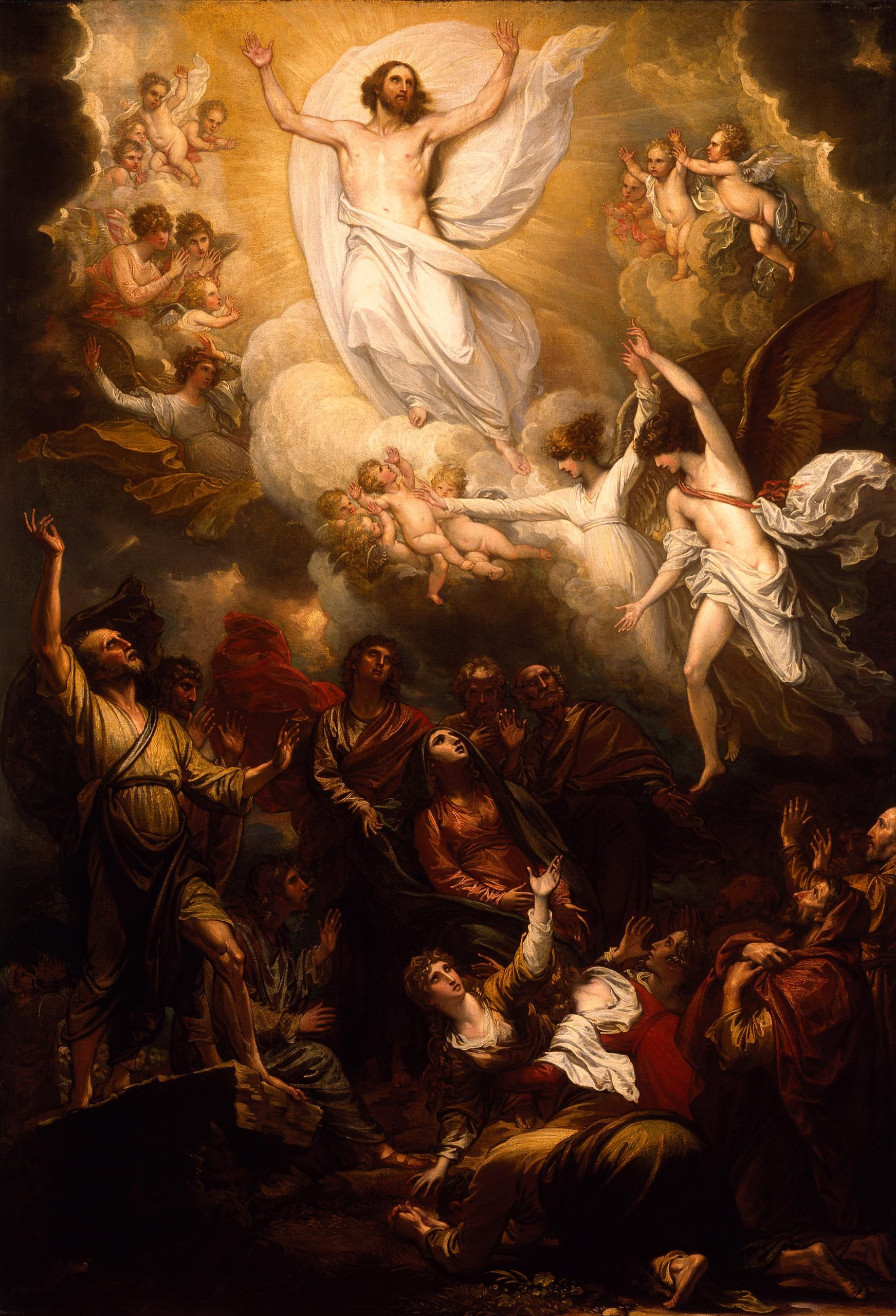
Benjamin West (1738-1820) The Ascension; Berger Collection

The truth is, “Jesus is not glorified in his own Person only. His Apostles had fed upon him [and so have we], had his body within them, by virtue of the Holy Eucharist…. Now upon his Ascension, His body in them is glorified instantaneously with the glorifying of his body at the right hand of God. Like an electric flash the glory of the Spirit shines out in the fires of Pentecost. The body of Christ, however veiled in our flesh, in our sinful persons, nevertheless cannot but have the glory of the Spirit of holy fire burning and resting upon it. We do not, I think, dwell as we ought to dwell upon the present glorification of our nature in our own persons, as members of the glorified body of Christ” (Benson, Richard Meux Further Letters, pages 268-269).

If Jesus is seated at the right hand of God, we are as well, as members of his body.

So, friends, look to the glory.

As Paul reminds us, “and all of us, with unveiled faces, seeing the glory of the Lord as though reflected in a mirror, are being transformed into the same image from one degree of glory to another; for this comes from the Lord, the Spirit” (2 Corinthians 3:18).

The Mass is a remembrance of Christ’s passion and pledge of future glory. In the Eucharistic liturgy the Ascension is celebrated again and again by us, in via, on the way. It is the holy banquet in which Christ is received. “Here heaven and earth meet, constellated around the ascended Christ who brings humanity into the very heart of the Godhead…. We need to rekindle the Catholic eschatological imagination: to realize anew Jesus Christ’s ascension as inaugurating the transfiguration of humanity and to envision boldly the cosmic scope and implications of that decisive and ongoing event” (Fr Robert Imbelli, Ongoing Ascension, May 10, 2018).

So, friends, may this year’s celebration of the Ascension and Pentecost be a moment of transition for you. We are invited in each Mass to lift up our hearts and we exclaim, “We have lifted them up to the Lord!” Raise your eyes from this earth. Upwards! Lift up your hearts! Dwell already where Christ is seated at the right hand of God. “Set your minds on things above, not on earthly things. For you died, and your life is now hidden with Christ in God. When Christ, who is your life, appears, then you also will appear with him in glory” (Colossians 3:2).

Image Credit: Benjamin West, Public domain, via Wikimedia Commons

Now heaven is present on the earth

The Solemnity of the Ascension can be eclipsed for most of us by the Resurrection, Good Friday, and Christmas. For me, the Ascension is a liturgical feast that draws me inward and upward. Pope Benedict stated in his homily for the Ascension in 2013: “Christ’s Ascension means that he no longer belongs to the world of corruption and death that conditions our life. It means that he belongs entirely to God. He, the Eternal Son, led our human existence into God’s presence, taking with him flesh and blood in a transfigured form.”

My human existence led into God’s presence as Jesus took with him flesh and blood in a transfigured form….

My human existence led into God’s presence…

My human existence…

St. Augustine said that although Jesus ascended to the Father alone, “we also ascend, because we are in him by grace.”

We are led by Christ into the new world of the resurrection, where all the members of his body are drawn upwards to the Father in heaven.

The apostles, in the reading today, were still wondering when Jesus was going to restore the kingdom to Israel. His answer to them is that they “would receive power” when the Holy Spirit was given to them:

“You will receive power when the Holy Spirit comes upon you,
and you will be my witnesses” (Acts 1:8).

In other words, Jesus directs their attention to this “new world of his resurrection.” After being brought to the life by the Spirit, they were to set their minds and hearts on things above where Christ is, not on earthly things (cf. Col 3:1-2).

In the early Church the Christians placed the Christ of the Ascension in the dome of their Churches to remind them that Christ ascended to his Father in heaven and that he was returning.

“Come, Lord Jesus!”

In a world of turmoil and crisis in which so many are suffering unjustly and needlessly, we can pray daily, “Thy Kingdom come! Thy will be done on earth, as it is in heaven.”

“Come, Lord Jesus!”

Perhaps we feel that we cannot effect the change the world so needs, but we can be that change. With our faith in Jesus Christ who is real, the strength of our belief in the kingdom present and among us in Christ who is close to us in our every need, we can experience how we are changed, how heaven is present on the earth and every sorrow, every closed door, every crisis is but a window to his drawing us with him to the Father, through the power of the Holy Spirit.

Photo Credit: Wolfgang Sauber, <a href="http://CC BY-SA 4.0, via Wikimedia Commons

You have been called with a purpose

Here at the end of the beautiful month of May and near the end if the Easter Season, the difficult and heart-wrenching days of the paschal triduum and the suffering and betrayal of the Lord are in the mists of my memory. This reading, however, brings me back with joy to those sorrowful days.

At the Last Supper we got a snapshot of the spiritual state of the apostles before the passion and death of their Master…before their dismal failure to stand with the One who was their Life. Peter boldly proclaimed at that Passover supper that he would die with Jesus, only a few hours later to declare he didn’t even know him. All of the Twelve wanted to be sure that they weren’t the one who would betray the Lord. “Is it I, Lord?” they each asked.

As Jesus walked into the mystery of his salvific death, alone, abandoned by his chosen Twelve, they each learned what they were capable of doing without their Lord and Master. Nothing. They each in some way abandoned Jesus. Before, they had fought with each other to see who would be the greatest, who was the most important, and Peter had tried to convince Jesus that the cross and death in Jerusalem was really not a good idea for the Messiah. In those dark and fear-filled days after Jesus died on the cross something happened to each of them.

The Apostles learned existentially that they were completely dependent on Jesus. They needed him for absolutely everything. Without him they were nothing, like branches cut from the vine. For each of them it was a crisis, a turning point, a transformation as they painfully emerged into who they were truly to be in the Kingdom: the foundation stones of the holy city Jerusalem in heaven.

“The wall of the city had twelve courses of stones as its foundation,
on which were inscribed the twelve names
of the twelve apostles of the Lamb” (Rev 21:14).

Moments of failure, of change, of challenge…we all have them. They are stages in our life in which we are still who-we-were and not quite yet who-we-will-be. And this liminal stage of confusion and darkness is what makes these times in our life so painful.

These transcendent crises come into my life on a regular basis. Sometimes the loss and confusion even last several years as I integrate who I was with who I am becoming, who I have been with who God has made me to be, my next step on the journey of my response to the call and grace of God. These are graced transitions.

If you are in one of these transformative crises in your life, take heart from the Twelve apostles. You may not be a stone in the foundation of the holy Jerusalem, and the Twelve certainly didn’t think they were during the 40 days after the resurrection when they remained fearfully hiding away. You have your own place in that holy city. You have been called with a purpose. Every event in your life has meaning. And no matter what you have come through or come from, God is working actively through every aspect of your daily life to keep moving you toward the fullness of what he has created you to be. Rejoice. Alleluia!

Image by Andrey Grachave on Pixabay