“To know the forest thaws” – Horizons of the Heart 9

Horizons of the Heart is a retreat-in-life inspired by the Spiritual Exercises of St Ignatius and my own notes from a thirty-day Ignatian retreat in 2022. See an index for the whole series.

The grace we are asking of God: a deep heartfelt knowledge of how God has chosen to fulfill his vision for all his creation through Jesus

In Chronicles of Transformation: A Spiritual Journey with C. S. Lewis I happily discovered the poem “On Knowing Him Here for a Little, A Poem in Seven Parts” by the poet Madeline Infantine. Each of the parts of her poem introduce one of the seven essays, one for each of the Narnian Chronicles. The first line of the poem immediately seized my attention. Like a magnet it brought into line my fragmented awareness:

“To know him here is to know the forest thaws.”

My inner world immediately stood at attention as these words pierced my heart. In a trice my imagination was activated, an intuitive response thawing my own inner world. Yes. When God meets me on the road of life, when he stares into my eyes to  catch my attention, my outer world crashes into silence…and my inner me thaws.

“To know him here is to know the forest thaws.”

To know.

To know him.

To know him here.

To know the forest.

To know the forest thaws.

Image by FrauLehrerin from Pixabay 

As I read these words for the first time the veil that covers the spiritual reality of the material world that I see with my senses was pulled aside for one very long expectant hush. And at that moment I knew. I touched what was beyond touch and saw what was beyond sight. For just a flash, this poem had touched my imagination and I knew with a felt experiential knowledge that could not be doubted.

St. Ignatius and Lewis both reverenced the imagination as the organ for deep meaning, the opening to the soul onto what is truly true. When the imagination is startled into silence, as mine was when I read this line of the poem, the eyes of the soul are lifted to the Really Real, as Lewis would say, to the land of the True North we are all seeking, our everlasting home.

In a similar way the Ignatian Exercises baptize our imagination by immersing it again and again into the Really Real. He guides the retreatant to contemplate the life of Jesus and the heart of the Father using their imagination, or more deeply, baptizing their imagination, blessing it, transforming it, redeeming it.

“To know him here is to know the forest thaws.”

The Annunciation, public domain via Wikipedia.

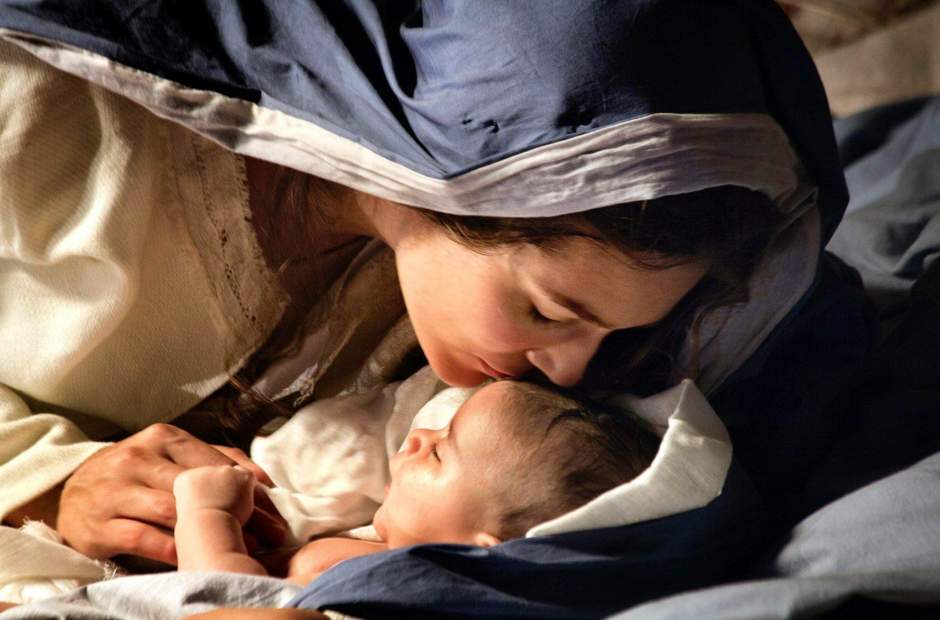
The angel quietly enters a humble house in Nazareth to announce that the world was about to thaw: she was to be the mother of the long-awaited Messiah, the Fire of the Father’s Love sent upon the earth to gather souls to salvation in the Kingdom.

Mary travelled to assist her elderly cousin Elizabeth. This elderly woman felt her child leap in her womb, as she proclaimed—the first human to do so—the Lord present on this earth, hidden now in the womb of the Virgin. She intimately knew that the frozen ground was beginning to thaw.

St Joseph, asleep when assured by an angel that he was needed as foster-father, protector, guide, provider. Bethlehem, a city packed with Israelites who were there for the census proclaimed by the Roman authorities… Even the forest thaws….

This “thaw” is God’s vision for the world.

There is a difference between reading and meditating, between pondering a mystery and entering into it, between being spiritually moved by religious truths and existentially changed by them.

In the second week of the Spiritual Exercises, Ignatius begins to lead the retreatant through a number of Gospel contemplations of the Incarnation. Beginning with the Annunciation, Ignatius invites us to enter into the Gospel stories surrounding the Incarnation of the Son of God and his birth and childhood. Why? Because “to know him here is to know the forest thaws.” Another line of Infantine’s first poem opens up the amazement of meditation: “where once was silence, only song.”

“God sent his Son, born of a woman, born in the fullness of time” (Gal 4:4). “God so loved the world that he sent his only Son that whoever believes in him might not perish but have life everlasting” (Jn 3:16). “For I am not ashamed of the gospel, for it is the power of God for salvation to everyone who believes” (Rom 1:16).

“For this is what the Lord has commanded us: ‘I have made you a light for the Gentiles, that you may bring salvation to the ends of the earth’” (Acts 13:47)

Image via Pixabay

During my Ignatian retreat, I found great healing as I prayed with the Gospel stories around the birth of Jesus. Very tenderly, Jesus touched me in ways that gave me new insight. He opened my heart to experiences of mercy I could never deserve. He wrapped up the broken places of my spirit and helped me stand again in his service.

These days I am praying through the Spiritual Exercises once more and find myself in a very different place. As I enter into these meditations my heart is being moved by the humility of God who lowered himself to come down on our level, to babble in our language, to walk our streets and take an interest in what concerns us. And why did he do this?

“To know him here is to know the forest thaws.”

To a world frozen over with idolatry, mediocrity, sin and death, Jesus came to bring a new warmth, a new hope, a new life.

As I pray now with these Gospel meditations I feel my heart thrill. I too want to give my life that others might live. I too want to lay down my life for the salvation of others. I too want to labor at the side of my humble Savior, to wash the feet of others that they might experience the radiant glory of his mercy.

Infantine invites us at the end of this first poem to come and to see, to witness, to behold, to ponder, to burst through frozen silence (where all has been subjugated to the powers of sin and death) into the praise that leads to adoration and contemplation. There, she says, we will discover life in the fire of his touch and the thaw of spring from the warmth of God’s breath.

In the next segments I will be offering Gospel meditations of Ignatius that make up the journey of the second week of the Exercises, that you might know anew that the forest thaws.

Featured image: by Ирина Кудрявцева from Pixabay 

How to Bear the Fruit of Christ in Your Life

https://www.podbean.com/media/share/pb-2ekuh-12d92b2

I certainly would never compare my life to that of St. Elizabeth of the Trinity. The memories I have of my childhood are of a little girl who always wanted to be a nun and who was—by my own standards at least—well-behaved. St. Elizabeth of the Trinity, however, had a will of steel and a temper that raged into violent outbursts even at the age of four. She was impossible to control. Family and friends recalled how she would lock herself in a room in a rage when she didn’t get what she wanted, kicking the door in her fury. Only when she had spent all her energies and was exhausted could her mother sit down with her and attempt to teach her gentleness and charity.

Though my childhood personality, at least as I remember it, was pretty calm, I have a distinct memory at twenty-one of raging against God. Just a month after suffering a stroke, and a year after my first profession of vows, I was silently before Jesus in the Eucharist one day in the chapel and from somewhere deep inside came words which surprised me, even shocked me. “I hate you,” I said to him. I had lost dreams and ambitions and physical abilities and, what seemed to me as a young adult, my future. And from somewhere within me, this anger and hatred at the one I felt was to blame came raging out. It took me by surprise, for, after all, I had been “well behaved” up to that point. Day after day, in a struggle that stretched to weeks and months and years, I submitted my heart to the transforming action of the Spirit at work in the Eucharist. Each day after receiving Jesus in Communion I prayed, “Help me, for I see now how poor I am, how in need I am of you, Jesus.”

In her diary, Elizabeth herself recorded how her first encounter with Jesus in the Eucharist was a moment of transformation. In fact, she said that it was decisive for the rest of her life. She began to take on from that moment the gentle self-control that would characterize her as an adult.

“In the depths of her soul, she heard his voice…. [The] Master took possession of her heart so completely that thenceforth her one desire was to give her life to Him” (The Spiritual Doctrine of Sister Elizabeth, pg 2)….

You, yes YOU, are God’s choice (Horizons of the Heart 8)

https://www.podbean.com/media/share/pb-pc9w7-12d40ac

The most important truth to be convinced of is not that God loves you. As broken, wounded, wandering as we each may be, as desperately yearning to know that we matter and that we are worth someone’s attention, contrary to what we might think, we do not need most to know how much God loves us.

I almost cringe as I write these words. For almost 40 years this has been both my mantra and my misery, my hope against hope, the alphabet of my feelings of spiritual failure. I had not realized that I was seeking for something that was only half-true, a shabby imitation of the fierce and passionate, surprisingly disconcerting way of divine love.

In the first week of the spiritual exercises, St Ignatius draws the retreatant into love through the very narrow and demanding path of coming to grips with what is not loving in one’s life. The retreatant comes to Jesus in prayer, again and again, begging for the grace to acknowledge the mystery of iniquity which spins a web of deceit around them. Repeatedly I came before Jesus begging for the grace to become deeply aware of my personal sin history and my hidden disorders. I begged Jesus and Mary for interior knowledge of my sins, an awareness of the disorder of my actions, that I might hate them and allow God to bring order once again to my life.

The way of truth is the only foundation for the confidence of love. But ah! how hard is this truth!

You, Yes YOU, Are God’s choice (Horizons of the Heart 8)

Horizons of the Heart is a retreat-in-life inspired by the Spiritual Exercises of St Ignatius and my own notes from a thirty-day Ignatian retreat in 2022. See an index for the whole series.

The grace we are asking of God: an ever-increasing awareness of God’s love for me

The most important truth to be convinced of is not that God loves you. As broken, wounded, wandering as we each may be, as desperately yearning to know that we matter and that we are worth someone’s attention, contrary to what we might think, we do not need most to know how much God loves us.

I almost cringe as I write these words. For almost 40 years this has been both my mantra and my misery, my hope against hope, the alphabet of my feelings of spiritual failure. I had not realized that I was seeking for something that was only half-true, a shabby imitation of the fierce and passionate, surprisingly disconcerting way of divine love.

In the first week of the spiritual exercises, St Ignatius draws the retreatant into love through the very narrow and demanding path of coming to grips with what is not loving in one’s life. The retreatant comes to Jesus in prayer, again and again, begging for the grace to acknowledge the mystery of iniquity which spins a web of deceit around them. Repeatedly I came before Jesus begging for the grace to become deeply aware of my personal sin history and my hidden disorders. I begged Jesus and Mary for interior knowledge of my sins, an awareness of the disorder of my actions, that I might hate them and allow God to bring order once again to my life.

The way of truth is the only foundation for the confidence of love. But ah! how hard is this truth!

Let me tell you a story that tries to clarify this intertwining of truth and love.

There once was a king who lived in an immense palace. He was well beloved by his people. He served them with an inward goodness. The king enjoyed great wealth, sumptuous banquets, gemstones and royal diadems, everything he could ever want.

The king was not yet married and it was every young woman’s dream who lived in the kingdom that she might one day be his bride.

One day the king left his palace and traveled to the smallest and poorest town of his kingdom. At the end of an almost impassible road at the furthermost edge of this village, he sought out a young woman who had survived a fire. She had burns on over 80% of her body that had left her terribly disfigured. Her face was almost unrecognizable, her hair only a short stubble.

The king entered her hovel and inquired after her needs, sending his own servants to provide for her. Then he proposed to her. “Will you marry me?” he asked her quietly.

The king took his bride-to-be back to his palace. He introduced her to the most important persons in the realm who surrounded him and took her to the palace ball.

This young woman must have felt humiliated as she was introduced to the king’s friends as his fiancé. “You could have anyone in your realm as your bride. Why did you pick me? I am not beautiful. I have nothing to offer you. I am disfigured and deformed, hideous to behold.” As she stood before the king’s staff and servants she would have realized her inadequacy certainly. As each subsequent day passed, however, she would have felt more and more confused and ashamed before the beauty, wealth, intelligence, culture, and gifts of his friends and courtiers.

Photo by Daniel Gutko on Unsplash

This sentiment exactly is part of what the First Week of the Exercises brings about in us, this deep and almost devastating awareness of the mystery of evil in which we are entangled. Before the purity of God, we realize how corrupt we are, sons and daughters of Adam and Eve whose refusal to obey the command of God has wrought such disastrous consequences on all of humanity. In his Ascent to Mount Carmel, Saint John of the Cross aptly describes what we their children experience: “So great is the harm that if we try to express how ugly and dirty is the imprint the appetites leave in the soul, we find nothing comparable to it—neither a place full of cobwebs and lizards near the unsightliness of a dead body nor the filthiest thing imaginable in this life […] The variety of filth caused in the soul is both inexplicable and unintelligible” (Book I, 9.3.).

Just as the new bride-to-be experienced at once her confusion and the love that had been showered upon her by the king, we too experience our humiliation at coming to grips with the web of evil woven around us and the absolute mercy of being forgiven, chosen, and beloved.

On the shore of the Lake of Tiberias, after Peter’s astounding denial of Jesus on the night of his betrayal, Jesus asked the sorrowing apostle just one question: Do you love me? Jesus didn’t jump in to assure Peter that no matter what he did God still loved him. In his threefold questioning, Jesus brought Peter back to his greatest moment of humiliation: his threefold denial. There. In that place. In the dark and sorrowing truth of weakness and sham, Peter had to once again assert his love for Jesus. I could imagine that Peter felt humiliated before the other apostles, particularly John who alone among them had walked with Jesus the way to Calvary and stood beneath the cross of the Master. In Peter’s threefold attestation of love in the very wound of his humiliation, he began to interiorly know in a way that could never be erased from his soul, that he himself was forgiven, chosen, and beloved.

This love of God poured anew into Peter’s humbled heart that now could become a vessel of grace.

What are the shame-filled memories of past betrayals that still haunt your soul? Do not flee from them. Return to them with Jesus, the king who has sought you out as his chosen beloved one. Ignatius would have us experience the shame we’d feel if we stood hand in hand with Jesus before all of humanity, we with all the mystery of iniquity burning within us, disfiguring our lives and distorting our hearts. Imagine yourself, hand in hand with Jesus the King, standing before all the angels and saints, before your guardian angel, before Mary, before the eternal Father. As they look at you they see, they understand the sorrowing and the inner confusion at being so loved by the King who holds your hand, yet being so unworthy, so very unworthy. They have been there.

Vanesa Guerrero, rpm

In this place of experiencing the effects of sin you have suffered and for which you are to some extent also responsible, marvel at God who in his mercy forgives you, preserves you, and…truly forever and ever loves you. Look into the eyes of your Savior and King. Let him show you that you are his choice. He would go to the ends of his kingdom to find you and to bring you to his mansion in heaven. Let him love you. Be confident in this love he has for you. You may find Psalm 139 a helpful guide for this prayer:

Lord, you know everything there is to know about me.
You perceive every movement of my heart and soul,
and you understand my every thought before it even enters my mind.
You are so intimately aware of me, Lord.
You read my heart like an open book
and you know all the words I’m about to speak
before I even start a sentence!
You know every step I will take before my journey even begins.
You’ve gone into my future to prepare the way,
and in kindness you follow behind me
to spare me from the harm of my past. 
You have laid your hand on me!
This is just too wonderful, deep, and incomprehensible!
Your understanding of me brings me wonder and strength.
Every single moment you are thinking of me!
How precious and wonderful to consider
that you cherish me constantly in your every thought!
O God, your desires toward me are more
than the grains of sand on every shore!
When I awake each morning, you’re still with me (Psalm 139: 1-6, 17-18).

Read prayerfully the story of the raising of Lazarus in the Gospel of John (11:38-44). Imagine yourself as Lazarus emerging from his tomb at the command of Jesus.

Giovanni di Paolo, Public domain, via Wikimedia Commons

What has been your tomb? What feels dead right now in your life? Where do you feel trapped, confined, sightless, stifled?

Right there in that place, imagine Jesus calling you forth from what has become your tomb, the place that smells like death, the place that seems like a final “no” to who you could have been.

As you walk out of the tomb toward the voice, into the light, hear the exclamations and twittering whispers of the crowd gathered in mourning.

What does the voice that is calling you to arise to new life sound like? Does it remind you of some other loved person’s voice? How does it reverberate within you? Does it make your heart leap? If so, in what way? What would you compare it to? A fountain? An earthquake? What are you thinking as you walk toward the voice? What are you fearing? Hoping? Desiring?

Begin to remove the strips of cloth that were wrapped around you during your burial. Let each piece of cloth represent something that you need to be freed from. As you let each one of them go, look again into the face of Jesus who is calling you by name to come out of your tomb. Notice how he looks at you. What is he saying with his eyes? Does he tell you anything else?

Finally, approach Jesus. Follow your heart as it leads you to worship, love, and gratitude.

“Praise be to the God and Father of our Lord Jesus Christ, who has blessed us in the heavenly realms with every spiritual blessing in Christ. For he chose us in him before the creation of the world to be holy and blameless in his sight. In love, he predestined us for adoption to sonship through Jesus Christ, in accordance with his pleasure and will— to the praise of his glorious grace, which he has freely given us in the One he loves. In him we have redemption through his blood, the forgiveness of sins, in accordance with the riches of God’s grace that he lavished on us” (Eph. 1:3-8).

Photo by Eric Aiden on Unsplash