Eat and Drink the Full Presence of Christ (Contemplating the Easter Mysteries IV)

In the Easter season, we the baptized reflect on how we have the amazing grace at each Eucharistic celebration of being brought to the table to eat and drink the full presence of Christ. Saint Gregory of Nyssa wrote: “Faith is the womb that conceives this new life, baptism the rebirth by which it is brought forth into the light of day. The Church is its nurse; her teachings are its milk, the bread from heaven is its food” (Oratio 1 in Christi Resurrectionem),

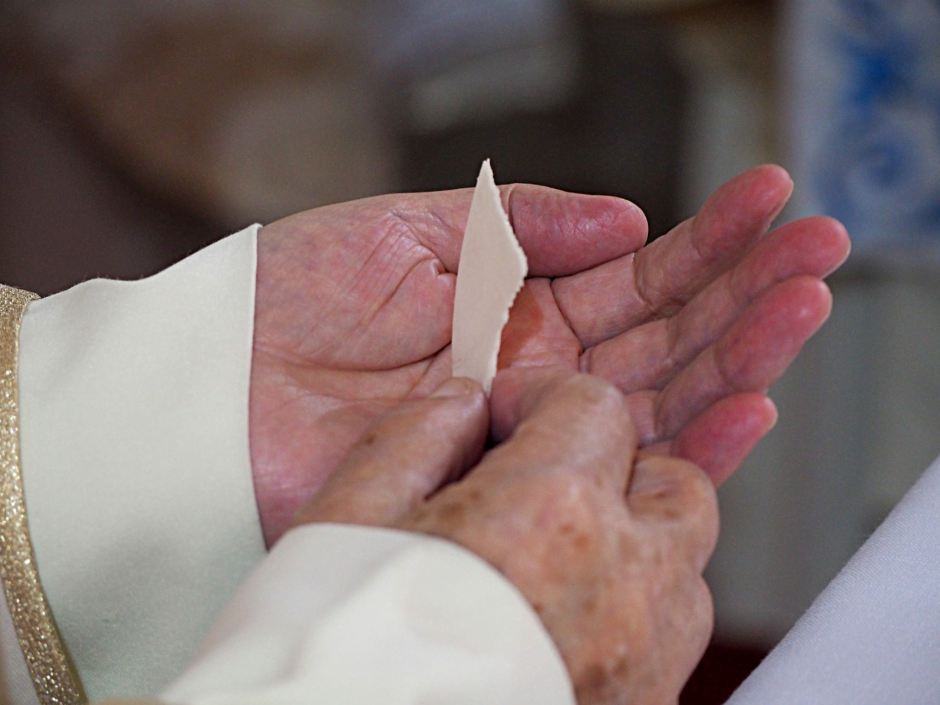
Jesus “addressed these words to us: Unless you eat my flesh and drink my blood, you will not have life in you. Daily it is before our eyes as a representation of the passion of Christ. We hold it in our hands, we receive it in our mouths, and we accept it in our hearts” (from a sermon by Saint Gaudentiu of Brescia, Tract 2).

To break open just how amazing this is, I want to share with you an image that comes down to us from Cyril of Alexandria. In the 5th Century he was the Patriach of Alexandria and is considered a Church Father and Doctor of the Church. This great bishop and teacher used the image of melted wax to help people understand their union with Christ through the Eucharist. Imagine that you are making homemade candles. After setting the pot over a heat source, you would add wax, sometimes different pieces of wax, and then allow the wax to melt. The resulting candle is a new piece of wax. The first piece of wax is now in the second, and the second is in the first. In the same way, when you receive holy Communion you are truly partaking of the flesh and blood of Christ. When you nourish yourself on the Eucharist you are now found in Christ and Christ is found in you, as we see in the image of the two pieces of wax that have been melted together. Saint Cyril of Alexandria said it this way: “For as if one should join wax with other wax, he will surely see (I suppose) the one in the other; in like manner (I deem) he who receives the flesh of our saviour Christ and drinks his precious blood, as he says, is found one with him…so that he is found in Christ, Christ again in him (On John 4.2).

One hundred years earlier, Saint Cyril of Jerusalem taught the faithful of his diocese about the Eucharist. What we believe about the Eucharist today is exactly what this great Saint taught the newly baptized in the 4th Century. We know this because his teaching is recorded in a very important document called The Jerusalem Catecheses.

On the night he was betrayed our Lord Jesus Christ took bread, and when he had given thanks, he broke it and gave it to his disciples and said: “Take, eat: this is my body.” He took the cup, gave thanks and said: “Take, drink: this is my blood.” Since Christ himself has declared the bread to be his body, who can have any further doubt? Since he himself has said quite categorically, This is my blood, who would dare to question it and say that it is not his blood? Therefore, it is with complete assurance that we receive the bread and wine as the body and blood of Christ. His body is given to us under the symbol of bread, and his blood is given to us under the symbol of wine, in order to make us by receiving them one body and blood with him. Having his body and blood in our members, we become bearers of Christ and sharers, as Saint Peter says, in the divine nature (St. Cyril of Jerusalem, From the Jerusalem Catecheses, Cat 22 Mystagogica).

Through our partaking of Jesus’ body and blood in the Eucharist, Jesus dwells in us. The theological doctrine for this ontological change of the bread and wine into the body and blood of Jesus is transubstantiation. This word began to be used in the twelfth century and was accepted by the Fourth Lateran Council (1215) and approved by the Magisterium. The word transubstantiation indicates that “once the substance or nature of the bread and wine has been changed into the Body and Blood of Christ, nothing remains of the bread and the wine except the Species—beneath which Christ, whole and entire in his physical ‘reality,’ is even corporeally present” (Paul VI, Mysterium Fidei, no. 47).

From the very beginning of Christian history, holy men and women have reflected on Christ’s presence in the Eucharist and have taught that the sacred transformation that occurs in the eucharistic liturgy is a sign and a cause of the transformation that should occur in the lives of all those who receive this great sacrament of Christ’s love.

It is the Holy Spirit who sanctifies and changes the bread and wine during the Eucharistic Prayer at Mass into the body and blood of Jesus. It is the divine Holy Spirit who sanctifies and divinizes people through the Eucharist. Cyril of Alexandria testifies to this when he wrote: “The holy body of Christ then gives life to those in whom it is […] being commingled with our body.” And also, ultimately, the aim of partaking of the Eucharist is for believers to be made partakers of the divine nature, to be made holy (On John).

We can see, then, why St Cyril of Jerusalem taught that Christians truly receive in the Eucharist a share in Christ’s body and blood, become of one body and one blood with Christ, and thus have become Christ-bearers who share in the divine nature through the Eucharist (cf. D.R. Hawk-Reinhard, “Cyril of Jerusalem’s Sacramental Theosis,” Studia Patristica, LSVI, pg. 248). Through partaking in the Eucharist we participate in life, because Christ is Life by nature.

With the concluding hymn of Mass, our attention could get captured by figuring out how we will maneuver our way out of the Church parking lot or arrive at the next event for the day on time—perhaps athletics or brunch or a project at home. Saint Gaudentius of Brescia teaches us that the heavenly sacrifice instituted by Christ, the Eucharist, “is our sustenance on life’s journey; by it we are nourished and supported along the road of life until we depart from this world and make our way to the Lord.”

The Eucharist supports us on our life’s journey through the rest of the week!

Jesus in the Eucharist teaches us how to walk through life’s maze of joys and struggles and tears. Diognetus wrote in a letter in the 2nd or 3rd Century state that there is something extraordinary about the lives of Christians, about our lives, yours and mine.
 
“And yet there is something extraordinary about their lives. They live in their own countries as though they were only passing through. …Any country can be their homeland, but for them their homeland, wherever it may be, is a foreign country. … They live in the flesh, but they are not governed by the desires of the flesh. They pass their days upon earth, but they are citizens of heaven. Obedient to the laws, they yet live on a level that transcends the law. Christians love all men, but all men persecute them. Condemned because they are not understood, they are put to death, but raised to life again. They live in poverty, but enrich many; they are totally destitute, but possess an abundance of everything. They suffer dishonour, but that is their glory. They are defamed, but vindicated. A blessing is their answer to abuse, deference their response to insult. For the good they do they receive the punishment of malefactors, but even then they rejoice, as though receiving the gift of life (The Letter to Diognetus).

We are encouraged to live on this earth as if passing through. Saint Gregory the Great opens up our hearts to the joy of the heavenly feast to which we are called:

Beloved brothers, let us set out for these pastures where we shall keep joyful festival with so many of our fellow citizens. May the thought of their happiness urge us on! Let us stir up our hearts, rekindle our faith, and long eagerly for what heaven has in store for us. To love thus is to be already on our way. No matter what obstacles we encounter, we must not allow them to turn us aside from the joy of that heavenly feast. Anyone who is determined to reach his destination is not deterred by the roughness of the road that leads to it. Nor must we allow the charm of success to seduce us, or we shall be like a foolish traveller who is so distracted by the pleasant meadows through which he is passing that he forgets where he is going (From a homily on the Gospels by St Gregory the Great, pope).

Saint John Chrysostom, however, speaks more directly to the Eucharistic life that we are called to live after receiving Jesus in the Eucharist at Mass. He comments on St. Paul’s words: “Because there is one bread, we who are many are one body, for we all partake of the one bread” (1 Cor. 10:17). Helping us dig more deeply into the meaning of this verse of the Bible that we hear–and even sing–often, Chrysostom explains how amazing these words of Paul are. It is true that in the Eucharist we have “communion in the body of Christ, as Paul stated in the previous verse. But now, the great Apostle goes further by stating that we are this very body of Christ. “For what is the bread?” Saint John Chrysostom asks. “It is the body of Christ. And what do the communicants become? The body of Christ. Not many bodies, but one body. For as the bread consists of many grains, so united that they are no longer distinguishable, and as they still subsist, though their individuality is no longer apparent to the eye because of their intimate union, so are we united one with the other and with Christ. … And so Paul adds: ‘We all partake of the one bread.’ If therefore by eating of the same body we all become that body, why do we not manifest to one another the same charity, and become on in this respect as well?”

O charity beyond all telling!

We have been loved with an endless outpouring of God’s charity. We have become through our partaking of the Eucharist one body with Christ and with each other. And we are called to live in this world a Eucharistic charity that is also beyond all telling! The first Christians were visible to the world around them only because of their love for one another and so should we be known for this same selfless outpouring of love.

Direction for prayer this Easter Season:

  1. At Mass, use images and phrases from this article that you have most resonated with to help you prepare more deeply for receiving the body and blood of Jesus in the Eucharist in Holy Communion and in your thanksgiving.
  2. Reflect slowly on the words of Saint Gregory the Great: “Let us set out for these pastures where we shall keep joyful festival with so many of our fellow citizens. May the thought of their happiness urge us on! Let us stir up our hearts, rekindle our faith, and long eagerly for what heaven has in store for us.” How could your love for the amazing gift of Jesus in the Eucharist bring you greater happiness the rest of the week?
  3. Read the challenging words of Saint John Chrysostom and ask Jesus: What more can I do? “For what is the bread?” Saint John Chrysostom asks. “It is the body of Christ. And what do the communicants become? The body of Christ. Not many bodies, but one body. For as the bread consists of many grains, so united that they are no longer distinguishable, and as they still subsist, though their individuality is no longer apparent to the eye because of their intimate union, so are we united one with the other and with Christ. … And so Paul adds: ‘We all partake of the one bread.’ If therefore by eating of the same body we all become that body, why do we not manifest to one another the same charity, and become on in this respect as well?”

Image Credit: Blessed Sacrament Chapel in the Shrine of the Immaculate Conception, Washington, D.C.


Pin Pricks and Pet Peeves

This is the third article in a short series on forgiveness. We have explored the dramatic and traumatic stories of Saint Rita and Corrie Ten Boom. In this article, we’ll be thinking about the million-and-one pin pricks that we receive and give to others every day. Though these aren’t dramatic or traumatic in themselves, when not attended to they can lead to drama and trauma and to the need for forgiveness in order to restore peace in a relationship.

These pin pricks never show up in the biographies of saints. We certainly don’t expect to read about Saint Rita’s frustration when her husband left his socks on the floor every morning or how Corrie was driven crazy by the way her father repetitively tapped his pencil on the desk. But, honestly, we have to face the fact our lives are full of these pet peeves that get under our skin and in the way of our relationships…and probably our saints had a few pet peeves themselves.

A quick Google search for pet peeves reveals that there are lists of pet peeves about just about everything: Wikipedia defines a pet peeve as “a minor annoyance that an individual finds particularly irritating to them, to a greater degree than would be expected based on the experience of others.”

One list of 70 pet peeves includes: chewing sounds, interrupting during a conversation, texting during a meal, throat clearing, leaving cabinet drawers open, not screwing the lids onto bottles and containers all the way, cutting lines, talking during movies, being late, cracking knuckles, and, well, you get the point…. I have to admit I do some of these things myself and am probably driving at least one sister I live with nuts.

One evening I learned a really important lesson. I was washing the dishes and had accidently left the sprayer option on the water faucet. When I turned on the water to rinse the dishes, I  sprayed not only the dishes but also my superior who was standing next to the sink to get water for the coffee pot. There was no response. No surprise. No disgust. No anger. No running to clean off her habit. Nothing. “It’s okay,” she said. “Don’t worry.” And that was the end of that. I learned two things that night, however. One: Always check to make sure you don’t have the sprayer left on when you turn on the water. Two: You don’t always need to give a dramatic reaction to make your point.

Back to my Google search for “pet peeves.” There are office pet peeves, driving pet peeves, as well as pet peeves particular to flight attendants, and teachers, and doctors, and veterinarians, and admissions counselors. There are annoying trends that drive us crazy about email, about social media, about sports, about teams. Pet peeves are a part of daily life.

When minor annoyances are not addressed over time, they can have serious effects on a relationship. The way someone who lives or works close to us chews, or piles things on their desk, or hums while they work, or leaves the newspaper on the table, or insists on giving their opinion rather categorically about just about everything, can make us feel misunderstood, not appreciated, unimportant. And we so often do things that make others feel the same way or worse.

Practices for addressing pet peeves

Here are some practices you can develop that will keep those pet peeves from ruining your day and your relationships:

Practice expressing respect actively and frequently throughout the day. Get in the habit of noticing what you like about other people and telling them what about them delights you. Tell others, in their presence, how great they are in a particular area. Build up a groundwork of trust and respect for each other.

Share behaviors that could be pet peeves that bother other people. Keeping things light and humorous, take some time to share with the people who work or live nearest you your own behaviors that could bother others. “I know I talk to myself at my desk here. It’s a habit I’ve had since childhood and one I picked up from my dad when he worked at home. Just let me know if it is bothering you because I honestly don’t even hear myself do it anymore. I promise not to be offended, at least not most of the time.” Your sharing not only lets others know you are aware that something you do mindlessly could bug them, it also tells them why you do it and gives them permission to ask you to tone it down if it is becoming obnoxious to them.

Have a dialogue about pet peeves with people who work or live close to you in different settings. Go around the room or table and let everyone share one pet peeve that bothers them in the office or home or team. Go around the room till everyone has three opportunities. Sometimes we have no idea that something we do or don’t do drives another crazy. At times, it requires just a simple adjustment. Religious sisters get transferred often from one assignment to another. In each community, we begin to live with different sisters who like things done a certain way. “My mom always told me to…. That’s why I…” Well, my mom didn’t really care that much about the item that is Sister’s pet peeve. I have to admit, however, that most of these things are small and I can adjust the way I do many little things in order to not bother the others as much as possible. The benefit for me is that I take on new habits that are actually really helpful. The pet peeves become my teachers!

Engage in anti-pet peeves. “An anti-pet peeve is the opposite of a pet peeve: a tiny thing in life that brings you an exponential amount of joy.”  This site provides themed collections of anti-pet peeves. Readers contribute activities that bring them great joy, so much joy that they make sure they enjoy them every chance they get. For example, one reader described how he loved bringing a cup of coffee to his wife first thing on Saturday morning and seeing her react as if it were Christmas morning. Every time. Another loved watching her dog on her back while she was on video calls.

Focus on what you love not what you hate. My dad loves thunderstorms. Nothing makes him more happy than to sit in a room and watch out the window as a thunderstorm rolls in. My mom hates thunderstorms. Dad shared with me one evening how he and mom were at a Bed and Breakfast in the mountains. They went to bed for the night and a thunderstorm broke out in the sky overhead. He, being nearest the window, was delighted as he watched the lightening and heard the thunder roll across the sky. In a few moments, mom got up and closed the blinds. He just rolled over and went to sleep. That story will remain in my heart forever. Dad’s love for mom far surpassed his frustration at not being able to watch thunderstorms. He loved her too much to fuss over something so small. I’m sure he sneaked out and watched storms when he could be alone. But he respected her fears and her wishes when they were together. Again and again my siblings and I hear our father say, “I love your mom so much!” The pet peeves couldn’t embitter a heart so full of love to the point that he made a big deal about insisting on what he wanted. Being in a good relationship was more important to him than indulging his desire to relish in thunderstorms.

Respect where another person is at. A pet peeve that bothers us about another person may actually just be a temporary stage of growth. Maybe at this point in the other person’s life they need to know they are important, valuable, smart, popular. Sometimes we just need to let another person alone as they grow through things. We can embody behaviors that correspond to our values, and these might have an influence on the other person as they notice there is another way to act. But just as you will only kill a seedling if you force the seed open to hasten its growth, stuffing another person into your own mold only leads to frustration and hurt.

Don’t waste your time with stupid stuff. Everyone has pet peeves, just as everyone has weaknesses. Be the person who has the wisdom to distinguish between what is worth fighting for and what isn’t. What’s important and what can pass. What’s serious and what is not. Be the wisdom figure who can think things through instead of blowing up. Who can work on themselves to be great-hearted rather than being petulant and demanding. The more we feed our pet peeves the stronger they will become and the more they will affect our relationships.

Learn to accept the fact that we are all imperfect Someone has the habit of putting wet dishes on top of the dry dishes in the kitchen. It doesn’t bother them, but it certainly bothers you because you have to put them away. You may be trying to finish a project and the rest of the team is behind you chatting about their plans for the weekend. A customer loses their temper and causes the scene, demanding to speak with your manager. There are so many things that can annoy us and drive us up the wall. Before pet peeves begin to take control and people become disgruntled, simply ask yourself if a situation is worth getting upset over. The question itself can give you a change of perspective. Some things are big and need to be addressed, but most things are small. We are all imperfect, and learning to accept this can go a long way toward being able to work together with charity.

When clashes and resentments break out between people over pet peeves forgiveness is a necessary path to healing. Next we’ll be presenting a prayerful exercise for forgiveness.

Baptism: becoming God’s beloved one Part 2 (Contemplating the Easter Mysteries III)

Your baptism was the most momentous moment of your life! In this sacrament you experienced an event, the action of the holy Trinity that changed the course of your life forever. Our feelings can tell us things that are not true about ourselves and about God. The action of God, however, reveals to us the truth of how we are loved by our Father, and God cannot lie.

Through your baptism you were incorporated into the love of Christ and the life of the Church. In being washed by the waters of Baptism, you were forever changed and are sealed with an indelible spiritual mark, or character, that enables you to participate in a full sharing in the life of the Church.

The Catechism states that this sacrament “signifies and actually brings about death to sin and entry into the life of the Most Holy Trinity through configuration to the Paschal mystery of Christ.” (CCC 1239)

Indeed, by our Baptism, we are initiated into an eternal sharing in the Divine Life of the Trinity and participate fully in the life of grace.

Cyril of Jerusalem said of Baptism, “You go down dead in your sins, and you come up made alive in righteousness.”

St. Augustine wrote, “Baptism washes away all, absolutely all, our sins …. This is the meaning of the great sacrament of Baptism, which is celebrated among us.”

St. Gregory of Nazianzus wrote, “Baptism is God’s most beautiful and magnificent gift … We call it gift, grace, anointing, enlightenment, garment of immortality, bath of rebirth.”

Nicholas Cabasillas wrote in The Life in Christ:

“They are no trifling gifts he bestows [in Baptism], nor are they trifling benefits of which he counts us worthy! … When we come up from the water we bear the Savior upon our souls, on our heads, on our eyes, in our very inward parts, on all our members—him who is pure from sin, free from all corruption, just as he was when he rose again and appeared to his disciples, as he was taken up, as he will come again to demand the return of his treasure. Thus we have been born; we have been stamped with Christ as though with some figure or shape. … He makes us his own body and he becomes for us what a head is for the members of a body. Since, then, he is the Head, we share all good things with him, for that which belongs to the head must needs pass into the body.”

We are truly God’s beloved, because we are one with Christ his beloved Son. In an ancient homily read every Holy Saturday in the Office of Readings, the author pictures the King seeking out our first parents who sit in darkness, to free them from imprisonment and pain. Jesus is often shown in icons depicting this event grasping the hands of Adam and Eve, pulling them toward himself, raising them with him, and with them, each of us:

“‘I command you: Awake, sleeper, I have not made you to be held a prisoner in the underworld. Arise from the dead; I am the life of the dead. Arise, O man, work of my hands, arise, you who were fashioned in my image. Rise, let us go hence; for you in me and I in you, together we are one undivided person….

“But arise, let us go hence. The enemy brought you out of the land of paradise; I will reinstate you, no longer in paradise, but on the throne of heaven. I denied you the tree of life, which was a figure, but now I myself am united to you, I who am life. I posted the cherubim to guard you as they would slaves; now I make the cherubim worship you as they would God.

“The cherubim throne has been prepared, the bearers are ready and waiting, the bridal chamber is in order, the food is provided, the everlasting houses and rooms are in readiness; the treasures of good things have been opened; the kingdom of heaven has been prepared before the ages.”

Entering deeply into the Easter mysteries through liturgical catechesis (also called mystagogy) is meant to stir things up for us, to unsettle us, to break open the tired and static meaning of our life, to push us out with radiant joy to share the mission of the Church and all those who have risked “entering into the life-altering mysteries of faith” (Geraard F. Baumbach, Eucharistic Mystagogy, 25).

What has been stirring in your heart as you’ve entered more deeply into the mystery of your baptism?

God wants you to become a living force for all mankind, lights shining in the world. You are to be radiant lights as you stand beside Christ, the great light, bathed in the glory of him who is the light of heaven. You are to enjoy more and more the pure and dazzling light of the Trinity, as now you have received – though not in its fullness – a ray of its splendour, proceeding from the one God, in Christ Jesus our Lord, to whom be glory and power for ever and ever. Amen (From a Sermon by Saint Gregory of Nazianzus, bishop, Oratio 39 in Sancta Lumina).

Directions for your prayer this Easter:

  1. What would be different in your life if these words of St. Gregory of Nazianzus guided your life: “God wants you to become a living force for all mankind, lights shining in the world. You are to be radiant lights as you stand beside Christ, the great light, bathed in the glory of him who is the light of heaven.” What would change? What would you renew? What would you begin? What would you relinquish?
  2. How is Jesus calling you to enter more deeply into the life of the Church, the celebration of the sacraments, and the missionary imperative to share what you have received with others?

Image: baptistry St Theresa’s Church in Ashburn, VA

The Bread of Life (John 6:22-29)

The thirst for God is present in every person on the face of the earth. The yearning for fulfillment beats in every human heart. The women and men in today’s Gospel had experienced being fed, completely satisfied, miraculously, in the presence of Jesus who had multiplied the bread and fish brought by a small boy. From a few loaves and fish, five thousand people had been more than amply provided for. This did not escape their notice.

When the people saw the sign he had done, they said, “This is truly the Prophet, the one who is to come into the world” (v. 14). Jesus, knowing what was in their hearts, fled because he knew they were coming to take him away and make him their king. These children of Israel, with their homeland occupied by the Romans, with all the humiliation and indignity that goes with being an oppressed people suddenly flickered with hope. They believed they had found a way out of their problems in the person of Jesus who had provided for them beyond their wildest imagining. If they could just keep him for themselves, like being able to make three wishes that would change the circumstances of their life forever. When they sought for Jesus the next day, he said as much to them.

“Jesus answered them and said, ‘Amen, amen, I say to you, you are looking for me not because you saw signs but because you ate the loaves and were filled. Do not work for food that perishes’” (v 26-27).

In order to live, we need to nourish ourselves, we need dignity and peace. The hearts of the people in this crowd were hoping against hope that things could change for them on a temporal level. They just didn’t realize that things had already changed. With the radical newness of the incarnation of the Son of God, everything had already become new. A greater hope of a more eternal promise was being fulfilled before their very eyes. Yet they could not recognize it. They were enamored still of the loaves of bread they had eaten. They were still looking for the food that perishes. Their imagination was too small.

In the document Verbum Domini, Benedict XVI writes:

What the Church proclaims to the world is the Logos of Hope (cf. 1 Pet 3:15); in order to be able to live fully each moment, men and women need “the great hope” which is “the God who possesses a human face and who ‘has loved us to the end’ (Jn 13:1)” (no. 91).

When we have found him, when we have let ourselves be seen by him, when we have allowed ourselves to be saved by him, we will no longer be absorbed by what we can get for ourselves, but in how we can tell others about Jesus.

Again, in the words of Benedict XVI:

We cannot keep to ourselves the words of eternal life given to us in our encounter with Jesus Christ: they are meant for everyone, for every man and woman. Everyone today, whether he or she knows it or not, needs this message. May the Lord himself…raise up in our midst a new hunger and thirst for the word of God (cf. Am 8:11) (no. 91).

Do not work for food that perishes,” Jesus admonishes the crowd, with an ardent desire to expand their hearts and deepen their hope. “Do not work for food that perishes but for the food that endures for eternal life, which the Son of Man will give you.”

This food by which they will truly be fed is “the true bread from heaven. For the bread of God is that which comes down from heaven and gives life to the world” (v. 32-33). It is the food on which we ourselves, thousands of years later, are weekly and even daily nourished if we so desire. In the first line of Panis angelicus, the famous Eucharistic hymn written in the 13th century by St. Thomas Aquinas,we sing, Panis angelicus fit panis hominum. (“The bread of angels is made the bread of mortals.”) Then St. Thomas leads us to cry out in wonder: O res mirabilis! Manducat Dominum / Pauper, pauper, servus et humilis. (Oh, wonderful thing! The Lord becomes our food / poor, a servant, and humble.)

With as much intensity and effort as the crowd sought out the Lord who had multiplied the loaves and the fishes, satisfying their needs that day, may we seek out the Bread of Angels, the true bread from heaven, the Eucharist to be nourished on the body and blood of the Lord. And having been fed with the Bread from Heaven may we become Eucharistic missionaries to all those who feel no need, no urgency, no desire to be fed with the Bread of Angels that lasts unto eternal life. As Pope Benedict XVI has said: “It is our responsibility to pass on what, by God’s grace, we ourselves have received” (no. 91).

Praying with this passage of Scripture

Lectio Divina is a way of listening to God as he speaks in his Word. It is a practice of communicating with God through Scripture and attending to God’s presence and what he wishes to tell us. In this slow and prayerful reading of the Word of God, we allow ourselves to be transformed by the Spirit who forms us into the image of Christ.
There are four movement in Lectio Divina: Read (lectio), Meditate (meditation), Pray (oratio), Contemplate (contemplation).

Begin by finding a still space to pray. Breathe deeply and become quieter within. Abandon any agenda, worries or thoughts you bring to this prayer and entrust these things to the merciful care of God. Ask for the grace to be receptive to what God will speak to you through this Scripture reading. Grant me, Jesus Divine Master, to be able to know the mysteries of the kingdom of God and your unfathomable riches. Grant that your word penetrate my soul; guide my steps, and brighten my way till the day dawns and darkness dissipates, you who live and reign forever and ever Amen.

Read (lectio)
Begin by slowly and meditatively reading your Scripture passage out loud. Listen for a particular word or phrase that speaks to you at this moment and sit with it for a time.

The next day the crowd that had stayed on the opposite shore of the lake realized that only one boat had been there, and that Jesus had not entered it with his disciples, but that they had gone away alone. Then some boats from Tiberias landed near the place where the people had eaten the bread after the Lord had given thanks. Once the crowd realized that neither Jesus nor his disciples were there, they got into the boats and went to Capernaum in search of Jesus.

When they found him on the other side of the lake, they asked him, “Rabbi, when did you get here?”

Jesus answered, “Very truly I tell you, you are looking for me, not because you saw the signs I performed but because you ate the loaves and had your fill. Do not work for food that spoils, but for food that endures to eternal life, which the Son of Man will give you. For on him God the Father has placed his seal of approval.”

Then they asked him, “What must we do to do the works God requires?”

Jesus answered, “The work of God is this: to believe in the one he has sent.”


Meditate (meditatio)
Read the passage a second time. As you re-engage the text, let the word or phrase that stood out become your invitation to speak from your heart with God who wishes to share his heart with you. Allow this word or phrase to wash over you and permeate your thoughts and feelings. You may wish to repeat this phrase quietly and gently for a period of time.

Pray (oratio)
Read the text a third time. Listen for what God is saying to you. Speak heart to heart with God. Notice the feelings that this conversation with God raises up within you. Share with God what you notice about your response to this conversation. You may wish to return to repeating the phrase quietly and gently, allowing it to permeate you more and more deeply.

Contemplate (contemplatio)
Read the text a final time. Now be still and rest in God’s embrace. Ask God to give you a gift to take with you from this prayer. You might ask God if he is inviting you to do some action, for instance, make some change in your thoughts, attitudes or reactions, in the way you speak or how you treat others. Thank God for this gift and invitation as you conclude your prayer.

Photo Credit: Fr. Fernando via Cathopic

Facing the unjust bits of life (Horizons of the Heart 20)

The grace we are asking of God: a deeply felt awareness of how God in all of history and most powerfully in the Word made flesh draws us into the unfolding of the mystery of his love which always is extravagant and which is always seeking to save us. We desire that in doing this we enter into a process of healing that we might love Jesus and follow him more intentionally, completely, and wholeheartedly.

Horizons of the Heart is inspired by the Spiritual Exercises of St Ignatius and my own notes from my thirty-day Ignatian retreat in 2022. See an index for the whole series.

Looming large in my 30-day retreat was a decision that was in a certain sense, due to forces outside myself, forced upon me.

Nothing strange there!

Doesn’t this happen to just about every one of us?

Even if we think we can control ourselves and mastermind our success, either materially or spiritually, we soon find out that we can’t control others, we can’t control the forces of nature, and we can’t control the randomness of incidents that could affect, break, and change the direction of our lives.

But still, when we need to do an unexpected about turn, when we are blocked and forced into a right or a left hand change of direction at what turned out to be a dead end, we at times suffer indescribable pain.

I remember standing at the end of the outdoor Stations of the Cross at the retreat house and reading the inscription taken from the second chapter of Paul’s letter to the Philippians: “Jesus did you deem equality with God something to be grasped at, but rather humbled himself taking the form of a slave.” Every injustice I had ever received, little ones and big ones, came back with powerful force and left me breathless… and angry.

How ashamed I felt, but there it was. Who Jesus was and what he invited me to, I was not, and at that moment I clearly refused to follow him. It was just too hard…by myself. I needed God’s help, a lot of help.

The natural reaction to injustice is hurt or rage or bitterness because something we deemed to be our own or somehow necessary to our living and thriving is suddenly changed and taken away.

As we enter into the next mystery of Jesus’ life, the flight into Egypt, we are entering into this sacred mystery of why bad things happen to good people. We certainly won’t be answering this age-old question, but instead offering the wisdom of Ignatius and the Scriptures to help us enter reverently ever deeper into the mystery of God’s loving us even in times that are difficult.

I randomly opened my notes from the retreat and discovered something that was pivotal to my finding peace:

God decides which alternative in our life is of value to me and my life in the world, what will make me more loving towards other people and more open to God’s love flooding my heart. God is the one who know which of two alternatives will ultimately make me more selfish and which will make me more selfless. Which ultimately will make me unhappy and which will result in my unending happiness which may or may not begin on this earth.

God knows….

I don’t really ultimately know which of two alternatives before me will give God the most glory and bring me and others true joy and peace. If I have fixed my attention on one alternative, and stick with that no matter what, unwilling to see or try what God is making apparent to me right before my eyes, if I try to force God to agree with me, what will I ultimately lose? And really what is it that I would gain in the end?

I can only live true to myself if I live true to who I am as I am in God’s plan and to all that he hopes in me.

This reminds me of another great quote from St. Paul, this time from his letter to the Romans:

If God is for us, who can ever be against us?  Since he did not spare even his own Son but gave him up for us all, won’t he also give us everything else?  Who dares accuse us whom God has chosen for his own? No one—for God himself has given us right standing with himself.  Who then will condemn us? No one—for Christ Jesus died for us and was raised to life for us, and he is sitting in the place of honor at God’s right hand, pleading for us.

Can anything ever separate us from Christ’s love? Does it mean he no longer loves us if we have trouble or calamity, or are persecuted, or hungry, or destitute, or in danger, or threatened with death?  As the Scriptures say, “For your sake we are killed every day; we are being slaughtered like sheep.”)  No, despite all these things, overwhelming victory is ours through Christ, who loved us.

And I am convinced that nothing can ever separate us from God’s love. Neither death nor life, neither angels nor demons, neither our fears for today nor our worries about tomorrow—not even the powers of hell can separate us from God’s love. No power in the sky above or in the earth below—indeed, nothing in all creation will ever be able to separate us from the love of God that is revealed in Christ Jesus our Lord. (Romans 8:33-39 NLT)

Our desire in these next meditations is to enter courageously into life as it is and to discover right there the unfolding of the mystery of God’s love which always is extravagant and which always is seeking to save us. How healing will be this discovery when we are embraced by Love. How we will desire out of sheer gratitude to follow Jesus more intentionally, completely, and wholeheartedly.

Blessed Dina Bélanger, a heavenly friend I found while on retreat, leads the way here, “My only pleasure is to let you have your way. I have abandoned myself completely to Your action, so that, without hindrance, You may be able to fulfill your designs in me, poor as I am, to act freely, always, and in everything.”

Baptism: becoming God’s beloved one Part 1 (Contemplating the Easter Mysteries II)

Ever wondered what God sees when he looks at you?

Wait. God looks at me?

You mean God sees this big hole I have in my heart? He knows that I can’t sleep for the worry that is nagging at my thoughts? He cares about how tired I feel from the endless responsibilities that keep me scurrying through my day?

Yes. When God looks at you he sees his daughter, his son. He also sees how often you—as children so often do—try to take care of things yourself without relying on your Father.

I’ve read about God’s love. I’ve heard people talk about it. But I don’t feel it so how can I know it is true? How can I know I mean anything to God?

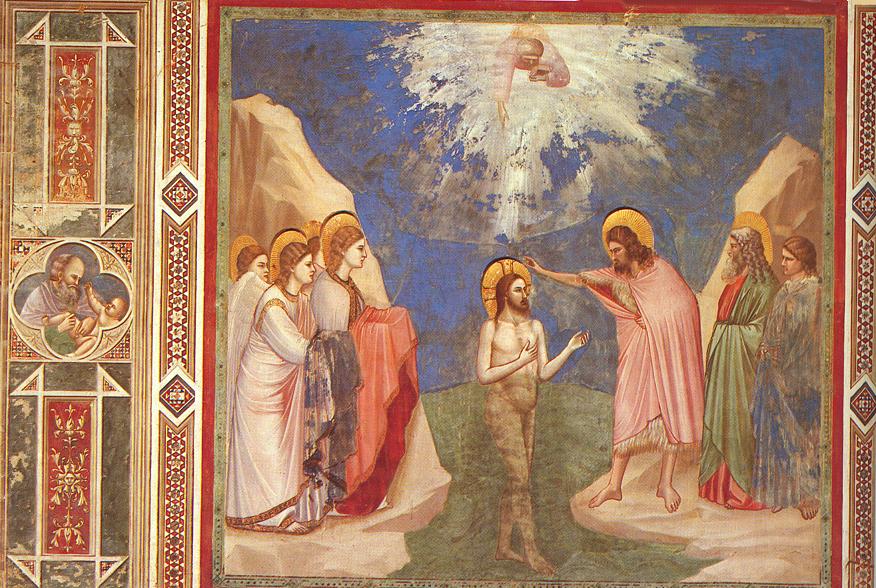
In the beginning of the public life of Jesus, when he was around thirty years old, there is recorded a mysterious event. Jesus had gone down to the River Jordan where his cousin John was baptizing in the water. All Judea was flocking to him to be baptized by him and to learn what they needed to do to return to God.

Jesus not only watched, he got in line to be baptized himself.

John is baptising when Jesus draws near. Perhaps he comes to sanctify his baptiser; certainly he comes to bury sinful humanity in the waters. He comes to sanctify the Jordan for our sake and in readiness for us; he who is spirit and flesh comes to begin a new creation through the Spirit and water. From a Sermon by Saint Gregory of Nazianzus, bishop
(Oratio 39 in Sancta Lumina, 14-16, 20: PG 36, 350-351, 354, 358-359)

But John tried to deter him, saying, “I need to be baptized by you, and do you come to me?”

Jesus replied, “Let it be so now; it is proper for us to do this to fulfill all righteousness.” Then John consented.

As soon as Jesus was baptized, he went up out of the water. At that moment heaven was opened, and he saw the Spirit of God descending like a dove and alighting on him. And a voice from heaven said, “This is my Son, whom I love; with him I am well pleased.”

Jesus knows what it is like for his Father to look at him, to hear the love that is in his Father’s voice as he spoke to him, calling him Son, the Son in whom he was well pleased, his beloved Son.

When someone talks about a child or friend as their “beloved,” they mean to say, “I have a real special liking for this person. I prefer them. I love being around them. I give them gifts to show them my love. I take them into my confidence. They are closer to me than all others. I can’t live without them.”

The baptism of Jesus has everything to do with your baptism and mine. It has everything to do with our becoming God’s beloved one.

Saint Maximus of Turin tells us: “Christ is baptized, not to be made holy by the water, but to make the water holy, and by his cleansing to purify the waters which he touched. For the consecration of Christ involves a more significant consecration of the water.”

Christ is bathed in light; let us also be bathed in light. Christ is baptised; let us also go down with him, and rise with him. (From a Sermon by Saint Gregory of Nazianzus, bishop, Oratio 39 in Sancta Lumina)


I have spent so many decades of my life wondering if God saw me, if God cared about me, if God was going to be there for me. Isn’t it true that so often we measure the gift of God by what our feelings are telling us? We don’t “feel” God’s presence, so he must not be here. We don’t “feel” lovable to ourselves and we project that on to the way we think God must feel about us. We “feel” alone and isolated and we act as though God has no power or interest to help us.

Notice that at the baptism of Jesus, we are not told about Jesus’ feelings. We witness an event. Jesus goes down into the water, is baptized by John, emerges from the water, and hears his Father’s voice calling him Son.

Jesus rises from the waters; the world rises with him. The heavens like Paradise with its flaming sword, closed by Adam for himself and his descendants, are rent open. The Spirit comes to him as to an equal, bearing witness to his Godhead. A voice bears witness to him from heaven, his place of origin. The Spirit descends in bodily form like the dove that so long ago announced the ending of the flood and so gives honour to the body that is one with God. (From a Sermon by Saint Gregory of Nazianzus, bishop, Oratio 39 in Sancta Lumina)

The Baptism of Jesus is the moment in which the Lord sanctified the waters. By immersing his holy body in them, Jesus made them fitting for conveying the grace of the sacrament of Christian baptism. Jesus makes it possible for us to be reborn to new life through the sacrament of baptism. Saint Maximus of Turn in the fifth century explains: “Christ is baptized, not to be made holy by the water, but to make the water holy, and by his cleansing to purify the waters which he touched. … For when the Savior is washed all water for our baptism is made clean, purified at its source for the dispensing of baptismal grace to the people of future ages. Christ is the first to be baptized, then, so that Christians will follow after him with confidence” (Sermo 8: De sancta Ephiphania, 2).


It was in Christ’s own baptism by John the Baptist in the river Jordan that this sacrament of initiation was instituted to enable us to share in the Divine Life of the Trinity.

Most of us probably don’t remember our baptism if we were baptized as infants. Our “feelings” at the moment were probably surprise or discomfort as water was poured on our heads three times while the priest called us by name and said the words: “I baptize you in the name of the Father, and of the Son, and of the Holy Spirit.”

Directions for your prayer this Easter:

Underline in this article every reference to a gift God has given you through your baptism. Notice how your soul responds to this litany of love. When you hold your experiences of sorrow and loss and doubt together with God’s action to bring you to the “pure and dazzling light of the Trinity,” what new things do you notice?

Image credit: Baptism of Christ fresco by Giotto di Bondone, c. 1305 (Cappella ScrovegniPaduaItaly) via Wikipedia, Public Domain