The Power of Love (John 15:9-17)

“I have told you this so that my joy may be in you
and your joy might be complete.
This is my commandment: love one another as I love you.
No one has greater love than this,
to lay down one’s life for one’s friends.
You are my friends if you do what I command you.”

John 15:9-17

Why is it that we are “commanded” to love? Wouldn’t it be better if we were invited to love others? Isn’t it true that no one can make us love another person? And if we love out of duty are we really loving at all?

There have been any number of people in my life that I personally have not liked to be around. Over the years, however, I have discovered that my life is about more than getting along, or obtaining what I want, or experiencing pleasant circumstances.

As a Christian, my life is no longer my own. I have been given the grace to experience the absolute love of God poured out on me in the sacrament of baptism and the only response to that overwhelming and limitless gift of God’s love and grace is to return love for love in as complete a manner as possible. As I put on the Lord Jesus, and I actualize his utter selfless loving here and now in whatever situation I find myself in through my own faltering attempts to love another, I keep the one command I have been given by Jesus at the Last Supper: “This is my commandment: love one another as I love you.” No, it is not a suggestion, if I feel like it, if it works out, or if it is to my benefit. That is not the way Jesus loved us and is not the way he commands that we love one another.

I will love you, I can say even as I wrestle within a relationship, but I may not agree with you.

I will love you, even though I don’t really prefer being around you.

I will love you, even though I will take steps to protect myself from your behaviors.

I will love you because Jesus has loved me and because Jesus loves you.

Love gives meaning to all the other commandments.

Love gives meaning to every suffering.

The power of love alone can give ultimate direction even to the hard realism of economics and politics and social strife and issues of social injustice and disparity. Love alone can break these open so they serve the world in charity.

Just before his death, Jesus talked about love, unity, friendship, glory, and joy, that the love the Father has for Jesus may be in us and that Jesus may be in us. If we focus on love, all else will follow. Love will lead us to unity and glory and joy, as Jesus is in us and we in him so that we may be brought to complete unity.

This love is the bedrock of our Christian life. If we miss this we have missed everything. The “command” should make it really stand out to us so that we keep this front and center in our journey to becoming and loving like Christ.

Image: Christian R. Rodríguez via Cathopic

Praying with this Passage of Scripture

Lectio Divina is a way of listening to God as he speaks in his Word. It is a practice of communicating with God through Scripture and attending to God’s presence and what he wishes to tell us. In this slow and prayerful reading of the Word of God, we allow ourselves to be transformed by the Spirit who forms us into the image of Christ. There are four movements in Lectio Divina: Read (lectio), Meditate (meditation), Pray (oratio), Contemplate (contemplation).

Begin by finding a still space to pray. Breathe deeply and become quieter within. Abandon any agenda, worries or thoughts you bring to this prayer and entrust these things to the merciful care of God. Ask for the grace to be receptive to what God will speak to you through this Scripture reading. Grant me, Jesus Divine Master, to be able to know the mysteries of the kingdom of God and your unfathomable riches. Grant that your word penetrate my soul; guide my steps, and brighten my way till the day dawns and darkness dissipates, you who live and reign forever and ever Amen.

Read (lectio)
Begin by slowly and meditatively reading your Scripture passage out loud. Listen for a particular word or phrase that speaks to you at this moment and sit with it for a time.

Pray (oratio)
Read the text a third time. Listen for what God is saying to you. Speak heart to heart with God. Notice the feelings that this conversation with God raises up within you. Share with God what you notice about your response to this conversation. You may wish to return to repeating the phrase quietly and gently, allowing it to permeate you more and more deeply.

Contemplate (contemplatio)
Read the text a final time. Now be still and rest in God’s embrace. Ask God to give you a gift to take with you from this prayer. You might ask God if he is inviting you to do some action, for instance, make some change in your thoughts, attitudes or reactions, in the way you speak or how you treat others. Thank God for this gift and invitation as you conclude your prayer.

Image: Myriams-Fotos; pixabay.com

Do you recognize Jesus when he calls your name? (John 10:22-30)

“My sheep hear my voice;
I know them, and they follow me.
I give them eternal life, and they shall never perish.
No one can take them out of my hand.
My Father, who has given them to me, is greater than all,
and no one can take them out of the Father’s hand.
The Father and I are one.”

John 10:22-30

My sheep hear my voice; I know them, and they follow me. I give them eternal life, and they shall never perish.

In the time of Jesus, the families of a village often kept their herds of sheep together in a common pen. In the morning the shepherds would come and call their own sheep by name. The shepherd had such an intimate knowledge of his sheep and a genuine love for them, that he would call them individually to follow him to green pastures and streams of running water.

Following the shepherd, then, is a matter of love and being cared for. It is a relationship of trust and belonging. When Jesus speaks of his followers he refers often to shepherding, because he wants us to know how much he longs for us to willingly adhere to him with all our being and to trust him to provide for us. Sheep know they belong to a shepherd. They are named, known, and counted at the end of every single day before being settled down for the night.

There are two ways a shepherd would lead his flock. Most often we see the shepherd walking in front of the sheep. There the shepherd can recognize danger and lead the sheep in the safest path. The shepherds lead by showing the sheep the best path to take.

At other times, the shepherd leads his flock from behind. In this case the shepherd is driving the sheep toward the destination and making sure that they don’t dilly-dally along the way, wandering off after some distraction or other.

In what area of your life is Jesus desiring to shepherd you more closely? Is there a destination or goal on the horizon to which he is drawing your heart? Have you found patterns of distraction in your life which keep you dilly-dallying along the way? Can you hear your Shepherd’s voice? Do you recognize when he calls your name?

Image: Gerd Altmann; Pixabay.

Praying with this Passage of Scripture

Lectio Divina is a way of listening to God as he speaks in his Word. It is a practice of communicating with God through Scripture and attending to God’s presence and what he wishes to tell us. In this slow and prayerful reading of the Word of God, we allow ourselves to be transformed by the Spirit who forms us into the image of Christ. There are four movements in Lectio Divina: Read (lectio), Meditate (meditation), Pray (oratio), Contemplate (contemplation).

Begin by finding a still space to pray. Breathe deeply and become quieter within. Abandon any agenda, worries or thoughts you bring to this prayer and entrust these things to the merciful care of God. Ask for the grace to be receptive to what God will speak to you through this Scripture reading. Grant me, Jesus Divine Master, to be able to know the mysteries of the kingdom of God and your unfathomable riches. Grant that your word penetrate my soul; guide my steps, and brighten my way till the day dawns and darkness dissipates, you who live and reign forever and ever Amen.

Read (lectio)
Begin by slowly and meditatively reading your Scripture passage out loud. Listen for a particular word or phrase that speaks to you at this moment and sit with it for a time.

Pray (oratio)
Read the text a third time. Listen for what God is saying to you. Speak heart to heart with God. Notice the feelings that this conversation with God raises up within you. Share with God what you notice about your response to this conversation. You may wish to return to repeating the phrase quietly and gently, allowing it to permeate you more and more deeply.

Contemplate (contemplatio)
Read the text a final time. Now be still and rest in God’s embrace. Ask God to give you a gift to take with you from this prayer. You might ask God if he is inviting you to do some action, for instance, make some change in your thoughts, attitudes or reactions, in the way you speak or how you treat others. Thank God for this gift and invitation as you conclude your prayer.

Image: Myriams-Fotos; pixabay.com
More than to be heard, we need to be Loved (Luke 24:13-35)

That very day, the first day of the week,
two of Jesus’ disciples were going
to a village seven miles from Jerusalem called Emmaus,
and they were conversing about all the things that had occurred.
And it happened that while they were conversing and debating,
Jesus himself drew near and walked with them,
but their eyes were prevented from recognizing him….
As they approached the village to which they were going,
he gave the impression that he was going on farther.
But they urged him, “Stay with us,
for it is nearly evening and the day is almost over.”
So he went in to stay with them.
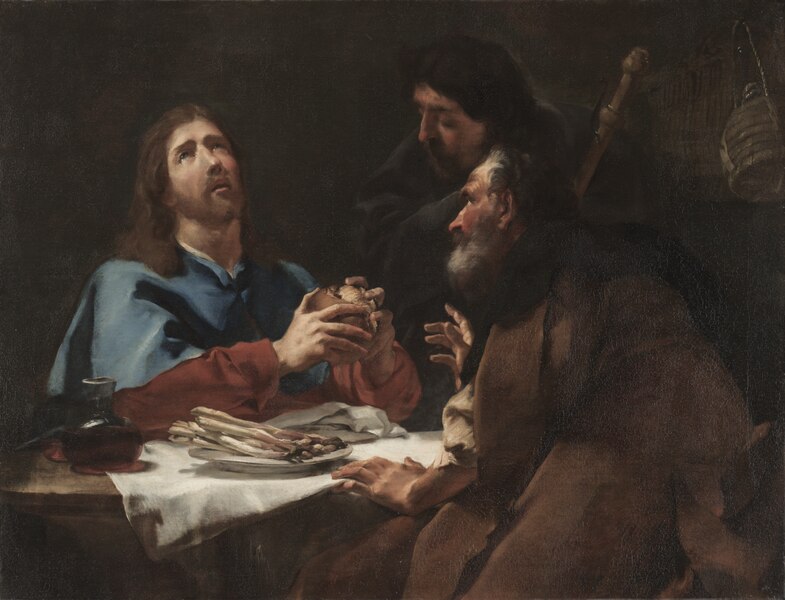
And it happened that, while he was with them at table,
he took bread, said the blessing,
broke it, and gave it to them.
With that their eyes were opened and they recognized him….

Luke 24:13-35

“‘Stay with us, for it is nearly evening and the day is almost over.’ So [Jesus] went in to stay with them. And it happened that, while he was with them at table, he took bread, said the blessing, broke it, and gave it to them.”

I wonder what Jesus felt when he was invited to stay with these two disciples making their away from all that had transpired in Jerusalem to the village of Emmaus. Certainly, Jesus had met these two disciples on the road. He had listened to their discouragement and disillusionment. He had even spent quite a bit of time teaching them, “Then beginning with Moses and all the prophets, he interpreted to them what referred to him in all the scriptures.” With all of that, however, Jesus was hoping for more. We need more than to be heard and understood and have our minds and hearts refreshed with an encounter with Truth. Deep down, the human heart yearns for intimacy and so does the heart of Jesus.

I can imagine Jesus, as he was clearly “giving the impression” that he was intending to go on his way, feeling overwhelmed with joy when the disciples invited him into the intimacy of their home. Jesus never forces his presence and his love on anyone. We can imagine them scouring about making sure there was a bed prepared and thinking about their evening meal.

When we invite Jesus into our hearts with this great hope of satisfying the longing for intimacy that both Jesus and we have, we often scurry about preparing things for his stay, telling him things, saying prayers, asking for what we need, tidying up our hearts as best we can. Jesus enters where he is invited in order to give himself entirely to us. And so when they sat down for their evening meal there is no mention of what the disciples had prepared. Instead, there is recounted the meal Jesus provided them. “And it happened that, while he was with them at table, he took bread, said the blessing, broke it, and gave it to them. With that their eyes were opened and they recognized him.”

Today, Jesus is “hanging around,” to use a somewhat colloquial phrase, hoping that you will invite him to stay with you. Invite Jesus in. Don’t be too worried about what your heart looks like or how you will make him feel welcome. Instead, for this time, just watch him. Experience his joy at being invited to your house, to your heart. Let him be the giver and you the receiver. Allow him to share his joy with you.

Image: Giovanni Battista Piazzetta, Public domain, via Wikimedia Commons

Praying with this Passage of Scripture

Lectio Divina is a way of listening to God as he speaks in his Word. It is a practice of communicating with God through Scripture and attending to God’s presence and what he wishes to tell us. In this slow and prayerful reading of the Word of God, we allow ourselves to be transformed by the Spirit who forms us into the image of Christ. There are four movements in Lectio Divina: Read (lectio), Meditate (meditation), Pray (oratio), Contemplate (contemplation).

Begin by finding a still space to pray. Breathe deeply and become quieter within. Abandon any agenda, worries or thoughts you bring to this prayer and entrust these things to the merciful care of God. Ask for the grace to be receptive to what God will speak to you through this Scripture reading. Grant me, Jesus Divine Master, to be able to know the mysteries of the kingdom of God and your unfathomable riches. Grant that your word penetrate my soul; guide my steps, and brighten my way till the day dawns and darkness dissipates, you who live and reign forever and ever Amen.

Read (lectio)
Begin by slowly and meditatively reading your Scripture passage out loud. Listen for a particular word or phrase that speaks to you at this moment and sit with it for a time.

Pray (oratio)
Read the text a third time. Listen for what God is saying to you. Speak heart to heart with God. Notice the feelings that this conversation with God raises up within you. Share with God what you notice about your response to this conversation. You may wish to return to repeating the phrase quietly and gently, allowing it to permeate you more and more deeply.

Contemplate (contemplatio)
Read the text a final time. Now be still and rest in God’s embrace. Ask God to give you a gift to take with you from this prayer. You might ask God if he is inviting you to do some action, for instance, make some change in your thoughts, attitudes or reactions, in the way you speak or how you treat others. Thank God for this gift and invitation as you conclude your prayer.

Image: Myriams-Fotos; pixabay.com

Jesus in the Desert: Resonating with Jesus (Horizons of the Heart 34)

The grace we are asking of God: to discover Jesus in my own personal story so that my personal myth may be transformed in Jesus, as was that of Ignatius, that I will be disposed to hear God’s call and follow it wholeheartedly

Horizons of the Heart is inspired by the Spiritual Exercises of St Ignatius and my own notes from my thirty-day Ignatian retreat in 2022. See an index for the whole series.

Begin by relaxing your body, your mind, letting go of anxieties and ambitions and expectations and plans… Lay all that you notice and all that you are bare and exposed before the Father who welcomes you with a gaze that is gently loving. Settle into the silence that runs deeper than emotional turbulence… Move beyond imagination where you wait upon the stirring of the soul and the movement of the heart. Return to Jesus to find the Rest he offers…to welcome the gift…to become a child held in safe arms….

Resonating with Jesus

Ask Jesus that every aspect of this prayer will please him and will give glory to God.

Then Jesus was led by the Spirit into the wilderness to be tempted by the devil (Matthew 4:1).

Slowly read the passage for your meditation once. Leave some moments of silence and then read it again with the intention of entering into the story, of entering into how Jesus is experiencing this event, how he is using his senses, what he is thinking, feeling, desiring….

Jesus could have prayed with Psalm 91 while he communed with his Father in the desert.

You who live in the shelter of the Most High,
    who abide in the shadow of the Almighty,
will say to the Lord, “My refuge and my fortress;
    my God, in whom I trust.”
For he will deliver you from the snare of the fowler
    and from the deadly pestilence.

…The fowler is set on destruction. He sets traps in favorable spots, attracting doves and other small birds by scattering grain inside the trap. The birds would walk into the snare, not suspecting danger until the trap had been sprung. Jesus would have reflected in this psalm how God delivers the one who trusts in him.. “Our soul is escaped as a bird out of the snare of the fowlers: The snare is broken, and we are escaped” (Psalm 14:7). In this Psalm God is proclaimed as trustworthy to rescue us by either helping us avoid the trap altogether or freeing us from the trap if caught… This is a very masculine image, particularly for Ancient Israel… The forces of evil are stalking us to destroy us, but our Rescuer ultimately calls the shots. There is only one outcome: freedom from the snare of the fowler. After the fall of Adam and Eve, through the thousands of years before the birth of Jesus, we were trapped in our infidelity and disloyalty and in the destructive power of death which seemed to have the last word…. Jesus in the desert proclaimed to Satan: “Your power is broken.”


He will cover you with his pinions,
    and under his wings you will find refuge.

…A pinion is the outer part of a bird’s wing and represents the protection a mother bird gives her chicks. She spread her wings over them. This is a call to confidence in God. If you make the Lord your resting place, he will never leave you…. Here the psalmist offers a feminine image for the protecting and caring power of God.

Attend to Jesus as he prays the rest of this psalm in the rocky landscape and oppressive heat of the desert loneliness:

[The Lord’s] faithfulness is a shield and buckler.
You will not fear the terror of the night,
    or the arrow that flies by day,
or the pestilence that stalks in darkness,
    or the destruction that wastes at noonday.

A thousand may fall at your side,
    ten thousand at your right hand,
    but it will not come near you.
You will only look with your eyes
    and see the punishment of the wicked.

Because you have made the Lord your refuge,
    the Most High your dwelling place,
no evil shall befall you,
    no scourge come near your tent.

For he will command his angels concerning you
    to guard you in all your ways.
On their hands they will bear you up,
    so that you will not dash your foot against a stone.
You will tread on the lion and the adder,
    the young lion and the serpent you will trample under foot.

Those who love me, I will deliver;
    I will protect those who know my name.
When they call to me, I will answer them;
    I will be with them in trouble,
    I will rescue them and honor them.
With long life I will satisfy them,
    and show them my salvation.

Rest in the awareness of what resonates in Jesus heart as he prays these words from the prayerbook of Ancient Israel. As you enter into his feelings, you will gradually lose interest in your own spontaneous reactions, defenses, and fears. Jesus will bring you to his way by attraction, sweetness, and beauty. He will make you feel his own heart’s safety, belonging, and hope.

Colloquy

Allow an image or object that encapsulates all these experiences to form in your mind. Take some time to speak with God about the meaning or significance of this object.

Ask Jesus to show you one specific gift he wishes to give you. Receive it and remain in stillness and quietly relaxed presence under the influence of the Holy Spirit.

Reviewing the Graces of Prayer

When you finish praying, write down the main gifts and discoveries from this time of intimate contemplation. What is one concrete thing you can do to solidify these gifts in your life.

Image: Jesus Tempted in the Wilderness (Jésus tenté dans le désert). Brooklyn Museum, New York, public domain, Wikimedia Commons

The Dynamic of the Grain of Wheat (John 12:20-33)

Amen, amen, I say to you, 
unless a grain of wheat falls to the ground and dies, 
it remains just a grain of wheat; 
but if it dies, it produces much fruit.
Whoever loves his life loses it,
and whoever hates his life in this world
will preserve it for eternal life.

John 12:20-33

Have you ever noticed how the Scriptures are filled with people just like ourselves whose lives take unexpected turns and then blossom in ways that can only be described as flourishing in and for the Kingdom of God.

Take Jacob. His “before” was manipulating his father’s blessing from his brother Esau and then serving his uncle Laban for many years, eventually marrying his daughters Leah and Rachel. His “after” was as the patriarch of the twelve tribes of Israel who escaped from Egypt, received the Law, and were chosen by God to be his covenant people. And even to this day, we read in Revelation 21 that on the twelve gates that belong to the New Jerusalem are written the names of the twelve tribes of Israel. The New Jerusalem itself sits on twelve foundations representing the twelve apostles who would reign over the twelve tribes of Israel.

Take Moses. His “before” was the life of Pharoah’s daughter’s adopted son in Egypt. We all know the story. His “after” was the fulfillment of God’s call to be the leader of his people to the Promised Land. And even to this day, the Christian understanding of the Paschal Mystery is rooted in the Exodus narrative.

Between the “before” and the “after” of each of these biblical figures there is a point of struggle and epiphany.

When Jesus says that the grain of wheat must fall to the ground and die if it is to be more than just a single grain, if it is to bear fruit, Jesus is talking about just this dynamic which plays out also in our own lives. Who we think we are, who we discover ourselves to be as we grow up and mature and try to figure out life, all this eventually needs to give way to the fullness of the way God lifts our lives up into his mighty and eternal plan. We each have a role to play in God’s Kingdom. We each have a mission in life. We each were created for a purpose. It is in those “hinge” seasons of our life between the “before” and “after” in which we feel the weight and sorrow of the grain of wheat dying. If you are in one of those “hinge” moments, know that this too is a way in which God raises you up to fulfill more completely the fullness of your life and his glory.

Praying with this Passage of Scripture

Lectio Divina is a way of listening to God as he speaks in his Word. It is a practice of communicating with God through Scripture and attending to God’s presence and what he wishes to tell us. In this slow and prayerful reading of the Word of God, we allow ourselves to be transformed by the Spirit who forms us into the image of Christ. There are four movements in Lectio Divina: Read (lectio), Meditate (meditation), Pray (oratio), Contemplate (contemplation).

Begin by finding a still space to pray. Breathe deeply and become quieter within. Abandon any agenda, worries or thoughts you bring to this prayer and entrust these things to the merciful care of God. Ask for the grace to be receptive to what God will speak to you through this Scripture reading. Grant me, Jesus Divine Master, to be able to know the mysteries of the kingdom of God and your unfathomable riches. Grant that your word penetrate my soul; guide my steps, and brighten my way till the day dawns and darkness dissipates, you who live and reign forever and ever Ame

Read (lectio)
Begin by slowly and meditatively reading your Scripture passage out loud. Listen for a particular word or phrase that speaks to you at this moment and sit with it for a time.

Meditate (meditatio)
Read the same passage a second time. As you re-engage the text, let the word or phrase that stood out become your invitation to speak from your heart with God who wishes to share his heart with you. Allow this word or phrase to wash over you and permeate your thoughts and feelings. You may wish to repeat this phrase quietly and gently for a period of time

Pray (oratio)
Read the text a third time. Listen for what God is saying to you. Speak heart to heart with God. Notice the feelings that this conversation with God raises up within you. Share with God what you notice about your response to this conversation. You may wish to return to repeating the phrase quietly and gently, allowing it to permeate you more and more deeply.

Contemplate (contemplatio)
Read the text a final time. Now be still and rest in God’s embrace. Ask God to give you a gift to take with you from this prayer. You might ask God if he is inviting you to do some action, for instance, make some change in your thoughts, attitudes or reactions, in the way you speak or how you treat others. Thank God for this gift and invitation as you conclude your prayer.

Image by Hans via Pixabay