2022: Like Mary and Joseph Let Yourself Be Swept Up Into God’s Purposes

https://www.podbean.com/media/share/pb-qur2q-116c334

You are an indispensable instrument of God’s plan and in perfectly surrendering to the divine flow of love, as mysterious and incomprehensible as it sometimes appears, you will find your happiness.

New Year’s Resolutions often target weaknesses in order to increase strengths so we can be who we want to be. Mystery and divine providence often relies specifically on our weaknesses to be the places where the glory of God shines through as we play our part in the drama of the mysterious plan of salvation.

In the end, life is Mystery:  not perplexing confusion, but the Wisdom that is larger than our strategies, the Future that is greater than our projects, the Love that will encompass all of our potential.

Mystery means God has a plan for you that is perfect in every way, a plan that can encompass and save even suffering and disappointment.

Mystery means God will use you just as you are for a plan that has existed since before the foundation of the world and will exist into the unending future of the eternal kingdom.

At Christmas, it‘s okay to feel just the way you do…

https://www.podbean.com/media/share/pb-9v229-1154772

I’ve been missing for 6 months because I’ve been home caregiving for my parents. What a gift, what a wealth of healing and mercy it has been.

Today I share a story from a young mother whom I observed yesterday that was also a moment of healing and grace.

As we gather near Jesus this Christmas season, we all have moments of tears, wistful memories of what could have been, empty places in our hearts and at our tables…. We sometimes shed tears, and are unable to explain exactly what they mean or what it is we need. God, like a good mother, says to you, “It’s okay to cry.”

God wraps his arms around you, kneels down to look you right in the eye, and whispers, “It’s okay to feel the way you do.” In a season where we are told we should be happy and nostalgic and romantic and excitedly anticipating sleigh rides “over the mountains and through the woods to grandmother’s house we go….”, it’s more than okay if your heart also carries a weight that is tearing open the veil to eternity from whence comes “the Dawn from on High.”

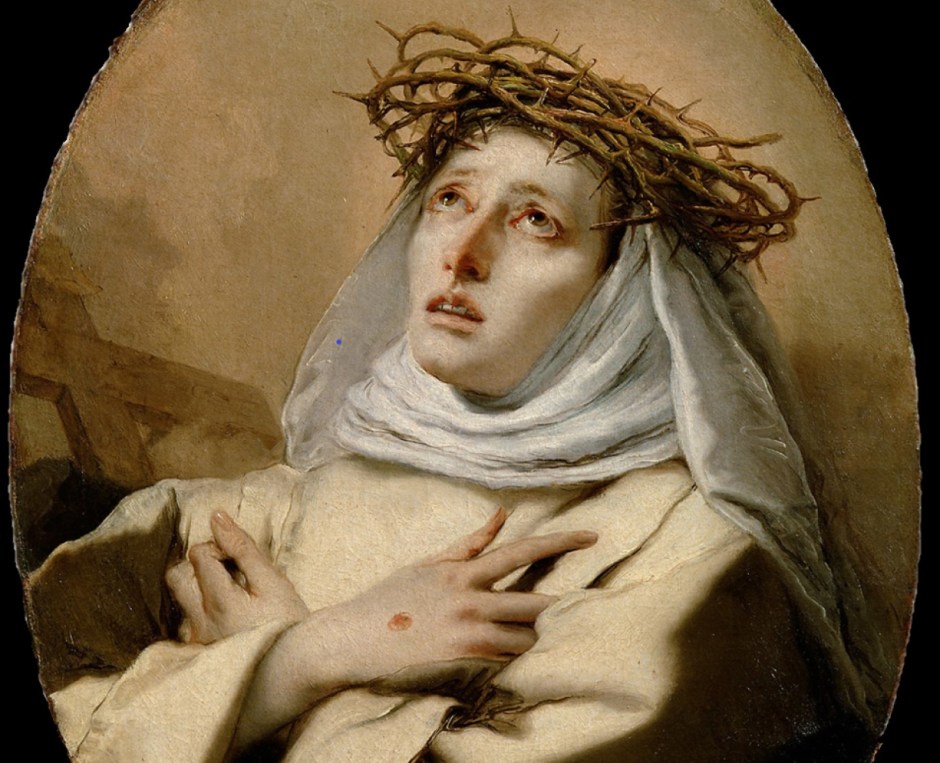
Prescriptions from the Doctors of the Church: Saint Catherine of Siena (March 25, 1347-April 29, 1380)

Saint Catherine of Siena is one of the thirty-six saints who are Doctors of the Church. The Doctors of the Church are renowned for their holiness and also for their important teachings. Using the doctor metaphor, we can say that in a sense each Doctor of the Church gives us a “prescription” for spiritual growth. Saint Catherine’s particular prescription for holiness will help be more focused on the important things in life.

Catherine Benincasa was the twenty-fourth of twenty-five children born to her parents, though only about half survived childhood. From a young age, Catherine had mystical visions and felt drawn to give her entire life to God. But her parents had other plans. When they began to arrange a marriage for her, Catherine resisted and took up extreme ascetical practices to demonstrate her firm resolve. Her parents eventually gave up and Catherine became a Dominican tertiary, living the Dominican spirituality within her family home.

For three years, Catherine lived in silence and solitude in a cell in her family home. After a mystical experience of union with Jesus, Catherine felt called to leave solitude and began aiding the ill and serving the poor. Gradually, she began to receive attention for her holiness and requests for advice from many prominent people. She dictated at least fifteen letters to Pope Gregory XI, insisting that he move back to Rome from Avignon—and he eventually relented. Around this time, Catherine began work on her Dialogues, the book of her meditations and revelations. Catherine died in Rome after a three-month illness. She was only thirty-three. She was canonized in 1461 and named a Doctor of the Church in 1970.

Catherine of Siena’s prescription: Think often about your salvation! Salvation comes through the blood of Christ.

Catherine reportedly died while saying “Blood! Blood! Blood!” It was a word she used often, over 1800 times in her writings. In using it she was thinking of the blood of Christ. The salvation of souls was of paramount importance to Catherine, and she knew that we are saved through the blood of Christ. She emphasized blood so that people would think about salvation more. She also stressed the reception of Christ’s blood in the sacrament of the Eucharist. Blood represents life, food, communion with Christ and with each other, and grace. It is a very rich concept and stands at the foundation of Catherine’s spiritual teaching.

Her love for Jesus spilled over into love for other people. Catherine could be found nursing the sick, feeding the hungry, teaching others about the great love God has for them. Because of her extreme penances, Catherine might seem odd or strange. Her mystical prayer life contained many visions and supernatural experiences. But she always insisted that apparitions don’t make a person holy; only love does. While she was deeply involved in working for the reform of the Church and in helping others, she never let go of the ultimate goal: salvation. And that salvation comes through the blood of Christ.

Some practical things to do:

  • Pray for the salvation of all people. Keep in mind especially those people who are wandering far away from God.
  • Pray the Divine Mercy chaplet, which is a way of praying by offering the blood of Jesus to the eternal Father. Here are instructions on how to pray it.
  • Perform one of the spiritual or corporal works of mercy as a way of showing love toward others.

Prayer

Saint Catherine, in your life you did unusual penances and experienced mystical phenomena. But that’s not what made you a saint. You became a saint because of your great love, love for Jesus first of all and then love of your neighbor. You  spent yourself in works of charity to aid the poor and the outcasts. Pray for us that we too might spend ourselves in love of neighbor by seeing Jesus in each person whom we meet. Help us to be authentic witnesses of the joy of the Gospel.

Feast: April 29
Patron: Italy, Europe, nurses and the sick; against fire, sexual temptation, illness, miscarriages

Selection from the writings of Saint Catherine

Eternal God, eternal Trinity, you have made the blood of Christ so precious through his sharing in your divine nature. You are a mystery as deep as the sea; the more I search, the more I find, and the more I find the more I search for you. But I can never be satisfied; what I receive will ever leave me desiring more. When you fill my soul I have an even greater hunger, and I grow more famished for your light. I desire above all to see you, the true light, as you really are.

I have tasted and seen the depth of your mystery and the beauty of your creation with the light of my understanding. I have clothed myself with your likeness and have seen what I shall be. Eternal Father, you have given me a share in your power and the wisdom that Christ claims as his own, and your Holy Spirit has given me the desire to love you. You are my Creator, eternal Trinity, and I am your creature. You have made of me a new creation in the blood of your Son, and I know that you are moved with love at the beauty of your creation, for you have enlightened me.

Eternal Trinity, Godhead, mystery deep as the sea, you could give me no greater gift than the gift of yourself. For you are a fire ever burning and never consumed, which itself consumes all the selfish love that fills my being. Yes, you are a fire that takes away the coldness, illuminates the mind with its light and causes me to know your truth. By this light, reflected as it were in a mirror, I recognize that you are the highest good, one we can neither comprehend nor fathom. And I know that you are beauty and wisdom itself. The food of angels, you gave yourself to man in the fire of your love.

You are the garment which covers our nakedness, and in our hunger you are a satisfying food, for you are sweetness and in you there is no taste of bitterness, O triune God!

From the Dialogue on Divine Providence, chapter 167

By Sr Marianne Lorraine Trouvé, FSP

Image Credit: Giovanni Battista Tiepolo via Wikimedia Commons

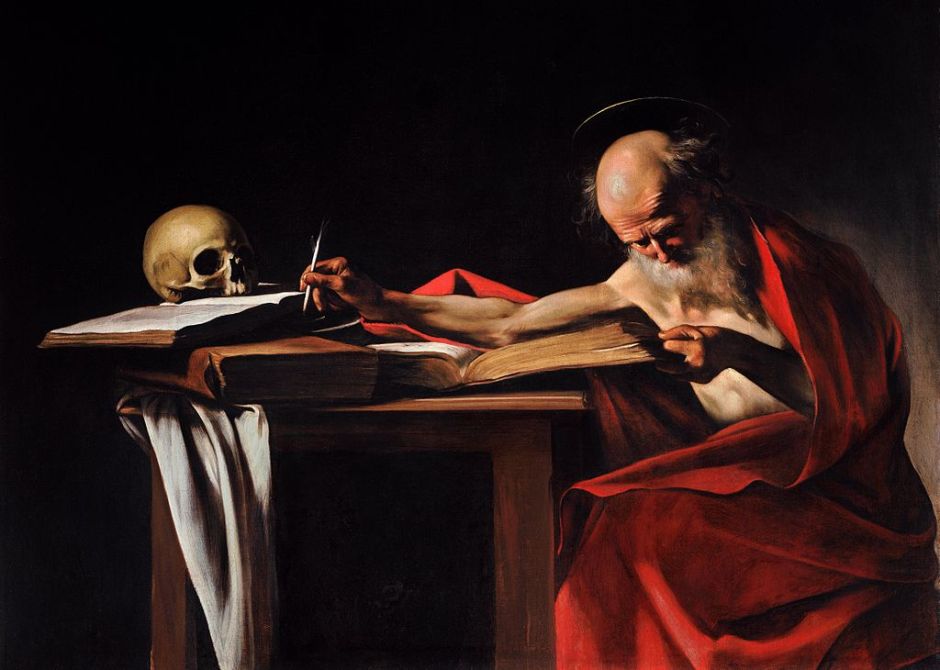
Prescriptions from the Doctors of the Church: Saint Jerome (c. 347-419/20)

Saint Jerome is one of the thirty-six saints who are Doctors of the Church. The Doctors of the Church are renowned for their holiness and also for their important teachings. Using the doctor metaphor, we can say that in a sense each Doctor of the Church gives us a “prescription” for spiritual growth. Saint Jerome’s particular prescription for holiness can help us in our daily fidelity in doing God’s will.

Jerome was born in Dalmatia and later went to Rome for studies. He converted to Christianity at about the age of eighteen and was baptized by Pope Liberius. Attracted by the ascetical life, Jerome traveled widely and was ordained to the priesthood in Antioch. He also studied for about two years under Saint Gregory Nazianzen in Constantinople. Back in Rome, Jerome became a secretary to Pope Damasus. The pope supported him despite Jerome being an unpopular ascetic who stirred up opposition with his acerbic wit and criticisms of lax clergy. When the pope died, Jerome decided to travel to the Holy Land.

Eventually, around 386, Jerome took up residence in a cave in Bethlehem. There he focused on his writing and on Scripture studies. An expert linguist, he translated the Bible from the original Hebrew and Greek into Latin. This translation, known as the Vulgate, became standard in the Church for many centuries. Jerome wrote extensive commentaries on the Bible and answered biblical questions from the entire Catholic world. He also directed a group of women ascetics and helped those in need. But for the most part, this brilliant man lived out his last years in quiet solitude, meditating on and translating the word of God.

Jerome’s Prescription: Read the Bible!

While Jerome wrote widely on many topics, he is outstanding for his work on the Bible, which is where we learn what God has revealed to us over many centuries. Jerome taught that the Bible is the Word of God and was written under the inspiration of the Holy Spirit. The human authors wrote according to their natural talents, but were inspired by the Holy Spirit, so that what they wrote is truly the Word of God. Through this Word we come to know the saving truth that leads us to salvation.

No matter what you think is wrong with the world today, the Bible is the answer because it gives us the basic, foundational truth about humanity and God. If people read the Bible and put what they read into practice, many problems would disappear. Just think of the Ten Commandments, for instance. Take merely one commandment, “You shall not steal.” Imagine what the world would be like if we could feel assured that no one was going to steal what we own. No fraud, no stealing, no forgeries, etc. Not only would society be a much safer place, but people would also be able to trust each other more.

On a personal level, reading the Bible brings us into relationship with God and in particular with Jesus. Jerome famously wrote that “Ignorance of Scripture is ignorance of Christ.” (From the Prologue of a commentary on Isaiah). (See Alba House book p. 121)

 If we want to know Jesus better, we need to soak ourselves in Scripture, especially the four Gospels.

How to read the Bible

Get a good Catholic study Bible and start to read it. It may be easier to start with the New Testament, which is already somewhat familiar to Catholics who listen carefully to the Mass readings each Sunday. If you read three chapters a day and five on Sundays, you can finish the whole Bible in about a year.

If your parish has a Bible study group, join it! It’s always easier to learn something together with others. Catholic online resources can also help you learn to read and understand the Bible better. For example, check out the Saint Paul Center online: https://stpaulcenter.com/ It’s best to stick with Catholic resources so you can be sure that what you are learning is according to Catholic teaching.

Some practical things to do:

  • Learn about lectio divina, a time-honored way of praying with Scripture.
  • Buy a Bible if you don’t have one. Read it!
  • Read one Gospel in one month.

Prayer

Saint Jerome, you devoted many years to studying the Bible and giving the fruits of your study to others. Pray for us that like you we may have a deep devotion to the holy Scriptures and let them illumine our path through life.

Feast: September 30

Patron: archaeologists, librarians, students, translators, Bible scholars

Selection from Saint Jerome:

On the benefits of reading Sacred Scripture:

Tell me whether you know of anything more sacred than this sacred mystery, anything more delightful than the pleasure found herein? What food, what honey could be sweeter than to learn of God’s Providence, to enter into his shrine and look into the mind of the Creator, to listen to the Lord’s words at which the wise of this world laugh, but which really are full of spiritual teaching? Others may have their wealth, may drink out of jeweled cups, be clad in silks, enjoy popular applause, find it impossible to exhaust their wealth by dissipating it in pleasures of all kinds; but our delight is to meditate on the Law of the Lord day and night, to knock at his door when shut, to receive our food from the Trinity of Persons, and, under the guidance of the Lord, trample underfoot the swelling tumults of this world.

Letter to Paula, 30, 13 as quoted in Pope Benedict XV: On Saint Jerome (Spiritus Paraclitus), no. 59. https://www.catholicculture.org/culture/library/view.cfm?recnum=3865

by Sr Lorraine Trouvé, FSP

Image Credit: Caravaggio, Public domain, via Wikimedia Commons