On May 15, 2022, Charles de Foucauld was canonized by Pope Francis. I have always been attracted by Charles de Foucauld’s spirituality, almost mysteriously so. The life I live is nowhere near his vocation as a desert hermit in the Sahara. Yet, in God’s Providence, I have felt there was always a connection, as have so many others.
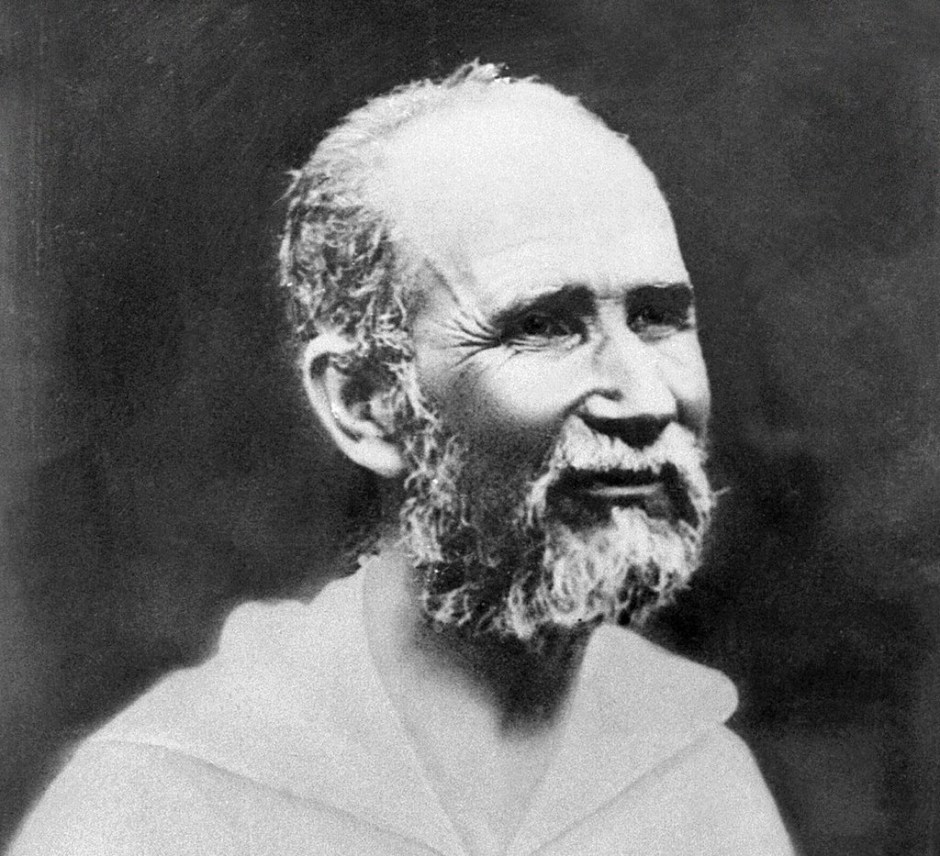
The short story of Charles de Foucauld’s life reads like this: he was born in Strasbourg France in 1858 into an aristocratic family with great means and privilege, he lost his faith as a teenager, he served as a soldier, then an explorer, had a conversion experience and became a monk, and finally a desert hermit, serving most of his years among the Tuareg people of Algeria.
He witnessed to his faith above all through his quiet example, without words. His desire was to live his faith through deep prayer and friendship and service to the people he came to know and love.
If you scratch the surface of his life, however, there is so much to this holy man that speaks to us today.
The tragic losses in the early years
When Charles was six both of his parents died just a few months apart. He and his sister lived with their paternal grandmother. One day they were out walking when a herd of cows came running at them. The grandmother was so frightened she had a heart attack, and shortly thereafter she died. The children went to live with their maternal grandfather who spoiled them.
After these tragic losses, it is no wonder that Charles grew up a very troubled young man. Through his reading he was led away from his faith and lost any sense of meaning in his life. His didn’t want to study. His grandfather got him into the military academy, and he finished at the bottom of his class. And that’s just a taste of his troubles. He was often disciplined for his behavior and openly paraded his mistress about town.
Charles was sent for military operations in Algeria, and in the mysterious ways of God it was there, that his journey back to God begave. It was through seeing the faith of the Muslim people who prayed together often during the day, these people who seemed to Charles to have this sense of the presence of God about them always, that his own journey towards faith began. Charles left the army after only a year of service and then spent a year exploring Morocco in disguise, since the country was closed to Christian Europeans.
God redeems the wounds we suffer on the way
One of the most beautiful things I think we can learn from the life of Charles de Foucauld is that our vocation unfolds gradually over time. We discover the meaning of our life little by little throughout the entirety of our life. We all come through experiences in our life that sometimes knock us off course, as we see in the life of Brother Charles. This journey that God leads each of us on redeems the wounds we suffer along the way. Because of the death of three important figures in his early childhood, Charles became rootless. However, this rootlessness that broke him in his earliest and most tender years, was transformed into a life that had no roots anywhere on this earth, but was ever and always a search to root himself in God. He wanted his roots to be in God’s will for him. Period. Praise God!
In his twenties, Charles became friends with his cousin Marie de Bondy who was like a second maternal figure to him. When he returned from Morocco and lived for a while with her and her family, he noticed how kind and intelligent and good she and her friends were and how warmly and respectfully they received him. Charles began to think that whatever it was they believed as Catholics couldn’t be that bad. But he just couldn’t get his head around the teachings of the Church…doctrines like the Trinity and the one person and two natures of Christ.
In his mid-twenties he went early one morning before Mass into a church, entered a confessional and announced to the priest Fr Henri Huvelin that he was not there for confession but wanted to talk about doctrine. Fr. Henri was famous for his gifts as a confessor and he realized immediately that Charles needed to meet Christ, not just talk about him and debate about doctrine. The priest told Charles to kneel and confess his sins. Amazingly, Charles did. After much time, and after sharing the troubles of his whole life, he left the confessional weeping. And then as Fr. Henri went to vest for Mass, he told him to receive Communion. That meeting of Charles with Jesus was so powerful, that later he wrote, “As soon as I knew there was a God, I knew I had to live for him alone.”
Father, I abandon myself into your hands
Even though many may not know the life and spirit of Charles de Foucauld, they probably have come across his famous prayer of abandonment:
Father,
I abandon myself into your hands.
Do with me what you will.
Whatever you may do, I thank you;
I am ready for all, I accept all.
Let only your Will be done in me, and in all your creatures.
I wish no more than this, O Lord.
Into your hands I commend my soul.
I offer it to you with all the love of my heart,
for I love you, Lord, and so need to give myself
to surrender myself into you’re your hands
without reserve and with boundless confidence
For you are my Father.
Amen.
Actually, this prayer was not written in this form by Charles de Foucauld. When Magdeleine Hutin founded the Little Sisters of Jesus based on the rule of Charles de Foucauld almost twenty years after he had died, she was looking through his writings for a prayer that could be used with her new novices. She found notes that Brother Charles had written in his journal when he had been struggling to decide if he should make solemn profession as a Trappist monk. He had entered the Trappists three years after his conversion, looking for the religious order in which he could live a life that was the most poor and obscure. The words that now make up the famous Prayer of Abandonment came from that painful struggle that had so seared his soul. He felt God calling him to Nazareth, to imitate Jesus in his poverty in complete obscurity, and he felt he couldn’t find this in the Trappists. The monks wanted him to study for the priesthood and had already decided that he should be the next novice master. This was exactly the opposite of all he wanted in following Jesus in Nazareth. So these words were written in a dark moment as he struggled to know what God was mysteriously calling him to do. It wasn’t clear to him. God didn’t show him the whole path of his life, every decision he should make. He had to abandon himself into God’s hands and pray, “Do with me whatever you will. I am ready for all. I love you, Lord, and so need to give myself….”
We can wonder sometimes if our life has any meaning. So many disparate starts and stops, choices that lead in opposite directions or even to dead ends. Brother Charles shows us through his life that there is a thread of meaning that very gradually emerges through the entirety of our life. We haven’t lived our life through to the end yet in order to see where that thread leads, and Charles was in the same condition when he wrote this prayer. But he knew one thing: he was ready to give up all and follow the Lord wherever he called him.
I like to think that this prayer of abandonment was in Brother Charles’ heart in some way through the many losses of his life. He was eventually ordained a priest at 43 and left for the Sahara, eventually creating a place to live, in a rugged, desolate land, Tamanrasset. He wanted to be among those who were “the furthest removed, the most abandoned.” He wanted all who drew close to him to find in him a brother, “a universal brother.” He wrote a rule for a community to gather around him and live the same way. In his lifetime no one came. He was alone, always alone, except for the beloved people he took care of in the areas around his lodging. “Father, whatever you may do, I thank you; I am ready for all, I accept all.”
On the evening of December 1, 1916, Charles was killed by a band of marauders who had encircled his lodging. Brother Charles knelt on the ground outside his hut, facing the wall, his hands behind his back.
“Let only your Will be done in me, and in all your creatures.
I wish no more than this, O Lord.
Into your hands I commend my soul.
I offer it to you with all the love of my heart….”
A group of soldiers rode up and in the confusion the man holding Brother Charles at gun point shot him.
I am ready for all, I accept all.
Let only your Will be done in me, and in all your creatures.
Everyone can live the spirituality of Nazareth
The poverty and obscurity of Jesus at Nazareth was an ideal for St. Charles de Foucauld that was determinative from the moment of his conversion to the very last moment of his life. We don’t have time here to go through the evolution of this Nazareth spirituality in Charles’ life, but just to touch upon the final evolution of this ideal, that can really guide us in this world in which people don’t want to hear what Catholics have to say, what Jesus invites us to in the Gospel.
When Charles settled down in the Sahara desert, he wanted to bring Jesus and his Gospel to others through a Nazareth way of life. This meant he would bring Jesus not through words but through a modest life of prayer on behalf of others, living among them, almost indistinguishable from them. When Jesus lived in Nazareth, he lived in our place, in our little town, the poorest most despised little town of Galilee. Charles would live in a place like this, living a spirituality of welcome, openness and presence among the people that lived around him.
I said earlier that no brothers came to share Brother Charles’ life. Eventually this holy desert hermit came to realize that Nazareth could be lived anywhere, in every life, in every vocation: religious, monastic, priestly, lay.
For St. Charles de Foucauld, the poorest of the poor are those who have not received the Gospel, or we could say, those also who have resisted or refused the Gospel. He wanted to bring the seed of the divine Word to as many of these poor people as possible. Every one of us can live this Nazareth spirituality. We can each in our own way, in wherever we are living and in whatever we are doing, bring the seeds of the Gospel through what we do, how we do it, why we do it.
Remember, Brother Charles’ life was transformed by a cousin who was respectful to this young man who lived a wayward and disgraceful life and who had long before left the faith. Without a word she was the instrument of God for this first thought that sent him on a lifetime journey of holiness: “Maybe what my cousin believes isn’t crazy. She is so good.”
Each of us today lives in mission territory. The new book Saint Charles de Foucauld: His life and spirituality is an easy but penetrating read that’s well worth the time you give to it. St Charles de Foucauld is the perfect companion for us who have to learn how to be Christ for others so often more by who we are than by what we say.
Pope Francis, at the canonization of St. Charles de Foucauld, spoke words so true of the new saint and for each of us, “Let us never forget this. Our abilities and our merits are not the central thing, but rather the unconditional, free and unmerited love of God. Our Christian lives begin not with doctrine and good works, but with the amazement born of realizing that we are loved, prior to any response on our part.”



 Touching the Sunrise