
One of the most spiritually life-giving verses of the Bible for me comes from Paul’s letter to the Romans: “For you did not receive the spirit of slavery to fall back into fear, but you have received the Spirit of adoption, by whom we cry, ‘Abba! Father!'” (8:15)
Slavery. Fear. Adoption. Abba!
Slavery—powerlessness, punishment, constriction, working for another, having nothing of one’s own—not even one’s own body…
Fear—to “fall back into fear” is to face the acknowledgement that there is no future, there is no hope, there is no belonging, only loss and despair…
Adoption—the “Spirit of adoption”: “For all who are led by the Spirit of God are sons of God” (8:14). “So you are no longer a slave, but a son, and if a son, then an heir through God” (Galatians 4:7).
Abba! Father!—The cry of the soul that has touched the utter loving reality of God’s being toward her, for her…. The exclamation at being saved and hidden now with Christ in God…. The song that issues from a heart that desires—at all times and in all things—to bend low in trusting worship.
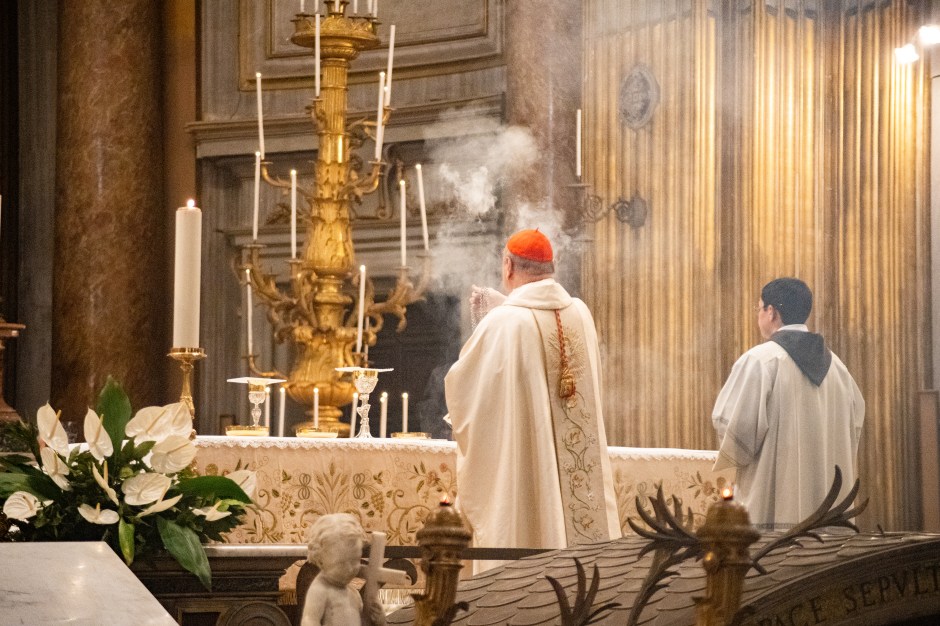
Dietrich von Hildebrand turns our eyes to the Liturgy where we learn this loving reverence through immersion: “The Liturgy is penetrated more than anything else by the spirit of true reverence. It is deeply permeated by the fear of God, by the cum timore et tremore (with fear and trembling), and at the same time by the consciousness that we are sons of God, in which we cry out ‘Abba, Father!’ It is full of the spirit of servire Domino in laetitia, of serving God in joy.”
In the Liturgy of the Hours, the Church prays a psalm at the beginning of each day which vividly “presents before our mind our own nothingness before God’s majesty, our absolute dependence on Him, [as well as] the fact that we belong to Him.”
The Lord is God, the mighty God,
the great king over all the gods.
He holds in his hands the depths of the earth
and the highest mountains as well
He made the sea; it belongs to him,
the dry land, too, for it was formed by his hands.
Come, then, let us bow down and worship,
bending the knee before the Lord, our maker,
For he is our God and we are his people,
the flock he shepherds. (Psalm 95)
The Mass is also pervaded with this reverence.
The Mass is pervaded with this consciousness of “his absolute dominion, and the acknowledgment that we receive all from Him.”
“Glory to God in the highest,
and on earth peace to people of good will.
We praise you, we bless you,
we adore you,we glorify you,
we give you thanks for your great glory.”
“It is truly right and just, our duty and our salvation,
always and everywhere to give you thanks,
Lord, holy Father, almighty and eternal God,
through Christ our Lord” (Preface I of Sundays of Ordinary Time).
“Holy, holy, holy, Lord God of hosts. Heaven and earth are full of your glory. Hosanna in the highest.”
“When these words are sung, how especially are we enveloped in the deepest reverence before God and drawn in to the true situation of the creature in relation to God.”
Its spirit is that of the “Introibo ad altare Dei, ad Deum, qui laetificat juventutem meam” (I will go in unto the altar of God, unto God, who giveth joy to my youth). This attitude is one which finds its expression in the “Quoniam in aeternum misericordia ejus” (For His mercy endureth forever), the “Gustate et videte quam suavis est Dominus” (Taste and see how sweet is the Lord), the “Misericordias Domini cantabo in aeternum” (I shall sing through all eternity the mercies of the Lord). Let us recall the upward glance which marks the beginning of each day, the “Deus in adjutorium meum intende, Domine ad adjuvandum me festina” (O God, come to my assistance, O Lord make haste to help me).
How much more our hearts would be nourished in the Mass if we were to step through the door of repeated words into the larger theme of reverence which pervades every prayer and posture and gesture of the Liturgy. If we were to become reverence, in a trusting worship of our Father.
Quotations from Dietrich von Hildebrand, Liturgy and Personality, Chapter Five.
Featured image: by Lupe Belmonte

 Touching the Sunrise