Soften your heart: How to keep love alive in violent times

“O Lord, remember not only men and women of good will, but also those of ill will. But do not remember all the suffering they inflicted on us. Remember the fruits we have borne thanks to this suffering: our comradeship, our humility, our courage, our generosity, the greatness of heart which has grown out of this; and when they come to judgment let all the fruits that we have borne be their forgiveness.”

~ Written on a piece of wrapping paper found near the body of a dead child in Ravensbruck, the second largest concentration camp for women in the German Reich, where 92,000 women and children died in the Holocaust.

How, O my God, could a woman in this death camp write these words?

How did she find the courage to keep her heart open? To care about the eternal salvation of those at whose hands she suffered and very likely died?

Friends, today we also are living through turbulent and violent times. As we watch the social fabric of our nation disintegrate with mass shootings and watch with horrified anger at what Russia is inflicting on the Ukrainian people and the world, we may find our hearts closing. It could be that our hearts are hardening in fear or anger without our even realizing it. Whatever we are feeling, it is okay. We might feel overwhelmed at the prospect of the future for our children and grandchildren. It is okay. We might feel lost in the midst of everything that is going on around us. It is all okay.

How difficult are you finding it to love and believe in the power of love in these days?

The news cycle overwhelms and incites the fires of anger and fear and hatred in our minds and hearts. It all can feel so righteous, so right. After all, there is a clear bad guy in these incidents, and our hearts immediately take the side of the innocent victims. Today only the bravest can keep lit in their hearts the flame of charity. 

Pema Chodron in Practicing Peace in Times of War counsels us, “We have to take responsibility when our own hearts and minds harden and close. We have to be brave enough to soften what is rigid, to find the soft spot and play with it. We have to have that kind of courage and take that kind of responsibility.”

The tiny snippet of paper found alongside the body of a child who had died in Ravensbruck, this one prayer that testifies to a love greater than death, could so easily have been lost to history. It is a testament to someone who courageously took responsibility, in the most atrocious suffering, to soften her heart. How many others there must have been in these concentration camps who lived and died with soft hearts! We’ll never know the hidden and silent acts of heroism among those who perished as well as those who survived.
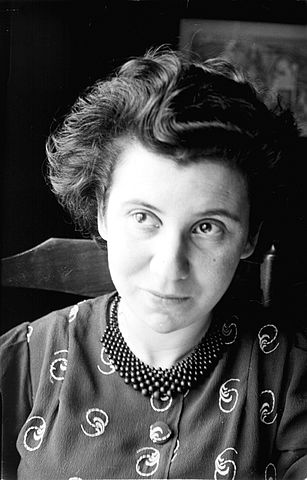
I think of Etty Hillesum who at the age of twenty-eight was murdered in Auschwitz. She became known to the world when her diaries were published under the title An Interrupted Life. The diaries reveal a heart that could not be sullied even by the evil she saw.Israeli author Aharon Appelfeld honored her in his preface to the Hebrew translation of the diaries saying she was one of those who “on the edge of the abyss, rise to become saint-like.” He compared her to Janusz Korczak, the director of a Jewish orphanage in Warsaw, who in 1942 declined an offer of sanctuary and accompanied the children to the Treblinka extermination camp.

We too stand on the edge of an abyss. We are in the midst of turbulent changes that will transform Europe and the world as we know it. Just as Etty and Janusz and the woman who wrote the note in Ravensbruck  couldn’t see into the future to understand the full horror of World War II and what lay beyond it, neither can we from the vantage point we have now comprehend the transformations in society the world is undergoing or where it will lead us as a human family.

3 ways to keep love alive in violent times

I want to offer three ways to open our hearts, soften our hearts, live with hearts set on fire with the love only God can give us. These three suggestions I have culled from the diaries of Fr. Christophe Libreton, the youngest of the seven Trappist monks assassinated in Algeria by terrorists in 1996. Their story has been dramatized in the film Of Gods and Men, and Christophe’s journals have been published in the book Born from the Gaze of God.

1. In each Eucharist we celebrate the victory of the Living One over against those who kill.

When his two friends Henri and Paule-Hélène were killed by the Islamic terrorists in Algiers a year before his own assassination, Christophe wrote these words in his journal on May 29, 1995: “After the murders of Henri and Paule-Hélène, our Christian community is marked, just like the people at large, by this shed blood—shed unjustly by the assassins and quite often courageously offered by their innocent victims. And then there is the blood of Christ, which gives life and offers us communion in eternal life…. In each Eucharist we celebrate LIFE: the victory of the Living One over against those who kill. This celebration overflows into a service of charity, exercised by each one according to the measure of his gift of faith: ‘caring for all life, and for the life of all’” (page 158).

The heart’s capacity to open outward in love flows from the victory of Jesus Christ over sin and death.

A way to keep your heart open:

At Mass we live already what the world will become when the Kingdom of God arrives and the will of God is done on earth as it is in heaven. Give as much time or more to prayer, the Mass, and Eucharistic adoration as you give to following and discussing the news.

By sharing life, giving life, sacrificing ourselves for the life of all, in whatever way you can, you overcome the power of death at work in the world with the power of love.

2. Open your heart for we belong to each other

In his meditation on March 11, 1995, Christophe reflected on the Gospel reading of the day: “I say to you, love your enemies and pray for those who persecute you, so that you may be sons of your Father who is in heaven; for he causes His sun to rise on the evil and the good, and sends rain on the righteous and the unrighteous” (Mt 5:44-46).

Christophe recorded his thoughts in his journal: “What’s at stake is love: non-exclusive, unlimited. Excessive love. Prayer for those who kill people (they haven’t threatened us explicitly yet, despite the arms they undoubtedly were ready to use against us) sustains our relationship with them. It also disposes us interiorly and identifies us as sons of the Father with regard to brothers who are also his beloved sons” (page 144).

These are hard words to hear, even more difficult to live. My heart wants to scream out No, I will not love a murderer, I will not love a perpetrator of war.

I, however, will only be truly human when I can love with an unlimited love that can embrace even the bad guy. It goes against all logic to call a murderer brother. We humans so want to charge the guilty, to dismiss them to the shadows of punishment where we no longer have to think of them again.

Fr. Christophe’s words are reminiscent of Mother Theresa’s admonition: “If we have no peace, it is because we have forgotten that we belong to each other.”

A way to keep your heart open:

Every snippet of news is a call to enter into the lives of our brothers and sisters. Whenever you see the headlines of news on the internet, television, or social media, whisper a prayer for everyone involved. Be honest with Jesus about what you are experiencing and feeling in the face of the tragic event, and plead with him for all of those who are affected. You could use words such as these: “Jesus, I am angry about this. What is happening makes me nervous about the future of society and the world. I worry about my own family. About the future. But right now, I beg you to send your angels to comfort the victims, to hold in your powerful care all those who are suffering from this. And yes, Jesus, this is hard for me, but I ask you to have mercy on the one who did this. Stop him. I pray that peace may be restored. Through your divine mercy change his heart. Help us all. May your Kingdom come. And, Jesus, I pray that this person who has created this tragedy may be with me in heaven. Father, we both are your children. Have mercy.”

You could pray the rosary, or favorite novenas or litanies for particular individuals or groups suffering in the world today.

3. Rest your head on the heart of Christ

Christophe looked out onto a world where there seemed to be no future in sight, where everything possible for peace was blocked, where there seemed to be nothing and no one that could stem the tide of violence. The monks at Tibhirine were becoming increasingly aware that this violence would also one day snuff out their own lives.

Yet as Christophe struggled with the thought of his own death, as he grew in trust of God’s providential care even in the midst of the evil all around them, his began to undergo a transformation of heart, almost a transplantation of heart, so that Christ’s own heart on the cross replaced his human and faltering heart. In time he no longer feared for his own life. He wrote at the end of 1994, “Ah, if dying could stop and prevent the death of so many others, then I would gladly say: Yes, I volunteer” (page 128).

Just today I read the account of drivers who are going into the war zones in Ukraine to bring humanitarian aid and to ferry out civilians who are stuck in cities now demolished by constant missile attacks and artillery fire. These individuals run into the danger because they know there are women and children who can’t save themselves and who need someone to bring them out. Many of those left are the elderly who need to be carried from their homes. It is in times of trial that we discover truly who we are becoming.

In his journals, Christophe includes quotes from various sources he was reading in those days. I have been greatly moved by this selection from Father Lev Gillet, speaking about the Apostle John who alone remained on Calvary with Mary Jesus’ mother:

… “ ‘The only one who remained standing in the hour of affliction was the one who, the night before, had bent his head to rest it on your breast’ (Father Lev Gillet, Un moine de l’Église d’Orient [“A Monk of the Eastern Church”], by Élisabeth Behr-Sigel, Éditions du Cerf, p. 311). I want to rest my head on you….”

What did the apostle John hear as he rested his head on Jesus’ chest? He heard the beating of a Heart overwhelmed with love, a great love, greater than any love ever known on earth. It was the beating of the Sacred Heart of the Savior of the world who would shortly give his life for this youngest Apostle and for all of us. Because the beating of that heart remained in the apostle John’s memory, because he had, in a certain sense, synched the beating of his own heart with that of the Sacred Heart, John could stand beneath the cross, where his Lord and Master died in an act of atrocious violence. John could stand there still loving, remaining in love, abiding in love, in that love that flowed from the Heart of Jesus. He saw how Jesus loved through it all.

A way to keep your heart open:

Give your life to others in an ever-growing divine love. No doubt, in some way, you are already giving your life, putting yourself on the line for others. It may be for your family, those you care for in ministry or career, elderly parents…. We can serve others for many reasons: it’s a good job, it’s what is expected of me as parent or daughter, it makes me feel like my life has meaning, it puts the dinner on the table, it’s what I always wanted to do in life…. None of these are bad reasons for giving of ourselves to another. However, this moment in history calls us to something more, to a love that is greater. At this moment raise your intentions to the supernatural level. Resolve to serve because you love. Resolve to serve because you care about the others. Resolve to serve even at the cost of your life. Resolve to love with the very love of Jesus who gave his life for us.

Greatness begins with the heart

Friends, we are living in times that call for greatness, and greatness begins with the heart. We can all begin right here, wherever we are, right now, to become giants in the love that beats in the heart of Christ.

Brother Luc, the medical doctor who served in the community where Fr. Christophe lived in Algiers prayed at the prayer of the faithful on December 31, 1993: “Lord, give us the grace to die without hatred in our heart” (page 25).

In the spirit and vision of Israeli author Aharon Appelfeld, may we “on the edge of the abyss, rise to become saint-like.”

O Lord, remember not only men and women of good will, but also those of ill will. But do not remember all the suffering they inflicted on us. Remember the fruits we have borne thanks to this suffering: our comradeship, our humility, our courage, our generosity, the greatness of heart which has grown out of this; and when they come to judgment let all the fruits that we have borne be their forgiveness.

Image Credit: Christian R. Rodríguez via Cathopic

The Ascension: a tremendous transition for us all

Beloved in Christ!

With what tenderness must have Jesus looked upon his apostles and disciples gathered on Mount Olivet…

Those final moments when they were alone, forty days after he rose from the dead…

With what joy did he look into each of their eyes that last time he saw them in his human body on this earth, flooding his heart with their face and the dearest memories of who they were, their characteristics, their love for him, their potential, their spiritual growth in the previous three years. Memories of conversations, struggles and victories, secrets of their heart…

These beloved friends who had been such a part of his life and mission and paschal mystery (yes, even in their failure, for their betrayals and fleeing from the cross have given us hope in our own fears and disloyalty)…

As he blessed them…  And withdrew from them… Here still in his blessing… Taken from their sight…

“When Jesus had said this, as they were watching, he was lifted up, and a cloud took him from their sight” (Acts 1:9).

The ascension was a moment of tremendous transition for Jesus, for Mary, for the Apostles and disciples, for Mary Magdalene and the women who had faithfully tended to their needs. Yes, clearly Jesus had gone and, as the angels said, would return one day. They had been told by Jesus to return to Jerusalem to await the coming of the Spirit. (And what a transition that was for these fearful and self-centered novices of the Lord who became the fearless messengers of the risen Jesus who had loved them, filling the world with his holy Name!)

But there is another hidden transition that affects you and I as well. Today. Right now. And how we need to hear this good news!

If Jesus is seated at the right hand of the Father, we are as well.

We dwell not only here on earth, looking forward to the happiness of heaven in an eternity beyond time, but now… right now… you and I… as members of the body of Christ who is our Head… as children of God… as inheritors of the kingdom of heaven… We dwell eternally in glory even now.

Ascension is not just about Jesus, his destiny, his glory…. It’s not like we peer into a heaven to see the Lamb seated on the Throne while we trudge through our lives on this earth alone… The ascension is about our present reality… here… now… today….

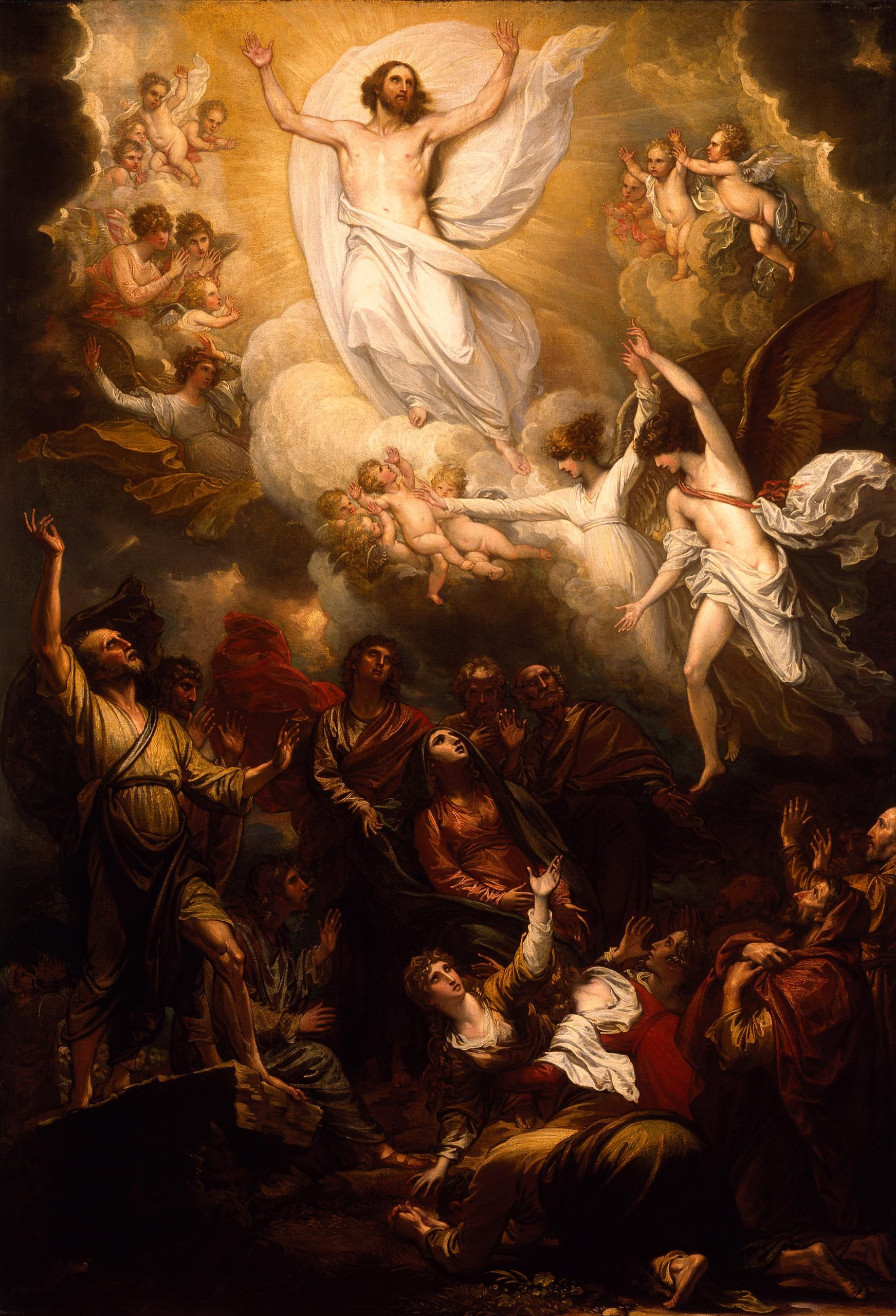
Benjamin West (1738-1820) The Ascension; Berger Collection

The truth is, “Jesus is not glorified in his own Person only. His Apostles had fed upon him [and so have we], had his body within them, by virtue of the Holy Eucharist…. Now upon his Ascension, His body in them is glorified instantaneously with the glorifying of his body at the right hand of God. Like an electric flash the glory of the Spirit shines out in the fires of Pentecost. The body of Christ, however veiled in our flesh, in our sinful persons, nevertheless cannot but have the glory of the Spirit of holy fire burning and resting upon it. We do not, I think, dwell as we ought to dwell upon the present glorification of our nature in our own persons, as members of the glorified body of Christ” (Benson, Richard Meux Further Letters, pages 268-269).

If Jesus is seated at the right hand of God, we are as well, as members of his body.

So, friends, look to the glory.

As Paul reminds us, “and all of us, with unveiled faces, seeing the glory of the Lord as though reflected in a mirror, are being transformed into the same image from one degree of glory to another; for this comes from the Lord, the Spirit” (2 Corinthians 3:18).

The Mass is a remembrance of Christ’s passion and pledge of future glory. In the Eucharistic liturgy the Ascension is celebrated again and again by us, in via, on the way. It is the holy banquet in which Christ is received. “Here heaven and earth meet, constellated around the ascended Christ who brings humanity into the very heart of the Godhead…. We need to rekindle the Catholic eschatological imagination: to realize anew Jesus Christ’s ascension as inaugurating the transfiguration of humanity and to envision boldly the cosmic scope and implications of that decisive and ongoing event” (Fr Robert Imbelli, Ongoing Ascension, May 10, 2018).

So, friends, may this year’s celebration of the Ascension and Pentecost be a moment of transition for you. We are invited in each Mass to lift up our hearts and we exclaim, “We have lifted them up to the Lord!” Raise your eyes from this earth. Upwards! Lift up your hearts! Dwell already where Christ is seated at the right hand of God. “Set your minds on things above, not on earthly things. For you died, and your life is now hidden with Christ in God. When Christ, who is your life, appears, then you also will appear with him in glory” (Colossians 3:2).

Image Credit: Benjamin West, Public domain, via Wikimedia Commons

Now heaven is present on the earth

The Solemnity of the Ascension can be eclipsed for most of us by the Resurrection, Good Friday, and Christmas. For me, the Ascension is a liturgical feast that draws me inward and upward. Pope Benedict stated in his homily for the Ascension in 2013: “Christ’s Ascension means that he no longer belongs to the world of corruption and death that conditions our life. It means that he belongs entirely to God. He, the Eternal Son, led our human existence into God’s presence, taking with him flesh and blood in a transfigured form.”

My human existence led into God’s presence as Jesus took with him flesh and blood in a transfigured form….

My human existence led into God’s presence…

My human existence…

St. Augustine said that although Jesus ascended to the Father alone, “we also ascend, because we are in him by grace.”

We are led by Christ into the new world of the resurrection, where all the members of his body are drawn upwards to the Father in heaven.

The apostles, in the reading today, were still wondering when Jesus was going to restore the kingdom to Israel. His answer to them is that they “would receive power” when the Holy Spirit was given to them:

“You will receive power when the Holy Spirit comes upon you,
and you will be my witnesses” (Acts 1:8).

In other words, Jesus directs their attention to this “new world of his resurrection.” After being brought to the life by the Spirit, they were to set their minds and hearts on things above where Christ is, not on earthly things (cf. Col 3:1-2).

In the early Church the Christians placed the Christ of the Ascension in the dome of their Churches to remind them that Christ ascended to his Father in heaven and that he was returning.

“Come, Lord Jesus!”

In a world of turmoil and crisis in which so many are suffering unjustly and needlessly, we can pray daily, “Thy Kingdom come! Thy will be done on earth, as it is in heaven.”

“Come, Lord Jesus!”

Perhaps we feel that we cannot effect the change the world so needs, but we can be that change. With our faith in Jesus Christ who is real, the strength of our belief in the kingdom present and among us in Christ who is close to us in our every need, we can experience how we are changed, how heaven is present on the earth and every sorrow, every closed door, every crisis is but a window to his drawing us with him to the Father, through the power of the Holy Spirit.

Photo Credit: Wolfgang Sauber, <a href="http://CC BY-SA 4.0, via Wikimedia Commons

You have been called with a purpose

Here at the end of the beautiful month of May and near the end if the Easter Season, the difficult and heart-wrenching days of the paschal triduum and the suffering and betrayal of the Lord are in the mists of my memory. This reading, however, brings me back with joy to those sorrowful days.

At the Last Supper we got a snapshot of the spiritual state of the apostles before the passion and death of their Master…before their dismal failure to stand with the One who was their Life. Peter boldly proclaimed at that Passover supper that he would die with Jesus, only a few hours later to declare he didn’t even know him. All of the Twelve wanted to be sure that they weren’t the one who would betray the Lord. “Is it I, Lord?” they each asked.

As Jesus walked into the mystery of his salvific death, alone, abandoned by his chosen Twelve, they each learned what they were capable of doing without their Lord and Master. Nothing. They each in some way abandoned Jesus. Before, they had fought with each other to see who would be the greatest, who was the most important, and Peter had tried to convince Jesus that the cross and death in Jerusalem was really not a good idea for the Messiah. In those dark and fear-filled days after Jesus died on the cross something happened to each of them.

The Apostles learned existentially that they were completely dependent on Jesus. They needed him for absolutely everything. Without him they were nothing, like branches cut from the vine. For each of them it was a crisis, a turning point, a transformation as they painfully emerged into who they were truly to be in the Kingdom: the foundation stones of the holy city Jerusalem in heaven.

“The wall of the city had twelve courses of stones as its foundation,
on which were inscribed the twelve names
of the twelve apostles of the Lamb” (Rev 21:14).

Moments of failure, of change, of challenge…we all have them. They are stages in our life in which we are still who-we-were and not quite yet who-we-will-be. And this liminal stage of confusion and darkness is what makes these times in our life so painful.

These transcendent crises come into my life on a regular basis. Sometimes the loss and confusion even last several years as I integrate who I was with who I am becoming, who I have been with who God has made me to be, my next step on the journey of my response to the call and grace of God. These are graced transitions.

If you are in one of these transformative crises in your life, take heart from the Twelve apostles. You may not be a stone in the foundation of the holy Jerusalem, and the Twelve certainly didn’t think they were during the 40 days after the resurrection when they remained fearfully hiding away. You have your own place in that holy city. You have been called with a purpose. Every event in your life has meaning. And no matter what you have come through or come from, God is working actively through every aspect of your daily life to keep moving you toward the fullness of what he has created you to be. Rejoice. Alleluia!

Image by Andrey Grachave on Pixabay

No power of evil can take us from Jesus’ hand

“These are the ones who have survived the time of great distress.”

This is one of the most powerful lines in the second reading for Good Shepherd Sunday, the Fourth Sunday of Easter. In this reading from the book of Revelation (chapter 7), evil exists only as something that has been eliminated through the victory of Christ, through the triumph of the blood of the Lamb….

Evil no longer has any power to destroy God’s people….

A vast multitude of women and men from every nation, race, people, and tongue worship the One who sits on the throne. They fear the powers of evil no longer, for they have survived the time of great distress and are now shepherded by the Lamb who wipes every tear from their eyes….

No tears.

No hunger.

No thirst.

No wounds.

No death.

No war.

Nothing but the triumph of love….

In the Gospel of John, Jesus says, “I give them eternal life, and they shall never perish. No one can take them out of my hand” (Jn. 10:28).

On August 1, 1943, eleven sisters of the Sisters of the Holy Family of Nazareth stood in a secluded spot in the woods about 3 miles from Nowogródek, located in what is now central Belarus. The town had been occupied by the German army since 1941. The sisters were an integral part of the town and had helped the community find hope and faith through the days of “distress” in which half of the population had been murdered because they were Jews. Now, the sisters huddled around a mass grave.

When the women of the town had turned to the sisters to pray for the release of their husbands and sons who had been arrested and slated for execution, the sisters gathered to discuss what they could do. Unanimously they had expressed their desire to offer their lives in sacrifice for the prisoners.

The Superior of the community, Sister Maria Stella, C.S.F.N., shared the community’s decision with their local pastor, Father Zienkiewicz, telling him: “My God, if sacrifice of life is needed, accept it from us and spare those who have families. We are even praying for this intention.” Shortly thereafter, the plan for the execution of the prisoners was changed to deportation to work camps in Germany, while some were released.

When the life of their local pastor was threatened, the sisters renewed the offering of their lives: “There is a greater need for a priest on this earth than for us. We pray that God will take us in his place, if sacrifice of life is needed.”

The youngest sister, Sister M. Boromea, was just twenty-six. The oldest sister and superior, Sister M. Stella of the Blessed Sacrament, was fifty-four. With one heart and soul the eleven young religious now stood together awaiting their death. The Lord had accepted their sacrifice. They, like Christ himself, the Lamb upon the Throne, had offered their lives for their brothers and sisters. As they were gunned down by the Gestapo and buried in a common grave, they had indeed “survived the time of great distress” because they had loved others more than preserving their own life. No power of evil, no weapon on this earth, could take them from Jesus’ hand. “I give them eternal life, and they shall never perish.”

Declared martyrs by Pope John Paul, he said of them at their beatification in 2000, “Together and unanimously they offered their lives to God, asking in exchange that the lives of the mothers and fathers of families and that of the local pastor be spared. The Lord graciously accepted their sacrifice and, we believe, abundantly rewarded them in his glory.”

Friends, we all face the power of destruction in our lives. We may face it in personal wounds, our own or those of loved ones, and in the powers of evil set loose in the world. These eleven martyrs teach us four important things:

  1. We will not perish. God has us in his hands. Nothing and no one can take us out of his hands.
  2. Only love is victorious, a love modeled on the self-giving heart of the Shepherd. No tanks can destroy that love.
  3. Our lives unfold in the time of great distress, but we do not need to fear what is happening around us because of who is in us.
  4. No matter the power of destruction that rages in our times, we need to wash our robes and make them white in the blood of the Lamb, and we too will stand before the throne and before the Lamb where God will wipe away every tear from our eyes, because death and evil at last will be no more.

I’m tired of storms

I must admit that I am tired of storms. I’m worn out trying to find my life story—my Covid pandemic life story—reflected in the apostles’ experience of storms at sea.

I’m exhausted trying to outsmart an invisible enemy.

I’m finished for a while with helping people make sense of what has been senseless suffering in their lives for these past two years.

The global consequences of the pandemic are so overwhelming I want to just sit down and cry. I long for the former days that seem in misty memory to have been more carefree and happy.

So the words that attracted my attention in the Gospel reading in today’s liturgy were these: “the boat immediately arrived at the shore to which they were heading.”

The apostles wanted to take Jesus into their boat. They were prepared to take charge and figure out the next best thing to do.

Oh, how much of my life I’ve spent doing precisely this. These past two years that have been not only pandemic-riddled but also have been years of great loss on different levels have finally worn me out. I certainly don’t know the next move and I’ve finally acknowledged that I certainly don’t have what it requires to take the situation in hand and plot a way forward.

If you feel this way, just a little, trust in the Lord who brought the boat immediately to the shore to which they were heading. Sometimes we get taken to places in our lives that we would never have gone on our own, places that we would never have chosen, that we still don’t entirely comprehend. Somehow through it all we are taken by God to a shore where we are safe, yet we don’t how we got there, where we are to go, or how we are to get there. We simply realize that God himself did it for us because he loves us poor storm-weary children.

It is a place of trust and of magnificent wonder: God is taking us somewhere, and he is doing it on his own, surprising us with his power, surrounding us with his love. “Do not be afraid,” he says. “It is I.”

I want to finish this reflection with three lines that perfectly express my prayer in these days. They are from a poem by Marie Noël (The Hours: Prime) found in the book Born from the Gaze of God: The Tibhirine Journal of a Martyr Monk (1993-1996).

Father, carry my soul in its carefreeness
To where you want, and let it sleep in your hand
Without asking the meaning and the goal of the road.