Sursum corda—Upward, hearts!

My friends, look up! Look up not in imitation of the apostles who watched Jesus leave them as he was lifted into the heavens.

Look up to see his coming! The feast of the Ascension “is the ever-new ‘moment’ of Christ’s coming,” says Jean Corbon in his masterful text Wellspring of Worship.

The early Christians, who commissioned great mosaics of the ascended Lord in the apses of their ancient basilicas, knew that when they gathered to manifest and become the body of Christ in the liturgy, Jesus Christ was manifested as both present, here among them, and as coming. He, who ascended to the Father’s right hand, was constantly drawing us, his body, after him.

Translated that means, the ascended Christ brings humanity into the very heart of the Godhead.

In a recent class on liturgical theology the professor said it this way: The divine persons of the Trinity have invited created persons into the home in which they live in their perfect communion of life. Everyone’s “home address,” in a sense, will one day be the Holy Trinity.

These next few weeks we will immerse ourselves in the mysteries of the Ascension, Pentecost, the Feast of the Most Holy Trinity, the Feast of the Body and Blood of Christ, and the Feast of the Sacred Heart of Jesus.

Entering the life of the Trinity

In these day reflect upon the most momentous moment of your life: your baptism.  In this sacrament you experienced an event, the action of the holy Trinity that changed the course of your life forever.

Through your baptism you were incorporated into the love of Christ and the life of the Church. In being washed by the waters of Baptism, you were forever changed and are sealed with an indelible spiritual mark, or character, that enables you to participate in a full sharing in the life of the Church.

The Catechism states that this sacrament “signifies and actually brings about death to sin and entry into the life of the Most Holy Trinity through configuration to the Paschal mystery of Christ.” (CCC 1239)

Start reflecting on your baptism here >

Sanctified and divinized by the Spirit

From the very beginning of Christian history, holy men and women have reflected on Christ’s presence in the Eucharist and have taught that the sacred transformation that occurs in the eucharistic liturgy is a sign and a cause of the transformation that should occur in the lives of all those who receive this great sacrament of Christ’s love.

It is the Holy Spirit who sanctifies and changes the bread and wine during the Eucharistic Prayer at Mass into the body and blood of Jesus. It is the divine Holy Spirit who sanctifies and divinizes people through the Eucharist. Cyril of Alexandria testifies to this when he wrote: “The holy body of Christ then gives life to those in whom it is […] being commingled with our body.” And also, ultimately, the aim of partaking of the Eucharist is for believers to be made partakers of the divine nature, to be made holy (On John).

Deepen your reflection on the Eucharist here >

10 ways to live a more contented life

“I am definitively loved and whatever happens to me—I am awaited by this Love. And so my life is good.”

These are the words of Saint Josephine Bakhita, who as a young girl had been sold into slavery in the Sudan and had suffered indescribable suffering, torture, physical and psychological abuse.

Knowing that she was loved and always had been loved through her whole life led to great happiness for Bakhita. Knowing ourselves to be loved we can surrender ourselves to Love even in the unfairness of life because we are certain that Love is with us. “I am awaited by this Love.” This Love is a person who deeply cares about me. His love alone is what makes my life good.

We most probably will not live through as destructive an experience as slavery and human trafficking as did Bakhita, and yet trauma does touch in many ways our spirits and sear our souls. For some of us more than others. But all of us in some way bear wounds that bring tears to our eyes.

Often it can take many years, often well into our adult life, until we can settle into a deep awareness of being loved. Encountering Jesus in the sacraments chips away at our fears and heals our wounds so that we can so gradually begin to sense that our spirits live on the very Breath of God.

Read Josephine Bakhita’s incredible story and 10 ways to live a more contented life >

My friends, remember: Sursum corda—Upward, hearts!

Image Credit: Benjamin West, Public domain, via Wikimedia Commons

Eat and Drink the Full Presence of Christ (Contemplating the Easter Mysteries IV)

In the Easter season, we the baptized reflect on how we have the amazing grace at each Eucharistic celebration of being brought to the table to eat and drink the full presence of Christ. Saint Gregory of Nyssa wrote: “Faith is the womb that conceives this new life, baptism the rebirth by which it is brought forth into the light of day. The Church is its nurse; her teachings are its milk, the bread from heaven is its food” (Oratio 1 in Christi Resurrectionem),

Jesus “addressed these words to us: Unless you eat my flesh and drink my blood, you will not have life in you. Daily it is before our eyes as a representation of the passion of Christ. We hold it in our hands, we receive it in our mouths, and we accept it in our hearts” (from a sermon by Saint Gaudentiu of Brescia, Tract 2).

To break open just how amazing this is, I want to share with you an image that comes down to us from Cyril of Alexandria. In the 5th Century he was the Patriach of Alexandria and is considered a Church Father and Doctor of the Church. This great bishop and teacher used the image of melted wax to help people understand their union with Christ through the Eucharist. Imagine that you are making homemade candles. After setting the pot over a heat source, you would add wax, sometimes different pieces of wax, and then allow the wax to melt. The resulting candle is a new piece of wax. The first piece of wax is now in the second, and the second is in the first. In the same way, when you receive holy Communion you are truly partaking of the flesh and blood of Christ. When you nourish yourself on the Eucharist you are now found in Christ and Christ is found in you, as we see in the image of the two pieces of wax that have been melted together. Saint Cyril of Alexandria said it this way: “For as if one should join wax with other wax, he will surely see (I suppose) the one in the other; in like manner (I deem) he who receives the flesh of our saviour Christ and drinks his precious blood, as he says, is found one with him…so that he is found in Christ, Christ again in him (On John 4.2).

One hundred years earlier, Saint Cyril of Jerusalem taught the faithful of his diocese about the Eucharist. What we believe about the Eucharist today is exactly what this great Saint taught the newly baptized in the 4th Century. We know this because his teaching is recorded in a very important document called The Jerusalem Catecheses.

On the night he was betrayed our Lord Jesus Christ took bread, and when he had given thanks, he broke it and gave it to his disciples and said: “Take, eat: this is my body.” He took the cup, gave thanks and said: “Take, drink: this is my blood.” Since Christ himself has declared the bread to be his body, who can have any further doubt? Since he himself has said quite categorically, This is my blood, who would dare to question it and say that it is not his blood? Therefore, it is with complete assurance that we receive the bread and wine as the body and blood of Christ. His body is given to us under the symbol of bread, and his blood is given to us under the symbol of wine, in order to make us by receiving them one body and blood with him. Having his body and blood in our members, we become bearers of Christ and sharers, as Saint Peter says, in the divine nature (St. Cyril of Jerusalem, From the Jerusalem Catecheses, Cat 22 Mystagogica).

Through our partaking of Jesus’ body and blood in the Eucharist, Jesus dwells in us. The theological doctrine for this ontological change of the bread and wine into the body and blood of Jesus is transubstantiation. This word began to be used in the twelfth century and was accepted by the Fourth Lateran Council (1215) and approved by the Magisterium. The word transubstantiation indicates that “once the substance or nature of the bread and wine has been changed into the Body and Blood of Christ, nothing remains of the bread and the wine except the Species—beneath which Christ, whole and entire in his physical ‘reality,’ is even corporeally present” (Paul VI, Mysterium Fidei, no. 47).

From the very beginning of Christian history, holy men and women have reflected on Christ’s presence in the Eucharist and have taught that the sacred transformation that occurs in the eucharistic liturgy is a sign and a cause of the transformation that should occur in the lives of all those who receive this great sacrament of Christ’s love.

It is the Holy Spirit who sanctifies and changes the bread and wine during the Eucharistic Prayer at Mass into the body and blood of Jesus. It is the divine Holy Spirit who sanctifies and divinizes people through the Eucharist. Cyril of Alexandria testifies to this when he wrote: “The holy body of Christ then gives life to those in whom it is […] being commingled with our body.” And also, ultimately, the aim of partaking of the Eucharist is for believers to be made partakers of the divine nature, to be made holy (On John).

We can see, then, why St Cyril of Jerusalem taught that Christians truly receive in the Eucharist a share in Christ’s body and blood, become of one body and one blood with Christ, and thus have become Christ-bearers who share in the divine nature through the Eucharist (cf. D.R. Hawk-Reinhard, “Cyril of Jerusalem’s Sacramental Theosis,” Studia Patristica, LSVI, pg. 248). Through partaking in the Eucharist we participate in life, because Christ is Life by nature.

With the concluding hymn of Mass, our attention could get captured by figuring out how we will maneuver our way out of the Church parking lot or arrive at the next event for the day on time—perhaps athletics or brunch or a project at home. Saint Gaudentius of Brescia teaches us that the heavenly sacrifice instituted by Christ, the Eucharist, “is our sustenance on life’s journey; by it we are nourished and supported along the road of life until we depart from this world and make our way to the Lord.”

The Eucharist supports us on our life’s journey through the rest of the week!

Jesus in the Eucharist teaches us how to walk through life’s maze of joys and struggles and tears. Diognetus wrote in a letter in the 2nd or 3rd Century state that there is something extraordinary about the lives of Christians, about our lives, yours and mine.
 
“And yet there is something extraordinary about their lives. They live in their own countries as though they were only passing through. …Any country can be their homeland, but for them their homeland, wherever it may be, is a foreign country. … They live in the flesh, but they are not governed by the desires of the flesh. They pass their days upon earth, but they are citizens of heaven. Obedient to the laws, they yet live on a level that transcends the law. Christians love all men, but all men persecute them. Condemned because they are not understood, they are put to death, but raised to life again. They live in poverty, but enrich many; they are totally destitute, but possess an abundance of everything. They suffer dishonour, but that is their glory. They are defamed, but vindicated. A blessing is their answer to abuse, deference their response to insult. For the good they do they receive the punishment of malefactors, but even then they rejoice, as though receiving the gift of life (The Letter to Diognetus).

We are encouraged to live on this earth as if passing through. Saint Gregory the Great opens up our hearts to the joy of the heavenly feast to which we are called:

Beloved brothers, let us set out for these pastures where we shall keep joyful festival with so many of our fellow citizens. May the thought of their happiness urge us on! Let us stir up our hearts, rekindle our faith, and long eagerly for what heaven has in store for us. To love thus is to be already on our way. No matter what obstacles we encounter, we must not allow them to turn us aside from the joy of that heavenly feast. Anyone who is determined to reach his destination is not deterred by the roughness of the road that leads to it. Nor must we allow the charm of success to seduce us, or we shall be like a foolish traveller who is so distracted by the pleasant meadows through which he is passing that he forgets where he is going (From a homily on the Gospels by St Gregory the Great, pope).

Saint John Chrysostom, however, speaks more directly to the Eucharistic life that we are called to live after receiving Jesus in the Eucharist at Mass. He comments on St. Paul’s words: “Because there is one bread, we who are many are one body, for we all partake of the one bread” (1 Cor. 10:17). Helping us dig more deeply into the meaning of this verse of the Bible that we hear–and even sing–often, Chrysostom explains how amazing these words of Paul are. It is true that in the Eucharist we have “communion in the body of Christ, as Paul stated in the previous verse. But now, the great Apostle goes further by stating that we are this very body of Christ. “For what is the bread?” Saint John Chrysostom asks. “It is the body of Christ. And what do the communicants become? The body of Christ. Not many bodies, but one body. For as the bread consists of many grains, so united that they are no longer distinguishable, and as they still subsist, though their individuality is no longer apparent to the eye because of their intimate union, so are we united one with the other and with Christ. … And so Paul adds: ‘We all partake of the one bread.’ If therefore by eating of the same body we all become that body, why do we not manifest to one another the same charity, and become on in this respect as well?”

O charity beyond all telling!

We have been loved with an endless outpouring of God’s charity. We have become through our partaking of the Eucharist one body with Christ and with each other. And we are called to live in this world a Eucharistic charity that is also beyond all telling! The first Christians were visible to the world around them only because of their love for one another and so should we be known for this same selfless outpouring of love.

Direction for prayer this Easter Season:

  1. At Mass, use images and phrases from this article that you have most resonated with to help you prepare more deeply for receiving the body and blood of Jesus in the Eucharist in Holy Communion and in your thanksgiving.
  2. Reflect slowly on the words of Saint Gregory the Great: “Let us set out for these pastures where we shall keep joyful festival with so many of our fellow citizens. May the thought of their happiness urge us on! Let us stir up our hearts, rekindle our faith, and long eagerly for what heaven has in store for us.” How could your love for the amazing gift of Jesus in the Eucharist bring you greater happiness the rest of the week?
  3. Read the challenging words of Saint John Chrysostom and ask Jesus: What more can I do? “For what is the bread?” Saint John Chrysostom asks. “It is the body of Christ. And what do the communicants become? The body of Christ. Not many bodies, but one body. For as the bread consists of many grains, so united that they are no longer distinguishable, and as they still subsist, though their individuality is no longer apparent to the eye because of their intimate union, so are we united one with the other and with Christ. … And so Paul adds: ‘We all partake of the one bread.’ If therefore by eating of the same body we all become that body, why do we not manifest to one another the same charity, and become on in this respect as well?”

Image Credit: Blessed Sacrament Chapel in the Shrine of the Immaculate Conception, Washington, D.C.

Baptism: becoming God’s beloved one Part 2 (Contemplating the Easter Mysteries III)

Your baptism was the most momentous moment of your life! In this sacrament you experienced an event, the action of the holy Trinity that changed the course of your life forever. Our feelings can tell us things that are not true about ourselves and about God. The action of God, however, reveals to us the truth of how we are loved by our Father, and God cannot lie.

Through your baptism you were incorporated into the love of Christ and the life of the Church. In being washed by the waters of Baptism, you were forever changed and are sealed with an indelible spiritual mark, or character, that enables you to participate in a full sharing in the life of the Church.

The Catechism states that this sacrament “signifies and actually brings about death to sin and entry into the life of the Most Holy Trinity through configuration to the Paschal mystery of Christ.” (CCC 1239)

Indeed, by our Baptism, we are initiated into an eternal sharing in the Divine Life of the Trinity and participate fully in the life of grace.

Cyril of Jerusalem said of Baptism, “You go down dead in your sins, and you come up made alive in righteousness.”

St. Augustine wrote, “Baptism washes away all, absolutely all, our sins …. This is the meaning of the great sacrament of Baptism, which is celebrated among us.”

St. Gregory of Nazianzus wrote, “Baptism is God’s most beautiful and magnificent gift … We call it gift, grace, anointing, enlightenment, garment of immortality, bath of rebirth.”

Nicholas Cabasillas wrote in The Life in Christ:

“They are no trifling gifts he bestows [in Baptism], nor are they trifling benefits of which he counts us worthy! … When we come up from the water we bear the Savior upon our souls, on our heads, on our eyes, in our very inward parts, on all our members—him who is pure from sin, free from all corruption, just as he was when he rose again and appeared to his disciples, as he was taken up, as he will come again to demand the return of his treasure. Thus we have been born; we have been stamped with Christ as though with some figure or shape. … He makes us his own body and he becomes for us what a head is for the members of a body. Since, then, he is the Head, we share all good things with him, for that which belongs to the head must needs pass into the body.”

We are truly God’s beloved, because we are one with Christ his beloved Son. In an ancient homily read every Holy Saturday in the Office of Readings, the author pictures the King seeking out our first parents who sit in darkness, to free them from imprisonment and pain. Jesus is often shown in icons depicting this event grasping the hands of Adam and Eve, pulling them toward himself, raising them with him, and with them, each of us:

“‘I command you: Awake, sleeper, I have not made you to be held a prisoner in the underworld. Arise from the dead; I am the life of the dead. Arise, O man, work of my hands, arise, you who were fashioned in my image. Rise, let us go hence; for you in me and I in you, together we are one undivided person….

“But arise, let us go hence. The enemy brought you out of the land of paradise; I will reinstate you, no longer in paradise, but on the throne of heaven. I denied you the tree of life, which was a figure, but now I myself am united to you, I who am life. I posted the cherubim to guard you as they would slaves; now I make the cherubim worship you as they would God.

“The cherubim throne has been prepared, the bearers are ready and waiting, the bridal chamber is in order, the food is provided, the everlasting houses and rooms are in readiness; the treasures of good things have been opened; the kingdom of heaven has been prepared before the ages.”

Entering deeply into the Easter mysteries through liturgical catechesis (also called mystagogy) is meant to stir things up for us, to unsettle us, to break open the tired and static meaning of our life, to push us out with radiant joy to share the mission of the Church and all those who have risked “entering into the life-altering mysteries of faith” (Geraard F. Baumbach, Eucharistic Mystagogy, 25).

What has been stirring in your heart as you’ve entered more deeply into the mystery of your baptism?

God wants you to become a living force for all mankind, lights shining in the world. You are to be radiant lights as you stand beside Christ, the great light, bathed in the glory of him who is the light of heaven. You are to enjoy more and more the pure and dazzling light of the Trinity, as now you have received – though not in its fullness – a ray of its splendour, proceeding from the one God, in Christ Jesus our Lord, to whom be glory and power for ever and ever. Amen (From a Sermon by Saint Gregory of Nazianzus, bishop, Oratio 39 in Sancta Lumina).

Directions for your prayer this Easter:

  1. What would be different in your life if these words of St. Gregory of Nazianzus guided your life: “God wants you to become a living force for all mankind, lights shining in the world. You are to be radiant lights as you stand beside Christ, the great light, bathed in the glory of him who is the light of heaven.” What would change? What would you renew? What would you begin? What would you relinquish?
  2. How is Jesus calling you to enter more deeply into the life of the Church, the celebration of the sacraments, and the missionary imperative to share what you have received with others?

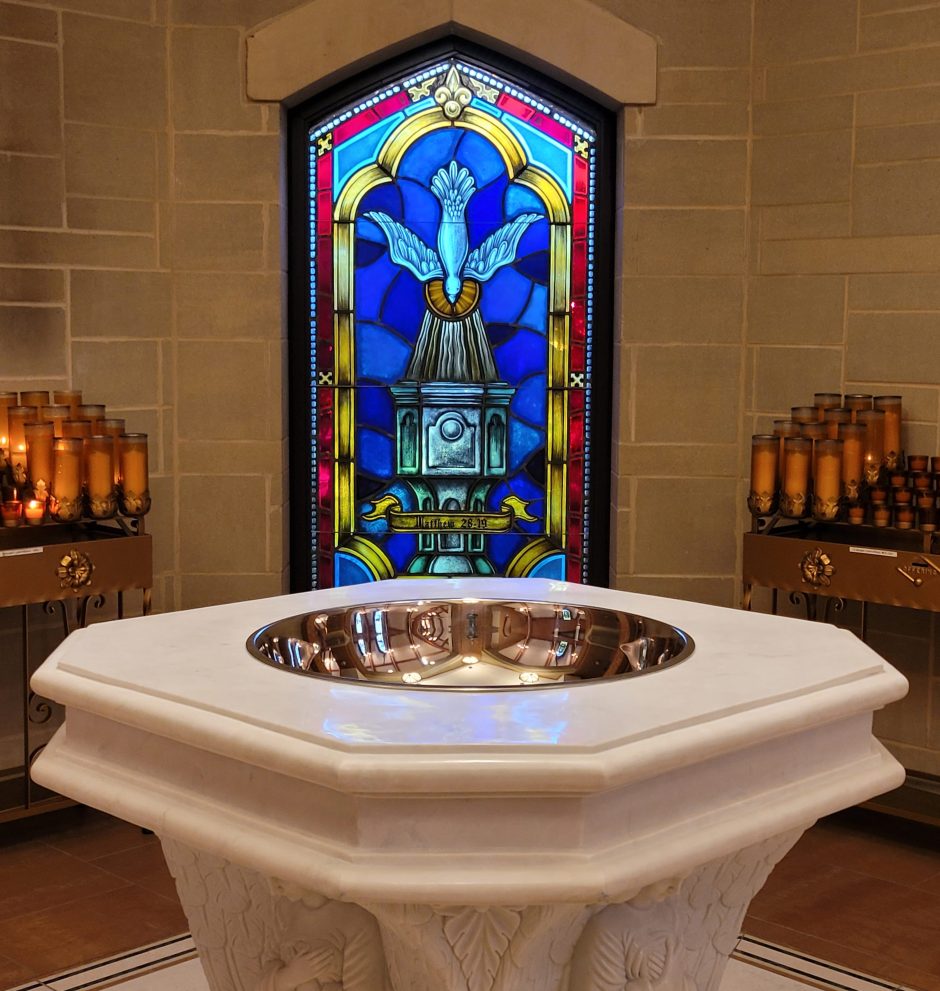
Image: baptistry St Theresa’s Church in Ashburn, VA

Baptism: becoming God’s beloved one Part 1 (Contemplating the Easter Mysteries II)

Ever wondered what God sees when he looks at you?

Wait. God looks at me?

You mean God sees this big hole I have in my heart? He knows that I can’t sleep for the worry that is nagging at my thoughts? He cares about how tired I feel from the endless responsibilities that keep me scurrying through my day?

Yes. When God looks at you he sees his daughter, his son. He also sees how often you—as children so often do—try to take care of things yourself without relying on your Father.

I’ve read about God’s love. I’ve heard people talk about it. But I don’t feel it so how can I know it is true? How can I know I mean anything to God?

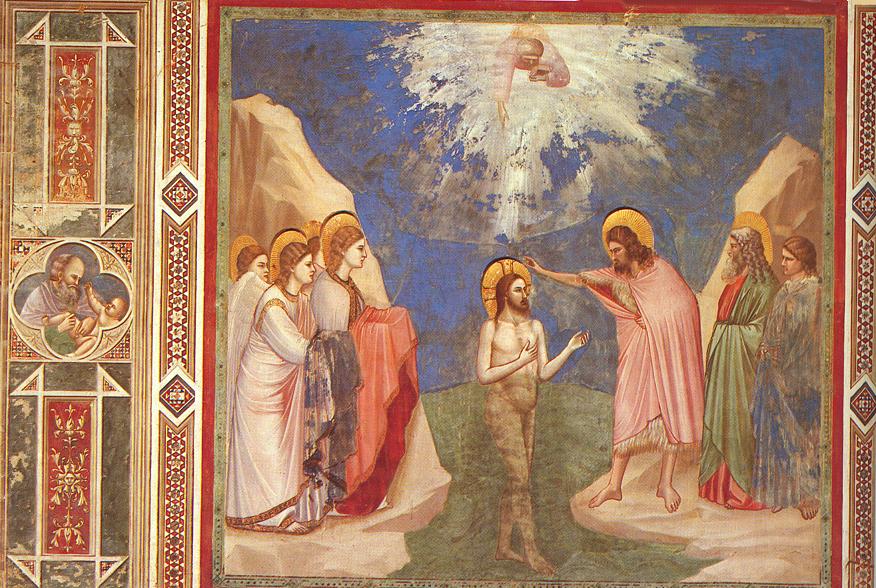
In the beginning of the public life of Jesus, when he was around thirty years old, there is recorded a mysterious event. Jesus had gone down to the River Jordan where his cousin John was baptizing in the water. All Judea was flocking to him to be baptized by him and to learn what they needed to do to return to God.

Jesus not only watched, he got in line to be baptized himself.

John is baptising when Jesus draws near. Perhaps he comes to sanctify his baptiser; certainly he comes to bury sinful humanity in the waters. He comes to sanctify the Jordan for our sake and in readiness for us; he who is spirit and flesh comes to begin a new creation through the Spirit and water. From a Sermon by Saint Gregory of Nazianzus, bishop
(Oratio 39 in Sancta Lumina, 14-16, 20: PG 36, 350-351, 354, 358-359)

But John tried to deter him, saying, “I need to be baptized by you, and do you come to me?”

Jesus replied, “Let it be so now; it is proper for us to do this to fulfill all righteousness.” Then John consented.

As soon as Jesus was baptized, he went up out of the water. At that moment heaven was opened, and he saw the Spirit of God descending like a dove and alighting on him. And a voice from heaven said, “This is my Son, whom I love; with him I am well pleased.”

Jesus knows what it is like for his Father to look at him, to hear the love that is in his Father’s voice as he spoke to him, calling him Son, the Son in whom he was well pleased, his beloved Son.

When someone talks about a child or friend as their “beloved,” they mean to say, “I have a real special liking for this person. I prefer them. I love being around them. I give them gifts to show them my love. I take them into my confidence. They are closer to me than all others. I can’t live without them.”

The baptism of Jesus has everything to do with your baptism and mine. It has everything to do with our becoming God’s beloved one.

Saint Maximus of Turin tells us: “Christ is baptized, not to be made holy by the water, but to make the water holy, and by his cleansing to purify the waters which he touched. For the consecration of Christ involves a more significant consecration of the water.”

Christ is bathed in light; let us also be bathed in light. Christ is baptised; let us also go down with him, and rise with him. (From a Sermon by Saint Gregory of Nazianzus, bishop, Oratio 39 in Sancta Lumina)


I have spent so many decades of my life wondering if God saw me, if God cared about me, if God was going to be there for me. Isn’t it true that so often we measure the gift of God by what our feelings are telling us? We don’t “feel” God’s presence, so he must not be here. We don’t “feel” lovable to ourselves and we project that on to the way we think God must feel about us. We “feel” alone and isolated and we act as though God has no power or interest to help us.

Notice that at the baptism of Jesus, we are not told about Jesus’ feelings. We witness an event. Jesus goes down into the water, is baptized by John, emerges from the water, and hears his Father’s voice calling him Son.

Jesus rises from the waters; the world rises with him. The heavens like Paradise with its flaming sword, closed by Adam for himself and his descendants, are rent open. The Spirit comes to him as to an equal, bearing witness to his Godhead. A voice bears witness to him from heaven, his place of origin. The Spirit descends in bodily form like the dove that so long ago announced the ending of the flood and so gives honour to the body that is one with God. (From a Sermon by Saint Gregory of Nazianzus, bishop, Oratio 39 in Sancta Lumina)

The Baptism of Jesus is the moment in which the Lord sanctified the waters. By immersing his holy body in them, Jesus made them fitting for conveying the grace of the sacrament of Christian baptism. Jesus makes it possible for us to be reborn to new life through the sacrament of baptism. Saint Maximus of Turn in the fifth century explains: “Christ is baptized, not to be made holy by the water, but to make the water holy, and by his cleansing to purify the waters which he touched. … For when the Savior is washed all water for our baptism is made clean, purified at its source for the dispensing of baptismal grace to the people of future ages. Christ is the first to be baptized, then, so that Christians will follow after him with confidence” (Sermo 8: De sancta Ephiphania, 2).


It was in Christ’s own baptism by John the Baptist in the river Jordan that this sacrament of initiation was instituted to enable us to share in the Divine Life of the Trinity.

Most of us probably don’t remember our baptism if we were baptized as infants. Our “feelings” at the moment were probably surprise or discomfort as water was poured on our heads three times while the priest called us by name and said the words: “I baptize you in the name of the Father, and of the Son, and of the Holy Spirit.”

Directions for your prayer this Easter:

Underline in this article every reference to a gift God has given you through your baptism. Notice how your soul responds to this litany of love. When you hold your experiences of sorrow and loss and doubt together with God’s action to bring you to the “pure and dazzling light of the Trinity,” what new things do you notice?

Image credit: Baptism of Christ fresco by Giotto di Bondone, c. 1305 (Cappella ScrovegniPaduaItaly) via Wikipedia, Public Domain

O charity beyond all telling! (Contemplating the Easter Mysteries I)

As I listened to the chanting of the Easter Proclamation at the Easter Vigil this year, my heart heard as if for the first time the words:

O wonder of your humble care for us!
O love, O charity beyond all telling,
to ransom a slave you gave away your Son!

Most of us can’t even imagine a love that would give away a precious treasure for the sake of someone that hated them. Yet Christ shed his blood that we, the daughters and sons of Adam and Eve, might live forever.

St. John Chrysostom explained it this way in Homily 15 on First Timothy:

”It is not in this way only that I have shown My love to thee, but by what I have suffered. For thee I was spit upon, I was scourged. I emptied myself of glory, I left My Father and came to thee, who dost hate Me, and turn from Me, and art loath to hear My Name. I pursued thee, I ran after thee, that I might overtake thee. I united and joined thee to myself, ‘eat Me, drink Me,’ I said. Above I hold thee, and below I embrace thee.”

O charity beyond all telling!

Have you noticed that when we purchase or receive something that we really want, it captures all our attention, not just at the moment we first have it, but for hours, or days and weeks afterwards. Depending on what it is, it may change the way we organize our time or our stuff (both digital and physical stuff!), or the way we entertain ourselves or even our appearance. We may discover we work better, make different decisions, feel differently about ourselves.

And then there is the unavoidable moment when we lose interest, we look for the next release, upgrade, improved version. Something different. Something more striking, more “us,” more useful. In a commercial world, we keep something only as long as it serves us and keeps our interest. Then we move on.

The Church, as a good Mother, knows that we are like this, and that our hearts which tire so easily and our attention which wanders so quickly need to re-fascinated with Jesus and the Eucharist for which there will be no upgrade or improved version.

The Easter Season—all 50 days of it—is for this reawakening of our hearts. We could find ourselves at times in something similar to a boring friendship, where we’ve lost interest in Jesus and his love in the Eucharist. Our “hearts move on” to things of earth, rather than things of heaven. We find ourselves searching for something more shiny and useful to us.

In the seven weeks of Easter, following the liturgical celebrations of Holy Week in which we experienced anew the “charity beyond all telling,” the Church invites us to immerse ourselves into what it is to believe, celebrate, live and pray as Catholics within the larger community of the Church. In the same way as our gadgets and toys make remarkable shifts in the way we live our lives, the death and resurrection of Christ celebrated at Easter is also the time when we learn to live as Christ in new ways, to think as Christ, to speak as Christ, to engage the world as Christ, to love as Christ. We ourselves become in the world this “charity beyond all telling!”

Again, in the words of St. John Chrysostom, our eyes need to be opened to the power of the blood poured out for us on Calvary:

This Blood, poured forth, washed clean all the world. This Blood is the salvation of our souls. By it the soul is washed, is made beautiful, and is set on fire. It causes our understanding to be brighter than fire and our soul more sparkling than gold. This Blood was poured forth and made heaven accessible.

Easter morning we arrived at the church for Mass 30 minutes early and barely found a parking place! We were seated in one of the last empty pews. What would the world be like if every Sunday most Catholics flocked to the Mass with the same urgency they congregate at restaurants and malls and athletic events….

What would the world be like if we spontaneously broke out in grateful praise during the day, announcing what Christ has done for all humanity in his death and resurrection, and the grace available to us today through the sacraments….

What if we ran to Mass because it was only there that we felt totally satisfied by the Eucharist, nourished, loved, and supported there by God himself and by the community….

Next: Easter Mystagogy 2: Baptism: becoming God’s beloved one

Photo credit: jlmajano via Cathopic

Jesus meets us at our “charcoal fires”

When it comes to St Peter, those last days of Jesus’ life and his death on Calvary became pretty intense. “You will never wash my feet!” Peter told the Master kneeling with basin and towel before him.

“I will never betray you!” Peter attested before his brother apostles when Jesus revealed that someone was going to betray him, someone in the room, someone he had known and trusted, someone he didn’t name. What a surge of terror may have passed through Peter as he imagined what that meant, what that might mean if it was him, what that would mean for their future. No. I will never betray you! the burly fisherman asserted if only to keep the potential terrors at bay.

“I do not know the man!” Before a wimpy servant-girl, the self-proclaimed immovable column of fidelity and strength collapsed. Three times. I don’t know this Jesus.

The witness of this intense shame was the charcoal fire around which everyone was warming themselves on that chilly and fateful night.

All of us have our own charcoal fires.

Back in the shadowy cobwebs of memories we wish were not our own, there are plenty of charcoal fires where we have chosen safety, pleasure, conceit over this Jesus whom we proclaim to love with all our hearts. The embers of these charcoal fires still may be warm, the ashes not yet blown away on the winds of mercy.

The charcoal fire appears again in Peter’s story shortly after the resurrection. He was out fishing, unsuccessfully, when a man called across the lake to lower their nets on the starboard side. Immediately the nets were filled to the breaking point. “It is the Lord!” John whispered to Peter.

What emotion must have gone through Peter’s heart at that moment. Without a fear, without a worry, without a memory of the ashes that still smoldered from the charcoal fire that witnessed his betrayal of the Lord, Peter leapt into the water and ran ashore.

And there Jesus stood.

Next to the visual symbol of his betrayal, of his weakness, of his shame.

And it was at that charcoal fire that Jesus asked him one question, three times: Do you love me? In the Passion Translation of the Bible the footnote for John 21:15 sheds some light on this question: The Aramaic word for “love” is hooba, and is taken from a root word that means “to set on fire.” This was the word Jesus would have used to ask Peter, “Do you burn with love for me?”

This time there were from Peter no blustering assertions and self-important declarations. Peter had touched the very roots of his weakness. Those weaknesses and mistakes and even sins that have been witnessed by our charcoal fires become the bridges to truth, to humility, to the trust that children have because they are not able to do anything for themselves.

The footnote continues: It was Peter’s boast that he loved Jesus more than the others, and though everyone else would leave him, Peter never would. That boast proved empty, as within hours of making the claim, Peter denied he even knew Jesus three times. So Jesus asked Peter three times if he loved him. In essence, Jesus knew how to bring healing to Peter and remove the pain of his denial. Three times Peter denied Jesus, but three times he made his confession of his deep love for Christ. By the third time, the “crowing rooster” inside Peter had been silenced, and now he was ready to be a shepherd for Jesus’ flock.

Here are five things always to remember when you think about the wounds the charcoal fires in your life have witnessed:

  1. Jesus resets the relationship we have with him. After three denials he invited Peter to express his love for him. No shame or guilt or failure or regret. It is about love. It is one hundred percent about love. No matter what you have done in your life, Jesus wants to know only one thing: Do you love me? Right now, here Jesus calling you by name and asking you that question.
  2. Peter and several other apostles went fishing, spending a futile night on the lake. He who had been made to be a “fisher of men,” returned to what he had been before he met the Lord Jesus at the lake’s shore three years earlier. Perhaps Peter thought that was all he was good for after having failed so miserably. But Jesus knew Peter. Jesus knew Peter loved him. Sometimes we are ashamed and we also reduce ourselves to a small life, letting go of dreams, relinquishing hope, sometimes even the hope of eternal life. It seems that there could be no way that God could not be disappointed in us. At the charcoal fire, however, Peter realized that God was not surprised, angry, vindictive or disappointed. When we stumble God is there to meet our failure with grace, a limitless love for all of us limping saints.
  3. Charcoal fires have a distinct smell. When Peter swam to shore and smelled the fire, the memory of the other, so recent and still stinging experience at a charcoal fire still seared his conscience. Jesus invited Peter to follow him into the memory of his failure and betrayal. Instead of leaving Peter to sink in the shame of these memories, Jesus invited Peter to let him into those memories. They could face them together. We all have memories of sins committed, as well as sins committed against us. Shame and guilt surround these memories. Memories that wound, that we want to hide, that we pretend never happened. But Jesus helped Peter confront the memory of his betraying the Master he loved. It is an invitation to not fear the healing process when Jesus stands on the shores of our heart, asking us to let him in, to let go of the past, to allow him to heal and transform our wounds with his glorious mercy. Jesus will often take us into memories where we do not wish to go, but he knows that we are more than we think we’ve become by our mistakes and weakness. By standing in our memories with Jesus, things change.
  4. Peter was hurt when Jesus asked him a third time, Do you love me? God’s love for us doesn’t gloss over our pain, the wounds that need healing in our life. Jesus specifically drew Peter to himself in order to reset the broken places of his denial with mercy. But just as a doctor carefully resets a broken bone (he doesn’t just say, “Oh, you’ll be all right. Everything is just fine.”), Jesus re-sets what is broken within us through the medicine of mercy. Even if the “brokenness” in our life has hardened and our hearts are “deformed” because they’ve never been taken under the Divine Physician’s care, love can make us pliable and whole once more. This is what Jesus does. In some mysterious way he is right now arranging your renewal through mercy and the willingness to love.
  5. When Peter denied Jesus, he also denied himself. He denied his love for the Master, the three years of growth and transformation as he walked by the Master’s side. Peter denied who he had become as the follower of Jesus and his apostle. On the shore that post-Resurrection morn, after a futile night fishing on the lake, Peter had again come up with nothing after relying on the one thing he felt he should be able to do–fish. He was a fisherman, after all. Jesus needed Peter to understand that he could not continue relying on himself. Again and again, with every boastful or desperate attempt to prove himself or provide for himself, he realized the nothingness from which he came and the nothingness of which he, of himself, was capable. “Throw your nets off the starboard side and you will catch something.” “Simon, do you love me? Feed my lambs.” Jesus has a plan for Peter who is to lead the Church as Rock. However, Peter needed to lead as sinner, not savior. Only Jesus saves. All of us, everyone of us, needs saving, yet participates in the mystery of the salvation of others. Always, it is miracle. Forever, it is mercy.

This Easter Jesus wants to bring you healing. He wants to turn the charcoal fire of your shame to the place that witnesses your humble love for him, your answer to Jesus’ heart that you will be his friend, that you will let him lead you, forgive you, heal you, and shape anew your life.