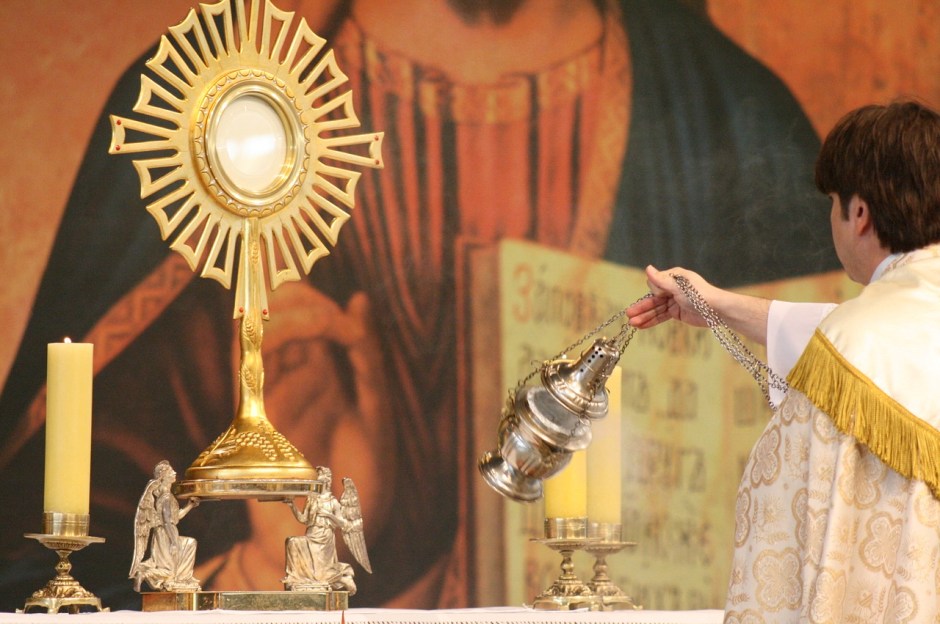
What Wondrous Majesty! The Saints and the Eucharist

“What wonderful majesty! What stupendous condescension! O sublime humility! That the Lord of the whole universe, God and the Son of God, should humble Himself like this under the form of a little bread, for our salvation.”
– St. Francis of Assisi
There are some amazing synonyms for prayer that only the saints seem to remember: Admiration! Astonishment! Humility! Adoration! Wonder! Mystery! These words of St. Francis of Assisi describe for us his prayer before the Blessed Sacrament.
I believe the heart-movements of adoration and wonder so dear to the saints have been deadened in us by the over-stimulation that bombards us from all sides these days. The beautiful Feast of Corpus Christi this Sunday causes us to step back, kneel down, prostrate ourselves before Infinite Glory, and be swept up into the divine life of the Trinity.
“God dwells in our midst, in the Blessed Sacrament of the altar.” – St. Maximilian Kolbe
Our parish churches and chapels are temples of the living God. In the Eucharist, the Trinity—Father, Son, and Spirit—becomes “fully a part of our human condition… God’s whole life encounters us and is sacramentally shared with us” (Sacramentum Caritatis, no 8).
Recently, I came across a story about Fr. Benedict Groeschel, CFR (priest, author, and retreat master, who died in 2014). He was traveling with a Protestant minister in a car and when they passed a Catholic Church, Fr. Benedict made the sign of the Cross. The minister asked him why he did this. Fr. Benedict explained that it was out of reverence for Jesus in the Most Blessed Sacrament. The minister told him, if I believed what you believe, I would get out of the car, run inside the Church, fall on my knees and never get up again.
God dwells in our midst. God dwells in our midst. It isn’t quite like the wardrobe that was the portal through which the three children slip into the fantastic world of Narnia in C.S. Lewis’ The Lion, the Witch, and the Wardrobe, from his epic fantasy series The Chronicles of Narnia.
Instead, heaven is here among us. It is no fantasy, but Mystery. Yet the same struggle between good and evil that raged in Narnia, plays out also in our midst. In the end, as the prophetical scene described in the fifth chapter of the book of Revelation reveals, the majesty of God will be gloriously triumphant:
Then I looked and heard the voice of many angels, numbering thousands upon thousands, and ten thousand times ten thousand. They encircled the throne and the living creatures and the elders. In a loud voice they were saying: “Worthy is the Lamb, who was slain, to receive power and wealth and wisdom and strength and honor and glory and praise!” Then I heard every creature in heaven and on earth and under the earth and on the sea, and all that is in them, saying: “To him who sits on the throne and to the Lamb be praise and honor and glory and power, for ever and ever!” The four living creatures said, “Amen,” and the elders fell down and worshipped.
Behind the tiny door of the tabernacle in our churches is not only a ciborium, but the awesome Glory of Infinite Love and Mercy who has chosen to live in our midst. Even in tabernacles where he is alone and blasphemed he remains with us.
“O Jesus, You instituted this Sacrament because Your love exceeds all words. Burning with love for us, You desired to give Yourself to us and took up Your dwelling in the consecrated Host, entirely and forever, until the end of time. And You did this, not only to give us a memorial of Your death which is our salvation, but You did it also, to remain with us entirely and forever.”
– St. Angela of Foligno

At the beginning of the fourth century, during the reign of the Emperor Diocletian, Christian worship was still forbidden by the imperial authorities. In 304, however, 49 Christians at Abitanae, however, felt compelled to celebrate the Lord’s Day with the Eucharist. Though the local bishop had obeyed the edict, they defied the prohibition. After cruel torture, the Christians and Saturninus, a priest, were martyred. Emeritus, in whose house the Christians had met, declared that it was not possible for them to live without the Eucharist, the food of the Lord. May these martyrs of Abitanae and all those who down the centuries have given their lives because “they couldn’t live without the Eucharist,” cause our hearts to burn in astonishment and gratitude for so great a gift.

For more, join me for spiritual support on my Facebook Group.
A treasure for praying before the Eucharist: Prayers for Eucharistic Adoration.

Inner Space

I usually have at least 20 tabs open on Chrome on one of my monitors with 8 to 10 programs open on the other. I’m switching constantly between online and offline programs to accomplish tasks connected with maintaining and website, making apps, or facilitating digital publishing. At the end of the day my spirit is fragmented into as many splintered pieces as windows that flashed in front of my sight and soul during the day. I’ve spent a lot of time pondering the effect of internet and computer use on the human spirit. If I were out gardening all day I’d probably have other complaints, but being in nature would be healing and whole. Multi-tasking across a number of different platforms in front of a screen doesn’t quite have the same healing effect.

One thing I’ve been trying to do is to spend 15 or 20 minutes before I go to bed, in a darkened room, in prayer or reading. Candles or incense awaken my senses to beauty once more. My reflections or conversations with God reconnect me personally to the Infinite Mystery who hears and listens and speaks and touches and tastes and holds and cares. This restores me to myself. This restores me to him.

Do you have any small rituals you’ve developed to restore your fragmented or drooping spirit at the end of a long day?

Allow the Spirit

Pope Francis, in his document Gaudete et Exsultate, encourages us to allow the Spirit into our lives that we might “be saints for God’s greater glory” (no. 177).  Below are a few quotes I found to be powerful departures for contemplation on this Solemnity of Pentecost.

Every saint is a message which the Holy Spirit takes from the riches of Jesus Christ and gives to his people (no. 21).

Always ask the Spirit what Jesus expects from you at every moment of your life and in every decision you must make so as to discern its place in the mission you have received (no. 23).

Allow the Spirit to forge in you the personal mystery that can reflect Jesus Christ in today’s world (no. 23).

Do not be afraid to set your sights higher, to allow yourself to be loved and liberated by God. Do not be afraid to let yourself be guided by the Holy Spirit. Holiness does not make you less human, since it is an encounter between your weakness and the power of God’s grace (no. 34).

Holiness is also parrhesía: it is boldness, an impulse to evangelize and to leave a mark in this world. To allow us to do this, Jesus himself comes and tells us once more, serenely yet firmly: “Do not be afraid” (Mk 6:50). “I am with you always, to the end of the world” (Mt 28:20). These words enable us to go forth and serve with the same courage that the Holy Spirit stirred up in the Apostles, impelling them to proclaim Jesus Christ. Boldness, enthusiasm, the freedom to speak out, apostolic fervor, all these are included in the word parrhesía. The Bible also uses this word to describe the freedom of a life open to God and to others (no. 129).

We need…to ask the Holy Spirit to liberate us and to expel the fear that makes us ban him from certain parts of our lives. God asks everything of us, yet he also gives everything to us (no. 175).

May I come to your house, please?

The Rabbi, surrounded by the crowd,
looked up into the tree

and he opened his arms wide
offered freely the treasures of his friendship

“May I come to your house?
Tonight?

Please?”

Perhaps there was a hesitancy
on the part of the one who
was out on a limb.

“Me?”

“Yes. You. I won’t take no for an answer”

Not a command–
a reassurance that the offer
was genuine
true
not dependent on all the “buts” that filled
the little man’s head
who knew himself unworthy
tax collector that he was
outcast
despised
unjust

Forgiven.

One of the most colorful stories in the Gospel of Luke is the story of Zacchaeus, the little man who climbed a tree in order to get a glimpse of Jesus as the rabbi walked through the city of Jericho. To his surprise, Jesus stopped when he came to his tree and, looking up, invited himself over to dinner. There were plenty of “good” people among the crowd that surrounded him that Jesus could have decided to dine with. Instead, he chose the most despised person in town, the tax collector known for being unjust, stealing their money, betraying the Jews by transferring his loyalty to the oppressive Roman regime.

Read Luke 19:1ff

Imagine yourself as a tree climber like Zacchaeus. Merge with this little man who is trying to hide his interest, perhaps feeling a tug of remorse or desire, embarrassed when the eyes of the whole crowd look up and see him perched on the limb of a tree. What does it feel like up there in the tree? Relate to Jesus as someone who is curious, or as someone who is attracted to Jesus’ message but not quite ready to commit. What areas of your life are you keeping from full commitment to the Lord and his way, his truth?

Jesus invites himself into your heart. Perhaps he knows there are areas of your life you are too shy or fearful to open to him. Jesus loves you too much to wait around till you muster enough courage to invite him into your life. So he invites himself! And he doesn’t intend to take no for an answer. Certainly, you could say no…that’s your option. But Jesus will be waiting for you around the next corner. “Are you sure you don’t want me to come to your house?”

Zacchaeus teaches us the value of stopping to notice, and what wonderful spirit-filled consequences such a simple decision can have. He left his money changing table and climbed a tree because he noticed that this Jesus was someone people thought was important enough to celebrate in the streets of Jericho. There are many things that can keep us from stopping to notice.

Name one habit you have that keeps you caught up in the everyday effort to survive and prevents you from noticing what is a cause for celebration.

Practice: Breathing slowly for a while in a quiet place, unconnected to a digital device. What does silence sound like? Feel like? What does the silence teach you about yourself?

Prayer: Jesus, I won’t give you no for an answer. I’m willing to go out on a limb for my belief in you. Come!

Why We Just Need a Little Compassion

At some point in life, in our younger or later years, we all do something or experience a situation that we truly regret. In our younger years, it is usually an individual situation, something we did, a decision we made, an experience we had, or an incident that has re-written the script of our life without our permission, such as an illness or accident. In our older years, we may feel uneasy as we recognize that a pattern of regret has stamped itself on our entire lifetime, creating an ocean of sorrow within and around us.

Each of us has arrived at the age we are now, bearing many scars. Some of us have scars from an imperfect or even abusive family life, unkind teachers, envious siblings, or teenage romances that broke our hearts. Others have been wounded by employers who fired us, spouses who betrayed us, colleagues who took advantage of us, and children who were ungrateful.  Our regrets are built on years of memories of hurts and disappointments, both intentional and accidental.

Some people may feel like victims of random situations or hurtful relationships. We don’t know why things happen to us the way they do. Our lives don’t match up with the seemingly magical lives of those around us, and we don’t understand why. But the “random” situations in our life that we regret are anything but random. It is possible, and even liberating, to identify the recurring patterns that lay beneath our regrets.

The patterns beneath our regrets can be difficult to discover because on the surface every situation is unique. For example, consider Stacy, a woman with a successful career as a lawyer. She is a no-nonsense person who gets what she wants, regardless of how it may affect others. As a parent she challenges any negative feedback regarding her children. She pushed her oldest child to attend a top-rated college and to follow in her footsteps in the field of law. While Stacy acts differently in her career than in her parenting, we can see a similar pattern in both spheres. As a lawyer and a parent, Stacy tries to dominate and force others to do what she wants. In one sphere it might work, but in another it causes Stacy serious problems and leads to broken relationships.

Scott is someone who finds his life frustrated by a series of failures that he always thinks another person caused. For every failure, Scott faults anyone but himself. When something goes wrong, Scott has fallen into the habit of shifting the blame and not taking responsibility. People who are close to Scott try to help him see the part he plays in his difficulties, but he is not open to feedback. But if Scott looked closely he would realize that his own thoughts, beliefs, and responses play a part in this pattern of blame in his life.

Each of these unfortunate situations is unique because every one of us is unique and we experience the world differently. Yet our experiences often form a more general underlying pattern. Unless we make a concerted effort we rarely discover these patterns, and when we can’t see them we are doomed to repeat them again and again.

When I was told that identifying patterns behind the things I regret in my life was a powerful way to make new choices for my future, I was skeptical. “Prove it,” I said. But when I tried this little exercise I began to clearly see some of the patterns that were influencing the circumstances in my life. First, identify an issue that is causing disruption in your life. Count back seven years and ask yourself if you experienced the same issue in some aspect of your life seven years ago. Count back another seven years and do the same. And another seven years. And another until you can go back no further.

The patterns in our life help us to identify something within ourselves that needs God’s mercy and his compassionate Healing. We can also hear our own inner heart-cry for  mercy and compassion, that special gift we alone can give to the wounded places in ourselves. Amazingly, as we bring these patterns to the Lord for healing, the situations around us begin to change. As we grow in freedom, in some mysterious way so also do others.

featured

Photo Credit:
Yoann Boyer