Let calm fill your hearts…

Welcome to August! In the month of August there are four days on which the UN commemorates human situations in the world today that weigh heavily on us:

August 9 is the International Day of the World’s Indigenous Peoples. 370 million indigenous people living across 90 countries in the world today make up less than five per cent of the world’s population. These people inherit unique cultures and ways of relating to people and the environment and are among the most disadvantaged and vulnerable groups of people in the world today. This year is dedicated to Indigenous People’s Languages. It is estimated that, every two weeks, an indigenous language disappears, placing at risk cultures and knowledge systems of these peoples. Perhaps we rarely, if ever, think of these people, beyond curiously reading articles about an uncontacted people being caught on camera deep in Amazon. Yet we all are poorer for their loss.

On August 21 and 22 and 30 we commemorate the victims of terrorism, the victims of acts of violence based on religion or belief, and victims of enforced disappearances.

Victims of violence struggle to have their voices heard, their needs supported and their rights upheld. After the initial news splash, victims of terrorist attacks often feel forgotten and neglected. There are continuing acts of intolerance and violence based on religion or belief against individuals and communities around the world, and the number and intensity of these incidents are increasing. Enforced disappearance has frequently been used as a strategy to spread terror within society. The feeling of insecurity generated by this practice is not limited to the close relatives of the disappeared, but also affects their communities and society as a whole. As terrorist events and other acts of violence are on the rise in an increasingly more unstable world, we all can feel overwhelmed and find our emotions spiraling out of control.

My friends, let’s pause right here.

What are you feeling? What is happening in your heart?
Do you feel yourself sinking, hiding, withdrawing,
angry, overwhelmed, powerless, or…?

I feel my heart closing… How can I effectively matter to these people? Certainly, I care. But I want to care deeply. I want to feel that these strangers are my brothers and sisters. I want to touch my most generous love for all of them and each of them, wherever they are, whatever they experience. I want to touch our oneness. I want to marvel that despite the evil and darkness that we can perpetrate against each other, it is, as Thomas Merton said in Conjectures of a Guilty Bystander, “a glorious destiny to be a member of the human race dedicated to many absurdities and one which makes terrible mistakes; yet, with all that, God Himself glories in becoming a member of the human race. A member of the human race! …I have the immense joy of being man, a member of a race in which God Himself became incarnate.”

Take a moment to breathe in the wonder
of this spark of truth that lies at the foundation
of our common human destiny.

Breathe it in, again and again.
Take in the wonder of God’s extravagant
and mad love for us.

I see now that it is God who can open my heart to fall in love with this humanity so threatened with shadows and fear, to give myself with a caring heart that pours itself out in the fragrance of prayer and hope, to surrender myself to the work he has called me to do no matter how small…or great…it may be.

This month let prayer, surrender, and calm
fill your hearts as we cherish our fragile world
so loved by our powerful and merciful Father.

Blessings,
Sr Kathryn

“I need a Heart…who will be my support forever”

“I need a Heart…who will be my support forever” (Saint Thérèse).

The Salve Regina is right when it calls this world a “vale of tears.” From Mary Magdalene to Saint Thérèse of Lisieux, the saints have sought in the Sacred Heart of Jesus their solace along this painful path we call life. If you are looking for a friend who will be refuge and strength in your every need, these two great saints point you to the most Sacred Heart of the Master.

In the still-darkened dawn, Mary Magdalene made her way to the tomb in which her Master had been laid after being taken down from the cross. It was the third day since the beating of that great Heart ceased on the hill of Calvary. Did Magdalene have any tears left to shed? Any marks of grief not yet exhausted?

Unknown to her, God was coming to meet her there at the tomb. He veiled his glory, showing her first his face, before allowing her to hear once again her name upon his lips: Mary.

Like Mary Magdalene, we all want to see the face of God. It is a desire planted in us at our creation, for it is the final goal of our lives to see the glory of God, to surrender to the glory of God.

Saint Thérèse of Lisieux, in her poem “To the Sacred Heart of Jesus,” declares how, like Mary Magdalene, she wants to see God. She writes of her own search for him:

“I need a heart burning with tenderness,
Who will be my support forever,
Who loves everything in me, even my weakness…
And who never leaves me day or night.”

Little Thérèse, in words typical of her Little Way, does not consider the symbol of Christ’s Heart wounded by the lance, a picture with which we are so familiar. Instead, she opens up for us the reality of that Heart: “the loving Person of Jesus, his deep feelings, and the love that fills his Heart” (The Poetry of St Thérèse of Lisieux: The Complete Edition, ICS Publications). For her, Mary Magdalene is the woman who opens up to us the floodgates of tenderness from a Heart that has loved us as no other.

She cries out in her poem, as if she herself suddenly sees Jesus face to face who has come in answer to her call:

“You heard me, only Friend whom I love.
To ravish my heart, you became man.
You shed your blood, what a supreme mystery!…
And you still live for me on the Altar.”

John Henry Newman, convert, cardinal, and major figure in the Oxford Movement, and now Doctor of the Church, composed this prayer to the Sacred Heart that is found in his Meditations and Devotions. He reminds us where we can find the Master’s face today, where the Heart of Jesus still beats: at the altar. What joy that after we receive Jesus in communion, we can pray, “O make my heart beat with Thy Heart.”

O most Sacred, most loving Heart of Jesus, Thou art concealed in the Holy Eucharist, and Thou beatest for us still… I worship Thee with all my best love and awe, with my fervent affection, with my most subdued, most resolved will.

O my God, when Thou dost condescend to suffer me to receive Thee, to eat and drink Thee, and Thou for a while takest up Thy abode within me, O make my heart beat with Thy Heart.

Purify it of all that is earthly, all that is proud and sensual, all that is hard and cruel, of all perversity, of all disorder, of all deadness.

So fill it with Thee, that neither the events of the day nor the circumstances of the time may have power to ruffle it, but that in Thy love and Thy fear it may have peace. Amen. (Source: www.newmanfriendsinternational.org)

Jesus wants to replace our heart, with all its suffering and treacherous disorders, with his own Heart. The story of Saint Lutgarde has always inspired me. Born in the 13th century, Saint Lutgarde was a Cistercian mystic of Aywieres, Belgium. She was one of the great precursors of the devotion to the Sacred Heart of Jesus. Christ came to Lutgarde and offered her any gift of grace she desired. She asked for a better grasp of Latin, so that she might better understand the word of God and sing his praise. She thought this gift would help her love the Lord more. Christ granted her request and Lutgarde’s mind was flooded with the riches of psalms, antiphons, readings, and responsories. However, her painful emptiness persisted. She returned to Christ, asking to return his gift, and wondering if she might exchange it for another. “And for what would you exchange it?” Christ asked. “Lord,” said Lutgarde, “I would exchange it for your Heart.” Christ then reached into Lutgarde and, removing her heart, replaced it with his own, at the same time hiding her heart within his breast.

All we need to do is ask for this most precious of gifts. We may feel no different. We will still fall in our weakness. But with Saint Thérèse we need not fear our littleness. As she prays in her poem To The Most Sacred Heart of Jesus:

Ah! I know well, all our righteousness
Is worthless in your sight.
To give value to my sacrifices,
I want to cast them into your Divine Heart.
…I hide myself in your Sacred Heart, Jesus.
I do not fear, my virtue is You!…

Thérèse teaches us to not tremble before the history of our weakness and sin or before the power of Almighty God. Instead, she encourages us to dare to trust, to cast our works into Jesus’ Heart. Even this daring is an expression of her love, and it can be also an expression of our own.

I pray this prayer for you. Let us pray it for each other:

O Heart beating with love for us, help us find you, always waiting for us, to show us your face. Oh what joy it must give you to find us there before the Blessed Sacrament where your Heart beats still and your love pours forth on the sisters and brothers you so love!

When tears moisten our pillows and depression weighs down our spirits, lift us up by calling us by name, turning our eyes to your face.

Let us remember that even as we look for you, you have already come in search of us, eager to reveal to us that we are, with all our weaknesses, welcome in your Father’s embrace.

Take our hearts as your own, hearts so in need of purification and consolation, disordered in so many ways. Cast our hearts into the fire that burns in your own most Sacred Heart.

Plant within us, tender Master, your own Heart, that your fire burning within us might propel us to help, preserve, and nurture every living being, that we might run through the world sharing the glorious inheritance you have freely given us by rescuing us completely from the rule of darkness, cancelling our sins, and translating us into your kingdom forever (cf. Colossians 1: 5, 12-13).

I praise you now for all you are working in us, all you will accomplish in us, for the holiness you will bring about in each of us and all we love. Amen.

by Sr Kathryn J. Hermes, FSP

What is impossible for us is possible for God

Look around you. Do you see Spirit-filled Christians? Do you see Catholics on fire for the Gospel? Men and women totally surrendered to God and living lives marked by the beatitudes: Blessed the poor in spirit, the meek, the pure of heart?

The event of Pentecost as recounted in the Acts of the Apostles gives us a clear indication of why we don’t see the Spirit transforming the earth.

The descent of the Holy Spirit on the apostles was part of a long process of transformation for these twelve disciples of Jesus. The Master took these men from their professions as fishermen or tax collector, for example, and began a three-year process of helping them see they could do nothing of themselves. Nothing. Peter’s betrayal of Jesus within just hours of his boast that he would die for him is a clear example of this. Peter learned, he had to learn, as we all have to learn, the truth: apart from Jesus we are nothing. We can do nothing. Without the Spirit of Jesus, no one of us can say Jesus is Lord.

This cuts against the grain. Today we all want to prove who we are, strut our stuff, even in the spiritual life. We humans think we can do at least part of it on our own and God can help us out with the rest.

It takes a long time to learn the first lesson: that salvation is not possible for us to achieve. And the second lesson is just as important: what is impossible to us is possible for God! Pentecost teaches us both lessons. The frightened apostle who gave way under the accusing glance of a maid in the High Priest’s garden after Jesus’ arrest, now stood before a crowd of 5000 boldly proclaiming that Jesus had died and risen. The difference? The Spirit now filled his heart after he’d learned the all-important lesson that he, by himself, could do nothing. He needed the divine omnipotence to work within him so he could delight in the law of God and do what God wills. God gives us the power to accomplish what his will desires.

If you have ever felt you couldn’t be virtuous, holy, or good, you are on the right road! Let yourself be led. When you are utterly helpless, God will come to work in you all that he desires of you.

Another word for this is “poor in spirit.” This is the first beatitude: “What happiness comes to you when you feel your spiritual poverty!” (Mt 5:3 TPT) The poor in spirit have only one remedy: trust in God. This total reliance upon God is the doorway to the Kingdom. Blessed are they who have surrendered to God and trust completely in him.

Isaiah the prophet proclaims:

“The oppressed and needy
search for water,
and there is none,
their tongue is parched with thirst.
I, Yahweh, shall answer them,
I, the God of Israel,
shall not abandon them.
I shall open up rivers on barren heights
and water-holes down in the ravines;
I shall turn the desert into a lake”… (Is 41:17-18 JB)

Imagine the Sahara desert being turned into a lake! It can’t turn itself into a lake gradually. It can’t do anything to become a lake. In fact, a lake is the exact opposite of a desert! But God can completely uproot the desert and plant in its place a body of water. And he wants to do so, because he will not abandon you.

In Peter’s complete failure, the Lord placed holiness and courage and power. It was the Lord’s work brought about by the coming of the Spirit.

So where are you failing?

What are you worrying about regarding your journey with the Lord?

What do your inner critics accuse you of?

Where are you hopelessly lost?

What are the attitudes and behaviors you can’t improve?

What are the addictions you can’t overcome?

Where are the prayers that are filled with distraction?

Who will save you? God will, through Jesus Christ.

So pray, “I can do nothing. God must and will do all. In prayer, in virtue, in love, in work, I believe the Spirit will work in me at every moment. Oh my God, teach me this! Show me what a God you are. How you place your omnipotence at the disposal of every child of yours. I count on you. My God, you are working out my life for me. You are making me holy. You are renewing the face of the earth. You are sending down on me your Spirit. You are refashioning me. You do all things.”

At the Last Supper Jesus promised to send the Holy Spirit to his followers. When he wants to give you the Holy Spirit, he will first bring you to the end of self, as he did Peter, and then he will flood your desert with the water of life and the fountain of the Spirit. Every moment you will receive this gift. Every moment you must depend on the Spirit. Every moment you must surrender yourself to receive from above what you cannot do on your own.

So you are called to be this Spirit-filled Christian! You are called to be the living witness of the Spirit’s power in the Church and the world!

Here is a short and powerful prayer you can say daily to surrender yourself completely to the Spirit’s guidance:

The Prayer to the Holy Spirit by Cardinal Mercier:

I am going to reveal to you the secret of sanctity and happiness. Every day for five minutes control your imagination and close your eyes to all the noises of the world in order to enter into yourself. Then, in the sanctuary of your baptized soul (which is the temple of the Holy Spirit) speak to that Divine Spirit, saying to Him:

O Holy Spirit, beloved of my soul, I adore You. Enlighten me, guide me, strengthen me, console me. Tell me what I should do; give me Your orders. I promise to submit myself to all that You desire of me and to accept all that You permit to happen to me. Let me only know Your Will.

If you do this, your life will flow along happily, serenely, and full of consolation, even in the midst of trials. Grace will be proportioned to the trial, giving you the strength to carry it and you will arrive at the Gate of Paradise, laden with merit. This submission to the Holy Spirit is the secret of sanctity.

When life breaks your heart: Mary is there

The long silent Holy Saturday…. Mary’s heart broke anew as she retraced in her memory every pain-filled step of her Son to Calvary, heard once more every gasp for breath, every word of his resounding in her soul… Mary was mother and mourned the limp body of her Son laid in her arms and then buried in the earth. Cast into the fire she waited, knelt before the Father, wept to wash away the pain.

On Holy Saturday I imagine Mary as the mother who in her humanness shared the misery of so many sorrowing mothers who worry for their children, who have life wrenched from their hands. Parents who see their children absorbed in evil or lost to the evil of another or swept away in accidents beyond their control.

We all can draw next to Mary when the night falls on our joy.

We can be sure she understands when our hearts break, when the desert sands swirl around us making us lose our way. When we fear for a loved one, and when we face our powerlessness to keep evil from affecting another, our powerlessness in the face of death.

With what tenderness must Jesus have approached his mother the morning of the resurrection. With a joy that for all its glory could never erase the wounds of the past two days. Both mother and Son forever would bear the agony of human hearts broken open on the edge of pain…the same that we all bear in some way in life. Mother. We call her mother. She is the one who knows. Who stands by us when we walk amid the flames.

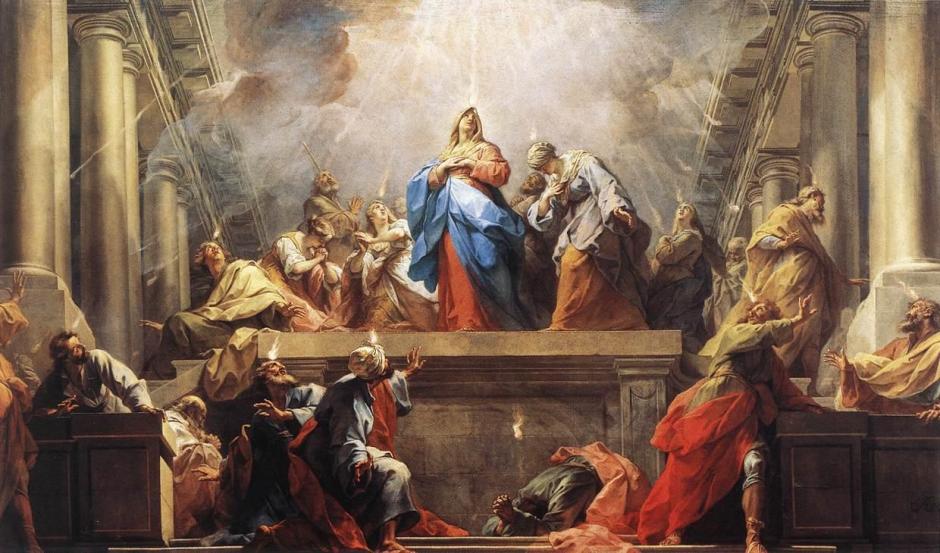
40 days of quiet joy, almost learning to breathe again, to trust again, to invite the sun’s splashing splendor to surround the disciples nearest to Jesus and his mother. Mother and more, the Risen Master pulled Mary into the center of the tiny community he would leave behind as he returned to the Father, a community of “sons” assigned to her from the altar of the cross. She was not only his mother but theirs. And in the nine days which they spent locked in retreat in the Cenacle, she quietly took on a mother’s role of teacher and guide, listener, getting to know each of the apostles with their specific gifts and challenges, knowing them as fully and wisely as she knew her Son. Their souls an open book to her tender searching eyes, as she helped each become more a bearer of Jesus. She knew just the right word for each, teaching them to pray, to trust in the Spirit’s advent promised by Jesus. In those nine days they gathered around their Mother and Teacher.

When the Spirit fell upon the apostles and those in the Cenacle, she encouraged them to go forth bearing the message of her Son to the world. As a mother she remained in the background, praying for her “children,” encouraging, supporting, loving. She walks through history bringing us Jesus, the mission she received at the Annunciation and which she carried out through her life. She brought Jesus to Elizabeth, and John the Baptist leapt in her womb for joy. She presented Jesus to the shepherds and the magi, and they left filled rejoicing. She has appeared throughout the centuries around the globe, continuing to call us to live the Gospel and love her Son. And she speaks to us in the quiet of prayer, knowing our souls intimately…our every need, desire, struggle, pain.

On the Saturday before Pentecost, the Pauline Family celebrates the Feast of Mary who is the Mother, Teacher, and Queen of the Apostles. Blessed James Alberione, our Founder, wanted to go back to the very source of Marian devotion in the Church, and at the source of find Mary as Queen of Apostles.

Mary is an apostle because she gave Jesus to the world. As his mother and ours, she has a unique vocation and gave Jesus to us in a way that no one else ever could. As Alberione put it: “By nature Mary is essentially an apostle. She came to give Jesus, to bring life to souls, to be mediatrix and distributrix of grace. Mary came to bring us the Life—Christ. She is an apostle in the prophecies of the Old Testament, in life and in heaven.”

On the spiritual level, every baptized Christian is also called to bring Jesus to the world today. So Mary is our model for evangelization. She can help us become bearers of Jesus, teaching us to “put on” Christ in our mind, will, and heart so as to live and serve as true disciples. She loves, guides, and supports us just as she did with the first disciples and apostles of Jesus.

As Mary walked the road to Calvary and now the roads of the world, she has only one desire: that we know and love her Son, that we find grace and glory through obedience to him.

Today my heart ached to be able to hold a friend who was scared about the health of her parents, a friend several states away. I had to step back and remind myself that Mary understands this not-being-able-to-take-away-the-pain-of-another. I can stand in the fire with her at my side. There is a comfort to that. But my devotion to Mary as the Queen of Apostles means she helps me take one step further: she helps me find Jesus in this experience; to put on Jesus’ thoughts, words, behavior; to want what Jesus wants in this situation, and then to give Jesus to my friend through prayer, words, and love.

This Saturday, let us take again this magnificent prayer to Mary given us by John Paul II, drawing close to her in our every need, allowing her to be our mother, teacher and queen.

Hail Mary, poor and humble Woman,
Blessed by the Most High!
Virgin of hope, dawn of a new era,
We join in your song of praise,
to celebrate the Lord’s mercy,
to proclaim the coming of the Kingdom
and the full liberation of humanity.

Hail Mary, lowly handmaid of the Lord,
Glorious Mother of Christ!
Faithful Virgin, holy dwelling-place of the Word,
Teach us to persevere in listening to the Word,
and to be docile to the voice of the Spirit,
attentive to his promptings in the depths of our conscience
and to his manifestations in the events of history.

Hail Mary, Woman of sorrows,
Mother of the living!
Virgin spouse beneath the Cross, the new Eve,
Be our guide along the paths of the world.
Teach us to experience and to spread the love of Christ,
to stand with you before the innumerable crosses
on which your Son is still crucified.

Hail Mary, woman of faith,
First of the disciples!
Virgin Mother of the Church, help us always
to account for the hope that is in us,
with trust in human goodness and the Father’s love.
Teach us to build up the world beginning from within:
in the depths of silence and prayer,
in the joy of fraternal love,
in the unique fruitfulness of the Cross.

Holy Mary, Mother of believers,
[Mary, Mother, Teacher, and Queen of Apostles]
pray for us.

Amen.

August 15, 2004

ENJOYED THIS ARTICLE? HERE ARE 5 WAYS TO GO DEEPER…

God has amazing ways of knocking on people’s hearts, awakening desires, arousing questions, provoking an unexpected spiritual fire. If you have enjoyed this article, and are ready to embark on a sustained spiritual journey, here are 6 ways you can join me on the journey:

  1. Join my private Facebook Group and walk the road of healing with a great group of people. I offer a half-hour live spiritual conference here Tuesday evenings at 7pm EST
  2. Sign-up for my letter Touching the Sunrise. I write a letter a couple times a month from my heart to yours to support you along the way.
  3. Explore my books: Surviving Depression: A Catholic Approach; Reclaim Regret: How God Heals Life’s Disappointments; Just a Minute Meditations Deeper Trust and Inner Peace.  Enroll in the free 5-day email series introducing Reclaim Regret.
  4. Enroll in courses on Midlife, Contemplative Prayer, and a do-it-yourself downloadable Surviving Depression retreat
  5. Become a part of the HeartWork Community, a place where you can ask the hard questions and find a path to a life that is free, fulfilling and fruitful.


Easter: From Ashes to Glory

All of us were glued on the Monday of Holy Week to phones and computers and television screens, to twitter feeds and facebook posts as we followed in dismay the blaze that was collapsing roof and spire of the Notre Dame Cathedral in Paris.

I closed my eyes and imagined all the people who had contributed to building Notre Dame Cathedral through the 2 centuries that stretched between 1163, during the reign of King Louis VII, and 1345. Craftsmen, artists, masons, architects, carpenters, painters, sculptors…all of them gathering around Our Lady in heaven with sorrow over the impending collapse of this magnificent icon of Christianity that bears her name, the cultural and religious heart of the French people and of all Catholics.

Our Lady received them with such gratitude for all they had done in her Son’s honor with a calmness that seemed out of character with all that was happening. And as I prayed, she seemed to say the words she has always said, “Fiat…. You will see that all shall be for God’s glory.” 

On Good Friday we remember the horror of the three hours Mary stood beneath the cross to which the Son of God, her son, was nailed. Jeered, derided, mocked…. Betrayed, thirsty, unable to breathe…

Moment by agonizing moment the fire of his love that had burned so brightly when he was alive seemed to flicker more weakly until, at last, she held his lifeless body in her arms.

“Fiat.” Perhaps the hardest Fiat of all.

There are no ashes where there cannot also be glory.

Notre Dame will rise anew from the ashes because of the millions pledged for the Cathedral’s renovation. In five years, as President Macron has promised, France will once again have its cultural and religious heart restored in the Notre Dame Cathedral. It will be a five-year intensive “retreat” for the entire country and for all Catholics as we follow the progress and prepare for the first liturgies of the opening day.

But the “glory” to which Our Lady in heaven referred is more than architectural splendor and a sacred space of worship that represents the heart of Catholicism and the French people.

The glory began already in the darkness of Monday of Holy Week and continues in the hearts of all of us who are yet pondering in our souls what this inferno of Notre Dame means spiritually to us personally, to us as Catholics, to the world as a whole.

In the marrow of our bones, we feel that this devastation of the sacred in the most sacred week of the year, carries with it the mystery of a message in a language we can no longer understand.

We no longer know how NOT to understand…Marian NOT understanding as she stood with peaceful faith at the foot of her dying Son.

We no longer have a comfort level with trusting that even if we don’t understand what is happening we can be absolutely certain that God is reliable and all will be for God’s glory.

This is now Easter week. And once again Our Lady is our guide to understanding the ways of God even in the midst of tragedy and loss.

All eyes have turned to her as she turns the attention of the world to a place of sacred worship of her Son.

We treasure in our hearts what we have seen and heard.

We ponder what it can all mean.

We ask the Holy Spirit to show us the deeper wisdom in all that has happened.

We enter with greater reverence our own sacred buildings of worship that, although they are much humbler than Notre Dame Cathedral, are nonetheless filled with myriads of angels and the presence of the Risen Lord in the Eucharist.

We rest with the Word in Scripture and let the dust settle so that we might be taught by God whose thoughts are far above our own.

We rejoice in the resurrection of Christ, as Our Lady must have done so, knowing that indeed God has the whole world in his hands.

In the ashes of last week, in the ashes of all of Lent, is the astounding way in which God’s glory, in ways incomprehensible to our little minds, continues to save us from ourselves and from the power of the Evil One.

Alleluia! Christ is Risen. Alleluia!


Blessed by My Cross

My friend, you who are the delight of the Lord, sought-after by your God, blessings!

Wherever you are I want to encourage you to cast away every fear, that you may walk more boldly in Christ, for in him God has chosen you before the creation of the world to be holy and blameless in his sight.

The road is narrow and at times a difficult climb, but we will walk the road together. We shall say, “I give myself absolutely to you, O Lord, do with me as you will.”

These words may seem frightening, for we hand over our future and the control of all that occurs to God’s tender regard for us. What a mighty surrendering trust it takes to utter these words with absolute sincerity. The Annunciation and agony of the Savior in Gethsemane’s garden crystallized in these words: Behold the handmaid of the Lord…. And Not what I will, but what you will.

Sometimes, I cling so strongly to my own fears that I am unable to say these words, “Do with me as you will.”

From the first cry of the newborn’s wail to the final sigh of the crucified Savior, these words ring out. The tiny child lying on the straw on a cold winter’s night in the small town Bethlehem is the mystery of Jesus’ life that most fills my spirit. I have small reminders of Christmas around me wherever I live or work: a statue of Mary lifting into the air her son and the Son of God, a very small nativity set, a suncatcher on the window that depicts the manger. Christmas is never far from my mind.

Yet my life, as perhaps many of yours, has been marked by the cross.

Life and death.

The fresh innocence of beginnings and the heavy struggles of adult life.

The joy of a mother’s love and the anguish of a mother’s agony as she stands beside her child to the end.

The wood of the cross mounted on Calvary’s hill didn’t come as a surprise to Jesus and Mary. Its long shadow cast itself into their lives very early after Jesus’ birth. A sudden departure in the night at the warning of angels, fleeing to Egypt to escape the hands of Herod who would extinguish the Light of the World that his own light might flicker in the darkness a few years longer.

From the beginning the darkness wrestled with the Light. We often hear that the name Bethlehem, means House of Bread, which is only one possible meaning of the name. You see the word “Beth” in Hebrew means house. The word “Lehem” has two different possible meanings. The first refers to leavening dough in order to make bread. The second means “hand-to-hand combat,” where we are stretched and wounded throughout our lives which are punctuated almost daily with the struggles of human existence. It is as if we are thrown into the arena and must fight for our lives that Light might triumph. Or is it that God fights for our lives? The tree of life is planted in our very heart.

The cross, as it has appeared in my life, has been this wrestling match between Jesus and the passions that pummel my heart, between the force of Love and the shadows of darkness. He has wrestled with the immaturity of my heart and the prejudice in my mind. I was untested and unable to respond to him wholly without a lifelong struggle of repentance in which I discovered my limits and the wondrous call to become fully human in Christ. A call that was beyond my human limits. The wounds of love that I bear from experiencing the cross, these alone could bring me to the glory and joy of Christ’s vision for my life.

As I have watched how Jesus has fought for my very life in the crosses that have become divine wrestling matches through the years I have learned three things:

  • When life is brought to a shabby wreck through illness, failure, fractured human relationships, the bitter awareness of sin, it is this paradoxically that is the place of my great hope. He has given me the gift of sight to see beyond the visible to his invisible Love at work.
  • Jesus has defeated my logic and led me out of the prison of having to understand everything. The cross as it appears in one’s life is often illogical compared to what we think should happen. To realize that the conclusions of my rational mind are incomplete, to open myself to paradox, and to silently wait for understanding to be given to me has brought much anguish…but slowly I’ve learned that Jesus can be trusted.
  • The situation that has defeated me has only done so that I might see how Jesus fights for me, that he himself might triumph in my life. The cross is essentially how God works in and through the way-things-are to defeat the darkness that still struggles for the upper hand in my life. I have been blessed to realize, at least in my better moments, that I want to let God act. In the words of Job, I am finally able to say, “Though He slay me, yet will I trust in Him” (cf. Job 13:15).

Friends, Mary, the Mother of Sorrows, stands with her Son as he hung on his cross, and she stands here with each of us. Whether the cross enters our life through loss, failure, sin, illness, relationships, Mary is with us because she knows our sorrow. She herself has lived through the agony of the moment-by-moment struggle to make sense of pain, to find a way forward, to reframe what is happening into something our minds can comprehend. And she knows the final leap of faith, the only thing that can make sense of this hand-to-hand combat we call our life.

I am sure of it. My crosses have become my blessings only because of this strong and tender presence of the Mother given to me at the foot of Jesus’ cross. She is the strong woman who teaches me how reliable God is, how ultimately secure I am in saying to him, “I give myself absolutely to you, O Lord, do with me as you will.” There is no easy way promised to us as we whisper these words, trembling perhaps, but wanting to give him everything. But it is God himself who guarantees our ultimate and absolute trust. When we have gotten to the end of our rope and the bottom of our heart where we find emptiness alone, God himself can take over where we have discovered ourselves impotent. He who has chosen us before the foundation of the world to be holy will guarantee that we are so, if we but repeat with every breath of our life: “I give myself absolutely to you, O Lord, do with me what you will.”