Jesus Wishes to Wash Your Feet: Guided Meditation

What keeps you up at night? What is in your heart that you wish you could share with someone who cares? In this Holy Thursday meditation, Jesus gathers you tightly into his embrace as he looks in to your eyes and says: “When will you give all this to me?”

Meditation with the Good Shepherd: Finding rest and inner peace Sr Kathryn's Podcast – Touching the Sunrise

What is important here is that we approach our thought world with compassion, curiosity, and creativity, a bit of humor, and a lot of prayer. It is like a cluster of screaming children clustered around our heart where God is dwelling. Think about a playground with kids out of control. It’s hard to get to the center, to the ground, to the inner room where God is dwelling when we are deflected by so many interests, fears, desires, and demands. In this meditation we experience the rest of our inner world that only Jesus and his compassion can bring us.
  1. Meditation with the Good Shepherd: Finding rest and inner peace
  2. Jesus wants to wash your feet: guided meditation
  3. Hope for uneasy times
  4. Become the Child God Made You: God Made Us for Himself
  5. Being the Child God Made You: God Calls Us into Existence to Exist Before Him

Being the Child God Made You: God Calls Us into Existence to Exist Before Him

When I ask Jesus to show me who I am in his eyes, it is always a child, and not just a static image of a child, but a toddler playing in a sandbox: safe, without a worry in the world, trusting…

Jesus has been showing me lately that all the adult things I have had to do in the last 40 years of my life, though important, though blessed, though gifted and talented, are not really what life is all about. It is this image of a child throwing sand into the air and giggling who is, at the core of my existence, the “little child” Jesus calls unto himself, the child God made because he loved her from before the foundation of the world (see Eph. 1).

“Accept being able to play and be loved”

Can you say to yourself, “God made something beautiful and strong and good and tender and kind when he made me.” What do you feel deep within yourself when you say these words about yourself? Can you notice your thoughts, any emotions, even physical sensations?

In my early steps of my own journey to accept being loved by God, I noticed that I would physically resist believing this: my stomach would tense up, my mind would freeze, and my emotions become rock.

One thing that will help you become the Child you are…

In a quiet place where you won’t be disturbed for about 30 minutes, say this sentence quietly to yourself:

“God made something beautiful and strong and good and tender and kind when he made me.”

Pause and get in touch with how you are reacting or responding to this tiny credo in God’s goodness that lies at the root of all joy. Just notice. Observe any thoughts, any emotions, even physical sensations….

After a while repeat this credo and spend some time noticing once more.

Finally say to your heart: “It’s okay. I see you responding in this way. I can understand that. I can sense what you are needing, even if I can’t give it to you right now. I want you to hear these words which are true: “The God who created you, loves you each and every day, in each and every moment of every day of your life. He can’t stop loving you, because he himself is love. Even if you can’t hear these words now, they are true. Someday you will be able to welcome them and entrust yourself to the One who made you with great trust. I promise.”

Still, God, you are our Father. We’re the clay and you’re our potter: All of us are what you made us. (Isaiah 64 MSG)

Image by ymyphoto from Pixabay

Being the Child God Made You: God Made Us for Himself

Shortly after her birth I met my new great-niece. She was just five weeks old and a bundle of joy for everyone around her. I saw clearly, however, as she cried out whenever she was in discomfort, how she was also a bundle of intense needs.

She cried when she was hungry. She wiggled and whimpered when she needed to be changed. She wailed when she was uncomfortable in the arms of someone other than her parents. The wired, tired cry told her parents that she was too tired to even settle down for sleep. With her little lungs she made it quite clear to everyone when she was in need.

I heard these words in my heart:

“You are just as helpless, and lovely, and loved as this tiny baby. She isn’t doing a single thing to ingratiate herself to anyone, other than to just be. Yet she is so endearing as she expresses what she needs and her parents jump to be there at her side, providing what she can’t provide for herself.”

“Accept your neediness and My Love….”

It takes a huge act of courage to tell someone we need something. We might be refused. We might be rejected. We might be ridiculed for what we can’t do ourselves. This dynamic, familiar to us all, looks one way as kids and another way when we are in the height of our adult years, and still another when we are in our senior years. To admit we can’t do something that is essential to a job we hold is risky. To admit we can no longer accomplish what is required for basic daily living may feel humiliating. To surrender what we really want to happen for ourselves or for another could feel like failure. Only the courageous are willing to be as honest as a baby about what they are undergoing, feeling, and needing.

One thing that will help you become the Child you are…

Tell God what you need, what you are experiencing, what’s happening to you and the way it makes you feel about your own worth, your past, your future….

Don’t be afraid to wail in the night. Be courageous and make your demands….

…and then listen….

In these moments of intense realness, you may find yourself coming face-to-face with a weakness or a wound that you are ready for the Holy Spirit to heal. There may be something that you realize you are ready to relinquish now. Perhaps you realize it isn’t as important as it was. The tears and wrenching regret may even be the space where you enter deeply into the fresh ground of your heart, prepared by Jesus for the seed of new life.

I cry out loudly to God,
    loudly I plead with God for mercy.
I spill out all my complaints before him,
    and spell out my troubles in detail:

“As I sink in despair, my spirit ebbing away,
    you know how I’m feeling…” (Psalm 142 MSG)

Image by jun yang from Pixabay

It Is Good for Us To Be Here

Dear Friends,

This morning while I was praying the Office of Readings, I was deeply moved, once again, by the liturgical praying of the psalms and readings, finding in them a response my heart so needs to the more difficult signs of the times we are living together. I wanted to simply share a few of these things with you.

As you read these snippets from the Office of Readings, bring before Jesus whatever worries or angers or frightens you about the world we are living in. Allow your heart to be fragile in his hands, turn your eyes toward his glory, as he invites you to know his love for the world he made…

Psalm 84

How delightful is your dwelling-place, Lord of hosts!
  My soul is weak with longing for the courts of your palace.
  My heart and my body rejoice in the living God.
Even the sparrow finds itself a home,
  the swallow a nest to raise her young –
  in your altars, O Lord,
  Lord of strength, my king and my God.
Blessed are they who dwell in your house:
  they will praise you for ever.

Know that the Lord has made this world and all that is in it. He is the potter who has fashioned each and every person in their mother’s womb. He guards us in the midst of all the events of history.

Psalm 97

You who love the Lord, hate evil!
The Lord protects the lives of his consecrated ones:
  he will free them from the hands of sinners.
A light has arisen for the just,
  and gladness for the upright in heart.
Rejoice, you just, in the Lord
  and proclaim his holiness.

The Lord reigns! The Lord is great! The laws of the Lord are just! May the world one day worship God and serve him, for he is holy!

Psalm 99

The Lord reigns! let the peoples tremble.
  He is enthroned on the cherubim: let the earth shake.
The Lord is great in Zion,
  he is high above all the peoples.
Let them proclaim his name – great and terrible it is,
  let them proclaim his holy name,
  the powerful king, who loves justice.
The laws you establish are just:
  you have given Jacob uprightness and right judgement.
Praise the Lord, our God,
  worship at his footstool,
  for he is holy.

Second Reading

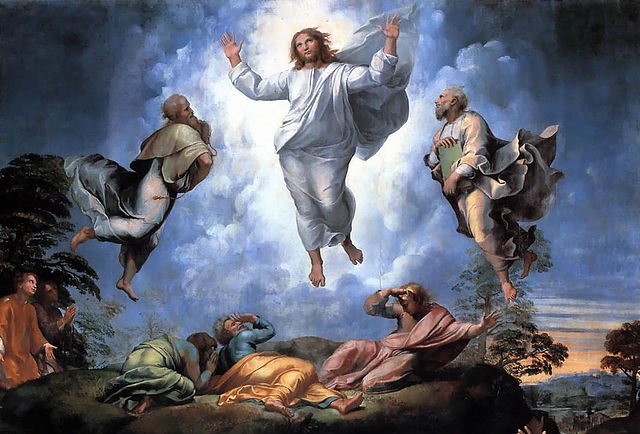
We do not have the grace of Peter, James, and John to see our Lord transfigured before our very eyes. As Bishop Anastasius of Sinai teaches us, however, Jesus still focuses our eyes on this heavenly vision. With our eyes we take into our souls images that disturb and disrupt and dismay. Instead, renew daily this vision that is more true than whatever else is impinging on our senses as we journey through the road to Life.

From a sermon on the transfiguration of the Lord by Anastasius of Sinai, bishop

…Jesus goes before us to show us the way, both up the mountain and into heaven, and – I speak boldly – it is for us now to follow him with all speed, yearning for the heavenly vision that will give us a share in his radiance, renew our spiritual nature and transform us into his own likeness, making us for ever sharers in his Godhead and raising us to heights as yet undreamed of.

…It is indeed good to be here, as you have said, Peter. It is good to be with Jesus and to remain here for ever. What greater happiness or higher honour could we have than to be with God, to be made like him and to live in his light?

 Therefore, since each of us possesses God in his heart and is being transformed into his divine image, we also should cry out with joy: It is good for us to be here – here where all things shine with divine radiance, where there is joy and gladness and exultation; where there is nothing in our hearts but peace, serenity and stillness; where God is seen. For here, in our hearts, Christ takes up his abode together with the Father, saying as he enters: Today salvation has come to this house. With Christ, our hearts receive all the wealth of his eternal blessings, and there where they are stored up for us in him, we see reflected as in a mirror both the first fruits and the whole of the world to come.

A Marian Feast You Might Be Missing

There is a lovely, little-known Memorial of the Blessed Virgin Mary under the title of Mary, Mother of the Church. It was established by Pope Francis in 2018 and is celebrated on the Monday after Pentecost.

On this Memorial, I find myself praying with the way that the Holy Spirit descended upon Mary, overshadowing her at the Annunciation. The Gospel says clearly that the Word becomes incarnate by the work of the Holy Spirit in the virginal womb of Mary (see Mt 1:18, Lk 1:35). I marvel at the way the Holy Spirit permeated Mary’s life for the rest of her life, giving life and hope to those who were around her. When she greeted Elizabeth, for instance, her elderly cousin who was shortly to give birth to John the Baptist, this humble woman exclaimed at Mary’s arrival, and was “filled with the Holy Spirit” (Lk 1:41). The Spirit brought Simeon to the Temple to hold in his arms, to see with his very eyes, the infant Jesus who had been brought in Mary’s arms to be presented in that holy place (see Lk 2:25-27).

Finally, the apostles had gathered around the Mother of Jesus after he had ascended into heaven, waiting with her for the outpouring of the Holy Spirit. Mary knew well the presence, almost the “feel”—spiritually speaking—of being inhabited, of being a Temple, of the Spirit of Jesus. She had profound spiritual sensitivity and was no stranger to the movement of the Spirit, through whom the Son of God took flesh within her.

At the Annunciation she became the Mother of Jesus, the Mother of the Son of God, and at that moment, in some mysterious way, the Mother of us, all of us who are the Mystical Body of Jesus Christ.

In the Cenacle, as the Spirit was poured out on all Jesus’ disciples praying there, Mary is manifested as a type of the Church who, as a mother herself, will give birth to children of God at the baptismal fonts of every country and every time through the grace poured out by the Spirit. This grace is a gift given on the initiative of God, purifying and elevating our nature without suppressing or changing it in its very being.

At the Annunciation Mary became the Mother of Jesus, the Mother of the Son of God, and at that moment, in some mysterious way, the Mother of us, all of us who are the Mystical Body of Jesus Christ.

Mary, Mother of the Church—our Mother, yes. But we, as a member of the Church, participate in this Motherhood by bringing others to the Church, to baptism, to the sacraments, to grace, to prayer, to communion with the other members of the Body of Christ. Mary shows us how to be a mother, solicitous and simple in the way we care about the salvation of those with whom we journey on the road of life.

The apostles went forth from the Cenacle, now powerfully sensitive to the movement of the Spirit who was sending them into the world with the mission of Jesus:

“Go into all the world and preach the gospel to the whole creation. He who believes and is baptized will be saved.” ( Mk 16:15-16)

They preached and then they baptized that day over 5000 persons. From that humble Cenacle where the disciples of Jesus received the divine gift of the Spirit, the Church has spread out, lifting people up to Jesus, as new citizens of the kingdom of glory.  

Mary, Mother of the Church, teach me how to be a mother to people who have fallen away from the Church. Inspire me how to enter into the troubled moments of others’ lives with a quiet invitation to accompany me to the Eucharist or adoration, there to meet your Son. Encourage me to say a gentle word of faith at a time when their heart is ready to receive it. Mary, Mother of the Church, pray for me.

God Knows What He is About

“God is in control and has a reason for everything, even if we don’t see it right now.”

I must confess this was at one time the way I made dealt with suffering in my life and it still is. How I made sense of life in my twenties and how I make sense of it in my sixties, however, is very different.

What has made that difference? I guess there have been many things, but the game changer has been, surprisingly, a tiny three-chapter book found in the Old Testament. The book of Ruth.

During a time of famine, Naomi and her husband Elimelek and her two sons left Bethlehem and went to live in Moab. There her two sons married the Moabite women Ruth and Orpah. Eventually Elimelek and her sons died. Hearing that there no longer was famine in Judah, Naomi determined to return to Bethlehem.

Naomi says these arresting words to Ruth and Orpah as she returns, “The Lord’s hand has turned against me!” (v 11) She acknowledges her bitterness and the dismal future that awaits her without any sons to care for her.

At the same time, earlier in her conversation she says to her daughters-in-law who were accompanying her back to Judah, “May the Lord show you kindness, as you have shown kindness to your dead husbands and to me. May the Lord grant that each of you will find rest in the home of another husband” (v 8, 9).

Naomi could acknowledge her bitterness, state exactly what she felt God was “doing to her,” and in the same breath call upon the Lord to bless others.

With all that Naomi had suffered and through all the hopelessness that awaited her she still thought of others and reached out to them in love.

With all that she had suffered and through all the hopelessness that awaited her she still thought of others and reached out to them in love. She was not swallowed up in bitterness.

Regardless of how she believed God was treating her, she still prayed.

Naomi isn’t one of the biblical heroes like Abraham or Moses or King David or Peter or Paul. She is just an ordinary woman with an ordinary life doing the next best thing. She lives simply in the delicate and beautiful web of salvation that is being spun through God’s providence in all the world. Everyday decisions are used by God as, unbeknownst to her, he accomplishes the mystery of salvation, and her tender story sets the stage for events of biblical proportions.

Here’s what I learned from Naomi:

  • God has a plan and nothing can stop that plan. God’s plan is much larger than our own individual lives, and yet our personal lives are of immense importance in the larger plan.
  • Sometimes it is nice to do a discernment about God’s will. But most of the time, we, like Naomi, only have the possibility of doing the next right thing, the next act of love for someone else. Each of those seemingly insignificant decisions are part of the unfolding of God’s providence for the coming of the Kingdom. Our life is of immense value.
  • Love is really important.
  • I don’t know the plan, but God does.
  • Keep praying. Keep believing. Keep talking. Keep loving.

Daily living is the theater of God’s glory. Though we don’t know the story line entirely, we do know that the Author of Salvation uses everything to bring the world to its final end, communion with God.

Naomi had no way of knowing that through all the micro-decisions of her life, the seeming failure, the bitterness and the determination, her daughter-in-law Ruth would end up being named in the genealogy of Jesus as the great-grandmother of King David (Mt. 1:5-6).

God knows what he is about and that is enough for me.