At Christmas, it’s okay to feel just the way you do

She was a young mother, not more than 25, and carried an eight-month-old baby girl in a front-facing baby wrap. With her left hand she guided her other daughter towards the Baby Jesus statue in our Book Center yesterday here in Alexandria, Virginia. It was our annual Baby Jesus Party and families were arriving all day to take their pictures with Baby Jesus and shop for books that would feed their spirits. (I heard there is a shortage of Santas this year, but all the children could definitely hear Jesus calling, “Let the children come to me.”)

So many beautiful families yesterday, but while I took a few moments to sit down, it was through this woman that God granted me such a moment of grace.

As they left Baby Jesus, it was the older daughter, maybe about two years of age, who began to cry. Mom dropped down to her knees and put her arm around her daughter and said, “It’s okay.” Then she let her cry if that’s what she needed to do, assuring her every now and then over the next four minutes or so that her tears were okay, gently trying to guess what might be causing her distress.

As we gather near Jesus this Christmas season, we all have moments of tears, wistful memories of what could have been, empty places in our hearts and at our tables…. We, like the little girl, sometimes shed tears, and are unable to explain exactly what they mean or what it is we need. God, like a good mother, says to you, “It’s okay to cry.”

God wraps his arms around you, kneels down to look you right in the eye, and whispers, “It’s okay to feel the way you do.” In a season where we are told we should be happy and nostalgic and romantic and excitedly anticipating sleigh rides “over the mountains and through the hills to grandmother’s house we go….”, it’s more than okay if your heart also carries a weight that is tearing open the veil to eternity from whence comes “the Dawn from on High.”

God wraps his arms around you, kneels down to look you right in the eye, and whispers, “It’s okay to feel the way you do.

So here are three things you can do if along with the sentiments of the season, you also find yourself shedding invisible tears:

  1. Give yourself the gift of Christmas alone-time just once. Eat your breakfast early one morning in front of your Christmas tree or crêche and just let everything be. Let the season soak in spiritually and emotionally. Let time pass without plans and alarms and getting ready for the next things to be done. No carols, no seasonal expectations, no putting yourself aside to make Christmas for someone else. Just as it takes time and protection from competing stimuli for short-term memories to convert into long-term memories, I believe it takes time and sacred quiet space for our experiences and feelings to sink into our spiritual consciousness and formatively shape who God is creating us to be.
  2. Do something “Christmassy” with family or friends that doesn’t involve any preparation. This afternoon I walked down to the waterfront here in Old Towne at the end of King Street. The river walk was a quiet place where I enjoyed the families who were out for the day. As I started back up King Street, though, I spontaneously called my dad just to say hi. A street musician was playing Christmas music on the saxophone and he so uplifted my heart! I needed to share it with someone else. Share what uplifts your heart with someone else, or go along with their fun for a few hours.
  3. Keep your Bible handy and dwell a bit on this passage from the prophet Baruch. If you have a designated prayer time like a turn for Eucharistic Adoration great, but just reading a few verses before you get out of bed each morning or during a coffee break will work just as well. As you read it, pay attention to the feelings this passage arouses in you, any memories, hopes and dreams. Pray the passage with a spirit of gratitude.

“Build up, build up, prepare the road!
    Remove the obstacles out of the way of my people.”
For this is what the high and exalted One says—
    he who lives forever, whose name is holy:
“I live in a high and holy place,
    but also with the one who is contrite and lowly in spirit,
to revive the spirit of the lowly
    and to revive the heart of the contrite.
I will not accuse them forever,
    nor will I always be angry,
for then they would faint away because of me—
    the very people I have created.
I was enraged by their sinful greed;
    I punished them, and hid my face in anger,
    yet they kept on in their willful ways.
I have seen their ways, but I will heal them;
    I will guide them and restore comfort to Israel’s mourners,
    creating praise on their lips.
Peace, peace, to those far and near,”
    says the Lord. “And I will heal them.”

Take off the garment of your sorrow and affliction, O Jerusalem,
    and put on forever the beauty of the glory from God.
Put on the robe of the righteousness that comes from God;
    put on your head the diadem of the glory of the Everlasting;
for God will show your splendor everywhere under heaven.
For God will give you evermore the name,
    “Righteous Peace, Godly Glory.”

Arise, O Jerusalem, stand upon the height;
    look toward the east,
and see your children gathered from west and east
    at the word of the Holy One,
    rejoicing that God has remembered them.
For they went out from you on foot,
    led away by their enemies;
but God will bring them back to you,
    carried in glory, as on a royal throne.
For God has ordered that every high mountain and the everlasting hills be made low
    and the valleys filled up, to make level ground,
    so that Israel may walk safely in the glory of God.
The woods and every fragrant tree
    have shaded Israel at God’s command.
For God will lead Israel with joy,
    in the light of his glory,
    with the mercy and righteousness that come from him.

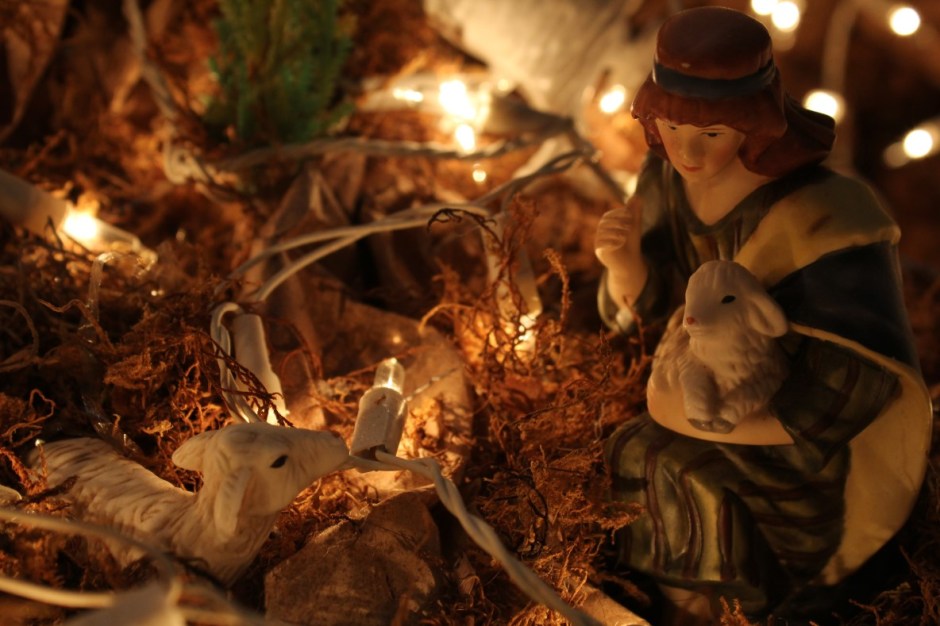
Finally, I imagine some readers are a little worried that I seem to have moved on to Christmas when Advent is just half over. It is Gaudete Sunday, however, and lifting hearts that are sorrowful is the redemptive excitement of the season of Advent. At St. Mary’s Basilica on Royal Street, I noticed they already have the stable up, which at first surprised me. I figured they’d be sticklers for the Advent-Christmas divide. I went up to look at it more closely and the stable was populated with all the animals of the nativity scene. Just animals and a shepherd. After all, the place where the animals were kept would have been there before the night Jesus was born, and it would have been used for day-to-day shelter for shepherds and animals. Into that simple and humble reality, Jesus was born, a surprise guest who made our earth his home.

We too in Advent, and all year through, live our simple and humble daily lives, always waiting for the exciting moment when it clicks in our heart that Jesus who has already come is here with us right now. So perhaps instead of keeping the Advent-Christmas divide so strictly this year, your heart might rejoice in the comfort the Redeemer came to bring you, and give it as many days as you can to let it soak in. There is nothing more urgent for our hearts and our world to know than this Advent-Christmas promise: through Christ our Redeemer, God has history under his powerful love, walks the ordinary paths of his people holding them each by hand, and will ultimately bring all of the chaos caused by the human disorder emerging from our unruly hearts into the dominion of the Kingdom that will never end.

Image Credit: Anakarina via Cathopic
This Advent let God do something new

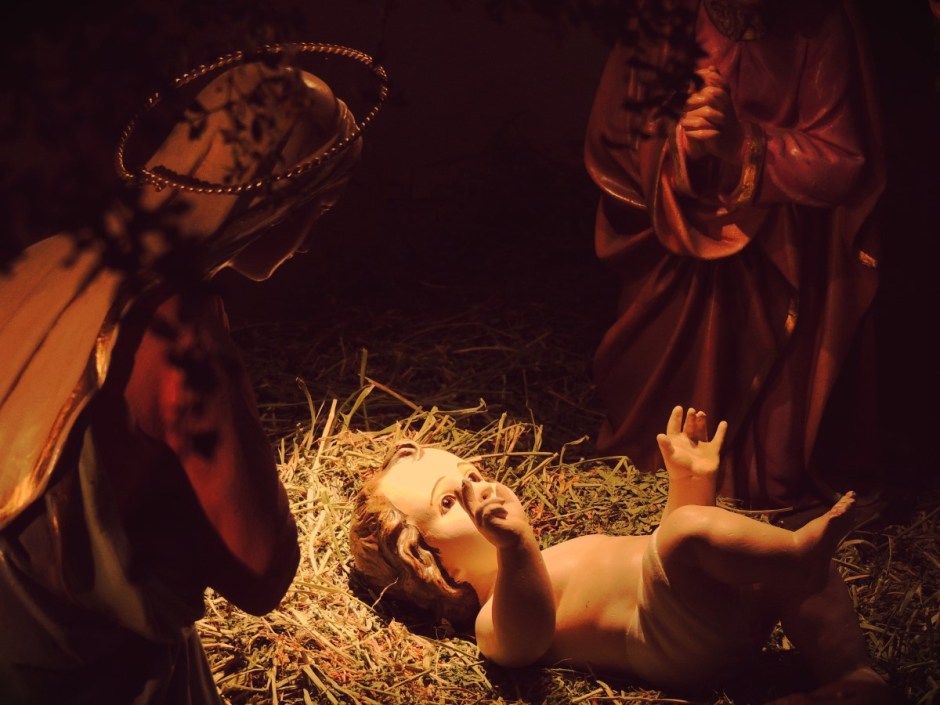
The Church has begun its new liturgical year with the haunting strains of O Come, O Come Emmanuel. The One who is Emmanuel—God-with-us—breaks through the prisons in which people had been confined by the experience and expectations of millennia of history. Yet this Jesus who is the key of all of history and the One who alone can make sense of our chaotic hearts was born in the dark of night to parents whose lives had been upended by a royal census. The shivering Babe was noticed only by sleepy shepherds and three wise men who found him inadvertently after stumbling into Herod’s palace for information about the star that had led them to Bethlehem.

I am doing something new….

As I leave my parents’ home to return to the new community to which I have been transferred, I too feel small. Yet Jesus said to me, “Do not allow the past to circumscribe the future I will create for you.” As we stand at the threshold of a new Advent, a new Christmas celebration, and the New Year 2022, these are words that the Christ Child says to all of us.

The Lord shakes us awake with similar words that he had once spoken through his prophet Isaiah. As I read them I think of the excitement of children on Christmas morning as they wake up and race to the Christmas tree to see if Santa has been to their house. How much more eager, I say to myself, should my heart be to see the fulfillment of these promises of the Lord in me, in us, in the world today.

I am doing something brand new, something unheard of.
Even now it sprouts and grows and matures.
Don’t you perceive it?
I will make a way in the wilderness
and open up flowing streams in the desert.
Wild beasts, jackals, and owls will glorify me.
For I supply streams of water in the desert
and rivers in the wilderness
to satisfy the thirst of my people, my chosen ones,
so that you, whom I have shaped and formed for myself,
will proclaim my praise (Isaiah 43:19-21 TPT).

 “Do not allow the past to circumscribe the future I will create for you.”

As I begin to allow God to do something brand new, I start each day with the expectation that events will unfold that only God can account for.

As I begin to expect God to do something brand new in my life, I feel less overworked and overwhelmed by the constant influx of bad news and fear-engendering headlines.

As I begin to expect God to do something new in the world, I find myself praising and thanking God throughout the day for—and sometimes despite—whatever happens.

As I begin to expect God to do something new in history, I am more confident that I can make a real difference and look around to see how I can serve and love.

As I begin to expect God to do something new, I close my eyes, know I’m protected, and exchange the hypervigilance created by screaming headlines for a constant affective gaze that rests with confidence on the face of the One who is God-with-us.

I wish you all a Blessed beginning of Advent, praying that you will discover the new things Emmanuel wishes to accomplish for you and through you. May no fear, no memory, no hesitation block the advent of the King! “God called you out of darkness to experience his marvelous light, and now he claims you as his very own. He did this so that you would broadcast his glorious wonders throughout the world” (1 Pt. 2:8 TPT).

Thanks for joining me on the journey,
Sr. Kathryn J. Hermes, FSP

Photo Credit: Eduardo Montivero via Cathopic

Someone needs your “beautiful feet”

In today’s first reading in this first week of Advent, St. Paul refers to a verse from the great prophet who accompanies us through every Advent: the prophet Isaiah (flourished 8th century B.C., Jerusalem): How beautiful upon the mountains are the feet of those who bring good news….

The entire verse found in the book of Isaiah reads this way:

Therefore my people shall know my name
    on that day, that it is I who speaks: Here I am!
How beautiful upon the mountains[a]
    are the feet of the one bringing good news,
Announcing peace, bearing good news,
    announcing salvation, saying to Zion,
    “Your God is King!” (Isaiah 52:6-7)

Those beautiful feet that Isaiah envisions came running to me in a restaurant parking lot several weeks ago when our family was gathering for a final meal before we placed mom in memory care in a facility where we could visit her daily. I was walking alone. “Hey, sister, is school out today?” a woman called out cheerfully. I laughed and shared with her the sorrow that was in my heart. “That is so hard,” she responded. “I promise you my prayers. I always ask God to take my body before my mind.” Then she continued with a mischievous smile, “But I tell my kids, don’t be afraid to put me in a nursing home at the end. If I have my mind it will be my last chance to evangelize. If I don’t have my mind I won’t know anyway.” Then she surrounded me with a great hug that completely warmed my heart before going on her way.

“Beautiful feet…”

In the last meeting we had with the administrator of the memory care facility on the previous day, she had said to my dad, “You have cared for your wife with great love till now. We are here to help you now. But in the end, even though we think we are the ones caring for her, we are the ones responsible, it is really God who is caring for her. God who is responsible for her. We are all just helpers.”

“Beautiful feet…”

Those who bring us the good news have beautiful feet because they are partnering with God to bring joy and salvation to others. Those feet that are actively moving about represent the way the Gospel reaches us in surprising places, through unexpected people, in exactly the right moment to assure us of God’s presence and God’s protection and God’s tender love for us.

Therefore my people shall know my name
    on that day, that it is I who speaks: Here I am! (v. 6)

Today is the feast of St Andrew and we celebrate liturgically the calling of this great apostle who in his turn became the beautiful feet that announced the good news to any and all who would listen.

You, too, can be the one who in beautiful ways brings the good news to someone else, in a parking lot, in a meeting, in a moment of confusion or sorrow or grief.

At some times you will be the one who announces the news that God says through you, “Here I am!” At other times you will be the one who receives the message of God reaching out to you. Later that day, God whispered quietly in my heart, “You know, Kathryn, I love your mom too.” I had to let her go and give her to her Father’s very capable hands and hide her in his heart.

So I end with this Advent reminder: Every year Advent and Christmas is a relearning that God is saying HERE I AM! We have a month to receive this message into our very bones so that we can in the new year be the beautiful ones that carry this message to others throughout the coming year. Or maybe someone needs your beautiful feet to find them today.

Image Credit: Will Bolanos on Cathopic

No shortage on Christ this Christmas

Yesterday the haunting verses of O Come, O Come Emmanuel were a welcome massage for my heart. Since early October we’ve been warned of supply chain shortages and inflation that threaten ruin to all we hope for in the Christmas holidays. Hearing the name of God-with-us cracks open our hearts to receive the light, the Light of the World.

The invitation of this morning’s liturgy redirects our attention from commercial revelations to divine revelation. We almost catch our breath as we hear the nations cry out, Come, let us climb the Lord’s mountain…. The Lord’s mountain will be seen as the highest mountain, according to the vision of the prophet Isaiah, speaking of the final age. Worship of the true God will be so conspicuous that it will be known to all people. The Kingdom established by the Messiah will be so attractive that all people will willingly lay aside the violence at hand to kneel before others in service: They shall beat their swords into plowshares / and their spears into pruning hooks.

This “mountain” envisioned by Isaiah is presented to us by today’s Gospel reading as a Person, a man with two hands and two feet. The One who doesn’t wait for us to climb the mountain but who instead comes to us who are poor, wretched, made up of a billion needs, dependent. The One whose coming we celebrate at Christmas, and whose coming is so tenderly depicted in the nativity scenes that we’ll soon see in churches and homes.

Jesus says to us, as he said to the centurion in Capernaum who appealed to him for his servant who was paralyzed, “I will come [to you] and heal you.”

As Christians we can hold on for sure to this promise even in the midst of the storms of these years we’ve lived: Christ has come. Jesus the Christ is here with us today. Christ will come again. The historical situation in which we live cannot rob us of the grace we’ve been given, the grace freely bestowed on us in Christ by the Father.

Take heart, my friends, from the simple words of the centurion in today’s gospel. A simple, clear, humble statement: Lord, my servant is suffering. Jesus immediately responds: I will come and cure him.

Lord, I am old and worry about my life. I will save you.
Lord, I am exhausted and suffering. I will come and cure you.
Lord, my children are far from you and from me. I will come and cure them.
Lord, I don’t know where to turn. I will come and hold you.
Lord, I feel alone and depressed. I will come and sit with you.

In the midst of all the struggles, trials and tribulations both in the world and in our lives, it is to the Lord himself this Christmas that we must look, to the God become man who walks among us even today, even now. It is to the Lord, more than any other resource, that we must turn to hear the Advent-Christmas promise: I will come. I have come. I will come again. There will be no shortage of Christ this Christmas.

Image credit: Laura Tapias on Pixabay

When your heart aches at the holidays

Have you been experiencing deep longings in your heart? As we approach the Thanksgiving holiday and the Advent-Christmas season, we wonder maybe a little more than usual about what truly makes us happy, what completely satisfies us. With the changes happening in my family as my mom has been placed recently in memory care, Thanksgiving and Christmas traditions are also being modified. Since I was a child I remember spending hours before the manger scene that graced the fireplace in our living room year after year. When my parents moved from the house to independent living, the crèche went with them and continued to have pride of place in their new apartment. But this year, I find my heart confused with a number of conflicting longings.

I long for things to be the way they were.

I long for my mom to be back in the apartment with Dad.

I long to set up the nativity with my Dad, as some sign that things will go ahead without really changing that much.

I long to let go and allow God to lead us all through this in his perfect design.

Our hearts ache a little more during the holidays, don’t they? We still haven’t found exactly what we are most deeply searching for.

And that’s OK. Because our longing–it’s good. The ache itself keeps us in touch with our need for God. The sometimes sharp pain keeps us focused on the billion needs that we are before God, that we are filled with needs that ultimately only God can satisfy.

Sr. Sharon, a good friend, shared with me an entry from her journal a number of years ago. In the very first line is the key to finding the peace we so long for:

Thank you, Jesus, for your delight in me, your creation.
I am a miracle of your love and mercy.
I love you. You love me.
Thank you for everything.
Love, you are love. May my humble life give you glory.
Lord, have mercy, have mercy. Amen.

Sr Sharon Legere, FSP

Our greatest desire is to know that God delights in us, wants to be with us, loves to hear our voices in prayer, chooses to “spend his time with us,” so to speak. God’s love for me is a miracle that will never fade. It is eternal.

What do you wish the Father would whisper right into the depths of your being? Quiet yourself down for just a moment and search inside for the answer to this question. Read as a prayer the journal entry above. And then listen to this Letter from God to you:

Image credit: #ArqTl on Pixabay

Sometimes there are no words…. (Tears at the Afghanistan evacuation)

One of my friends posted this on her Instragram account. To me, it said more than words could ever say. It includes the artist’s name.

This reminds me of the reflections of Etty Hillesum in her book An Interrupted Life. Esther (Etty) Hillesum (15 January 1914–30 November 1943) was the Dutch author of confessional letters and diaries which describe both her religious awakening and the persecutions of Jewish people in Amerstdam during the German Occupation. In 1943 she was deported and killed In Auschwitz concentration camp. In one of her diary entries she wrote, in a similar vein to the image above, that even the German mothers are mourning the loss of their sons, just as the Jewish mothers are. I have always kept An Interrupted Life and love to pull it out at times such as these. Some of my favorite quotes from Etty:

“All disaster stems from us. Why is there a war? Perhaps because now and then I might be inclined to snap at my neighbour. Because I and my neighbour and everyone else do not have enough love. Yet we could fight war with all its excrescences by releasing, each day, the love that is shackled inside us, and giving it a chance to live. And I believe that I will never be able to hate any human being for his so-called wickedness, that I shall only hate the evil that is within me, though hate is perhaps putting it too strongly even then. In any case, we cannot be lax enough in what we demand of others and strict enough in what we demand of ourselves.”
― Etty Hillesum, An Interrupted Life: The Diaries, 1941-1943; and Letters from Westerbork

“Ultimately, we have just one moral duty: to reclaim large areas of peace in ourselves, more and more peace, and to reflect it toward others. And the more peace there is in us, the more peace there will also be in our troubled world.”
― Etty Hillesum

“Despite everything, life is full of beauty and meaning.”
― Etty Hillesum, Lettres De Westerbork

“Each of us must turn inward and destroy in himself all that he thinks he ought to destroy in others.”
― Etty Hillesum

“I know and share the many sorrows a human being can experience, but I do not cling to them; they pass through me, like life itself, as a broad eternal stream…and life continues…”
― Etty Hillesum

“I really see no other solution than to turn inwards and to root out all the rottenness there. I no longer believe that we can change anything in the world until we first change ourselves. And that seems to me the only lesson to be learned.”
― Etty Hillesum, Lettres De Westerbork

“I know that those who hate have good reason to do so. But why should we always have to choose the cheapest and easiest way? It has been brought home forcibly to me here how every atom of hatred added to the world makes it an even more inhospitable place.”
― Etty Hillesum, An Interrupted Life: The Diaries, 1941-1943; and Letters from Westerbork

“When you have an interior life, it certainly doesn’t matter what side of the prison fence you’re on. . . I’ve already died a thousand times in a thousand concentration camps. I know everything. There is no new information to trouble me. One way or another, I already know everything. And yet, I find this life beautiful and rich in meaning. At every moment.”
― Etty Hillesum, An Interrupted Life: The Diaries, 1941-1943; and Letters from Westerbork

“We go too far in fearing for our unhappy bodies, but our forgotten spirit shrivels up in some corner. Our lives are going wrong, we conduct ourselves without dignity. We lack historical sense, forget that even those about to perish are part of history. I hate nobody. I am not embittered. And once the love of mankind has germinated in you, it will grow without measure.”
― Etty Hillesum, An Interrupted Life: The Diaries, 1941-1943; and Letters from Westerbork