Take a deep breath!

September—the month where the summer’s lush fullness is traded for autumn’s sharp clarity. When restless winds tug at the trees, reminding us that the vibrant colors of the fall are around the corner. School starts and summer’s freedom is replaced by the challenge and excitement of new things to learn, to explore, to become. Vacation months give our spirits a bit of space to breathe more deeply, before we pick up again the weight and concern of burdens of a world that feels turbulent and stretched thin.

We can’t forget how to breathe.

We can’t forget that we’re standing right in the middle of God’s great story.

The apostles—not unlike us—felt nervous and frightened and frustrated, when they weren’t able to see beyond their own strength, their own solutions to problems, their own abilities, and what they had at hand. Whether they were trying to figure out how to feed five thousand people with five loaves of bread, or straining to pull the oars in the midst of a storm that struck terror in their hearts, Jesus helped them gently learn: You cannot do it alone. Without me you can do nothing. I am here. I love you. And I will take care of you. And I will provide for you. And I will protect you.

That’s been sitting with me. The apostles couldn’t fix the hunger of the crowd, and they couldn’t calm the storm at sea. And I realize: I can’t fix my family, our culture, or the world. Neither can you. But we can turn to Jesus, who is Life itself, and who meets us with abundance when we’ve reached our limits.

The saints remind us that the quality of our days isn’t determined by the times we live in, but by the way we live them. Or as Pope Leo recently said, quoting St. Augustine, “Let us live well and the times will be good. We are the times.”

I believe this is a moment of awakening—a time to choose joy, to walk in holiness, and to let Christ’s light shine through us. These are hopeful times, because Christ is with us. To be Catholic right now means carrying him into the world, not with our own strength, but with his life flowing through us.

So don’t forget how to breathe as the pace picks up in these weeks.

Sr Kathryn

Being the Child God Made You: Like the Little Sparrows

Sparrows, in the biblical sense, are birds of freedom. Israel has long been a home for sparrows; the earliest fossil remnants of house sparrows anywhere in the world were found in Israel in caves in the Carmel Mountain range near Haifa and also in caves near Bethlehem, just to the South of Jerusalem.

Sparrows don’t live in deserts or deserted places and they don’t migrate. Instead they plaster mud nests in the Temple eves near the altar. They are swift in flight and it is impossible to retain them in captivity. Sparrows are songbirds and utter a sweet, slow note that is pleasing to the ear (contrasted with the harsh and incessant chatter of other birds in biblical times such as the swift).

O Lord my God, my heart and soul, like the sparrow, cry out for you! (see Psalm 84)

Most likely we rarely pay attention to the common sparrow. Birds with more flashy colors and extravagant markings are more likely to be photographed and shared. Yet Jesus chose the sparrow, not the parrot or the ostrich or the blue jay, to convince us that God will take good care of us:

“Are not two sparrows sold for a penny? And not one of them will fall to the ground without your Father’s will. But even the hairs of your head are all numbered. Fear not, therefore; you are of more value than many sparrows” (Mt 10:30-31).

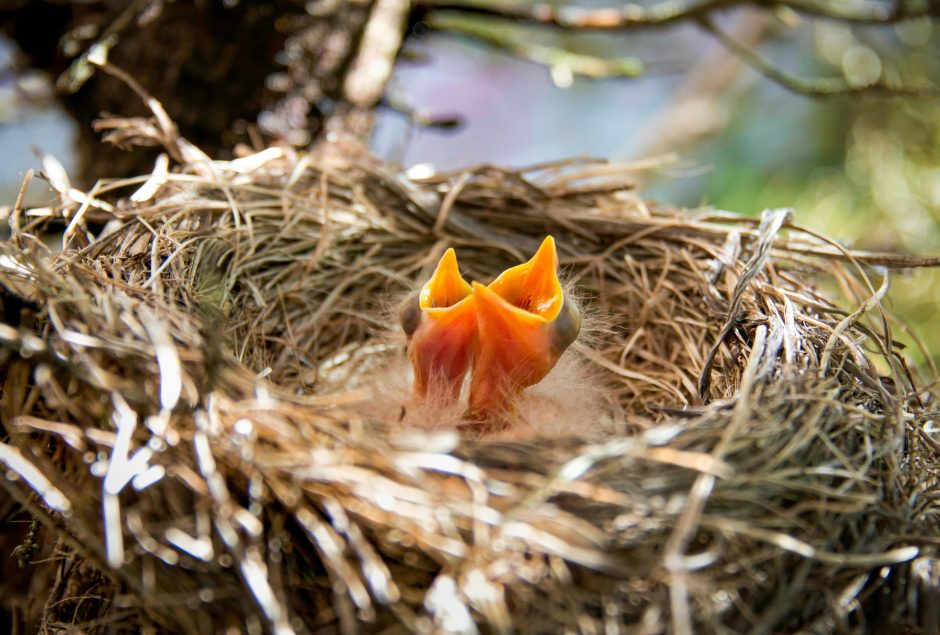
As children, my sister and brother and I loved watching a nest full of newly hatched chicks. Whenever my mother discovered one she would call us over to carefully peek inside. Newly hatched songbirds are blind, featherless, and helpless. Immediately after hatching, these types of birds can do little more than open their mouths to beg for food. The hungrier they are the louder they cry and the more they open up their beaks. For the first two to three weeks of life they remain in the nest and the parents feed them every fifteen minutes during the day. At first the chicks cannot control their own body temperature and must be constantly kept warm by their parents. While the mother and father are searching for food and flitting back and forth to their nest, they are also watching for predators. As the newly hatched chicks eat almost constantly during the day for the first ten days or so their growth rate is incredible.

“Are not two sparrows sold for a penny? And not one of them will fall to the ground without your Father’s will. But even the hairs of your head are all numbered. Fear not, therefore; you are of more value than many sparrows.”

“Acknowledge your hunger and cry out to the Lord…”

You’ve probably seen nests packed tightly with baby chicks, their heads held up high, cheeping loudly, with their mouth open as wide as possible, showing off the interior of their brightly colored mouth. The inside of a baby’s mouth is called a “gape,” and red, orange, yellow, and pink are common gape colors. The chick gaping with a wide-open beak and the high-contrast colors trigger something in the parents who are biologically wired to put food into gaping mouths.  The hungrier the baby birds are, the more enthusiastically they beg for food, and they don’t stop cheeping until they are full and satisfied. The parents only stop feeding the chicks when all of them are sitting quietly in the nest at the end of the day.

These days I live in a convent in a city, so birds’ nests are not something I ever see. But I do build my own “nest,” so to speak, near the altar of the Lord of hosts, in the convent chapel. There is the place where we can all open our mouths and tell the Lord of our hunger to know him, our hunger for life, our hunger for eternity. Like the baby birds, I am learning to never stop begging to be fed.

How lovely is your dwelling place,
    O Lord of hosts!
My soul longs, indeed it faints
    for the courts of the Lord;
my heart and my flesh sing for joy
    to the living God.

Even the sparrow finds a home,
    and the swallow a nest for herself,
    where she may lay her young,
at your altars, O Lord of hosts,
    my King and my God.
Happy are those who live in your house,
    ever singing your praise (Psalm 84:1-4).

One thing that will help you become the Child you are…

God has made us for himself. He is providing for us, nourishing us, protecting us, warming us, delighting us… As long as we keep our hearts open, begging for him and his life, we will receive all he is giving us.

What gets in the way of this inbuilt hunger for God? For each of us there would be a different list. One of the habits in the following list might be on yours: hours of scrolling through social media feeds, trying to do what only God can do, attempting to change people around you instead of changing yourself, numbing habits, grasping for empty fillers like higher salaries, success, possessions, status… When we are satisfied with what can never satisfy us….

One thing we can do to increase our hunger for God is to avoid these ultimately unsatisfactory fillers and meditate instead on these famous words of St. Augustine who said:

“You have made us for yourself, O Lord, and our heart is restless until it rests in you.

“Who will grant it to me to find peace in you? Who will grant me this grace, that you should come into my heart and inebriate it, enabling me to forget the evils that beset me and embrace you, my only good? What are you to me? Have mercy on me, so that I may tell. What indeed am I to you, that you should command me to love you, and grow angry with me if I do not, and threaten me with enormous woes? Is not the failure to love you woe enough in itself?

Alas for me! Through your own merciful dealings with me, O Lord my God, tell me what you are to me. Say to my soul, I am your salvation. Say it so that I can hear it. My heart is listening, Lord; open the ears of my heart and say to my soul, I am your salvation. Let me run towards this voice and seize hold of you. Do not hide your face from me: let me die so that I may see it, for not to see it would be death to me indeed.”

St. Augustine’s Confessions (Lib 1,1-2,2.5,5: CSEL 33, 1-5) 

Image credit: Photo by Mohan Nannapaneni

“Like a little child, I keep myself”: Retreat Reflection

I was building a sandcastle.

Jesus was running along the beach, throwing sand up into the air.

I was serious.

Jesus was laughing.

I was facing away from the ocean and the sunshine, busy with my project in the sand, my face in shadow.

Jesus gazed into the horizon, his face lit by the sun, as he sat in awe at the edge of the water.

Retreat always begins with a “before,” and ends with an “after.”

In my inspired imagination, as I prayed on the first day of my 8-day annual retreat this year, Jesus showed me that my “before”—my approach to life as a responsible and serious project-conscious adult—was no longer satisfying me. And he showed me in prayer that what he wanted for me was “delight,” his way of both delighting in the Father’s love for him and knowing that he was the delight of his Father.

In Psalm 131 there is this lovely line in the Jerusalem Bible translation: “Like a little child, so I keep myself.”

As I watched the ocean gently wash away the cares of the very important work of creating my sandcastle, Jesus helped me to feel on every level of my being what I have been created for: to be a child of the Father, as he himself is the Child of the Father. In fact, Jesus’ urging us to lay aside our self-importance to become like little children is rooted in his very way of life. Jesus wanted me to feel what he felt going about his life on this earth, what he felt in prayer on the mountains, connecting with his Father, indeed, what he feels before the Father for all eternity.

Hans Urs von Balthasar wrote in the book Unless You Become Like a Child that as a grown man, Jesus never leaves the “bosom of the Father.” His identity is inseparable from his being a Child in the bosom of the Father. In one place in the book he imagines the child Jesus becoming conscious of the world around him … “When the Mother awakens him, the opening up of the whole horizon of reality is experienced not only as something holy but as the realization that in the depths of this opened fullness of being there radiates the personal Face of his Father, personally turned toward him.”

Jesus draws us in prayer to sit beside him as he gazes into the Face of his Father who is “personally turned toward him,” personally turned toward us. This is the one thing necessary, this sitting, this receiving, this allowing oneself to be seen, to be loved. It is this that Mary had discovered and Martha’s heart—and mine—still yearned to know.

There are many things in our lives that frighten us into hiding from love, that paralyze parts of us so that we are hesitant to open up to receive the welcoming smile of God and of others. Retreats are often the long stretch of quiet healing that make it possible for us to accept being loved.

After all, Jesus was showing me, isn’t that what a tiny child longs for, needs, depends on, and trusts in? No matter what has happened in our lives, the eternal Father’s love heals and holds us until we are warmed with the gaze of his Face and are confident in the strength of his tender care for us.

Jesus didn’t ask us to be smart, accomplished, successful, organized. Nowhere in the Gospel do we find him suggesting that anything depends on us alone, especially this very important work that we were invited to share: the salvation of the world. There is only an insistence on spiritual childhood, this transformation of heart and mind made possible through the grace of the Holy Spirit.

“The child has time to take time as it comes, one day at a time, calmly, without advance planning or greedy hoarding of time. Time to play, time to sleep. He knows nothing of appointment books in which every moment has already been sold in advance.” Instead, every moment “we should receive with gratitude the full cup that is handed to us … And only with time of this quality can the Christian find God in all things, just as Christ found the Father in all things.”

This is my “after,” the gift of my retreat, the first day of the rest of my life. This is the joy Jesus has desired for me to know, the delight that is now mine forever.

Image credit: Christ with Martha and Maria by Henryk Siemiradzki, 1886 via Wikimedia, in the public domain.

Being the Child God Made You: How Beautiful You Are

Lunch period was always my most dreaded class period in school. While others couldn’t wait to be set loose for 40 minutes to be with their friends, this favorite part of most kids day was for me a torment. For many reasons I won’t go into here, I didn’t sync with the other kids in my class.

I knew when I walked into the cafeteria that it would be an embarrassing experience scanning the tables crowded with jostling and laughing kids for a place where I might be able to fit in. I wasn’t friendless, certainly, but I knew I wasn’t the one that everyone wanted on their table. Far from the life of the party I always felt outside and boring. It is an image I have had of myself that has remained with me through the years.

Recently on retreat I found myself asking Jesus: “Will you leave me, drop me, because I am not interesting enough?” Isn’t that the fear we all have. That somehow God won’t be so captivated with love for us that he’ll decide we are not worth being with for the long haul?

These were Jesus’ words I felt that he said in my heart:

“It is I who have planted my tent on your land. It is I who have desired to possess your soul… It is I who have chosen you. My choice is irrevocable. I choose to love your story—all of it. It is not a journey from bad to good. It is a life from seed to blossom. You have survived the blights and bugs, the storms, the bending and breaking, MY mending and molding. And now in MY garden, you are blossoming. It is ALL good.”

“Acknowledge your journey and all you’ve survived….”

In the Song of Songs the Lover whispers his love to his Beloved repeatedly: “How beautiful you are.”

This little book of the Bible is really all about her beauty, a beauty that the Lover has bestowed on her. Her beauty, even a passing glimpse of this beauty which he has given her, captivates his heart. As I was reading the Song of Songs on retreat, it struck me that the Lover, God, tells the Beloved, the soul, that she is precisely this, only this: beautiful. This is the one thing most of us in this culture want where so many are fixed and tucked and airbrushed to appear more beautiful.

When I heard my Dad say of my Mom, who had lived four years in memory care with late-stage Alzheimer’s, “Mom is so beautiful. She is still beautiful. She was always beautiful,” I am deeply moved. At that point, Mom wasn’t interesting to be with, she hadn’t done anything for him in a decade, and she most likely didn’t actually know who he was when he faithfully visited her at least twice a day.

After sixty years, Mom had gone from seed to blossom. She had become entirely the one God loves and cares for and fusses around, like a mother would a child. Her journey has taken her through many sufferings and much heartache, joys and laughter and love and sacrifice and care. She has survived. Indeed, she has triumphed. She passed into eternity several months ago, and now she enjoys what we struggle to understand and so often get wrong.

One thing that will help you become the Child you are…

For the Church, we are persons who live before God. What constitutes us is our relationship with God, the fact that God loves us, that God loves ME, that God loves ME with such a singular, passionate love that he called ME into being, each of us, called into being to exist forever before him.

The child who can do nothing but cry, the mature woman or man at the peak of their life, the person sunk in old age, or even lost to the world in dementia, are all the same person before God: beautiful.

We are beautiful when we are successful and when our lives seem torn apart into shreds. We are beautiful when we are surrounded by love and when we wander along, fearing no one wants us. We are beautiful to God, as Mom was still and always beautiful to Dad, as we survive the blights and the bugs, the storms, the bending and the breaking, God’s mending and molding… We are beautiful in God’s beautiful garden. And it is all beautiful.

One thing you might do in a moment of prayer with Jesus after Communion or before the Eucharist in adoration, is to make a list of the things that you try to hide even from yourself, those things that you have decided “aren’t beautiful.”

At the bottom write:

“It is I who have chosen you, I, Jesus. My choice is irrevocable. I choose to love your story… All of it… Every last inch of the woven tapestry of your life is beautiful to me.”

Is there one thing on your list that Jesus begins to open up for you to see in a new way? Allow Jesus to say to you these words,

“I enjoy being around you. I want to spend time with you. I love wasting time with you. From forever I have lavished my Heart’s attention on you.”

Image Credit: Photo by Garon Piceli

Being the Child God Made You: Royal and Loved

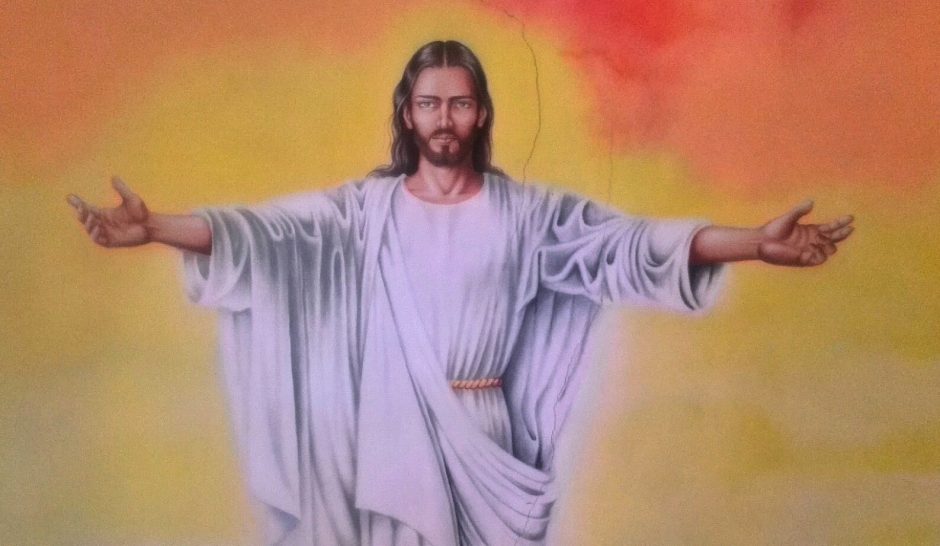
One of my sisters likes to post on Instagram stylized pictures of Jesus. He is often depicted as a King and the “soul” as a princess. There is something endearing and captivating about this artistic way of depicting something so true about who we are: we are adopted into the family of the King. With our baptism we truly are royalty. We are princes and princesses who are loved by the King of Kings.

So amazing! Yet this reality, this truth that is hinted at on every page of God’s word, is so hard to remember about ourselves and about others. Jesus, the Son of God, loves us. Jesus chooses us. We belong to the King of Kings and the Lord of the Universe. In Isaiah there is more than a hint:

“You shall be a crown of beauty in the hand of the Lord,
    and a royal diadem in the hand of your God.

…You shall be called My Delight Is in Her” (Isaiah 62:3, 4).

And in the Psalms there is a beautiful psalm that speaks of the marriage of the King and the princess:

My heart overflows with a goodly theme;
    I address my verses to the king;
    my tongue is like the pen of a ready scribe.

You are the most handsome of men;
    grace is poured upon your lips.

The princess is decked in her chamber with gold-woven robes;
    in many-colored robes she is led to the king (Psalm 45:1-2, 13-14).

And in the Song of Songs we hear the voice of the King and Bridegroom as he speaks to his bride:

You have ravished my heart, my sister, my bride,
    you have ravished my heart with a glance of your eyes,
    with one jewel of your necklace.
How sweet is your love, my sister, my bride! (Song of Songs 4:9-10)

These prophetic words are fulfilled in Jesus who says in the Gospel of John: “You did not choose me but I chose you. I have chosen you out of the world” (John 15:16, 19).

“Remember you have been made a ‘partaker of the divine nature’….”

Baptism is what makes us royalty. I follow the royal family in Great Britain. There people are born into royalty. We, instead, through Baptism, having no claim on being a part of the Royal Family of God, have been made a “partaker of the divine nature,” member of Jesus Christ and a temple of the Holy Spirit.

As the Catechism of the Catholic Church states: “Baptism … makes the neophyte ‘a new creature,’ an adopted son of God, who has become a ‘partaker of the divine nature,’ member of Christ and co-heir with him, and a temple of the Holy Spirit” (Catechism of the Catholic Church, n. 1265).

“Baptism is God’s most beautiful and magnificent gift. . . .We call it gift, grace, anointing, enlightenment, garment of immortality, bath of rebirth, seal, and most precious gift. It is called gift because it is conferred on those who bring nothing of their own; grace since it is given even to the guilty; Baptism because sin is buried in the water; anointing for it is priestly and royal as are those who are anointed; enlightenment because it radiates light; clothing since it veils our shame; bath because it washes; and seal as it is our guard and the sign of God’s Lordship” (St. Gregory Of Nazianzus, Oratio 40,3-4:PG 36,361C., quoted in the Catechism of the Catholic Church, n. 1216).

One thing that will help you become the Child you are…

This old adage is actually not true: “The memory is the faculty that was made to forget.” Yes, the memory forgets a lot, a lot of the time. But it was not made by God to do that. That wouldn’t make sense.

We were given a memory so that we could remember God and remember who we are. Instead, it gets really good at remembering past hurts or grievances, has little recall of how God has been present in our life and how he has shaped us and our lives in his love. We have hardly the focus and intention to call to mind that the infinite and transcendent God is always calling us to become more, to become our true identity, united with Christ in God’s own life. We are called to union with and within the divine life itself.

These things just seem to vanish from my mind. It doesn’t help that the Enemy is determined to wipe away any remembrance of God’s mercies from our mind, and to fill them with distractions and remembrances of grievances. I have to really work at using my memory the way it was made to be used. Do you find this to be true?

One thing you can do then is simply this: remember! Read these passages of Scripture and the Catechism over and over again day after day. At the beginning of the day visualize the situations you know you’ll encounter and picture yourself going through them as royalty. At the end of the day bring clarity to your soul by clearing out any memories that don’t reflect the truth of who you are and renew your commitment to live as one who is loved.

I have loved you with an everlasting love;
    therefore I have continued my faithfulness to you (Jeremiah 31:3).

Image Credit: Photo by Church of the King on Unsplash

Holy Saturday: From an Ancient Homily

The day I most cherish in this most holy of weeks is Saturday–Holy Saturday. It is a hinge between Good Friday and Easter, a sigh in the “great silence because the King sleeps,” a day of triumph because God “goes to seek out our first parent like a lost sheep; he wishes to visit those who sit in darkness and in the shadow of death. He goes to free the prisoner Adam and his fellow-prisoner Eve from their pains, he who is God, and Adam’s son.”

These quotations are from an ancient homily read every Holy Saturday in the Office of Readings titled “The Lord’s Descent Into the Realm of the Dead.” In this homily, Jesus calls out to those who slept in darkness:

‘Rise. I command you: Awake, sleeper, I have not made you to be held a prisoner in the underworld. Arise from the dead; I am the life of the dead. Arise, O man, work of my hands, arise, you who were fashioned in my image. Rise, let us go hence; for you in me and I in you, together we are one undivided person.’”