How to Keep the Real Meaning of Christmas (Luke 1:67-79)

“Blessed be the Lord, the God of Israel;
        for he has come to his people and set them free.
    He has raised up for us a mighty Savior,
        born of the house of his servant David….

   You, my child, shall be called the prophet of the Most High,
        for you will go before the Lord to prepare his way,
        to give his people knowledge of salvation
        by the forgiveness of their sins.
    In the tender compassion of our God
        the dawn from on high shall break upon us,
        to shine on those who dwell in darkness and the shadow of death,
        and to guide our feet into the way of peace.”

Luke 1:67-79

Let me begin by sharing with you one of my pet peeves: the jingle—Jesus is the reason for the season.  Jesus is not the reason for the season. Jesus is the reason for everything. Jesus is the center of all things and of all time, and through him we are brought into communion with God for all eternity.

It is absolutely too small for Jesus to simply be the reason for the Christmas season, as if we were trying really hard to keep the Christmas celebrations focused on their real meaning.

We need to keep reminding ourselves that Jesus is the reason for the season only when we don’t live centered around him as our ultimate reason for existence at every moment of the year. If we did, Christmas would be an intensification of the glory we give Christ every day of the year.

Zechariah had spent nine long months waiting for his son’s birth. They were nine silent months since the day he had been struck dumb by the Angel Gabriel when he wanted to know how he could be sure that what was promised him would actually come to pass. He had nine whole months to reflect on what the angel had said to him about his son: Many will rejoice at his birth…. He will be great in the sight of the Lord…. He will be filled with the holy Spirit…. He will go before the Lord in the spirit of power of Elijah to prepare a people fit for the Lord….

Day after silent day, the aged priest pondered the scriptures and the words of the angel spoken to him that day in the Temple. The silence whispered through his soul and ever so gradually he came to see that his whole life revolved around the Messiah. His fatherhood, a gift bestowed when he was an old man, was geared toward preparing for the Messiah. His child’s entire life would be dedicated to making way for the one who was promised to Israel.

When his lips were opened after the birth of his son, Zechariah burst forth in a canticle that proclaimed that Jesus was the reason for his child’s whole life. Jesus is the daybreak from on high who has visited his people and brought them redemption. He is the light that has shone in our darkness where we walk in the shadow of death, and through his life, death, resurrection, and ascension he has guided our feet into the path of peace. “And you, child, will be called prophet of the Most High, for you will go before the Lord to prepare his ways.”

Jesus is not the reason for the Christmas season. Zechariah shows us that Jesus is the reason for everything. The day after Christmas the world will get bored, Christmas songs will vanish from the radio, and retail stores will turn over quickly to the next commercial feast day. But you, do not forget that Jesus is the reason for your very life, the purpose of your existence, and he offers you the promise of eternal glory, every moment of every day, next year and every year after that.

With Zechariah cry out all year: “Blessed be the Lord, the God of Israel, for he has visited and brought redemption to his people.”

Image: The child Jesus and John the Baptist; Bartolomé Esteban Murillo, Public domain, via Wikimedia Commons

Praying with this Passage of Scripture

Lectio Divina is a way of listening to God as he speaks in his Word. It is a practice of communicating with God through Scripture and attending to God’s presence and what he wishes to tell us. In this slow and prayerful reading of the Word of God, we allow ourselves to be transformed by the Spirit who forms us into the image of Christ. There are four movements in Lectio Divina: Read (lectio), Meditate (meditation), Pray (oratio), Contemplate (contemplation).

Begin by finding a still space to pray. Breathe deeply and become quieter within. Abandon any agenda, worries or thoughts you bring to this prayer and entrust these things to the merciful care of God. Ask for the grace to be receptive to what God will speak to you through this Scripture reading. Grant me, Jesus Divine Master, to be able to know the mysteries of the kingdom of God and your unfathomable riches. Grant that your word penetrate my soul; guide my steps, and brighten my way till the day dawns and darkness dissipates, you who live and reign forever and ever Amen.

Read (lectio)
Begin by slowly and meditatively reading your Scripture passage out loud. Listen for a particular word or phrase that speaks to you at this moment and sit with it for a time.

Pray (oratio)
Read the text a third time. Listen for what God is saying to you. Speak heart to heart with God. Notice the feelings that this conversation with God raises up within you. Share with God what you notice about your response to this conversation. You may wish to return to repeating the phrase quietly and gently, allowing it to permeate you more and more deeply.

Contemplate (contemplatio)
Read the text a final time. Now be still and rest in God’s embrace. Ask God to give you a gift to take with you from this prayer. You might ask God if he is inviting you to do some action, for instance, make some change in your thoughts, attitudes or reactions, in the way you speak or how you treat others. Thank God for this gift and invitation as you conclude your prayer.

Image: Myriams-Fotos; pixabay.com

An Advent Secret for Following God’s Will (Luke 1:39-45)

Mary set out
and traveled to the hill country in haste
to a town of Judah, 
where she entered the house of Zechariah
and greeted Elizabeth.
When Elizabeth heard Mary’s greeting,
the infant leaped in her womb, 
and Elizabeth, filled with the Holy Spirit, 
cried out in a loud voice and said, 
“Blessed are you among women, 
and blessed is the fruit of your womb.
And how does this happen to me, 
that the mother of my Lord should come to me?
For at the moment the sound of your greeting reached my ears, 
the infant in my womb leaped for joy.
Blessed are you who believed
that what was spoken to you by the Lord
would be fulfilled.”

Luke 1:39-45

Most of us would like it if God would make super clear to us what he wanted us to do. Sometimes when I have been trying to discern what was God’s will for me in a specific situation, I would look with envy at the great biblical figures who received a clear-cut, can’t-be-missed message. Moses and the burning bush comes to mind. Or St Paul on the road to Damascus. Or Gideon. Or Jeremiah.

Even Mary at the Annunciation clearly knew what God was asking of her through the angel Gabriel’s message.

That would sure be nice, I used to think.

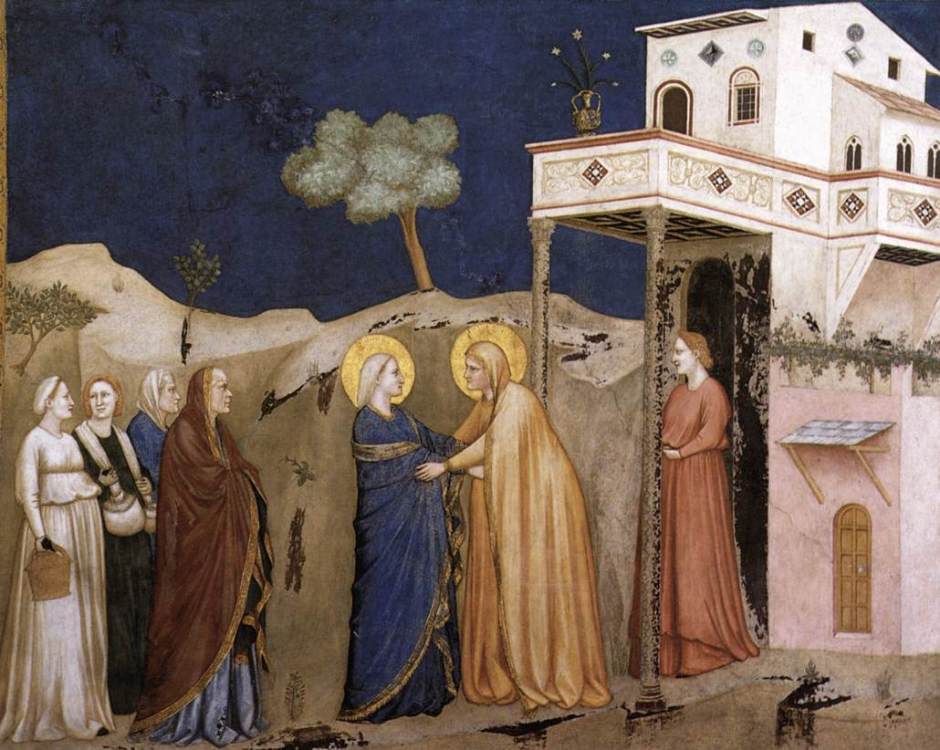
When Mary travelled to see her cousin Elizabeth directly after the Annunciation, in the first days of her pregnancy, a fifteen-year-old girl going to assist an elderly cousin and perhaps seek her advice, she went on a hint. The angel Gabriel mentioned that Elizabeth her cousin was pregnant and was in her sixth month. There was nothing about Elizabeth being the mother of the forerunner of the Messiah. There was no clear-cut, can’t-be-missed declaration that it was God’s will that Mary go and visit her. There was just a mention. In the English translation, the mention is just about 20 words out of the 200 words she heard that morning.

Such an announcement would have left most of us wondering and worrying and scurrying about in concern for ourselves. Mary instead went in haste, putting her cousin first. Mary dropped everything and left, not because she was commanded to, but because she got the hint.

There are certain times in our life when we make formal discernments as we seek the will of God in our life. I’ve learned that most of the time, however, we discover God’s call to us by picking up on the hints he is dropping all around us.

Mary “got the hint” when she heard the “mention” of Elizabeth being with child, because she was ever seeking to please the Lord, attuned to the way God works in the world, and because her heart was full of compassion and kindness for others, putting their needs before her own. As we prepare for Christmas we are immersed in all three of these qualities of Mary’s heart: seeking and waiting and loving; being attuned to both God and others; putting others’ needs before our own.

In these remaining days of Advent and through the Christmas season, keep your eyes and ears and heart open to pick up on all the hints God is dropping. These hints are the way he indicates what he desires of you. If you do so, then your Christmas celebration will truly be joyous.

Image: Giotto, Public domain, via Wikimedia Commons

Praying with this Passage of Scripture

Lectio Divina is a way of listening to God as he speaks in his Word. It is a practice of communicating with God through Scripture and attending to God’s presence and what he wishes to tell us. In this slow and prayerful reading of the Word of God, we allow ourselves to be transformed by the Spirit who forms us into the image of Christ. There are four movements in Lectio Divina: Read (lectio), Meditate (meditation), Pray (oratio), Contemplate (contemplation).

Begin by finding a still space to pray. Breathe deeply and become quieter within. Abandon any agenda, worries or thoughts you bring to this prayer and entrust these things to the merciful care of God. Ask for the grace to be receptive to what God will speak to you through this Scripture reading. Grant me, Jesus Divine Master, to be able to know the mysteries of the kingdom of God and your unfathomable riches. Grant that your word penetrate my soul; guide my steps, and brighten my way till the day dawns and darkness dissipates, you who live and reign forever and ever Amen.

Read (lectio)
Begin by slowly and meditatively reading your Scripture passage out loud. Listen for a particular word or phrase that speaks to you at this moment and sit with it for a time.

Pray (oratio)
Read the text a third time. Listen for what God is saying to you. Speak heart to heart with God. Notice the feelings that this conversation with God raises up within you. Share with God what you notice about your response to this conversation. You may wish to return to repeating the phrase quietly and gently, allowing it to permeate you more and more deeply.

Contemplate (contemplatio)
Read the text a final time. Now be still and rest in God’s embrace. Ask God to give you a gift to take with you from this prayer. You might ask God if he is inviting you to do some action, for instance, make some change in your thoughts, attitudes or reactions, in the way you speak or how you treat others. Thank God for this gift and invitation as you conclude your prayer.

Image: Myriams-Fotos; pixabay.com

Set Your Hearts Completely on the Grace of Christ (Mark 13:24-32)

“Learn a lesson from the fig tree.
When its branch becomes tender and sprouts leaves,
you know that summer is near.
In the same way, when you see these things happening,
know that he is near, at the gates. 
Amen, I say to you,
this generation will not pass away
until all these things have taken place. 
Heaven and earth will pass away,
but my words will not pass away.

“But of that day or hour, no one knows,
neither the angels in heaven, nor the Son, but only the Father.”

Mark 13:24-32

Today’s Gospel passage is part of a conversation between Jesus and the apostles in the Temple. It began with the apostles walking through the city of Jerusalem and being amazed at the beauty of the Temple. They said to Jesus, “Look, teacher, what stones and what buildings!” (Mk 13:1)

It is no wonder that they were in awe as they saw the Temple. The temple compound, originally rebuilt by Zerubbabel and Ezra and then greatly expanded and improved by Herod the Great, was one of the magnificent structures known in the ancient world and the center of Jewish life for almost 1,000 years. Herod began work on the building in 19 B.C. and completed it in A.D. 63, seven years before its destruction in 70 A.D. by fire at the hands of the Romans.

So what did the apostles see that was so overwhelming in its beauty and grandeur? Josephus, the Jewish historian, documents that the temple was covered on the outside with gold plating, and when the sun shone it was blinding. Where there wasn’t gold, there were blocks of marble that were pure white. The stones used in building the temple were massive. The limestone blocks used in the retaining wall for the temple compound alone are enormous and can still be seen today. Some of them are 50 feet wide, 25 feet high, and 15 feet deep.

Jesus responds to his closest followers with the disconcerting statement that not one of these stones would be left on a stone. In the eschatological discourse that followed, Jesus exhorted his disciples and the church to faith and obedience through the trials that would confront them before Jesus’ return in great power and glory. No one but the Father knows the precise time of the Parousia.

This Gospel passage about the coming tribulation was particularly unsettling, and for us could even seem terrifying. For those apostles who up to that time had experienced their life with Jesus filled with teaching, healing the sick, and prayer, this may have seemed to them like a sharp turn in the road. We ourselves when we hear this Gospel proclaimed may wonder with alarm if we are seeing the signs of the end actually occurring in the world as we know it.

Should we focus our attention on the books and podcasts and websites predicting the end times, the three days of darkness, or the chastisement?

Notice that Jesus didn’t advise his followers to be worried and terrified. He exhorted us to be vigilant, to watch, and to have faith. His words will not pass away, and he will return in glory to gather to himself those who have believed in him.

I think it would be best to take our cue from Peter who wrote in his first letter:

“Therefore, gird up the loins of your mind, live soberly, and set your hopes completely on the grace to be brought to you at the revelation of Jesus Christ. Like obedient children, do not act in compliance with the desires of your former ignorance but, as he who called you is holy, be holy yourselves in every aspect of your conduct, for it is written, ‘Be holy because I [am] holy’” (1 Pt. 13-16).

Image: Petra Österreich from Pixabay

Praying with this Passage of Scripture

Lectio Divina is a way of listening to God as he speaks in his Word. It is a practice of communicating with God through Scripture and attending to God’s presence and what he wishes to tell us. In this slow and prayerful reading of the Word of God, we allow ourselves to be transformed by the Spirit who forms us into the image of Christ. There are four movements in Lectio Divina: Read (lectio), Meditate (meditation), Pray (oratio), Contemplate (contemplation).

Begin by finding a still space to pray. Breathe deeply and become quieter within. Abandon any agenda, worries or thoughts you bring to this prayer and entrust these things to the merciful care of God. Ask for the grace to be receptive to what God will speak to you through this Scripture reading. Grant me, Jesus Divine Master, to be able to know the mysteries of the kingdom of God and your unfathomable riches. Grant that your word penetrate my soul; guide my steps, and brighten my way till the day dawns and darkness dissipates, you who live and reign forever and ever Amen.

Read (lectio)
Begin by slowly and meditatively reading your Scripture passage out loud. Listen for a particular word or phrase that speaks to you at this moment and sit with it for a time.

Pray (oratio)
Read the text a third time. Listen for what God is saying to you. Speak heart to heart with God. Notice the feelings that this conversation with God raises up within you. Share with God what you notice about your response to this conversation. You may wish to return to repeating the phrase quietly and gently, allowing it to permeate you more and more deeply.

Contemplate (contemplatio)
Read the text a final time. Now be still and rest in God’s embrace. Ask God to give you a gift to take with you from this prayer. You might ask God if he is inviting you to do some action, for instance, make some change in your thoughts, attitudes or reactions, in the way you speak or how you treat others. Thank God for this gift and invitation as you conclude your prayer.

Image: Myriams-Fotos; pixabay.com
Our Love Should Be a One-Way Road to His Heart (Luke 14:25-33)

“Whoever does not carry his own cross and come after me
cannot be my disciple.”

Luke 14:25-33

I remember once watching a skit that humorously demonstrated how our crosses were perfectly chosen by God for us. The skit made the point that if our crosses were cut down to a more “acceptable” size that wouldn’t be quite as burdensome to ourselves, they would in the end no longer be able to stretch across the chasm leading into heaven. They wouldn’t be the “bridge” which the crosses in our life are meant to be.

I have to confess that I’ve focused on crosses in my life as those things which irk me, cause me to suffer, or bring me into situations that are unfair and from which I cannot escape (but wish I could!). We all know the situations that we’d personally label “the crosses in my life.”

We learn from an early age to accept the cross and to unite ourselves to Jesus when the cross touches our life. And although some of my crosses have been profoundly hurtful or more difficult to endure than others, I’d have to admit on the scale of world events where the suffering of others is immense, my imagination of how the cross has touched my life can get a little over dramatic.

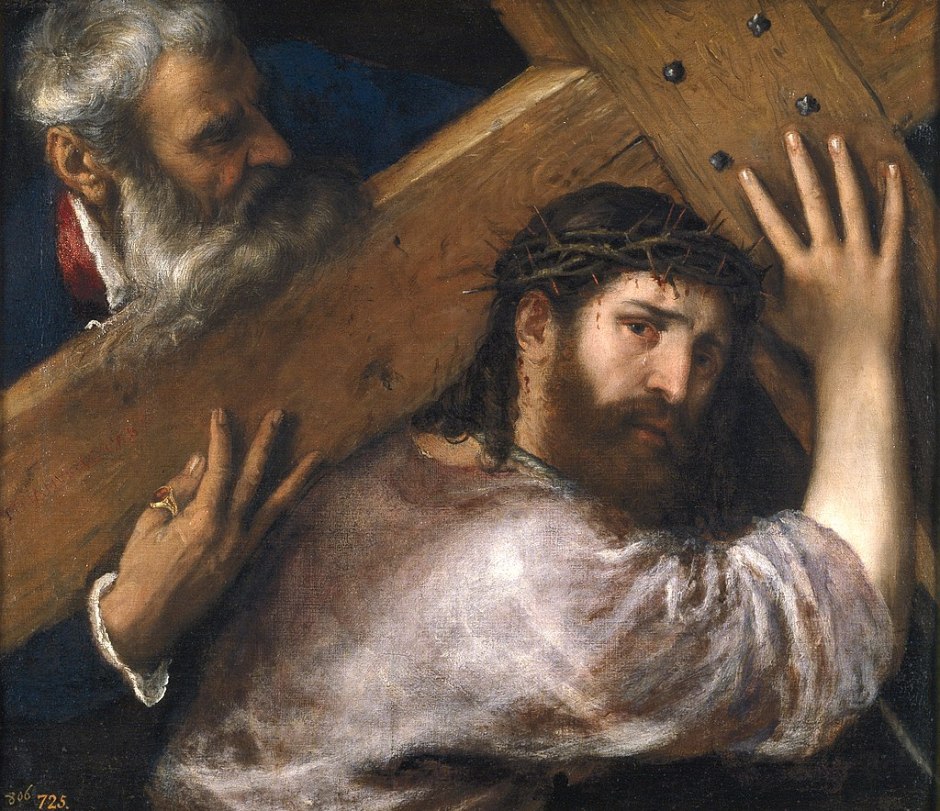
When the people who followed Jesus heard this invitation to take up their cross, they pictured something very different from the skit that I remember. It wasn’t humorous at all. They knew the person carrying the cross was on a one-way road to a humiliating and painful death. This is how Jesus loved us, and how we are called to love him in return. Jesus tells us that nothing should stand in the way of our love for him. Our love should take us on a one-way road to his heart!

It can be that family relationships support us in our love for Jesus and our walk of discipleship. If we need to make a choice, however, the choice should be clear.

There are times when advancing our careers and our material possessions and our ambitions will be in line with the values of Jesus in the Gospel. When they are not, the choice we need to make should be clear.

To prioritize Jesus is to categorically refuse to live in service of worldly desires so that we can freely choose to love in such a way that we will live eternally in the love that we have been shown by Jesus Christ. Carrying the cross means a living adherence to Christ Jesus.

Today ask yourself: “Jesus, what does this mean for you and for me?”

Image: Titian, Christ Carrying the Cross, Oil on Canvas, Public domain, via Wikimedia Commons

Praying with this Passage of Scripture

Lectio Divina is a way of listening to God as he speaks in his Word. It is a practice of communicating with God through Scripture and attending to God’s presence and what he wishes to tell us. In this slow and prayerful reading of the Word of God, we allow ourselves to be transformed by the Spirit who forms us into the image of Christ. There are four movements in Lectio Divina: Read (lectio), Meditate (meditation), Pray (oratio), Contemplate (contemplation).

Begin by finding a still space to pray. Breathe deeply and become quieter within. Abandon any agenda, worries or thoughts you bring to this prayer and entrust these things to the merciful care of God. Ask for the grace to be receptive to what God will speak to you through this Scripture reading. Grant me, Jesus Divine Master, to be able to know the mysteries of the kingdom of God and your unfathomable riches. Grant that your word penetrate my soul; guide my steps, and brighten my way till the day dawns and darkness dissipates, you who live and reign forever and ever Amen.

Read (lectio)
Begin by slowly and meditatively reading your Scripture passage out loud. Listen for a particular word or phrase that speaks to you at this moment and sit with it for a time.

Pray (oratio)
Read the text a third time. Listen for what God is saying to you. Speak heart to heart with God. Notice the feelings that this conversation with God raises up within you. Share with God what you notice about your response to this conversation. You may wish to return to repeating the phrase quietly and gently, allowing it to permeate you more and more deeply.

Contemplate (contemplatio)
Read the text a final time. Now be still and rest in God’s embrace. Ask God to give you a gift to take with you from this prayer. You might ask God if he is inviting you to do some action, for instance, make some change in your thoughts, attitudes or reactions, in the way you speak or how you treat others. Thank God for this gift and invitation as you conclude your prayer.

Image: Myriams-Fotos; pixabay.com

Jesus Is a Fire on This Earth (Luke 12:49-53)

Jesus said to his disciples:
“I have come to set the earth on fire,
and how I wish it were already blazing!
There is a baptism with which I must be baptized,
and how great is my anguish until it is accomplished!”

Luke 12:49-53

Most of us are afraid of fire. Of course, there is fear of the fire that destructively burns on this earth, and there is certainly the fire that burns eternally. In this passage, however, Jesus was not speaking of fire in this way.

Jesus was speaking of the fire that would require us to lose our very lives to save our soul. It is a living fire that leaps up to the glory of God, a consuming fire that melts all that resists his loving embrace. Christian life can often be reduced to good feelings, successful community gatherings, projects and programs. Getting along. Doing a kind deed. Contributing time, treasure, and talent.

Jesus himself defines Christian life in another way:

“I am fire! I wish to blaze across the earth, setting the whole world on fire with this love that burns in my most sacred Heart! I don’t want anything or anyone to be lost! I will hand myself over to cross and death, bitter humiliation, loneliness and loss if only this fire will push men and women beyond the limits they have set for themselves, the boundaries by which they protect their own interest. How I desire that they break out of the personal worlds of their own making, and step into the Kingdom revealed by my Father.”

We encounter this raging fire through those sudden insights, shifts to conversion, and overwhelming moments of wonder that surprise us. We know they are not our own. Something is happening to us. Someone is pouring fire into us. Augustine, in his famous words written in the Confessions, talks about one of these moments of his own: “You called, shouted, broke through my deafness; You flared, blazed, banished my blindness; You lavished Your fragrance, I gasped, and now I pant for You; I tasted You, and I hunger and thirst; You touched me, and I burned for Your peace.”

Each of us, in our own way, have had at least one of these experiences with divine Mystery that have ignited a fire within us. A powerful way to begin prayer is to return to these moments. To relive them. To reread them if we have journalled about the experience. To share with God what we appreciate about them. It is in this way that Jesus continues to cast fire on the earth through our life and to call us out into the uncharted adventure of his blazing love.

“Be who God meant you to be and you will set the world on fire” (St. Catherine of Siena).

Image: Arina Krasnikova, via Pexels

Praying with this Passage of Scripture

Lectio Divina is a way of listening to God as he speaks in his Word. It is a practice of communicating with God through Scripture and attending to God’s presence and what he wishes to tell us. In this slow and prayerful reading of the Word of God, we allow ourselves to be transformed by the Spirit who forms us into the image of Christ. There are four movements in Lectio Divina: Read (lectio), Meditate (meditation), Pray (oratio), Contemplate (contemplation).

Begin by finding a still space to pray. Breathe deeply and become quieter within. Abandon any agenda, worries or thoughts you bring to this prayer and entrust these things to the merciful care of God. Ask for the grace to be receptive to what God will speak to you through this Scripture reading. Grant me, Jesus Divine Master, to be able to know the mysteries of the kingdom of God and your unfathomable riches. Grant that your word penetrate my soul; guide my steps, and brighten my way till the day dawns and darkness dissipates, you who live and reign forever and ever Amen.

Read (lectio)
Begin by slowly and meditatively reading your Scripture passage out loud. Listen for a particular word or phrase that speaks to you at this moment and sit with it for a time.

Pray (oratio)
Read the text a third time. Listen for what God is saying to you. Speak heart to heart with God. Notice the feelings that this conversation with God raises up within you. Share with God what you notice about your response to this conversation. You may wish to return to repeating the phrase quietly and gently, allowing it to permeate you more and more deeply.

Contemplate (contemplatio)
Read the text a final time. Now be still and rest in God’s embrace. Ask God to give you a gift to take with you from this prayer. You might ask God if he is inviting you to do some action, for instance, make some change in your thoughts, attitudes or reactions, in the way you speak or how you treat others. Thank God for this gift and invitation as you conclude your prayer.

Image: Myriams-Fotos; pixabay.com
Are You Asking Yourself the One Question that Should Guide Your Life? (Luke 11:29-32)

While still more people gathered in the crowd, Jesus said to them,
“This generation is an evil generation;
it seeks a sign, but no sign will be given it,
except the sign of Jonah.
Just as Jonah became a sign to the Ninevites,
so will the Son of Man be to this generation.
At the judgment 
the queen of the south will rise with the men of this generation
and she will condemn them,
because she came from the ends of the earth
to hear the wisdom of Solomon,
and there is something greater than Solomon here.
At the judgment the men of Nineveh will arise with this generation 
and condemn it,
because at the preaching of Jonah they repented,
and there is something greater than Jonah here.”

Luke 11:29-32

This Gospel passage hints at one question we should all be asking ourselves: Am I serving God?

This one question guided Saint John Paul II, as can be seen through his meditations and reflections handwritten in his personal diaries between 1962 and two hours before his death. (These are available in the book In God’s Hands: The Spiritual Diaries of Pope John Paul II.)

John Paul II was a pope of the Catholic Church, powerful, influential statesman on the world scene, and a devout man who transformed lives and nations with his charisma. His diaries, however, reveal him to be first and foremost a selfless servant of God. For over forty years, from his bishopric in Krakow, to his election to the papacy, to his final years, this one question guided him: “Am I serving God?”

In one note in his diaries in 1981, the then Cardinal Wojtyla wrote his reflections after a theological discussion with other priests:

“The word of the Lord. Do I love the word of God? Do I live by it? Do I serve it willingly. Help me, Lord, to live by your word,” he wrote. “Do I serve the Holy Spirit that lives in the Church?”

Jesus personally approaches each of us as the way, the truth, and the life of humanity. Each of us has been given a role to play in the unfolding of the mystery of salvation in the world. The most important question we can ask ourselves is this: “Am I serving God?”

The adventure of the radical discipleship required to follow Jesus will put us squarely in situations that will help us recognize those areas in which we aren’t yet serving God completely. Where we need conversion. Where we need hope. Where we need to give ourselves more wholly to love.

Over and over Jesus calls. Again and again, we are given the capacity to respond.

Jesus is, indeed, patient. Yet what he wants to give to us is so great that he will do everything possible to keep us from dilly-dallying along the way. He will prod our consciences and awaken us from our sleep.

Today, identify the one question you will write at the top of every journal page and allow God to ask you at the beginning of every day until your heart leaps up with a resounding “Yes! I will serve you with all that I am and all that I have!”

Image credit: Thomas J. O’Halloran, photographer, U.S. News & World Report magazine, Public domain, via Wikimedia Commons

Praying with this Passage of Scripture

Lectio Divina is a way of listening to God as he speaks in his Word. It is a practice of communicating with God through Scripture and attending to God’s presence and what he wishes to tell us. In this slow and prayerful reading of the Word of God, we allow ourselves to be transformed by the Spirit who forms us into the image of Christ. There are four movements in Lectio Divina: Read (lectio), Meditate (meditation), Pray (oratio), Contemplate (contemplation).

Begin by finding a still space to pray. Breathe deeply and become quieter within. Abandon any agenda, worries or thoughts you bring to this prayer and entrust these things to the merciful care of God. Ask for the grace to be receptive to what God will speak to you through this Scripture reading. Grant me, Jesus Divine Master, to be able to know the mysteries of the kingdom of God and your unfathomable riches. Grant that your word penetrate my soul; guide my steps, and brighten my way till the day dawns and darkness dissipates, you who live and reign forever and ever Amen.

Read (lectio)
Begin by slowly and meditatively reading your Scripture passage out loud. Listen for a particular word or phrase that speaks to you at this moment and sit with it for a time.

Pray (oratio)
Read the text a third time. Listen for what God is saying to you. Speak heart to heart with God. Notice the feelings that this conversation with God raises up within you. Share with God what you notice about your response to this conversation. You may wish to return to repeating the phrase quietly and gently, allowing it to permeate you more and more deeply.

Contemplate (contemplatio)
Read the text a final time. Now be still and rest in God’s embrace. Ask God to give you a gift to take with you from this prayer. You might ask God if he is inviting you to do some action, for instance, make some change in your thoughts, attitudes or reactions, in the way you speak or how you treat others. Thank God for this gift and invitation as you conclude your prayer.

Image: Myriams-Fotos; pixabay.com