Get up, take the Child, and run! (Horizons of the Heart 21)

The grace we are asking of God: a deeply felt awareness of how God in all of history and most powerfully in the Word made flesh draws us into the unfolding of the mystery of his love which always is extravagant and which is always seeking to save us. We desire that in doing this we enter into a process of healing that we might love Jesus and follow him more intentionally, completely, and wholeheartedly.

Horizons of the Heart is inspired by the Spiritual Exercises of St Ignatius and my own notes from my thirty-day Ignatian retreat in 2022. See an index for the whole series.

Entering Prayer

Offer your prayer to God, desiring that in every way it will give him glory. I pour myself out in worship. You could use a few lines from the following Psalms if this helps you enter into prayer:

Psalm 100:1-5
Psalm 34:1-9
Psalm 111:1-5
Psalm 95:1-7
Psalm 92:1-8
Psalm 7:17

Ask of God what you think you need. (It could be later that God will show what you truly need and what you should be asking for, but begin now where you are.)

The flight into Egypt

Over several periods of prayer, linger imaginatively over the events narrated in Matthew 2:13-18.

The Holy Family were settled in a house (we know this because the Gospel says the Magi found Mary, Joseph and the child Jesus in a house). Since everyone of the tribe and lineage of Judah had returned to Bethlehem for the census, both Mary and Joseph may have found relatives there that they could stay with in the weeks directly after Jesus birth.

One night, Joseph is awoken by a dream. An angel prods him awake, telling him to leave right then and there and flee to Egypt. He had to run, waste no time, if he was to save the Child’s life.

One could imagine Mary and Joseph’s hopes to take Jesus back to Nazareth. After all, their home was there, a home totally prepared for Jesus’ arrival. Family and friends would have been a comfort. Joseph’s workshop and tools and unfinished jobs were in Nazareth.

But no, God’s plans were otherwise.

The Flight into Egypt by Giotto di Bondone (1304–1306, Scrovegni Chapel, Padua) via Wikimedia

“Get up, now, take the Child and flee in the middle of the night through the desert to another country and wait there until you are told it is safe to  return.”

Joseph could have thought of at least a couple reasons why this might not be such a good idea. It was night. It was dangerous. They had never been there before. He didn’t have his tools and had no way of making a living. It would be hard. The child was just born.

We don’t know exactly how old Jesus would have been when Joseph shook Mary awake and urged her to gather everything quickly and come with him. Together they left the house of their guest and vanished into the night.

Imagining Yourself Present

Over several days, imagine yourself present to this story of intrique, faith, and sorrow.

In Gospel contemplation you attempt to grasp something of Jesus’ human existence and as you do this, the Spirit begins to grasp you in your existence. This prayer gives us contact with Jesus, the risen Lord, who is present now, influencing my life now. The historical events of Jesus’ life, death and resurrection, his healing and his preaching, transcend time and place. The THEN of Jesus’ life becomes NOW. It is important to allow oneself to become part of the story-event.

I found myself drawn to be the woman who had hosted the Holy Family in her house.

I watched them as they gathered their things to leave. “We need to leave now,” Joseph was saying quickly as he looked around for anything they  had left behind. Something about a message of angels and keeping Jesus safe.

Quietly I watched them leave. Wondering. A couple hours later I was awakened again. Thundering horses. Yelling. Screaming. The banging of doors. Torches illuminating the streets. Babies crying. I ran to the window and my heart froze. There, banging on my door, was my daughter with her lifeless son in her arms.

“We need to leave now,” Joseph was saying. Something about a message of angels and keeping Jesus safe.

Not knowing how to find the Christ Child, King Herod gave the disastrous order to kill all the children that were in Bethlehem and its surroundings from two years old and under. This type of cruelty was typical of Herod who eliminated any who opposed him, including his wife and two sons.

Herod hoped that among these children would be killed the child who was the Messiah. How many children were killed? According to the Catholic Encyclopedia, “The Greek Liturgy asserts that Herod killed 14,000 boys (ton hagion id chiliadon Nepion), the Syrians speak of 64,000, [and] many medieval authors of 144,000.” Since the population of Bethlehem would have been about 300 people, that would put the number of children two years old or younger at about six or seven. However, the number of people who had travelled to Bethlehem for the census could have meant that the population at that time had grown much larger.

Jesus’ earthly life was bracketed by the maneuvering of two power-players to keep their grip on positions of power—King Herod and Pontius Pilate, the vacillating governor.

I spent a lot of time in prayer, as this woman who had hosted Joseph and Mary who had escaped the murder of their son through God’s intervention and who know rocked her own daughter who wailed in agony over the loss of her own baby boy.

This passage from the Gospel of Matthew is about faith all the way around. The faith and sacrifice of Joseph, the trust and willing cooperation of Mary, the struggle of every member of Bethlehem as they watched the Roman soldiers kill their youngest boys.

Imagining the Gospel events in the present

Over time, allow these stories in the gospel of Matthew to become current as if Mary and Joseph were fleeing with the Child Jesus to escape  death. Sit with the many mothers mourning the loss of their children…. So many mourning broken dreams, a future without promise, a present in which they cannot flourish because of situations outside their control.

Sit beside fathers and mothers trying to bring their families to safety. Pray with those who are struggling to understand what God is asking of them in difficult situations.

In Gospel Contemplation, Ignatius takes advantage of the way in which spiritual growth, like so many other aspects of maturing that we experience, takes place primarily when our affectivity is engaged. It is the shift in one’s deeper emotions and feelings that leads to a change in one’s behavior. We reach these deeper levels through metaphor, image, and symbol—the work of the imagination.

Photographed during the exhibition « Rubens et son Temps » (Rubens and His Times) at the Museum of Louvre-Lens. Public Domain.

Observing attractions and resistance

Notice any interior reactions that you experience: comfort, discomfort, being lifted up, struggle, joy, sadness….

Observe the actions, words, emotions, sensitivities, attitudes of Mary, Joseph, and Jesus and to which of them you feel more attracted. Which of them arouse more negative feelings or resistance? Return to aspects of these meditations that seem more personally meaningful.

This story raises more questions than it answers, immerses us into pain and sorrow and vulnerability. We stand in awe of God himself made to flee before the pompous vanity of one of his creatures. Yet even this seems to be unable to destroy God’s plan of unfolding love and mercy.

Entering the Mystery of the story

As you begin to enter the mystery of the story more deeply, you will begin to see or hear or touch, the pain, the mystery of your own life. You will enter into the event and interact more deeply. Flee with Joseph and try to let him teach you why he left without a word, why he trusts even what he can’t understand. Sit beside Mary as she longs for home even as her little one begins to grow up in Egypt. Watch them as they face fear, danger, suffering, struggle, loneliness. Little by little you will become more present to the mystery and the mystery will be present to you.

As you become more and more involved in the event of Jesus’ mystery that you are contemplating, your life and your choices are affected. You find yourself changing and desiring to change.

Conversing as with a friend

Continue in quiet—or even silent—intimate conversation with Mary, Joseph and Jesus. Ask them what is the grace that you should be praying for. Beg this grace of the Father. Then beg this grace of the Son, your Savior and Shepherd. Finally, beg for this grace from the Holy Spirit who is the source of all holiness.

If you wholly lived this grace that you are begging for, what would your life look like? Your relationships? Your prayer? The way you work? The way you love? The way you serve? What about you would make you the most happy?

Ask Mary, Joseph and Jesus to show you one specific gift they wish to give you. Receive it and remain in stillness and quietly relaxed presence under the influence of the Holy Spirit.

Reviewing the graces of prayer

When you finish praying, write down the main gifts and discoveries from this time of intimate contemplation. What is one concrete thing you can do to solidify these gifts in your life?

Image credit: The Flight into Egypt (1647-1650) by Bartolomé Esteban Murillo via Wikimedia
Facing the unjust bits of life (Horizons of the Heart 20)

The grace we are asking of God: a deeply felt awareness of how God in all of history and most powerfully in the Word made flesh draws us into the unfolding of the mystery of his love which always is extravagant and which is always seeking to save us. We desire that in doing this we enter into a process of healing that we might love Jesus and follow him more intentionally, completely, and wholeheartedly.

Horizons of the Heart is inspired by the Spiritual Exercises of St Ignatius and my own notes from my thirty-day Ignatian retreat in 2022. See an index for the whole series.

Looming large in my 30-day retreat was a decision that was in a certain sense, due to forces outside myself, forced upon me.

Nothing strange there!

Doesn’t this happen to just about every one of us?

Even if we think we can control ourselves and mastermind our success, either materially or spiritually, we soon find out that we can’t control others, we can’t control the forces of nature, and we can’t control the randomness of incidents that could affect, break, and change the direction of our lives.

But still, when we need to do an unexpected about turn, when we are blocked and forced into a right or a left hand change of direction at what turned out to be a dead end, we at times suffer indescribable pain.

I remember standing at the end of the outdoor Stations of the Cross at the retreat house and reading the inscription taken from the second chapter of Paul’s letter to the Philippians: “Jesus did you deem equality with God something to be grasped at, but rather humbled himself taking the form of a slave.” Every injustice I had ever received, little ones and big ones, came back with powerful force and left me breathless… and angry.

How ashamed I felt, but there it was. Who Jesus was and what he invited me to, I was not, and at that moment I clearly refused to follow him. It was just too hard…by myself. I needed God’s help, a lot of help.

The natural reaction to injustice is hurt or rage or bitterness because something we deemed to be our own or somehow necessary to our living and thriving is suddenly changed and taken away.

As we enter into the next mystery of Jesus’ life, the flight into Egypt, we are entering into this sacred mystery of why bad things happen to good people. We certainly won’t be answering this age-old question, but instead offering the wisdom of Ignatius and the Scriptures to help us enter reverently ever deeper into the mystery of God’s loving us even in times that are difficult.

I randomly opened my notes from the retreat and discovered something that was pivotal to my finding peace:

God decides which alternative in our life is of value to me and my life in the world, what will make me more loving towards other people and more open to God’s love flooding my heart. God is the one who know which of two alternatives will ultimately make me more selfish and which will make me more selfless. Which ultimately will make me unhappy and which will result in my unending happiness which may or may not begin on this earth.

God knows….

I don’t really ultimately know which of two alternatives before me will give God the most glory and bring me and others true joy and peace. If I have fixed my attention on one alternative, and stick with that no matter what, unwilling to see or try what God is making apparent to me right before my eyes, if I try to force God to agree with me, what will I ultimately lose? And really what is it that I would gain in the end?

I can only live true to myself if I live true to who I am as I am in God’s plan and to all that he hopes in me.

This reminds me of another great quote from St. Paul, this time from his letter to the Romans:

If God is for us, who can ever be against us?  Since he did not spare even his own Son but gave him up for us all, won’t he also give us everything else?  Who dares accuse us whom God has chosen for his own? No one—for God himself has given us right standing with himself.  Who then will condemn us? No one—for Christ Jesus died for us and was raised to life for us, and he is sitting in the place of honor at God’s right hand, pleading for us.

Can anything ever separate us from Christ’s love? Does it mean he no longer loves us if we have trouble or calamity, or are persecuted, or hungry, or destitute, or in danger, or threatened with death?  As the Scriptures say, “For your sake we are killed every day; we are being slaughtered like sheep.”)  No, despite all these things, overwhelming victory is ours through Christ, who loved us.

And I am convinced that nothing can ever separate us from God’s love. Neither death nor life, neither angels nor demons, neither our fears for today nor our worries about tomorrow—not even the powers of hell can separate us from God’s love. No power in the sky above or in the earth below—indeed, nothing in all creation will ever be able to separate us from the love of God that is revealed in Christ Jesus our Lord. (Romans 8:33-39 NLT)

Our desire in these next meditations is to enter courageously into life as it is and to discover right there the unfolding of the mystery of God’s love which always is extravagant and which always is seeking to save us. How healing will be this discovery when we are embraced by Love. How we will desire out of sheer gratitude to follow Jesus more intentionally, completely, and wholeheartedly.

Blessed Dina Bélanger, a heavenly friend I found while on retreat, leads the way here, “My only pleasure is to let you have your way. I have abandoned myself completely to Your action, so that, without hindrance, You may be able to fulfill your designs in me, poor as I am, to act freely, always, and in everything.”

The Magi rejoiced with great joy exceedingly (Horizons of the Heart 19)

The grace we are asking of God: a deeply felt awareness of how God draws us into the unfolding of the mystery of the Word made flesh and how in doing this we enter into a process of healing that we might love Jesus and follow him more intentionally, completely, and wholeheartedly.

Horizons of the Heart is inspired by the Spiritual Exercises of St Ignatius and my own notes from my thirty-day Ignatian retreat in 2022. See an index for the whole series.

Entering Prayer

Offer your prayer to God, desiring that in every way it will give him glory. I pour myself out in worship. You could use a few lines from the following passage from the prophet Isaiah if this helps you enter into prayer:

Isaiah 60:1-6

Ask of God what you think you need. (It could be later that God will show what you truly need and what should be asking for, but begin now where you are.)

Imagining Yourself Present

Over several periods of prayer, linger imaginatively over the events narrated in Matthew 2:1-12.

These men who studied the stars came from the east in search of the newborn king of the Jews. They came because they saw in the sky a star that indicated to them that a new king had been born, and it went before them into the land of Judea. The wise men, as we popularly call them today, went first to Herod’s palace in Jerusalem, and after inquiring where the child would be born, they journeyed on to Bethlehem where the star stopped over the place where the child lay.

These visitors from the East were people of great wealth and power. They are called Magi in the Greek, which was a term that referred to a kind of subclass of Persian priests. Looking to a star was very much in keeping with the religious tradition of this place in which they looked to the heavens, the stars, and the planets for information about the gods’ wishes and doings. Interestingly, according to Time (December 13, 2004) “Secrets of the Nativity,” when the actual Persians came marauding Judea in 614, the only place of worship they didn’t touch was the Church of the Nativity in Palestine, whose golden entry mosaic featured the Magi dressed as Persians.

According to a calculation by German astronomer Johannes Kepler in the 16th century, an extremely rare conjunction between Jupiter and Saturn occurred three times in the constellation Pisces in 7 B.C., appearing to observers as a single luminous star. This would coincide with St. Matthew’s description of the celestial body appearing, disappearing and then reappearing to the Magi.

This theory gained more credibility in 1925, when German orientalist Paul Schnabel deciphered ancient cuneiform tablets from the astronomical school of the Babylonian city of Sippar, which described the exact same astronomical conjunction in 7 B.C.

The Magi from the East brought gifts of gold (a gift for a king), frankincense (an incense and symbol of deity), and myrrh (an embalming oil and symbol of death).

publicdomainpictures.net

There are various calculations about how long this journey was and how many people would have been in the entourage that arrived in Jerusalem and Bethlehem. The length of their journey is estimated by the distance they travelled and the fact that Herod, who had heard the story of the star directly from the Magi, killed all baby boys in Bethlehem and the environs who were two years old and younger. We could say then that the Magi perhaps travelled 5 to 9 months to reach Bethlehem. They would have had to spend several months preparing for such a long journey and would have spent the same amount of time making their journey home. That’s quite a length of time, definitely a major commitment on their part.

In one Bible translation’s footnote regarding the passage in Matthew 2 that recounts the arrival of the Magi in Jerusalem, it is speculated that there may have been a hundred people in their entourage. Three persons arriving in Jerusalem would not have created such a stir as is recounted by Matthew. Whether it was a hundred people or not, the Magi would have needed to bring along servants, cooks (there weren’t restaurants in the desert), security, persons to put up tents and take care of animals for a journey that could potentially last almost two years.

We know that the Magi did not arrive in Bethlehem while Jesus was in the manger because Matthew reports that they found Jesus in a “house.” Additionally, Mary and Joseph offered the gifts of the poor when they brought Jesus to the temple. They would not have done so if they had gold, frankincense and myrrh stashed away in Bethlehem where they had been staying since the birth of Jesus.

This is a perfect time to imagine who you are on this journey. One of the Magi? A servant? The cook? Just someone tagging along? Or following them from a distance?

Imagine the length of time you would have had to commit to in order to follow the star with them. What you would have had to leave behind for potentially a year and a half or more of travel to an unknown destination? We know now where the Magi ended their journey, where they found what they were looking for, but they set out on a journey to follow a star wherever it went and however long it took.

Where are you in this story? Speak to the people that are with you along the way. Allow your affective imagination to lead you closer to them, to give you a sense of this felt-closeness that you so desire. You can imagine with your mind’s eye, with your sense of hearing or touch.

Photo by Jimmy Larry on Unsplash

Imagining the Gospel events in the present

Over time, allow these stories in the gospel of Matthew to become current as if the Magi (and you along with their whole entourage) are travelling to some unknown destination in the world today. Somewhere out of your comfort zone. Perhaps into the territory of a government you would consider an enemy or a threat.

What keeps you going? What do you fear? Anticipate? Hope for? Expect?

Watch the Magi. What are their feelings associated with seeing the star?

“Where is the one who has been born king of the Jews? We saw his star when it rose and have come to worship him” (Matthew 2:2 NIV). “We’ve come to bow before him in worship” (TPT).

 “After their audience with the king they set out. And behold, the star that they had seen at its rising preceded them, until it came and stopped over the place where the child was. They were overjoyed at seeing the star” (Matthew 2:9-10 NABRE).

“And on their way to Bethlehem, the same star they had seen in the East suddenly reappeared! Amazed, they watched as it went ahead of them and stopped directly over the place where the child was. And when they saw the star, they were so ecstatic that they shouted and celebrated with unrestrained joy (TPT).

Duane R. Hurst (Public Domain)

The footnote in The Passion Translation states that “the Greek here is hard to translate since it contains so many redundant words for joy in this one verse. It is literally, ‘They rejoiced with a great joy exceedingly.’ They were ecstatic!”

“When they saw the star, they rejoiced exceedingly with great joy” (Matthew 2:10 AMP).

Observe how the Magi express these feelings. Usually we picture them kneeling in the stable as we see at Christmas. We aren’t as reflective about what it meant for them to be led by a star to the one who had just been born before whom they would bow down in worship. Listen to their conversations among themselves. Ask them why they are so happy.

In Gospel Contemplation, Ignatius takes advantage of the way in which spiritual growth, like so many other aspects of maturing that we experience, takes place primarily when our affectivity is engaged. It is the shift in one’s deeper emotions and feelings that leads to a change in one’s behavior. We reach these deeper levels through metaphor, image, and symbol—the work of the imagination.

Observing attractions and resistance

Notice any interior reactions that you experience: comfort, discomfort, being lifted up, struggle, joy, sadness….

Observe the actions, words, emotions, sensitivities, attitudes of the Magi, Herod, the people in Jerusalem. To which of them do you feel more attracted? Which of them arouse more negative feelings or resistance? Return to aspects of these meditations that seem more personally meaningful.

Entering the Mystery of the story

As you begin to enter the mystery of the story more deeply, you will begin to see or hear or touch. As you see the glory of the star, you may be  drawn to “see” the faith of the Magi. As you walk in the “dark” and shudder in the “cold,” you may realize that what is truly dark and cold is the lack of faith, the refusal of faith, the way the others did not go along to worship. After all we are talking about a six-mile journey from Jerusalem to Bethlehem.

You will enter into the event and interact more deeply. Little by little you will become more present to the mystery and the mystery will be present to you.

As you become more and more involved in the event of Jesus’ mystery that you are contemplating, your life and your choices are affected.

Watching the Magi’s exceeding joy may open your heart to the Holy Spirit as your life and heart are lifted up along with these men who travelled so far and so long to bow in worship.

You may also sense the tension in the story as one group devotes themselves to following the “star” that leads them to Jesus (at great cost to themselves) and another group doesn’t seem to notice or care, or rejects him all together. After all, it was clear to the chief priests and scribes that they knew that from Bethlehem a “ruler” would come “who will shepherd my people Israel” (v. 6). They told Herod so when he requested anxiously to know where the Messiah was to be born. But they did not go themselves to Bethlehem. They did not bother to even be curious about whether this was the Messiah. And Herod tried to kill him in a move of political expediency.

As you continue playing out your part in the story of the Magi, you find yourself changing and desiring to change.

Conversing as with a friend

Read the following verses from Psalm 72 and the prophet Isaiah (62:11-12) in relation to the visit of the Magi. Both of these passages are read in the liturgy on the feast of the Epiphany. Read this slowly, several times, allowing some moments of rest between your reading.

“May the kings of Tarshish and the islands bring tribute,
the kings of Sheba and Seba offer gifts.
May all kings bow before him,
all nations serve him” (Psalm 72:10-11).

“Arise! Shine, for your light has come,
the glory of the Lord has dawned upon you
. . . Nations shall walk by your light,
kings by the radiance of your dawning
Raise your eyes and look about;
they all gather and come to you —
Your sons from afar
. . . Then you shall see and be radiant
. . . For the riches of the sea shall be poured out before you,
the wealth of nations shall come to you.
Caravans of camels shall cover you,
dromedaries of Midian and Ephah;
All from Sheba shall come
bearing gold and frankincense
and heralding the praises of the Lord” (Isaiah 60:1-6).

Is there some new awareness coming forward as you consider these words? Do they shed some unexpected or new light on your own following of Jesus?

Continue in quiet—or even silent—intimate conversation with the Magi and with Jesus. Ask them what is the grace that you should be praying for. Beg this grace of the Father. Then beg this grace of the Son, your Savior and Shepherd. Finally, beg for this grace from the Holy Spirit who is the source of all holiness.

If you wholly lived this grace that you are begging for, what would your life look like? Your relationships? Your prayer? The way you work? The way you love? The way you serve? What about you would make you the most happy?

Ask the Magi and Jesus to show you one specific gift they wish to give you. Receive it and remain in stillness and quietly relaxed presence under the influence of the Holy Spirit.

Reviewing the graces of prayer

When you finish praying, write down the main gifts and discoveries from this time of intimate contemplation. What is one concrete thing you can do to solidify these gifts in your life.

Image Credit: Edward Burne-Jones, Public domain, via Wikimedia Commons

How to want what truly matters (Horizons of the Heart 18)

The grace we are asking of God: a deeply felt awareness of how God draws us into the unfolding of the mystery of the Word made flesh and how in doing this we enter into a process of healing that we might love Jesus and follow him more intentionally, completely, and wholeheartedly.

Horizons of the Heart is inspired by the Spiritual Exercises of St Ignatius and my own notes from my thirty-day Ignatian retreat in 2022. See an index for the whole series.

The grace we are asking for in the Spiritual Exercises is the grace to love rightly and the grace to love well.

If we have a deeply felt awareness of how another human being loves us and wants us near them, our response is wonder, gratitude, love, and wanting to be both physically and spiritually close to them. We no longer feel alone. We have a sense of belonging to someone who desires our presence. We feel safe and happy.

Similarly, God’s drawing us awakens in us a desire to return love for love, to offer ourselves in love, to leave ourselves in order to draw near to God in grateful praise. St. Ignatius is having us beg for the grace to deeply feel this in our very bones. We are loved! And love for God is rising like the sun in our hearts. This love overflows with joy.

This love for God, however, needs to be trained. This divine love, just like any love, needs strengthening through focus and practice. Our hearts and desires have become sluggish by loving material things, by being satisfied with what is of the earth and what brings pleasure to our senses. We are bombarded daily by stimulations, memories aroused by sights and sounds, emotional responses to whatever is going on around us. As David Fagerburg, author of Liturgical Mysticism, said, “In both body and soul, the human person is the matrix of a thousand bits of data input.”

St. Paul encourages us to direct our attention upwards:

Since, then, you have been raised with Christ, set your hearts on things above, where Christ is, seated at the right hand of God. Set your minds on things above, not on earthly things. For you died, and your life is now hidden with Christ in God. When Christ, who is your life, appears, then you also will appear with him in glory. (Colossians 3:1-4 NIV).

As a good father, St. Paul is instructing us to direct our desires toward what will truly bring us ultimate and eternal satisfaction and glory. This is the telos or end for which we were created: the beatific life.

Cathopic: lulitobal

“The beatific life requires a sort of integrity from us…. Integrity means being a person who wants, instead of a person who is a collection of wants” (Liturgical Mysticism, page 102). This kind of response to the drawing of God, this kind of wanting demands a true attentiveness, a spiritual and steady awareness sustained over time. We need to train our wants to discover how insipid are the things that simply give passing pleasure, episodic and trivial desires, and how beautiful is the taste for worthwhile things, consequential things that order the mass of sensations that harass us daily toward “the things above.”

In the Spiritual Exercises we learn to want steadily what truly matters. They train us to keep our eye on the target, so to speak. We become sensitive to those behaviors in which we engage that contribute to our desires dissipating, losing their fragrance. And we feel a greater attraction to what contributes to a deeply felt knowledge of that to which God is drawing us in his immense and illimitable love.

You may wish to reflect on what is drawing your heart right now.

What are behaviors that dissipate your spiritual strength?

What are the desires that give you peace? That make you feel closer to God? How can you train those desires?

Image Credit: Rawpixel, public domain.

What is the working image of your life? (Horizons of the Heart 17)

The grace we are asking of God: a deeply felt awareness of how God draws us into the unfolding of the mystery of the Word made flesh and how in doing this we enter into a process of healing that we might love Jesus and follow him more intentionally

Horizons of the Heart is inspired by the Spiritual Exercises of St Ignatius and my own notes from my thirty-day Ignatian retreat in 2022. See an index for the whole series.

I invite you to read the passage below from the second chapter of the Gospel of Luke a couple times. There is a Gospel contemplation on this passage here. In this meditation we will be expanding on the Gospel contemplation, exploring the fruits of your conversation with Jesus and Mary, helping you getting a sense of how Jesus is calling you to follow him more intensely and more closely.

From the Gospel of Luke:

When the time came for the purification rites required by the Law of Moses, Joseph and Mary took him to Jerusalem to present him to the Lord (as it is written in the Law of the Lord, “Every firstborn male is to be consecrated to the Lord”), and to offer a sacrifice in keeping with what is said in the Law of the Lord: “a pair of doves or two young pigeons.”

Now there was a man in Jerusalem called Simeon, who was righteous and devout. He was waiting for the consolation of Israel, and the Holy Spirit was on him. It had been revealed to him by the Holy Spirit that he would not die before he had seen the Lord’s Messiah. Moved by the Spirit, he went into the temple courts. When the parents brought in the child Jesus to do for him what the custom of the Law required, Simeon took him in his arms and praised God, saying:

“Sovereign Lord, as you have promised,
    you may now dismiss your servant in peace.
For my eyes have seen your salvation,
    which you have prepared in the sight of all nations:
a light for revelation to the Gentiles,
    and the glory of your people Israel.”

The child’s father and mother marveled at what was said about him. Then Simeon blessed them and said to Mary, his mother: “This child is destined to cause the falling and rising of many in Israel, and to be a sign that will be spoken against, so that the thoughts of many hearts will be revealed. And a sword will pierce your own soul too.”

There was also a prophet, Anna, the daughter of Penuel, of the tribe of Asher. She was very old; she had lived with her husband seven years after her marriage, and then was a widow until she was eighty-four. She never left the temple but worshiped night and day, fasting and praying. Coming up to them at that very moment, she gave thanks to God and spoke about the child to all who were looking forward to the redemption of Jerusalem.

When Joseph and Mary had done everything required by the Law of the Lord, they returned to Galilee to their own town of Nazareth. And the child grew and became strong; he was filled with wisdom, and the grace of God was on him (Luke 2:21-38).

This passage that St Ignatius suggests to the person making the Spiritual Exercises can open up, through the power of the Holy Spirit, our own experience of birth, childhood, family, religious upbringing, and midlife.

It isn’t uncommon, in fact it is actually really healthy, that midway through the various periods of our life we stop and evaluate where we have been, where we are going, where we are currently. Wondering if “where we are headed” based on “where we are coming from” is really “where we want to go” is a great spiritual exercise. Certainly it isn’t couched in mystical and spiritual language. Instead it is downright real.

Am I who I want to be?
Am I who I think I am?
Am I where God has intended me to be?

These mid-way moments can happen in our mid-thirties, half-way through our fifties, or as we turn seventy. They are moments of grace.

Going Deeper

Read the passage from Luke again and notice how the four main figures that appear in the temple that day—Mary and Joseph, Simeon and Anna—all have a history.

Anna once was married and has lived as a widow for many decades.

Simeon is an old man and now his one goal is to see the Savior. What were his goals, I wonder, at the beginning of his priestly ministry?

Mary and Joseph had intended to live a virginal life and unexpectedly have been caught up in the mystery of salvation as the Messiah’s mother and foster-father. They now have different responsibilities than they had thought would be theirs. There is joy. There will be sorrow….

  • What is your “before, present, and projected future”?
  • How has your life been upended by God? By others? By situations outside of your control?
  • How have you changed and grown through these transitions?

Ignatius himself had a before and an after. Very simply, we can see that before his conversion he was fascinated by daydreams and fantasies of winning the hand of a beautiful lady by doing great deeds. He desires to serve the ideal lord as a great soldier esteemed by all for his conquests. After his conversion, he was fascinated by daydreams and fantasies of doing great deeds for the Lord Jesus in service of the Divine Majesty.

“In all of us, there are similar energies that give direction, potency and meaning to our lives. They develop through the processes of our own psyches and imaginations which are influenced in a multiplicity of ways: stories we listened to as children, songs we sang, role models we experienced, images we ingested from movies and television, games we played, poetry and stories we read, historical events and movements of our own time. These archetypal energies coalesce into powerful imagery made up with images, dreams, ideologies, visions, etc., which express our heartfelt desires. The expression of these desires in story form or in some other imaginative figure can be called a myth. These myths draw upon unconscious energies fed by our own history. Myths operate predominantly below consciousness. Myths can express the direction of our lives and help us express what is ultimately ineffable — the world of ultimate meaning. Thus, my working definition of myth is a coalescence of values, images, insights, dreams, meanings that give energy and focus to our lives” (John Veltri, S.J.)

Praying with the Passage

I invite you to stand with the four adult figures of this Gospel passage. Which one of them catches your attention the most? As they meet in the Temple that day how do they represent in different ways a participation in the dreams of God for the world? What does this story make you remember or acknowledge about your own life? Your own following of Jesus?

In praying with this passage I was surprised by a few things God helped me to see about myself. I share them to jumpstart your own imagination:

  • I entered the convent at 15, at almost the same age as Mary in this passage. We both entered the service of the Lord at a young age.
  • I have had sorrows like Anna and have been left bereft and alone as her. Yet I haven’t taken on her stand of “worshipping night and day in the Temple, fasting and praying” so as to attain the mystic vision of seeing the Lord’s presence as he arrives unexpectedly before me.
  • I have had a myth in my earlier years of doing, not wasting time, keeping my nose to the ground, propelled by forces outside me. All four of these figures in the Temple live in a stillness out of which they emerge, speak, receive, act. I have noticed that for the last number of years Jesus has gradually been attracting me to this new spiritual space. This prayer is a confirmation and a challenge to make the transition NOW.

Enter the mystery of the story. As you begin to enter the story more deeply, you will begin to see or hear or touch. You will enter into the event and interact with Jesus and Mary, Symeon and Anna more deeply. Little by little you will become more present to the mystery and the mystery will be present to you. You will feel nudged to something new. You will begin to see a thread through the last days or months or years that suddenly is understandable and makes perfect sense. You will face the option of responding or letting the opportunity go.

What is Jesus and Mary, Symeon or Anna saying to you? Continue to reflect and share a conversation with them over the next few days, noting important points in your journal.

What do you want to say to Jesus who asks you to follow him more closely today?

Photo by Dhivakaran S via Pexels

“See Your Savior Comes” (Horizons of the Heart 16)

The grace we are asking of God: a deeply felt awareness of how God draws us into the unfolding of the mystery of the Word made flesh and how in doing this we enter into a process of healing that we might love Jesus and follow him more intentionally

Horizons of the Heart is inspired by the Spiritual Exercises of St Ignatius and my own notes from my thirty-day Ignatian retreat in 2022. See an index for the whole series.

Entering Prayer

Offer your prayer to God, desiring that in every way it will give him glory. I pour myself out in worship. You could use a few lines from the following Psalms if this helps you enter into prayer:

Psalm 100:1-5
Psalm 34:1-9
Psalm 111:1-5
Psalm 95:1-7
Psalm 92:1-8
Psalm 7:17

Ask of God what you think you need. (It could be later that God will show what you truly need and what you should be asking for, but begin now where you are.)

Giovanni Bellini, Public domain, via Wikimedia Commons

The Circumcision and the Presentation of Jesus in the Temple

Over several periods of prayer, linger imaginatively over the events narrated in Luke 2:21-38.

In the second chapter of Saint Luke’s Gospel, beginning from verse 21, the evangelist tells us about the Circumcision and Presentation of Jesus in the Temple. Circumcision was performed eight days after the birth. The Presentation of Jesus and the Purification of the Virgin was held forty days after Jesus’ birth.

At the Circumcision, Jesus was incorporated into the people of Israel. At this family ceremony, he received the name Jesus, indicating that he was to be the Savior of mankind. In the Circumcision, we encounter the true scandal of the Incarnation: God really became human. God really took up all that human life entails, including the suffering that would culminate one day on the cross.

The circumcision constituted Jesus a member of the old covenant, but his presentation in the temple was his formal dedication to the service of the Lord. According to the Law, every woman who gives birth to a son must wait forty days before entering the temple, and then “she shall take two turtles, or two young pigeons, one for a holocaust, and another for sin: and the priest shall pray for her, and so she shall be cleansed” (Lev 12:8).

This feast also celebrates the coming of the Lord into his temple. As the prophet Malachi proclaims, “presently the Lord, whom you seek, and the angel of the testament, whom you desire, shall come to his temple” (Mal 3:1). In the Presentation of the Lord, we see the long-expected fulfillment of God’s promises. For more than a millennium, the Jewish people waited for the Messiah. Generation after generation endured hardship and suffering—evil kings, idolatrous neighbors, exile—yet still, they waited. This patient expectance is typified in Simeon and Anna, two faithful Jews who greet the baby Jesus in the Temple, recognizing at last the One who is to come.

Imagining Yourself Present

Over several days, spend some time imagining yourself at the family celebration of Jesus’ circumcision and later in the temple with Mary and Joseph, Simeon and Anna.

In Gospel contemplation you attempt to grasp something of Jesus’ human existence and as you do this, the Spirit begins to grasp you in your existence. This prayer gives us contact with Jesus, the risen Lord, who is present now, influencing my life now. The historical events of Jesus’ life, death and resurrection, his healing and his preaching, transcend time and place. The THEN of Jesus’ life becomes NOW. It is important to allow oneself to become part of the story-event.

This is a perfect time also to place in Jesus’ heart your own birth and childhood, early family situations and your relationship with parents, your religious upbringing in the first half of your life, encounters with the elders in your own family… Memories… Gratitude… Regrets… Hurt…

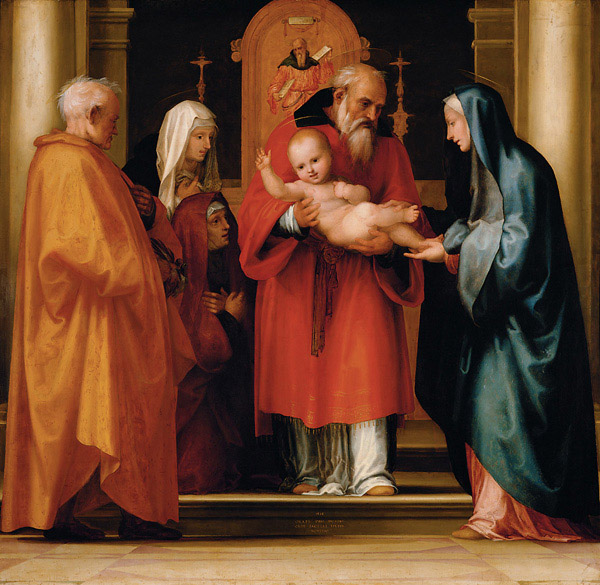
Fra Bartolomeo, Public domain, via Wikimedia Commons

Are you carried in Mary’s arms? Does aged Anna lift you to her heart? Do you regret that there was no baptism, or no real religious sense in your home? Were you a young mother like Mary?

Where are you in these scenes? Speak to the people that populate them. Allow your affective imagination to lead you closer to them, to give you a sense of this felt-closeness that you so desire. You can imagine with your mind’s eye, with your sense of hearing or touch.

Imagining the Gospel events in the present

Over time, allow these stories in the gospel of Luke to become current as if Mary and Joseph are walking into your house with your friends and family. What do you feel as they enter into your space.

In Gospel Contemplation, Ignatius takes advantage of the way in which spiritual growth, like so many other aspects of maturing that we experience, takes place primarily when our affectivity is engaged. It is the shift in one’s deeper emotions and feelings that leads to a change in one’s behavior. We reach these deeper levels through metaphor, image, and symbol—the work of the imagination.

Observing attractions and resistance

Notice any interior reactions that you experience: comfort, discomfort, being lifted up, struggle, joy, sadness….

Observe the actions, words, emotions, sensitivities, attitudes of Mary, Joseph, and Jesus and to which of them you feel more attracted. Which of them arouse more negative feelings or resistance? Return to aspects of these meditations that seem more personally meaningful.

Entering the Mystery of the story

As you begin to enter the mystery of the story more deeply, you will begin to see or hear or touch. You will enter into the event and interact more deeply. Little by little you will become more present to the mystery and the mystery will be present to you.

As you become more and more involved in the event of Jesus’ mystery that you are contemplating, your life and your choices are affected. You find yourself changing and desiring to change.

Conversing as with a friend

Read the following verses from the prophet Isaiah (62:11-12) in relation to Jesus coming to the temple. Read this slowly, several times, allowing some moments of rest between your reading.

The Lord has made proclamation
    to the ends of the earth:
“Say to Daughter Zion,
    ‘See, your Savior comes!
See, his reward is with him,
    and his recompense accompanies him.’”
They will be called the Holy People,
    the Redeemed of the Lord;
and you will be called Sought After,
    the City No Longer Deserted.

Is there some new awareness coming forward as you consider these words? Do they shed some unexpected or new light on your own birth and childhood?

Continue in quiet—or even silent—intimate conversation with Mary, Joseph and Jesus. Ask them what is the grace that you should be praying for. Beg this grace of the Father. Then beg this grace of the Son, your Savior and Shepherd. Finally, beg for this grace from the Holy Spirit who is the source of all holiness.

If you wholly lived this grace that you are begging for, what would your life look like? Your relationships? Your prayer? The way you work? The way you love? The way you serve? What about you would make you the most happy?

Ask Mary, Joseph and Jesus to show you one specific gift they wish to give you. Receive it and remain in stillness and quietly relaxed presence under the influence of the Holy Spirit.

Reviewing the graces of prayer

When you finish praying, write down the main gifts and discoveries from this time of intimate contemplation. What is one concrete thing you can do to solidify these gifts in your life.