I want to encourage you to cast aside every fear

My friend, you who are the delight of the Lord, sought-after by your God, blessings!

Wherever you are, I want to encourage you to cast away every fear, that you may walk more boldly in Christ, for in him God has chosen you before the creation of the world to be holy and blameless in his sight.

The road is narrow and at times a difficult climb, but we will walk the road together. We shall say, “I give myself absolutely to you, O Lord, do with me as you will.”

These words may seem frightening, for we hand over our future and the control of all that occurs to God’s tender regard for us. What a mighty surrendering trust it takes to utter these words with absolute sincerity. The Annunciation to Mary and agony of the Savior in Gethsemane’s garden crystallized in these words: Behold the handmaid of the Lord…. Not what I will, but what you will. I cling so strongly to my own fears that I sometimes I am unable to say these words, “Do with me as you will.”

From the first cry of the newborn’s wail to the final sigh of the crucified Savior, these words ring out. The tiny child lying on the straw on a cold winter’s night in the small town of Bethlehem is the mystery of Jesus’ life that most fills my spirit. I have small reminders of Christmas around me wherever I live or work: a statue of Mary lifting into the air her son and the Son of God, a very small nativity set, a suncatcher on the window. Christmas is never far from my mind.

Yet my life, as perhaps many of yours, has been marked by the cross.

Life and death.

The fresh innocence of beginnings and the heavy struggles of adult life.

The joy of a mother’s love and the anguish of a mother’s agony as she stands beside her child to the end.

The wood of the cross mounted on Calvary’s hill didn’t come as a surprise to Jesus and Mary. Its long shadow cast itself into their lives very early after Jesus’ birth. A sudden departure in the night at the warning of angels, fleeing to Egypt to escape the hands of Herod who would extinguish the Light of the World that his own light might flicker in the darkness a few years longer.

From the beginning, the darkness wrestled with the Light. We often hear that the name Bethlehem means House of Bread, which is only one possible meaning of the name. You see the word “Beth” in Hebrew means house. The word “Lehem” has two different possible meanings. The first refers to the leavening of dough in order to make bread. The second meaning of “Lehem” means “hand-to-hand combat” where we are stretched and wounded throughout our lives which are punctuated almost daily with the struggles of human existence. It is as if we are thrown into the arena and must fight for our lives that Light might triumph. Or is it that God fights for our lives? The tree of life is planted in our very heart.

The cross, as it has appeared in my life, has been this wrestling match between Jesus and the passions that pummel my heart, between the force of Love and the shadows of darkness. He has wrestled with the immaturity of my heart and the prejudice in my mind. I was untested and unable to respond to him wholly without a lifelong struggle of repentance in which I discovered my limits and the wondrous call to become fully human in Christ. A call that was beyond my human limits. The wounds of love that I bear from experiencing the cross, these alone could bring me to the glory and joy of Christ’s vision for my life.

As I have watched how Jesus has fought for my very life in the crosses that have become divine wrestling matches through the years I have learned three things:

  • When life is brought to a shabby wreck through illness, failure, fractured human relationships, the bitter awareness of sin, it is this paradoxically that is the place of my great hope. He has given me the gift of sight to see beyond the visible to his invisible Love at work.
  • Jesus has defeated my logic and led me out of the prison of having to understand everything. The cross as it appears in one’s life is often illogical compared to what we think should happen. To realize that the conclusions of my rational mind are incomplete, to open myself to paradox, and to silently wait for understanding to be given to me has brought much anguish…but slowly I’ve learned that Jesus can be trusted.
  • The situation that has defeated me has only done so that I might see how Jesus fights for me, that he himself might triumph in my life. The cross is essentially how God works in and through the way-things-are to defeat the darkness that still struggles for the upper hand in my life. I have been blessed to realize, at least in my better moments, that I want to let God act. In the words of Job, I am finally able to say, “Though He slay me, yet will I trust in Him” (cf. Job 13:15).

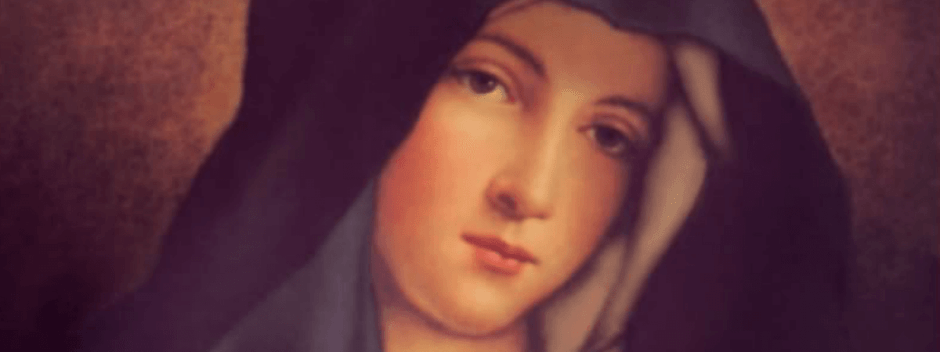
Friends, Mary, the Mother of Sorrows, (whose Feast we celebrated Saturday) stands with her Son as he hung on his cross, and she stands here with each of us. Whether the cross enters our life through loss, failure, sin, illness, relationships, Mary is with us because she knows our sorrow. She herself has lived through the agony of the moment-by-moment struggle to make sense of pain, to find a way forward, to reframe what is happening into something our minds can comprehend. And she knows the final leap of faith, the only thing that can make sense of this hand-to-hand combat we call our life.

I am sure of it. My crosses have become my blessings only because of this strong and tender presence of the Mother given to me at the foot of Jesus’ cross. She is the strong woman who teaches me how reliable God is, how ultimately secure I am in saying to him, “I give myself absolutely to you, O Lord, do with me as you will.” There is no easy way promised to us as we whisper these words, trembling perhaps, but wanting to give him everything. But it is God himself who guarantees our ultimate and absolute trust. When we have gotten to the end of our rope and the bottom of our heart where we find emptiness alone, God himself can take over where we have discovered ourselves impotent. He who has chosen us before the foundation of the world to be holy will guarantee that we are so if we but repeat with every breath of our life: “I give myself absolutely to you, O Lord, do with me what you will.”

Our truest certainty

If we have faith, if we keep loving and hoping through the tears, the joy of the resurrection, the glory of the God who is with us, will transform our sorrow into a calm and radiant certainty of God’s love. Though now we cannot see the ultimate victory—on this earth we still live in a vale of tears, and unhappiness is a part of our human reality—sadness will not remain the last word because we are with someone who has already conquered death and pain. All pain Jesus has transformed into victory. This is our faith. This is our truest certainty.

From the book Surviving Depression

Inhabited by God

Each day our Baptism brings us again to a radiant newness. Sin and evil can no longer dominate us, because within us is the One who conquers evil; the One who took all sin, all tears, all sickness, all evil upon himself. Baptism transforms the entire being of the person. You become nothing less than the home of the Holy Trinity, the temple of the Holy Trinity, inhabited by the Most High God. All of heaven is within you!

From the book Surviving Depression     

Meditation Six: Heal From Fear and Disappointments

“Were not our hearts burning within us?” (Luke 24:32)

The banging reverberated down the empty Jerusalem street cloaked in inky blackness. “I know they are in here,” Cleopas said under his breath to his companion. “Peter!” he called in a loud voice. “It’s me! Cleopas! Open the door. We’ve come back from Emmaus! We’ve seen the Lord! Let us in!” 

Step One: Allow yourself to go within. Embrace the stillness inside yourself, the peace. Even if you don’t feel it right away, it is there. Take a few moments for your whole being to settle down into that space in the center of your soul where God dwells. Even if you can’t feel him or sense him, God is there, shining, giving, and loving. It might help to picture a bright light, or a gentle candle, in the center of your heart, to represent God’s radiant presence within you.

Step Two: When you are settled, read the accounts of some of the experiences of the disciples after Jesus’ crucifixion in Luke 24:13-49. As you read, focus on the experience of Cleopas as he walked on the road to Emmaus and later returned to Jerusalem to notify the other disciples. Imagine the fear and disappointment he must have been experiencing after the death of his beloved Lord. When you have finished reading, sit in silence for some time.

Step Three: Slowly read the passage again. When you finish, you may wish to use the following guide to enter into Cleopas’ experience to find healing.

Praying with Cleopas

  1. Cleopas must have been frightened and confused as he walked to Emmaus! Have you ever felt like all is lost before? Imagine you are Cleopas, walking down the road to Emmaus after the death of Jesus. What regrets are you running from like Cleopas and the other disciple? Where are you trying to control your life? To fix a problem your own way? To redirect your own life without the presence and power of Jesus? Experience Cleopas’ joy when he realized that Jesus had appeared to him. Have you ever felt a change from dejection to joy in a few short hours? Do you identify with Cleopas’ sadness or his joy?
  2. Imagine yourself in the room when Cleopas and the other disciple returned to tell them what happened to the disciples who were in hiding. Watch the scene play out. You can imagine yourself as one of the people in the room or you can be yourself. You can watch what happens or participate. Allow your imagination to take over as you make this Scripture story your own.

To put yourself in the story, it may help to read this imaginative account:

A servant cautiously cracked the door open, raised a lamp, and peered out to see who was knocking so loudly. “It’s them!” he called over his shoulder, then quickly pulled the two disciples into the house where the Apostles were hiding.

Everyone started speaking at once.

“We saw Jesus!” Cleopas said excitedly.

“You saw him? So has Peter!”

“Where did you see him? What did he look like?”

“Tell us, Cleopas. What was he like?”

“Quiet!” said Peter, “Give them something to drink. They’ve come from Emmaus, that’s a long journey. Let them catch their breath.”

Cleopas sat down, took a drink of water, and then began. “You all know we left Jerusalem yesterday morning. I saw no reason to stay. Jesus was dead. He had died like a criminal. I couldn’t believe I had given up so much to follow him and then he died like that. I wasn’t going to hang around in hiding. On the way back to Emmaus we were talking about what had happened, what went wrong, what we could have done, should have done. It felt so lonely out there on the road, walking back to our old life. We were trying to figure it out, to make sense out of it. Attempting to comprehend what our own lives meant after this devastating loss of Jesus. We were getting nowhere.”

Cleopas paused and reflected quietly, then said, “We were getting nowhere until this man joined us on the way. There was something different about him. He was so full of joy. Peace flowed from him.”

“Was it Jesus?” James asked.

“We thought he was just a traveler,” Cleopas continued. “When we told him about Jesus’ death on Calvary, everything made sense to him. Where we saw roadblocks and problems, he explained to us the mysterious plan, the designs of God starting with Moses, David, and Isaiah and fulfilled now in Jesus. It gave me such a feeling of hope to think that what seemed like the end might just be one dark moment in a journey that the Lord has blessed—” Cleopas paused and the room was in complete silence for a moment.

“—we don’t really need to understand this on our own terms but on God’s,” Cleopas continued. “As the evening began to fall, we stopped and ate together. I realized how my heart was burning like…like…”

“Like the first time we met the Master,” Peter quietly broke in.

“Yes,” Cleopas agreed. “But the stranger gave himself away when he broke bread and gave it to us, just as Jesus had done at the supper we shared on the night he was arrested.”

Cleopas put his hand on Peter’s shoulder. “Peter, I think everything is going to be alright. I think everything is just the way it is meant to be.”

“Look!” James exclaimed.

The room was bursting with radiant light and their hearts swelled with joy. A figure had appeared. He said, “Do not be afraid. Why do you doubt it is I?”

“Jesus!” Cleopas exclaimed.

“Look at my hands and my feet. It is me—risen—here—with you.”

3. As Cleopas walked away from Jerusalem in confusion and regret, his shattered expectations had become a wall between him and reality. Recall the times in your life when things didn’t work out as planned. Someone got hurt. Plans fell apart. Dreams were shattered through others’ mistakes or your own. A good question to ask yourself in these situations is, “Am I certain that this wall of fear and disappointment is the whole truth?”

Write down or recall a situation in your life that seemed bleak but that you were later able to see more clearly.

4. Quietly imagine yourself with the disciples and the stranger eating supper in Emmaus. Watch as Jesus quietly prays and then breaks the bread, handing it to you with the words, “This is my body. Take and eat.” Let the radiance emanating from the face of Jesus pour over you. Freeze the moment and soak in the warmth and light from around that table. …

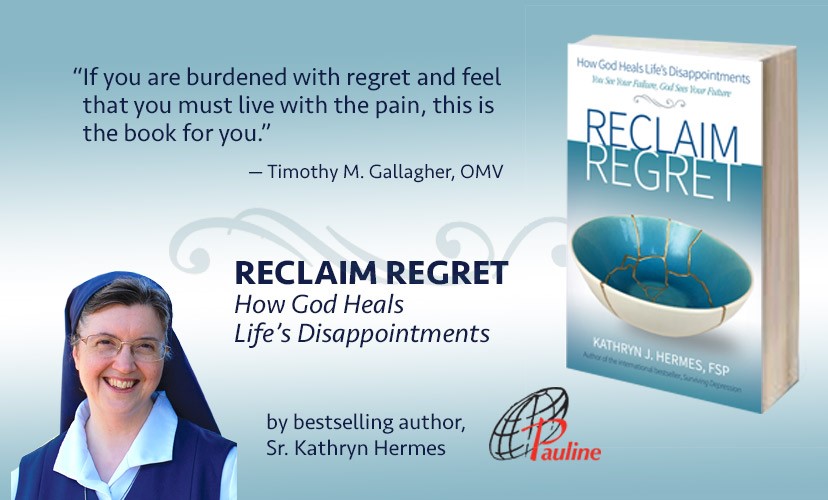
This is taken from one of the meditations in Reclaim Regret: How God Heals Life’s Disappointments

My new book is officially released this week-end.

If you have felt moved by the above meditation, take advantage of the offer of free shipping this weekend (August 24 to 28), and start your own journey of healing.


Mary understands your burdens

Have you had to be strong, even as you bore great sorrow in your heart or suffered with depression? Have you watched new dreams and relationships and futures come to birth in the ashes of something you have lost? Gather, as the others beneath the cross, around Mary. Watch and listen. Share with her the burdens you carry. What does she say to you?

From the book Prayers for Surviving Depression

Sacred tears

Jesus made tears sacred because he cried. He knew the agony and the frustration of our problems. He chose to bear all that is human and as a man with our human nature he brought us with him on his return to the Father. The One who sits at God’s right hand knows what it is to cry. He preached an upside-down world in which the poor, the marginalized, the suffering, those who agonize through emotional pain, are the first, the guests of honor, and the privileged.

From the book Surviving Depression