
We are Infinitely and Forever Loved by a God who Won’t Let Us Down

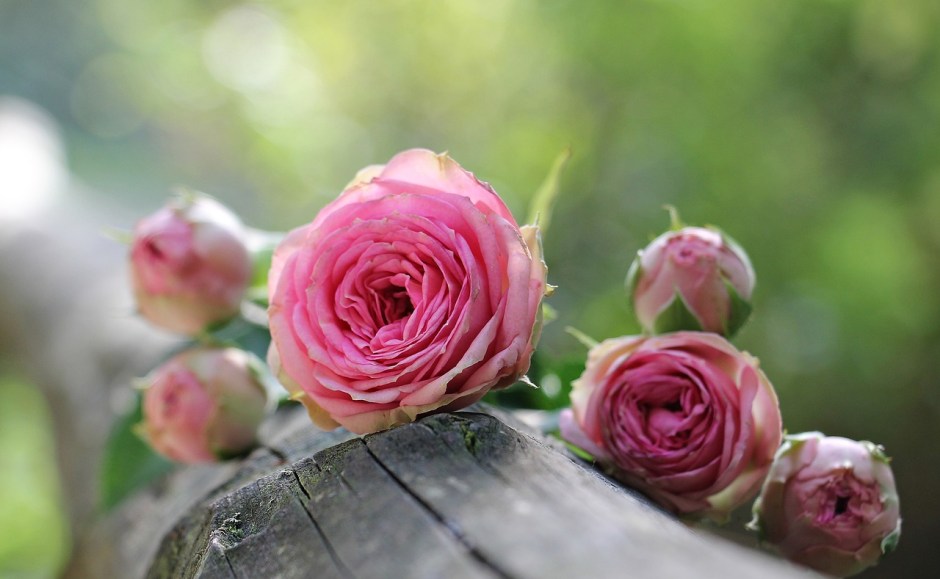
This past weekend, because of being just after Valentine’s Day, my thoughts have been about love. I saw a couple of Facebook posts describing in one instance a young boy, in another a gym coach,  handing red roses to every girl in their school because they wanted every girl to feel special on that day. An imaginative way to open the windows of a stuffy commercially driven celebration! These two individuals—and I’m sure there were others—shifted the center of their attention from what pleases them to what benefits others. Such a simple gesture, although I’m sure the roses were quite an investment. A gesture that will last a long time in the memories and hearts of these young women.

A woman on a retreat I was leading shared how she used to buy a small bouquet of flowers whenever she went to the grocery store. She would write on the little card: God loves you! After she paid for her groceries, she would turn and hand the bouquet to the person behind her, no matter who it was. Years later her son in Florida heard a woman on the radio relating how she had unexpectedly received a bouquet of flowers in a grocery line. When she had loaded the groceries into the car and slipped into the driver’s seat, she opened the card and read the simple message about God’s love. The woman was in tears: that message had meant the difference between life and death for her. When the son called his mom to tell her what had become of just one lady who had received one of her flower bouquets in a grocery line, she knew that in some mysterious way this simple gift, so small and hidden, a gift for which no one was able to thank her directly, had assured people they were loving, lovable, and infinitely forever loved by a God who would never let them down.

It is so easy to “sleep” through our days and nights. I have done it. I have objectified others and objects in the name of efficiency and right-thinking, right-doing, law-abiding righteousness. Not on purpose. Perhaps it is a stage we all go through as we embrace responsibility, mature into generativity, and at the same time juggle the judgment-laden atmosphere around us. It could be that middle years open windows to our spirit that wash our younger-aged beliefs and thoughts and judgments gently with ointment and anoint us anew as a child of God, hid with Christ in God, breathed into life through divine breath, and loving with the breath of love that created us.

In a recent survey we asked what struggles people wanted us to address. In the light of this love and this amazing story of the gift of flowers I’d like to speak to four comments that we received:

  1. God wants more of me, but I’m not sure what I should do. Books could be written on this, but I’d say for starters, begin with the life you have. Turn around and give bouquets of flowers to someone. Speak to Jesus when you go to Mass and ask him to tell you clearly what he desires of you. Find someone who can be a spiritual companion for at least a few conversations to jumpstart the journey into the unknown invitation. Follow your curiosity and read a book. Learn how to pray with Scripture. Basically, God is already leading you into the “more” he is giving you. You don’t have to figure it out, achieve it, possess it, maintain it. Take advantage of the next step, whatever it may be, in your life as it is, and through that step he will lead you step-by-step to the “more.”
  2. I struggle with forgiveness and the endless thoughts recirculating the pain over and over. I know. It is the nature of the mind to hang on and hang on to what has hurt us or was unjust, unfair, or just not right. These days for me the words of Flannery O’Connor ring true: “I do not know You, God, because I am in the way.” In the spirit of the “bouquet of flowers” I’ve noticed a new sister in the community showing love and kindness to persons I have felt hurt by. That act has touched me deeply to explore with Jesus why I am still hanging on. What I’m getting out of it. How this resentment is keeping an illusory sense of self alive. It is not my identity as a child of God and a beloved of the Father. Such simple acts I observe, yet they have meant much to my heart. As for the nature of the rat-race of thoughts in our heads see the next number.
  3. How to reduce busyness and embrace what has true value. The busyness of our life, or most especially of our mind, helps us sustain an image of ourselves, a “me” that is important, needed, useful, good, or whatever. Reducing busyness for me has started often with reserving a time period a little longer than usual to just be alone. I may need to organize myself very carefully to carve out this very needed and precious time. I go there with a couple of books, a Bible, and a journal. I go there to listen to God, to others through their written words that I read, to my own heart. I take walks, drink coffee, and pray. I follow the thread of what Jesus begins to show me through my journal notes. I learn what is of true value. It is here I touch that part of the little “me” that is resentful, that hasn’t forgiven, as we said above. In this sacred space I let God touch me. That divine touch melts that meaner “me” so that I realize that it isn’t my true identity. When it melts, all that is left is a loving tenderness. When I choose this as all I want, it becomes easier to confess and repent of resentful memories and withholding love to others who have hurt me.
  4. The healing of our fragmented inner space. Our “inner space” can feel fragmented and divided into a million pieces, particularly if we don’t carve out some sacred healing space. I’m seeing a growing number of articles about people saying they tried to do everything they (and others) thought they should do to be the best at what they do, and respond to every expectation and need. Finally, they just decided they could do it no longer. Some of these authors were people who didn’t have a great amount of responsibility for others and could easily walk off toward a blissfully quiet horizon. But some were people who carried responsibility for families. Here are some of the things that worked for them and for me: talk to others around you about how you can carve out this sacred time for your inner spirit. Discuss how this will affect the whole, what accommodations will need to be made, what things on the to-do list aren’t really that important to do at all and could be dropped, what are the highest values of each one in the group who will be  affected, how can you create a win-win situation for everyone, where is the stretch-area that will help everyone grow in respect and love for each other, what is the breaking point, how can you create a “format” for your sacred time to make it truly restorative and healing (watching TV and surfing the net, reading email and social media aren’t as restorative as other activities and without a “plan” your free time could degenerate into wasted time).

The time you preserve and protect for your deepest self will translate into a happier, more harmonious, and self-less living and giving if you do it right. You will be less likely to get caught up in resentful reactions, and more likely to focus on what is of true value. You will also find it easier to help others do likewise.

ENJOYED THIS ARTICLE? HERE ARE 5 WAYS TO GO DEEPER…

God has amazing ways of knocking on people’s hearts, awakening desires, arousing questions, provoking an unexpected spiritual fire. If you have enjoyed this article, and are ready to embark on a sustained spiritual journey, here are 6 ways you can join me on the journey:

  1. Join my private Facebook Group and walk the road of healing with a great group of people. I offer a half-hour live spiritual conference here Tuesday evenings at 7pm EST
  2. Sign-up for my letter Touching the Sunrise. I write a letter a couple times a month from my heart to yours to support you along the way.
  3. Explore my books: Surviving Depression: A Catholic Approach; Reclaim Regret: How God Heals Life’s Disappointments; Just a Minute Meditations Deeper Trust and Inner Peace. Enroll in the free 5-day email series introducing Reclaim Regret.
  4. Enroll in courses on Midlife, Contemplative Prayer, and a do-it-yourself downloadable Surviving Depression retreat
  5. Become a part of the HeartWork Community, a place where you can ask the hard questions and find a path to a life that is free, fulfilling and fruitful.

 

A Powerful Practice to Melt Away Negativity

https://www.podbean.com/media/share/pb-tkkkg-cdd6cc

Today is our final reflection on ways to live the new year in a new way, to seek the new you in the present, every present moment of the coming year. We’ll talk about a practice I began to address the negative thoughts that I find myself thinking…. And did I discover how many negative thoughts I had! Jeannette and I talk about how quickly things start to change when a simple practice gets put into place that catches our mind whenever it is engaged (or kidnapped may be better) by a negative thought.

ENJOYED THIS PODCAST? HERE ARE 4 WAYS TO GO DEEPER…

God has amazing ways of knocking on people’s hearts, awakening desires, arousing questions, provoking an unexpected spiritual fire. If you have enjoyed this article, and are ready to embark on a sustained spiritual journey, here are 4 ways you can join me on the journey. You can learn more about them at touchingthesunrise.com.

Join my private Facebook Group and walk the road of healing with a great group of people. I offer a half-hour live spiritual conference here Tuesday evenings at 7pm EST.

Sign-up for my letter Touching the Sunrise. I write a letter a couple times a month from my heart to yours to support you along the way.

Explore my books: Surviving Depression: A Catholic Approach; Reclaim Regret: How God Heals Life’s Disappointments; Just a Minute Meditations Deeper Trust and Inner Peace.

Become a part of the HeartWork Community, A blend of spiritual guidance, mentorship, and counseling, the HeartWork community is a place where you learn to explore, love, open and nourish your heart, your deep heart where God is dwelling within you.

New perspectives on our lives in 2020

https://www.podbean.com/media/share/pb-c2sp7-cdd69e

When we think of New Year’s resolutions, we are often really thinking about closure and control, about getting to a goal that helps me become something I want to be. Poets, authors, and saints offer different perspectives on life that invite openness, vulnerability and love. Jeannette and I talk about contributions from Rainer Maria Rilke, St Augustine, Adrienne Rich, Erich Fromme, Anne Truitt, St Elizabeth Ann Seton, and others.

ENJOYED THIS PODCAST? HERE ARE 4 WAYS TO GO DEEPER…

God has amazing ways of knocking on people’s hearts, awakening desires, arousing questions, provoking an unexpected spiritual fire. If you have enjoyed this article, and are ready to embark on a sustained spiritual journey, here are 4 ways you can join me on the journey. You can learn more about them at touchingthesunrise.com.

Join my private Facebook Group and walk the road of healing with a great group of people. I offer a half-hour live spiritual conference here Tuesday evenings at 7pm EST.

Sign-up for my letter Touching the Sunrise. I write a letter a couple times a month from my heart to yours to support you along the way.

Explore my books: Surviving Depression: A Catholic Approach; Reclaim Regret: How God Heals Life’s Disappointments; Just a Minute Meditations Deeper Trust and Inner Peace.

Become a part of the HeartWork Community, A blend of spiritual guidance, mentorship, and counseling, the HeartWork community is a place where you learn to explore, love, open and nourish your heart, your deep heart where God is dwelling within you.

Four ways to enjoy simplicity in your life

Do you know someone who has embraced the minimalist mindset? Simple food. A clean house. A stripped-down wardrobe. Quiet entertainment. Gentleness. Beauty. Simplicity. Essentials. Health.

I have friends who are minimalists. Who simply live—or live simply—with as little as possible. There is something very attractive to decluttering, getting back to nature, enjoying uncomplicated ways of living… There’s so much there, I could have written this article on embracing the minimalist challenge. However, I’d have to admit, I myself haven’t taken on the challenge myself! I look around my office and it’s filled with what I need to do my mission—along with numberless papers, piles of papers and notes and requests and reminders that eventually have to be tended to—or (hopefully) thrown out when they’re no longer relevant.

Instead of minimalism, what Jesus has been attracting me to is something at the heart of minimalism: simplicity. Finding and living from the essential.

I really like the definition of simplicity found on wikiuniversity:

Simplicity is the virtue of removing the unrelated things to reveal the essence. Simplicity is the direct alignment with reality and it is the opposite of false and its various manifestations including pretension, prevarication, bloviating, masquerading, exaggeration, denial, grandiloquence, falsehood, or misunderstanding. Simplicity is the opposite of excess, and its various manifestations including opulence, extravagance, gaudiness, ostentatiousness, and waste. Simplicity is also the opposite of indirect, and its various manifestations including oblique, roundabout, convoluted, devious, and circuitous. Simplicity fully enjoys the magnificent essence it has revealed.

Simplicity is not simple-mindedness, nor is it simplistic. Simplicity grasps the essence that organizes what is apparently complex. It reveals an elegance that often is only understood after examining and comprehending immense complexity. Simplistic ideas are false because they take invalid short-cuts that misrepresent the complexities, subtleties, and full scope of reality (read the full article here).

In these first weeks of 2020, I’ve been talking with God about what is essential in my life, in what makes up my “me.”

The Lord has shown me how we humans build up defenses, and masks, and monuments, and exaggerate grandiose projects in order to hide from the pain of not having found the essential. In a sense, we seek to become gods and escape the woundedness and poverty of  what it is to be human, to be created, contingent. Not the masters of our destiny.

In short, we don’t want to remain faithful to the humanity entrusted to us—that humanity with its limits, its trials, its unknowns, its risks.

We run away from the simplicity of who we are as created and loved creatures. In the words of Johann B. Metz in the spiritual classic Poverty of Spirit, “Man must learn to accept himself in the painful experiment of his living. He must embrace the spiritual adventure of becoming a man, moving through the many stages that lie between birth and death. Even the life of the child is darkened by the repulsive enigma of death. Soon enough, with man’s first feeble explorations into the unchartered inner depths of his personality, is he tempted to an outright denial of what is most his own. Man’s flight from himself begins early” (p. 8).

  1. Choose poverty

God chose to be born into that poverty from which we flee. God “became man.” The Word “took on flesh,” as John so starkly puts it in his gospel. He took on our flesh. For Metz, being man (as in created, as in not being God) is to be poor. It is to have no bragging rights before God. No support. No power. Only the enthusiasm of our heart. “Becoming man involves proclaiming the poverty of the human spirit in the face of the total claims of a transcendent God” (p 14). Friends, Jesus chose this because he loved us. He needed to show us himself the beauty of our fragile created humanness.

Jesus chose poverty. He chose to be simple. He chose to live what is essential.

So what does this look like for me? An image that came to me in prayer that represents my simple givenness, my poor essentialness, my trustful createdness, is that of a leaf floating gently down a stream. It is a small leaf. It has no plans, no projects, no dreams, nothing to build up or become. There is no masquerading, exaggeration, or falsehood. There is no excess, no ostentatiousness, no waste. The leaf is carried along by the stream, protected by the stream (as precarious as this seems), almost embraced by the stream. The leaf is a symbol to me of what is left when all else is stripped away… the essential. It is a place of simplicity. It is a place where I discover the absolute essential point of “me:” I am loved by the One who made me.

Simplicity is a difficult virtue to practice. It demands other virtues that come first: self-awareness, humility, the honoring of our heart’s reality with a listening and compassionate ear. It requires us to learn gradually to let go of all that clings and clutters, all our props, everything that pervades our lives with distractions and dissolution and dispersion. All that hides, and all that holds us back from embracing our own humble humanness.

It is a choice for essence, for the essential. A choice for beauty and authenticity. It is a life that grows in meaning and the power of intentional self-giving to others through a leap of the heart.

Whether you are attracted to minimalism, hoping to declutter your life, or are searching for the essential, these five practices will help you enjoy simplicity in your life. See which one resonates with you!

  1. Schedule sacred slow-down time

There is something to be said for putzing around. For taking 30 minutes, 90 minutes, half a day, all day, just to do whatever you want—or nothing at all.

It isn’t my way at all. I’ve been very focused, organized, intent, and can get an amazing amount of work done. But the soul, remember, needs leisure. It is not a project. It unfolds, enfolds as it is led to. So give your soul a gift and schedule in some leisure time regularly. As you spend that time you may feel like your wasting time. Good! You need to waste time to find yourself. To live from the essential. To feel your way into the deepest part of your heart’s desire…

  1. Take time out for the moon

In Awaken Your Senses, co-author Beth Booram remembers the long slow summer days of playing outside all day when she was a child. She remembers most her time watching praying mantises, catching tadpoles, and… gazing at the moon. She wasn’t raised in a church-going family, but when she looked at the moon, she said, “I would swear that someone was looking back at me.” Even as an adult, gazing at the moon remains one of her strongest “God moments.” She writes, “When I stare up into the darkness of night and see this incandescent globe, it has a humbling effect.”

Gazing at the moon, a long, wondering appreciative gaze, helps us become childlike again. We find the simplicity of wonder, the essential role of awe in our hearts.

When I look at your heavens, the work of your fingers,
the moon and the stars that you have established;
what are human beings that you are mindful of them,
mortals that you care for them? (Ps 8:3-4 NRSV)

And you know that even as you gaze at the heavens, God is gazing back at you.

  1. Assure yourself you are loved!

Love keeps things simple. It’s when we fear we aren’t loved that we begin to play a part, put on a power plays, amass distinctions, money, stuff, popularity—anything we can get our hands on. A simple way to start is this simple reflection: “I deeply love and unconditionally accept myself, because God does.” Try saying it nonstop for half an hour and discover the difference it makes!

And then ask God what simplicity looks like for you.

Images are powerful things. Like stories, they’re more persuasive in moving us toward an attitude adjustment, or to taking on new values that require difficult changes. God gave me the image of the leaf. Your image will be your own. To talk to God about receiving the gift of his vision for your more simple life this year, take just a few moments to jot down in the center of a piece of paper some highlights of where you’ve been and around that identify the feelings that come up for each of those situations. Then listen to God say to you, “Turn to me with all this.” As you picture yourself handing it all over to a loving and generous Father, ask him what he will give you in return. Wait for an image, an impression, a word or phrase. Let the meaning sink deeply within your soul.

It is the path to the essential.

I’d love to hear what is YOUR path to the essential!

ENJOYED THIS ARTICLE? HERE ARE 5 WAYS TO GO DEEPER…

God has amazing ways of knocking on people’s hearts, awakening desires, arousing questions, provoking an unexpected spiritual fire. If you have enjoyed this article, and are ready to embark on a sustained spiritual journey, here are 6 ways you can join me on the journey:

  1. Join my private Facebook Group and walk the road of healing with a great group of people. I offer a half-hour live spiritual conference here Tuesday evenings at 7pm EST
  2. Sign-up for my letter Touching the Sunrise. I write a letter a couple times a month from my heart to yours to support you along the way.
  3. Explore my books: Surviving Depression: A Catholic Approach; Reclaim Regret: How God Heals Life’s Disappointments; Just a Minute Meditations Deeper Trust and Inner Peace. Enroll in the free 5-day email series introducing Reclaim Regret.
  4. Enroll in courses on Midlife, Contemplative Prayer, and a do-it-yourself downloadable Surviving Depression retreat
  5. Become a part of the HeartWork Community, a place where you can ask the hard questions and find a path to a life that is free, fulfilling and fruitful.


Image by rawpixel.

Everything I get to do, is truly a privilege

https://www.podbean.com/media/share/pb-nc3sg-cdd490

This year, instead of resolutions, I began the year with practices. In today’s conversation with Jeannette, I share a practice I recently began: doing everything as if it were potentially the final time I would have the privilege of doing it. In our conversation we talk about what I learned after just a few days of doing this and why I think it is more effective than New Year’s resolutions.