The image that has drawn me in my ministry is Touching the Sunrise. I believe each person, no matter where they are and what they have lived, is a temple of the Trinity and can, indeed, taste the presence of God within. You can find resources for healing and prayer and follow me at touchingthesunrise.com.
He says, “Be still, and know that I am God; I will be exalted among the nations, I will be exalted in the earth.” Psalm 46:10
We know that all things work together for good for those who love God, who are called according to his purpose. Romans 8:28
In my more anxious moments I am far from being still. The word “frantic” would be more accurate. Mentally I try to take back control from a situation, person or event that I perceive has threatened me or my happiness or my success. Frantic thoughts stir up feelings of desperation. Anxious thoughts bring on more anxious thoughts.
I remember describing to a counselor a situation I was deeply concerned about—actually, frantic over. After ten minutes she broke into my monologue and said one word, “Stop!” I was shocked into a moment of silence. “Has any of that happened to you yet?”
“No,” I had to admit. The mental storm was over, and I felt more peaceful.
God tells us, “Be still!”
“Be still before you get all worked up. Be still because I have your best interests at heart. Be still because you are my most treasured possession. Be still because I am God and can make all things—no matter how they appear to you—work out for your benefit.”
Lord, far too often my anxious thoughts hijack my peace of mind. Help me to hear you–and to still them. The future is in your hands and I can rest in that knowledge. Help me to trust you and to let go of my fears. Amen.
A reflective pause
Go to a place where you can spend some time either paging through letters or photo albums or scrolling through photo galleries, emails, texts, or phone messages.
Breathe deeply.
Inhale and exhale. Notice any frantic thoughts of worries.
Quietly bless them with Psalm 46: “Be still.”
Imagine God placing his hand on your head and blessing you. “Be still.”
Spend a little time looking through photos, letters, texts, emails, or listening to some voice messages, whatever you have. Look for evidence of how God has your best interests at heart. Something that surprised you unexpectedly. Someone who reached out when you needed it. A colleague or family member who sent a message that lifted your spirits. An offer that saved the day.
Invite your heart to be still. Offer a word of gratitude to God.
To tuck in with you tonight
I trust, my God, that you have my best interests at heart.
Do you feel ready to face weeks, months, perhaps years of uncertainty and anxiety as the war in Ukraine plays out before us? Are you overwhelmed? Tired? After two years of pandemic anxiety do you feel angry that just as we were getting a respite, we are thrown once again into a dangerous situation?
I feel exhausted and not ready to be there for others, even across the world in prayer, as a Christian, as Christ. I’ve been drawn into the tragedy, the heroism, the injustice playing out in the invasion of Ukraine by Putin. I’ve been drawn into it through prayer for peace, my heart breaking for those who are hurting, transfixed by the amazing leadership of President Zelenskyy, but also burdened—and at times drowning—in feelings of fear, powerlessness, anger…. But what I want to be a person of hope. I want to be certain of the mercy that is flowing through the world even in this agony. Instead of fear, I want to think, act, and speak the love of Jesus. In these desperate days, I need support. My emotional and spiritual reserves are low.
The good, the bad, and the ugly
This invasion is being played out not only on the battlefield in Ukraine, but also in social media where President Zelenskyy is battling for everyone’s attention, everyone’s empathy, everyone’s sense of responsibility and justice, everyone’s humanity. He has rallied everyone who honors the values of human dignity, freedom, and peace around the cause of the Ukrainian people. “Glory to Ukraine!” And suddenly in the space of five days, I’ve become committed to standing with the people of a country that I never really thought much about before. I feel that I’m doing something for the future of humanity by caring about the people of Ukraine.
However, watching war play out on our computers and phones is exhausting. On social media, the Ukrainian citizens broadcast their fear and worry to a global audience as we hear explosions in the background. I feel helpless. I watch a baby sleeping at her mother’s side in a bomb shelter and I feel sad. I read conflicting information and I feel confused. I see an explosion in a civilian neighborhood and I feel angry. I see Russian military vehicles abandoned because they ran out of gas and I feel something in my heart say, “It serves them right.” And I am ashamed. I see unarmed citizens standing in front of a convoy of military vehicles driving into their city, preventing them from passing, and I feel myself wanting to cheer them on. I read the last message texted to his mother by a Russian conscript who thought he was on training exercises: “Mom… I’m afraid. We’re bombing all of the cities….” And my heart breaks. For him. And for her. And for us all.
Yes, I’m not just watching; I’m emotionally involved in this war. And so are you.
On top of that, I’m not so sure I’m happy with all that is happening within me. I know I needed to find something to support me in responding from a deeper place to the tragedy of this war, so I turned to music. I recently stumbled upon the artists Kimberly and Alberto Rivera, and I have found especially the songs on their albums From His Heart to Yours and The Father Sings so helpful. I want to share some of these with you, and I invite you to take some time for your heart.
A mini-retreat to revive your heart
So take a deep breath and let the dust settle. Let your heart receive the tender love of the Father…. There has never been a moment in time when you weren’t Mine. From the very first breath that I breathed into your spirit, you were Mine….
Close your eyes and listen to Kimberly prayerfully sing words from the Father’s heart to yours. Notice what you feel. Remember. Wonder. Rest in the Father’s heart.
I lift up my eyes to the mountains— where does my help come from? My help comes from the Lord, the Maker of heaven and earth.
He will not let your foot slip— he who watches over you will not slumber; indeed, he who watches over Israel will neither slumber nor sleep.
The Lord watches over you— the Lord is your shade at your right hand; the sun will not harm you by day, nor the moon by night.
The Lord will keep you from all harm— he will watch over your life; the Lord will watch over your coming and going both now and forevermore.
I’ve started reading the news while I am listening to the Rivera’s music. Rooted in the goodness of my God, I can hold the chaos and tragic sorrow of the world in hands uplifted in prayer. Instead of offering up prayers as if God needs me to tell him exactly what needs to happen, I remind him that he has promised to be faithful, I remember that he has been faithful to us his creation, and am absolutely certain that he will be faithful forever to us, even as the powers of evil rage.
Trusting in God, abandoning ourselves into his care for us, doesn’t preclude us caring deeply about those suffering the horrors of war in Ukraine. We can be confident in the God who holds each of us close to his heart, and at the same time deeply grieve the injustice and commit ourselves to do something to help. The difference is that we are following our heart which now rests in God’s heart. We love with the deep knowledge that we have been loved, as has everyone else in this dreadful situation. We have a message, not just anger. We are prophetic, not reactive. We are at peace and can bring peace.
Finally, as I have reflected upon the actions of Putin, I have felt deeply convicted of my own sin. Yes, maybe only in small ways perhaps, I too have used people, demanded my way, run over others to keep my place, and so on. But I know that I have been forgiven. It is this forgiveness that I believe is possible also for Mr. Putin. Fr. Alexander Laschuk, a Ukrainian Catholic priest ministering in Toronto said, “Forgiving doesn’t mean being a pushover. It means loving [adversaries] and desiring their salvation and seeing they too are created in the image of God,” Laschuk said.
“And in the specific case of Mr. Putin – this is something a lot of people obviously struggle with, even before this most recent move. But he says he is a Christian. I believe he thinks about his faith. And for me, that is something the Holy Spirit can work with. I tell people to pray for him.”
This Lent, we are challenged to take on a Christ-like love for the world, to feel toward the world as God feels. Beneath the cross, we learn to pray for the salvation of the world with Christ’s own heart. These forty days of more intense repentance and renewal will focus our prayer, self-knowledge, and repentance, as the events in the world challenge us: the heroism being displayed before us by the Ukrainians challenges us as much as the tragedy of the invasion.
Father Zacharias, a monk at the Monastery of St John the Baptist, England, assures us that the energy of prayer offered ‘in spirit and in truth’ (John 4:23) never fails or degenerates. It remains in eternity before the Lord. It may fail in its ultimate goal because people possess the divine gift of freedom which God will always safeguard. “The people loved darkness better than the light” (John 3:19). Therefore, we should not be surprised that prayer often meets with resistance. Father Zacharias writes: “Although the desired change in the spiritual state of the world does not come about, notwithstanding, this prayer checks the advance and dominion of the ‘power of darkness’ (Luke 22:53). In their prayer for the whole world, the saints become pleasing to God, and because of them, the blessing of God descends on the earth. A saint who intercedes for the world is a phenomenon of exceptional value, an ‘event’ of cosmic scale. In his person, evil suffers defeat, with beneficial consequences for the whole of humanity” (Christ, Our Way and Our Life, page 252).
Now, I can breathe again, the fresh air of the resurrection, the fragrance of the Kingdom, the hope of eternity, the promise of mercy for the world. Now, instead of my mind running in circles of fear, instead of my heart being pulled to watch the news of the war as if it were some video game or wrestling match where people cheer on the winning side or their favorite team, I can breathe in the love of the heart of Jesus for each and every human being caught up in this tragedy, can mourn the devastation of a country and it’s beautiful land as a mother mourns for her only child. Now I can believe in hope, offer hope for a future of peace because I myself have been restored in hope, filled with hope, renewed with hope. And, after all, isn’t that the highest purpose of Lent.
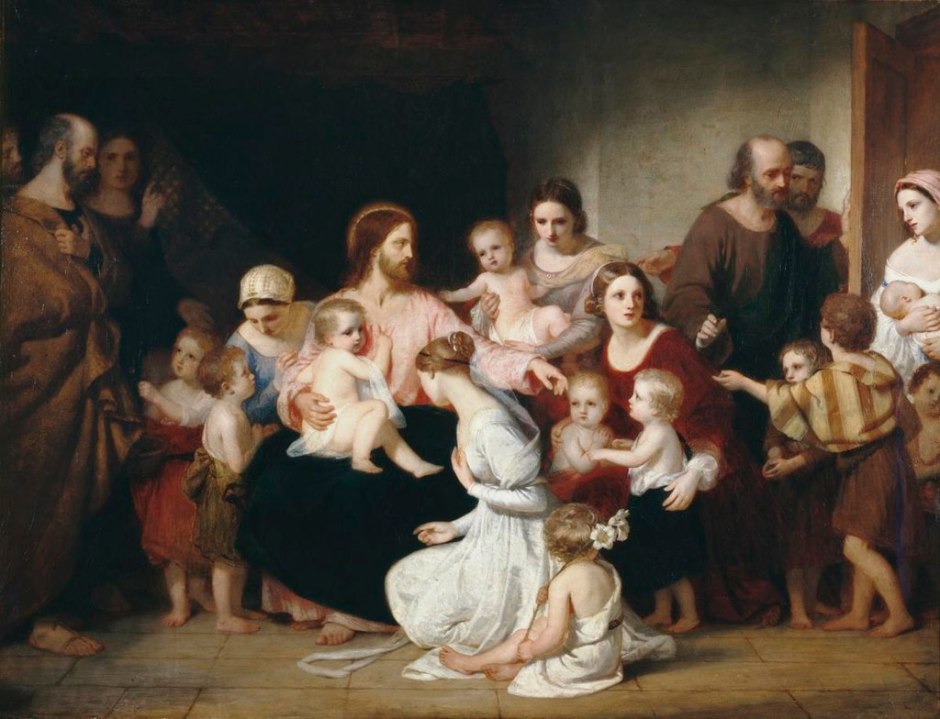
In today’s liturgy the first reading is from the Letter of James and the Gospel reading is the account of Jesus blessing the little children.
Everyone knows the proverb “It takes a village to raise a child.” It means that children need an entire community of people providing for them and engaging them constructively for those children to grow into healthy and wholesome adults.
Today’s two readings, however, have made me wonder if it is not just children who need a village to support and walk with them. Don’t we all? Don’t we even as adults have this deep sense that we need others to be with us, for us, to truly know our own worth, that we need to be welcomed by others in order to truly welcome ourselves? Looking back on the changes in my life, it was the times that I didn’t feel a safety net of people who would hold, support, care about, anoint, pray and walk with me that I seemed to shrivel inside. Some place deep within my soul knew that I needed to be in communion with others in a vulnerable, honest, mutually responsible way to feel whole, to blossom, and to eventually, in my own turn, give life to others.
What would it be like if we really knew community?
In the beginning of the reading from James, he asks: Is anyone suffering? Is anyone undergoing hardships? Ill-treated or distressed? He directs them to connect with God in the community of faith. We might know the wisdom of the world in this regard as: Are you suffering? Stay at home, crawl in bed. Or try harder, be strong, you can do it. Are you in good spirits? Treat yourself. Buy something you like. Go to the bar. Are you sick? Go to the doctor. And if there is a difficult diagnosis call your friends afterwards and ask for prayers. In other words, we live very individual lives, trying to make it on our own, seeking out our own happiness, not expecting others to be with us.
A couple stories. I know two people who took considerable time off work just to be at the service of someone who was sick and needed assistance to and from the doctor as well as a hand to hold during the scary time of “not knowing” the outcome of their treatment.
Recently I read in The Wild Edge of Sorrow the author’s experience in the village of Dano in Burkina Faso in West Africa. He tells of the practice of the villagers to come together every night in the common area of the village just to share their day with each. There was food and beer, stories, tears, laughter, rejoicing. Children were present, and played together as they ran through the adults who were welcoming each other’s lives and hearts through the narration of the day’s experiences. There was a huge sense of connection in the safe space that was created by this daily ritual for vulnerability, compassion, and cheering one another on. While there, he met a young woman, about seventeen years old, who had an extensive burn scar on her face. She wasn’t self-conscious, but seemed happy and outgoing. When he inquired about what had happened to her, he was told that her mother had thrown boiling water on her in a fit of rage. But immediately after that the village came together and let this girl know that what her mother had done was wrong and had nothing to do with her, and that she was loved and cherished by the people of the village and would always be so.
Jesus was there for other people
In the Gospel, the apostles were indignant that mothers of little children of no real significance thought they had the right to encroach upon the very important time of Jesus. The mothers wanted Jesus “to touch them.” Jesus used touch to bless, heal, include. It was an act of intimacy, an assurance that the other was being seen and was known by him, by God. Jesus was indignant that the apostles were not opening the community to include these tiny members of God’s people. How embarrassed must the mothers have felt. Humiliated. Excluded.
Jesus and James call the Church to be a communion of faith where people are there for each other, a compelling sign of hope that ultimately we are one with each other and will be there for each other, and a witness to a way of life that is truly human and truly divine.
Image Credit: Charles Lock Eastlake, Public domain, via Wikimedia Commons
“People are trying to make sense of what is going on, they are overwhelmed, in shock, it is hard to think clearly,” Rabiy told us.
But the bishop was clear: Christians, Ukrainians, and especially Ukrainian Christians have a very particular mission right now:
“It’s not time to start ‘whining’ so to speak, it’s time for us to pull ourselves up. As spiritual people this is what we are supposed to show, hope: that God will provide, that everything is in His hands, and we believe in it.”
It’s an uncompromising message. But this is an uncompromising reality Ukraine is facing.
Bringing the Ukrainian community together in prayer, the bishop explained, is an essential part of strengthening faith, and of understanding hope as a spiritual reality instead of an irrational optimism.
“Speaking the words of the Gospel and praying the Psalms, this helps us to pray and to recall the history, how God worked in the past, how He has saved people — so why would we have a reason to doubt that this time he will save us? We believe in Him, but our hope and faith have to be really sincere — even as Jesus said, if it is the size of a mustard seed, the tiniest of all seeds, but we have to show something!”
“We do not lose hope for a glimmer of conscience on the part of those who hold in their hands the fortunes of the world. And we continue to pray and fast – as we shall do this coming Ash Wednesday – for peace in Ukraine and in the entire world,” Parolin added.
These and many other emotions could be filling our hearts these days. The invasion of Ukraine is threatening the cohesiveness of peoples and nations in a frightening way that affects all of us.
This morning I prayed for Ukraine with the blessing which the Lord gave to Aaron and his sons to speak over the people (Num. 6:23-27):
The Lord bless you and keep you; the Lord make his face to shine upon you, and be gracious to you; the Lord lift up his countenance upon you, and give you peace.
“A blessing or benediction is a prayer invoking God’s power and care upon some person, place, thing, or undertaking. The prayer of benediction acknowledges God as the source of all blessing” (CCC, glossary, page 868).
Praying this blessing was a small movement of the heart, to implore God’s mercy on this poor world of ours, the people of Ukraine, the suffering on all sides, the threat to the world order this situation will precipitate. We learn from the Scriptures, that the prayer of the people of God, no matter what form it takes—pleading, complaint, argument, desire, sorrow—“is always an intercession that awaits and prepares for the intervention of the Savior God, the Lord of history” (CCC, 2584). In this spirit, I’d like to share this prayer with you so that, pleading together, we might open up the way for the Sovereign of history and Lord of the nations to act in our world today.
In a quiet place, in a still point of your day (even for five minutes!), sink into God’s presence and slowly begin to hold these phrases in your prayer. Hold them gently, lifting them up to the Lord, and allowing the silence to enfold you. May your prayers rise like incense:
May the Lord bless us. May the Lord keep us. May the Lord bless us today. May the Lord keep us today.
May the Lord bless us here and now. May the Lord keep us here and now.
May the Lord make his face to shine upon us. For the mother in Ukraine who is overwhelmed, may the Lord make his face to shine upon her. For the children who are afraid, make your face to shine upon them. For the soldiers in danger, make your face to shine upon them.
For government leaders who are making crucial decisions that will affect millions of people across the globe, make your face to shine upon them.
In Russia, make your face to shine. O God, have mercy.
O God be gracious to us. Be gracious to us. Be gracious to us. Have mercy. Have mercy on us.
Give us peace. Give us peace. Give us your peace. Fill our souls with the peace of your countenance. Bless our weary and embattled hearts with peace. Bring your peace to hearts that would hurt, destroy, take. Peace, Lord. Have mercy.
Keep us as the apple of your eye. Hide us in the shadow of your wings (Ps 17:8).
Save your people, Lord, and bless your inheritance. Shepherd us and carry us forever. (Ps 28:9).
Father. Our Father. Thy kingdom come. Thy kingdom come. Thy will be done on earth as it is in heaven.
Thy will be done on earth by me… as it is in heaven.
Thy will be done on earth by (insert the name of those whom God inspires you to pray over)… as it is in heaven.
O God be gracious to us. Be gracious to us. Be gracious to us. Have mercy. Have mercy on us.
The long and interminable hours of the night can be devastating. Those who struggle for life itself through the long hours of the night or who are tossed about by worries, illness, longing for the safe return of loved ones, loneliness, these particularly are they who know the Psalmist’s cry wrenched from his heart in the wee hours of darkness: “As the watchman waits for the dawn, O Lord, my soul longs for thee! Longs for thee in the night, my night, our night! Come, Lord Jesus, come!”
Living with insomnia, I have since my early twenties been one of these watchers in the night. Once I would have observed life at three in the morning as it played out beneath my window. In this season of my life, however, when I routinely rise throughout the night, I am picking up the Night Hours by Phyllis Tickle, uniting myself three times for just a few moments with an untold number of Christians and monastics across the globe who raise their hands and voices with urgency: “My soul longs for thee in the night.” I unite myself also to mothers by the bed of a sick child, workers on night shifts, cleaning agencies that work through the night, doctors and nurses and first responders, and now also to military spouses who fear for their loved ones recently mobilized to Europe for whom every day is still a night….
It was in the night that Ukraine feared they would receive the first incursion of Russia into their homeland. It was in that night, as on every night, that I rose and prayed alongside my unknown and anonymous night-watching companions. It was in that night that I prayed for women who feared for their lives, for soldiers training for war, for the mothers on both sides who knew their sons and husbands, fathers and brothers might never return to them…. For them I watched in the night.
And today we all read the headlines we have dreaded and hoped to never see. Our every day now has turned into the darkness of fear, and a feeling of dreaded powerlessness against the machine of war fills every hour.
Prayer seems such a small gesture in the face of all this. Could something so small have any import on the events of history, we could ask? Your prayers and mine, in the night, during the day, with every breath, calling out for God to rain down his mercy?
I say yes, and this is why:
Jesus commands us to pray for the whole world.
St John Chrysostom writes in his Homily on the nineteenth chapter of the Gospel of Matthew where Jesus teaches the apostles the Our Father: “Consider how Jesus Christ teaches us to be humble, by making us see that our virtue does not depend on our work alone but on grace from on high. He commands each of the faithful who prays to do so universally, for the whole world. For he did not say ‘thy will be done in me or in us,’ but ‘on earth,’ the whole earth, so that error may be banished from it, truth take root in it, all vice be destroyed on it, virtue flourish on it, and earth no longer differ from heaven” (CCC, no. 2825).
Through the act of prayer we become a space where love triumphs over evil.
Saint Edith Stein, Theresa Benedicta of the Cross, who suffered a martyr’s death at Auschwitz in 1942, assures us of the power of prayer and of offering one’s own life as proxy for another. Freda Mary Oben, Ph.D in her article “Edith Stein and the Science of the Cross,” described how Edith Stein took seriously the Christian disciple’s responsibility to combat evil and to become a space where love triumphs over evil. She writes, “When Hitler came on the scene, [Edith Stein] became a Carmelite in order to pray for the evil ones — the Nazi oppressors — as well as for the innocent ones, the Jews and all souls everywhere suffering in World War II. Shortly before her death she said to a priest, ‘Who will do penance for the evil that the Germans are inflicting?’ On the way to her crucifixion, the gas chamber at Auschwitz, she spoke of her suffering as an offering ‘for the conversion of atheists, for her fellow Jews, for the Nazi persecutors, and for all who no longer had the love of God in their hearts.’”
Edith Stein believed that even a single person offering her life for another has more meaning and power than armies and tanks.
Simple gestures such as this witness to the initiative of God which shapes the paths and journeys of history and of our lives.
Most of us are not in high-level positions such that our political decisions could affect the direction of events. We are, however, in a higher position than the government to effectively address the powers of war released on the earth. Through prayer we hold our ground and create an inner space of commitment and solidarity, of faith and of hope that can change everything.
The words of Saint John Paul II almost twenty years ago are prophetic for today. To the members of the diplomatic core on January 13, 2003 he said, “I have been personally struck by the feeling of fear which often dwells in the hearts of our contemporaries. [He listed the unresolved problems in the world of that year, and then continued] Yet everything can change. It depends on each of us. Everyone can develop within himself his potential for faith, for honesty, for respect of others and for commitment to the service of others.”
“I plead with you–never, ever give up on hope, never doubt, never tire, and never become discouraged. Be not afraid.”
Saint John Paul II
When John Paul II spoke of war he insisted that it is always a defeat for humanity, but with his characteristic call to us to not be afraid, a refrain which rang throughout the years of his pontificate, he stated again and again: “I plead with you–never, ever give up on hope, never doubt, never tire, and never become discouraged. Be not afraid.”
We are tired and the world is tired, yet we hold on to hope.
Though we are afraid, our choice to trust keeps us steady as we hold onto our indomitable certainty that God alone is our unwavering hope. God alone is sovereign of history.
Don’t be surprised that hope and trembling alternate in your heart.
These are seriously concerning times. My heart trembles, particularly when I think of what this could mean for me and friends and loved ones and my sisters throughout Europe. It is then that I reach out to my anonymous brothers and sisters who are immediately in the path of destruction in the Ukraine. In spirit I put down my trembling anxieties for my own welfare in order to stand at the side of children who are terrified, comforting and holding them, giving courage to mothers who are overwhelmed as they fear for the safety of their sons and daughters and husbands and fathers. I shed a light on the path of those who flee, and pray at the side of the wounded and dying. I kneel in prayer to the Holy Spirit in the rooms where decisions are being discerned and discussed and debated. Only God knows the way. God alone will show the way for each one and for us all.
When each of us carries the cross that is now upon us for the sake of the other, then and only then will we find peace.
I firmly believe that when each of us like Jesus reaches out together for the other, extending ourselves beyond our own trembling hearts to embrace the heart of this ever hurting world, when each of us carries the cross that is now upon us for the sake of the other, laying down our life that others might live, then and only then will we find peace…. Peace in our own hearts. Peace in between nations. Peace in the world.




 Touching the Sunrise
