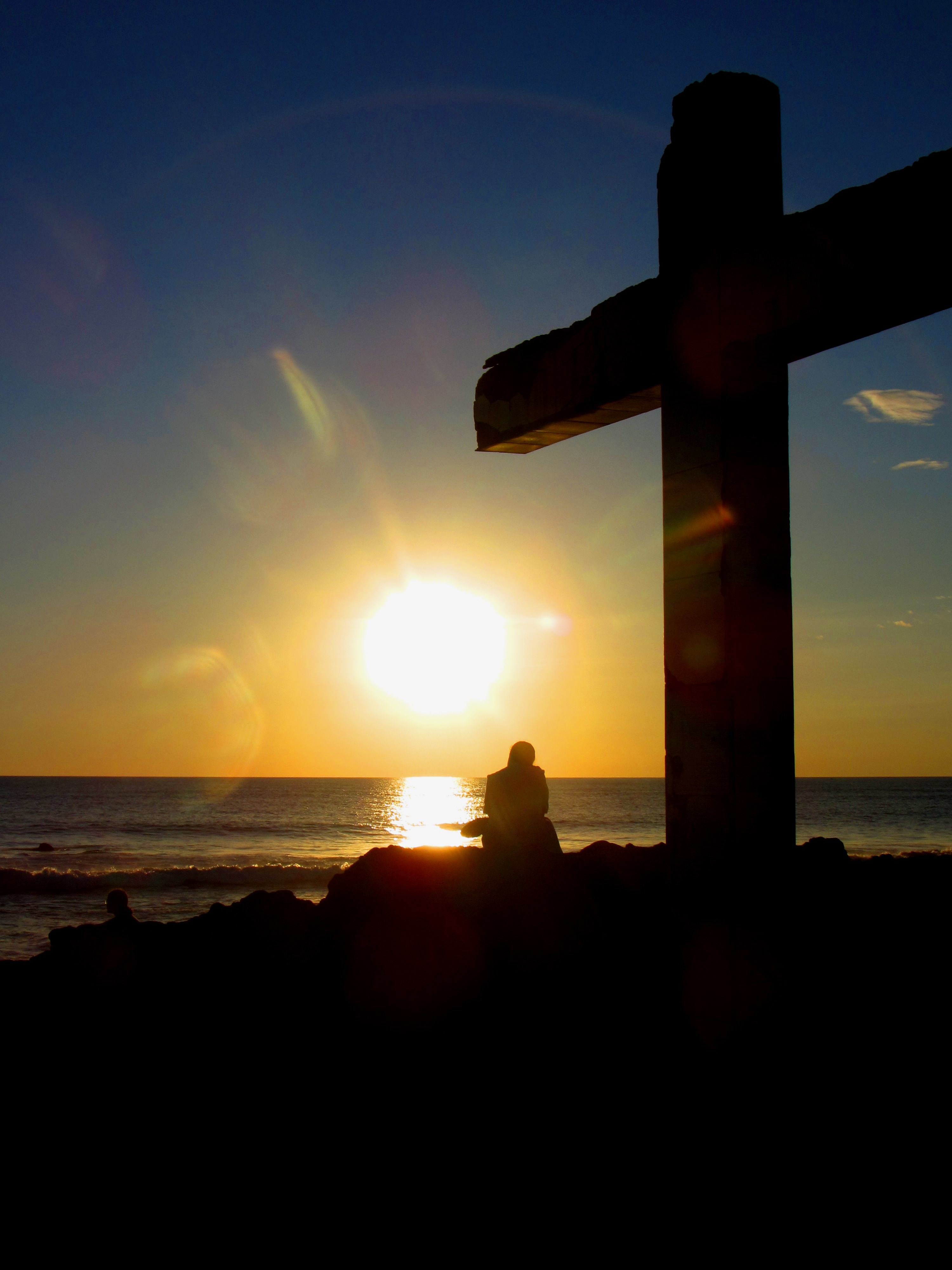
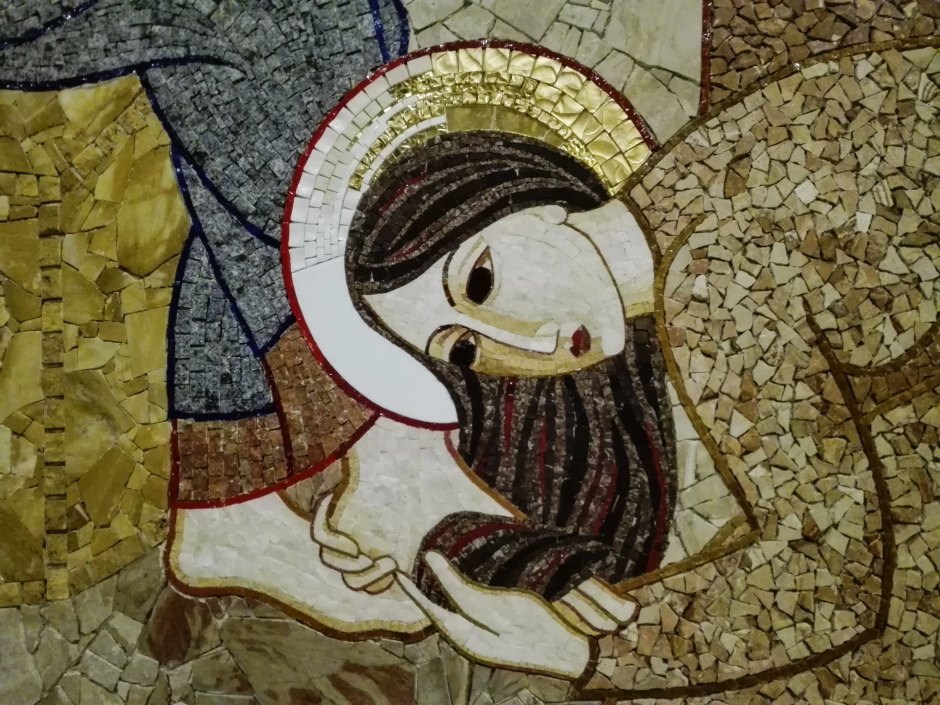
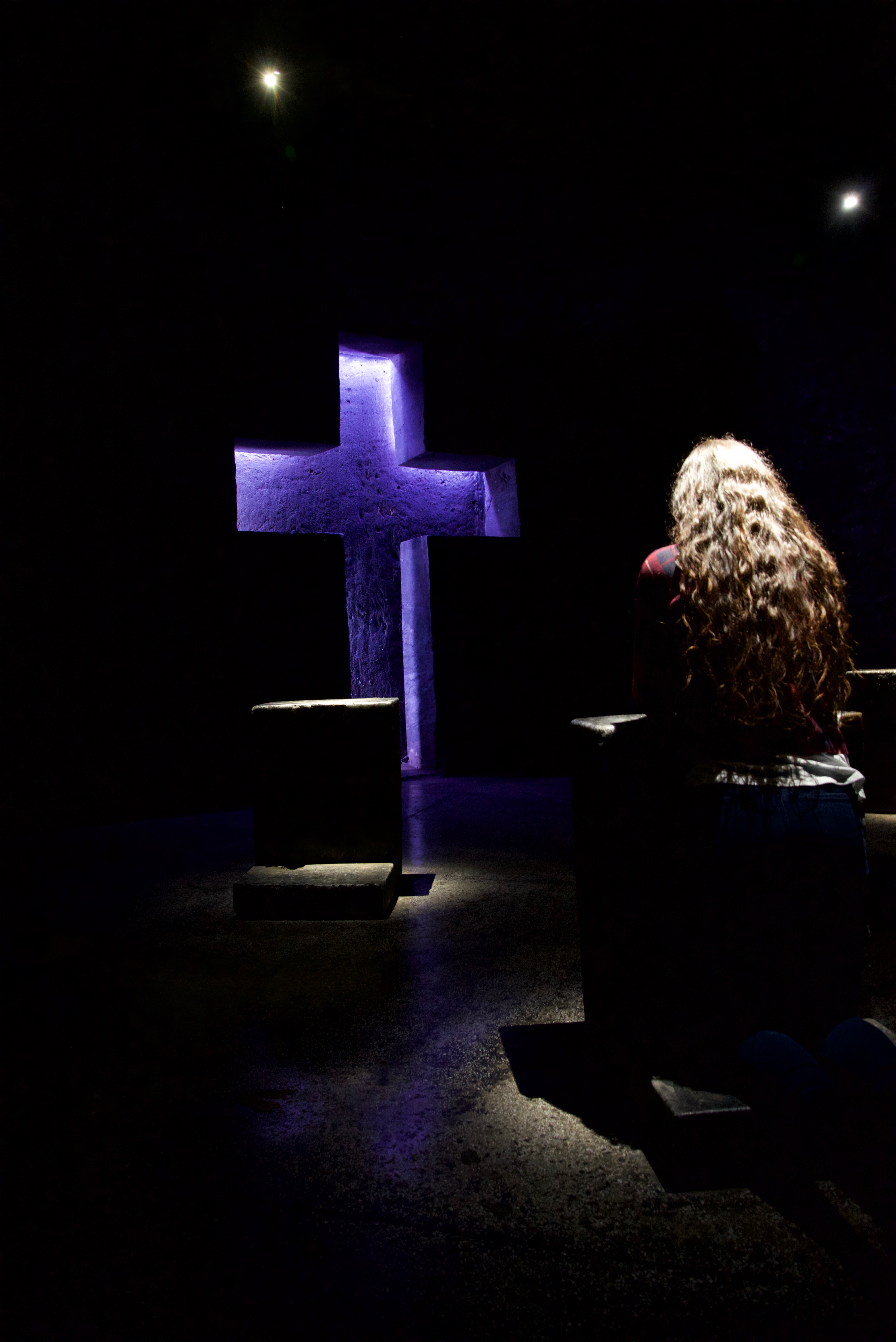
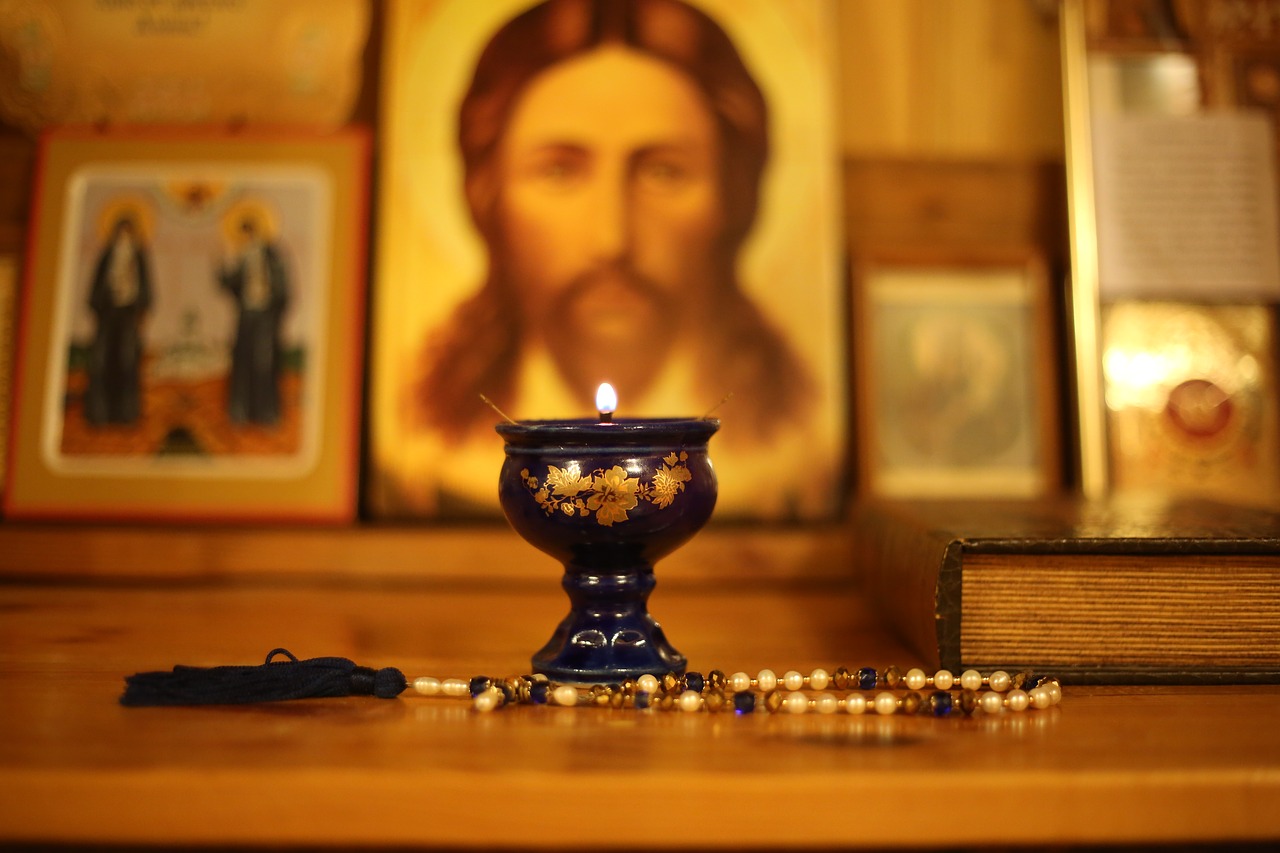
Bend your knee before your King!

I heard the voices of a multitude of angels who surrounded the throne and the living creatures and the elders. These angels numbered thousands upon thousands and ten thousand times ten thousand of them. 

And they cried out with a loud voice:

“Worthy is the Lamb that was sacrificed
    to receive power and riches, wisdom and strength,
    honor and glory and praise.”

Then I heard every creature in heaven and on earth and under the earth and in the sea, and all that is in them, saying:

“To the one seated on the throne
    and to the Lamb
be blessing and honor and glory and might
    forever and ever.”

The four living creatures said, “Amen,” and the elders prostrated themselves in worship (Rev. 5:11ff.).

Worship. Worship is the inward gaze of the soul upon God. Worship is where we sink low to become what we shall ever be: adorers of our God.

“To the one seated on the throne
    and to the Lamb
be blessing and honor and glory and might
    forever and ever.”

O callous of heart! Bend your knee before your King… How many times a day I must recall my wandering heart and wavering mind to the King. To sink at his feet. To bless him forever and ever. To affirm him of my love. In the words of the hymn by Saint Alphonsus de Ligouri (one of my favorite hymns):

O God of loveliness, O Lord of Heaven above,
How worthy to possess my heart’s devoted love.
So sweet Thy countenance, so gracious to behold
That one, one only glance to me were bliss untold.

Thou art blest Three in One, yet undivided still,
Thou art the One alone whose love my heart can fill.
The heav’ns and earth below were fashioned by Thy Word,
How amiable art Thou, my ever dearest Lord.

To think Thou art my God—O thought forever blest!
My heart has overflowed with joy within my breast.
My soul so full of bliss, is plunged as in a sea,
Deep in the sweet abyss of holy charity.

O Loveliness supreme, and Beauty infinite,
O ever flowing Stream and Ocean of delight,
O Life by which I live, my truest Life above,
To Thee alone I give my undivided love.

Source: The Cyber Hymnal #4879

Worship and love put us before the greatness and loveliness of our God. How immense is God’s love that as small as we are, we are taken by him into God’s own life, his Kingdom, given a part in his salvific deeds.

Jesus told them another parable: “The kingdom of heaven is like a mustard seed, which a man took and planted in his field. Though it is the smallest of all seeds, yet when it grows, it is the largest of garden plants and becomes a tree, so that the birds come and perch in its branches” (Mt. 13:31-32).

Our Mother General commented to us that this parable is extraordinary. The Kingdom of God is very important, eternally important, and yet it never makes the news. The world is fascinated by what and who is big and powerful, victorious and beautiful. But when Jesus collects the members of his Kingdom, he doesn’t gather these striking individuals and make a big splash. Rather, he announces the Kingdom that is as small as a mustard seed filled with small people. Before God we are all small people. She writes: “When we opt for the Kingdom of heaven, the Lord is able to heal us from the delusion that we are omnipotent, from the desire to be first, from the illusion to see ourselves as perfect and from the temptation to want others to be the same.”

Learning to be small isn’t so easy because it means that we give up control, direction, the self-made purpose of our accomplishments in exchange for the power of trusting in the goodness and providence of God in whatever form it takes in our life, in all circumstances.

We have many teachers on this call to smallness and this journey of the Kingdom:

The first is a prayer that has always meant a lot to me in moments of change and struggle. It is from Charles de Foucauld, willingly martyred in Algeria in 1916:

Father,
I abandon myself into your hands;
do with me what you will.
Whatever you may do, I thank you:
I am ready for all, I accept all.

Let only your will be done in me,
and in all your creatures –
I wish no more than this, O Lord.

Into your hands I commend my soul:
I offer it to you with all the love of my heart,
for I love you, Lord, and so need to give myself,
to surrender myself into your hands without reserve,
and with boundless confidence,

Another prayer like this was written some 350 years earlier. Like the prayer of Charles de Foucauld, this prayer leads us to offer our heart, our freedom, our entire being wholly and entirely out of love. It is given to us by St. Ignatius of Loyola:

“Take, O Lord, and receive my entire liberty, my memory, my understanding and my whole will.  All that I am and all that I possess You have given me: I surrender it all to You to be disposed of according to Your will.  Give me only Your love and Your grace; with these I will be rich enough, and will desire nothing more.”

Those who are small, who live the life of a mustard seed, know that everything—absolutely everything—comes from God. St. Paul wrote to the Corinthians: “God chose those who were regarded as foolish by the world to shame the wise; God chose those in the world who were weak to shame the strong. God chose those in the world who were lowly and despised, those who count for nothing, to reduce to nothing those who were regarded as worthy” (1 Corinthians 1:27-28).

Shahbaz Bhatti shows us the courage of the mustard seed. In the early 2000s in Pakistan, he was the only Christian on the Cabinet as the Federal Minister for Minorities Affairs in the predominantly Muslim country.  It was a dangerous job, one that carried an almost inevitable outcome of assassination.  But Shahbaz remained in this position because he believed in the vision and values of religious freedom for his fellow Christians. Shahbaz was assassinated by Islamist terrorists in 2011.  His cause for beatification was opened in 2016 and he is now a Servant of God. Bishop Anthony Lobo, who gave an interview to Fides News Agency shortly before his death in 2013, said that Bhatti “decided to play an active part in politics in order to protect the country’s Christians and other minorities…. A man of great commitment, he decided not to marry. He lived a life of celibacy. He had no possessions and saw his activity as a service. I believe that Clement Shahbaz Bhatti was a dedicated lay Catholic martyred for his faith.”

Three years earlier Bhatti said in an interview,

“I do not feel any fear in this country.  Many times the extremists wanted to kill me, many times they wanted to put me in prison, they threatened me, they harassed me and they terrorized my family.  [I told my father], ‘Until I live, until my last breath, I will continue to serve Jesus, to serve the poor humanity, the suffering humanity, the Christians, the needy, the poor.’
“I want that my life, my character, my actions speak for me and indicate that I am following Jesus Christ.  Because of this desire, I will consider myself even to be more fortunate if – in this effort and struggle to help the needy, the poor, to help the persecuted and victimized Christians of Pakistan – Jesus Christ will accept the sacrifice of my life.”

This morning I was praying with St Joseph’s utter obedience and willingness to give his life over to the Kingdom. He was and he remained through his whole life small and vulnerable.

When I first held the Child Jesus at his birth
Ahh.
All the earth disappeared in his smile. In his gaze.
Too soon, however, the darkness tried to snuff out this life–
the Son of God, the angel said.

There is no room in any of Bethlehem’s inns, escape with the child to Egypt, the anonymity and disconnection from family, culture, Nazareth while in exile, the uprooting once again to return some seven years later.
This great plan of God, of God’s Kingdom, I served by loving the Child, and obeying each wild change on the path…

never building, no long-range plan, no monuments, no settled comfort,
no familiar surroundings that Mary and I had made.

And now, in Jerusalem, Jesus lost and at last found again. I cannot tell you the pain in my heart when I heard my son say, “I must be in my Father’s house.” My Father’s house. Not my house as his earthly father, but his Father’s house.

So soon, too soon, to give him up. Not to be able to create him in my image.

I was but a child…
of the Father’s deep affection,
trusted with his treasures and yet unable to do anything
to protect them except to obey.

no power
nothing built beyond serving in the present moment,
trusting because I could not do my mission on my own strength and planning

I could just instantly obey. It’s all I had. It’s all I could give.

That was all that was needed from me. And, Kathryn, that is what God needs from you.

Sometimes I look around the world and worry that somehow I’m not doing the one great thing that I was supposed to do on this earth. Joseph and Shabhaz Bhatti and Charles de Foucauld and Ignatius of Loyola remind me that the Kingdom of God is made of small people obeying in their little place at each wild turn of the road of their life. Nothing more.

Here is deep insight from John Henry Newman about trusting the smallness and unknown paths and purpose of our lives on this earth:

“God has created me to do Him some definite service.  He has committed some work to me which He has not committed to another.  I have my mission.  I may never know it in this life, but I shall be told it in the next… I will trust Him, whatever I am, I can never be thrown away.  If I am in sickness, my sickness may serve Him, in perplexity, my perplexity may serve Him. If I am in sorrow, my sorrow may serve Him. He does nothing in vain. He knows what He is about. He may take away my friends. He may throw me among strangers. He may make me feel desolate, make my spirits sink, hide my future from me. Still, He knows what He is about.”

He knows what He is about… No matter what happens in my life, He knows what He is about. I pray you have a chance today to sit with the assurance of this simple act of faith.

God is longing for your heart

To the words that begin our first reading at Mass today…

Vanity of vanities, says Qoheleth,
vanity of vanities!  All things are vanity!

…let us add these words of St. John of the Cross:

“To be perfectly united to God by love and will, the soul must first be cleansed of all appetites of the will, even the smallest” (Ascent of Mount Carmel).

In the language of St John of the Cross, the word “appetites” refers to disordered inclinations or affections for oneself or creatures, we could say the “vanities of the world,” tendencies which are more or less contrary to God’s will.

In talking about the value of Ignatian Spirituality for leadership in his book Heroic Leadership, Chris Lowney talks about his being driven by the “I-want-it-so-badly” virus, a type of a modern formulation of the “vanity of vanities” of Qoheleth. Lowney shares how he so wanted to get to the top of company, to be wealthy, recognized, have the best house and the most exciting life. He wanted it so badly that it seemed it must be right precisely because he wanted it so badly.

Sound familiar?

How subtle are the deceptions of the evil one. This absolute certainty that God is on our side might be a delusion. Often it is one of the signs that we are after things that fall under the category of “vanity of vanities.” Maybe it is not God’s design for us that we have the things we so badly desire, but only an “ego itch” actually leading us astray as we chase after our vanities and vainglory. “Disordered inclinations and affections for oneself or creatures.”

In the second reading today, St. Paul in his letter to the Colossians teaches us simply, clearly, leaving us no wiggle room to justify collecting our vanities here on earth:

Brothers and sisters:
If you were raised with Christ, seek what is above,
where Christ is seated at the right hand of God.
Think of what is above, not of what is on earth.

And lest we think that these words are some fantasy or imaginative contemplation of Christ in heaven, Paul clearly lays out in no-nonsense and practical terms what this means for us here on earth:

Put to death, then, the parts of you that are earthly:
immorality, impurity, passion, evil desire,
and the greed that is idolatry.
Stop lying to one another,
since you have taken off the old self with its practices
and have put on the new self,
which is being renewed, for knowledge,
in the image of its creator.

So, brothers and sisters, cherish these words today, these words of God who is longing for your heart, “put on the new self.”

Indeed, my friends, God says to us all, “If today you hear [my] voice, harden not your hearts.”

Image Credit: Image by Daniel Reche from Pixabay.

Maintaining Peace when Worries Overwhelm You

Worries. It seems that worry is just a part of everyday life these days. Sometimes worries can overwhelm us so much that they take over a whole day. I can’t imagine living day in and day out with some of the worries that are shared with me when people ask for prayer.

The other day a mother told me her sorrow over a son who was a drug addict. Having known a couple mothers in the past who had walked this way themselves, I knew a little about the devastating ways this could affect a family. I shared with her my compassion. She leaned in closer and said in a quiet voice, “Sister, I told God that he has my son in his hands. This whole experience has brought me closer to God. I’ve learned to trust him more than I ever would have without having to deal with this addiction in my son’s life and the way it has affected my family. I keep telling God that I know that he is bringing good out of this. He is that powerful. God is love. I put my worries in his heart.”

This mother had learned the difference between concern and worry.

To worry is to take the burden of a situation on ourselves and to rely on ourselves to fix it or deal with the consequences.

Concern is to carry the same burden, but to entrust it to God who now takes charge of it (and who takes this task very seriously). The burden is no longer ours to carry but now belongs to God. We are asked to do what we humanly can and to trust in God to do what is needed. To do what only God can. The “freedom of the children of God” means that those who hand their burdens over to God walk the path of life with great lightness and carefreeness.

To move from worry to concern entails learning to let go. That can seem like such a huge leap when the burdens we carry are heavy. I’d like to share with you some of the living words of Jesus to Father Dolindo Ruotolo (1882 – 1970), an Italian Catholic priest who lived in Naples, Italy. Saint Padre Pio himself said to pilgrims who had come to Pietrelcina to see him, “Why do you come here when you have Don Dolindo in Naples? Go to him, he’s a saint!”

“Leave the care of your affairs to me!”

These words come from the living experience of the presence of Jesus in the prayer life of Father Dolindo:

“Why do you confuse yourselves by worrying? Leave the care of your affairs to me and everything will be peaceful. I say to you in truth that every act of true, blind, complete surrender to me produces the effect that you desire and resolves all difficult situations.”

“To surrender to me does not mean to fret, to be upset, or to lose hope, nor does it mean offering to me a worried prayer asking me to follow you and change your worry into prayer. It is against this surrender, deeply against it, to worry, to be nervous, and to desire to think about the consequences of anything. It is like the confusion that children feel when they ask their mother to see to their needs, and then try to take care of those needs for themselves so that their childlike efforts get in their mother’s way. Surrender means to placidly close the eyes of the soul, to turn away from thoughts of tribulation, and to put yourself in my care, so that only I act, saying ‘You take care of it.'”

The prayer that Father Dolindo encouraged people to say is so simple, it can be said at any time of the day, even all day: “O Jesus, I surrender myself to you, take care of everything!”

Jesus promises: “Close your eyes and let yourself be carried away on the flowing current of my grace; close your eyes and do not think of the present, turning your thoughts away from the future just as you would from temptation. Repose in me, believing in my goodness, and I promise you by my love that if you say ‘You take care of it,’ I will take care of it all; I will console you, liberate you and guide you.”

How to Bear the Fruit of Christ in Your Life

I certainly would never compare my life to that of St. Elizabeth of the Trinity. The memories I have of my childhood are of a little girl who always wanted to be a nun and who was—by my own standards at least—well-behaved. St. Elizabeth of the Trinity, however, had a will of steel and a temper that raged into violent outbursts even at the age of four. She was impossible to control. Family and friends recalled how she would lock herself in a room in a rage when she didn’t get what she wanted, kicking the door in her fury. Only when she had spent all her energies and was exhausted could her mother sit down with her and attempt to teach her gentleness and charity.

Though my childhood personality, at least as I remember it, was pretty calm, I have a distinct memory at twenty-one of raging against God. Just a month after suffering a stroke, and a year after my first profession of vows, I was silently before Jesus in the Eucharist one day in the chapel and from somewhere deep inside came words which surprised me, even shocked me. “I hate you,” I said to him. I had lost dreams and ambitions and physical abilities and, what seemed to me as a young adult, my future. And from somewhere within me, this anger and hatred at the one I felt was to blame came raging out. It took me by surprise, for, after all, I had been “well behaved” up to that point. Day after day, in a struggle that stretched to weeks and months and years, I submitted my heart to the transforming action of the Spirit at work in the Eucharist. Each day after receiving Jesus in Communion I prayed, “Help me, for I see now how poor I am, how in need I am of you, Jesus.”

In her diary, Elizabeth herself recorded how her first encounter with Jesus in the Eucharist was a moment of transformation. In fact, she said that it was decisive for the rest of her life. She began to take on from that moment the gentle self-control that would characterize her as an adult.

“In the depths of her soul, she heard his voice…. [The] Master took possession of her heart so completely that thenceforth her one desire was to give her life to Him” (The Spiritual Doctrine of Sister Elizabeth, pg 2).

I learned in a new way in those days after my stroke, in that period of heart-raging when the strength of my heart’s hurt and fury surprised me with its force, that I was a sinner and that Jesus had known that all along, that he had known me all along. He had come to me on the amazing day of my First Communion and had not given up on me. He continued, again and again, to join his life to mine, even when I struggled to accept what had happened in my life and to believe in his love for me, Jesus still gave himself to me in Communion.

Go to Jesus in the Eucharist with your struggles

Writing in the 4th century, St. Cyril of Alexandria recognized that the Eucharist was the place Christians needed to go with their struggles. Here is what he wrote:

If the poison of pride is swelling up in you, turn to the Eucharist; and that Bread, Which is your God humbling and disguising Himself, will teach you humility. If the fever of selfish greed rages in you, feed on this Bread; and you will learn generosity. If the cold wind of coveting withers you, hasten to the Bread of Angels; and charity will come to blossom in your heart. If you feel the itch of intemperance, nourish yourself with the Flesh and Blood of Christ, Who practiced heroic self-control during His earthly life; and you will become temperate. If you are lazy and sluggish about spiritual things, strengthen yourself with this heavenly Food; and you will grow fervent. Lastly, if you feel scorched by the fever of impurity, go to the banquet of the Angels; and the spotless Flesh of Christ will make you pure and chaste.

In those raging days as I struggled to align my dreams with God’s dreams for me, I learned that Jesus wants us to share our weaknesses and struggles with him, not hide them. It became clear to me that Jesus is not afraid of the mess we try to conceal from others and even ourselves. Jesus is the doctor who can heal us when we are unable to help ourselves when our lives or relationships are riddled with the consequences of our passionate outbursts or resentments at what our life has become. I learned that even when we think we are “well behaved,” we are still not so holy that we are transformed in Christ. We still fall short of the glory of God (cf. Rom 3:23).

In his Angelus message on June 6, 2021, Pope Francis encouraged us all with these words:

“Each time we receive the Bread of Life, Jesus comes to give new meaning to our fragilities. He reminds us that in his eyes we are more precious than we think. He tells us he is pleased if we share our fragilities with him. He repeats to us that his mercy is not afraid of our miseries. The mercy of Jesus is not afraid of our miseries. And above all, he heals us from those fragilities that we cannot heal on our own, with love. What fragilities? Let’s think. That of feeling resentment toward those who have done us harm — we cannot heal from this on our own; that of distancing ourselves from others and closing off within ourselves — we cannot heal from that on our own; that of feeling sorry for ourselves and complaining without finding peace; from this too, we cannot heal on our own. It is He who heals us with his presence, with his bread, with the Eucharist. The Eucharist is an effective medicine for these closures. The Bread of Life, in fact, heals rigidity and transforms it into docility.”

Be docile to the action of the Spirit

No matter how well-behaved we think we may be, we cannot transform ourselves into Christ which is the goal of every Christian life. That is the work of the Holy Spirit who is at work in the Eucharist. But how does this happen we might ask. In the recently released document Desiderio desideravi, I found this amazing passage:

“Liturgy is about praise, about rendering thanks for the Passover of the Son whose power reaches our lives. The celebration concerns the reality of our being docile to the action of the Spirit who operates through it until Christ be formed in us (cf. Gal 4:19). The full extent of our formation is our conformation to Christ…[our] becoming Him.” (n. 40).

To become Christ begin by sharing with Jesus your fragilities, your weakness, even your raging hearts. Show him your struggles, your resentments, your deceit, your discouragement in the desert of life. In the Eucharist, “Jesus tells us he is pleased if we share our fragilities with him. He repeats to us that his mercy is not afraid of our miseries. The mercy of Jesus is not afraid of our miseries. And above all, he heals us from those fragilities that we cannot heal on our own, with love” (Pope Francis).

We are in Christ and Christ is in us

Saint Cyril of Jerusalem described our being united with Jesus through the reception of Communion with this beautiful image: “Just as by melting two candles together you get one piece of wax, so, I think, one who receives the Flesh and Blood of Jesus is fused together with him. And the soul finds that he is in Christ and Christ is in him.”

It is clear, then, that Christ “infuses himself into us,” using a phrase dear to Nicholas Cabasillas, in his book Life in Christ. Jesus transforms us into himself as a small drop of water is changed when it is poured into a great vase of ointment. That small drop of simple water is infused with the fragrance of the ointment. The two could no longer be divided from each other, even if we tried to do so.  Just like that drop of water, we ourselves are poured in a vase of ointment so to speak, when we receive Jesus in the Eucharist, and we become the sweet-smelling fragrance of Christ whose very life was poured out for us (2 Cor. 2:15).

Blessed James Alberione, founder of the Daughters of St. Paul, often used the image of the olive tree to express the power of Jesus that in the Eucharist at Mass unites our life to his own. It is the power that we see active in the young life of St. Elizabeth of the Trinity who remarkably began to mature in her Christian life after her First Communion. Alberione explained that in Communion it is like this: Jesus is like the good olive tree and we are wild, uncultivated olive trees that left to themselves would only bear fruit of inferior quality. However, when the wild olive tree is grafted into the cultivated olive tree of greater quality, the wild tree no longer bears its own fruit but begins to bear the fruit of the good olive tree itself.

In the same way, when you and I consent to allow ourselves to be grafted into Jesus through receiving his Body and Blood in Holy Communion, we no longer bear the fruits of our own weakness and sinfulness. Instead, by being united to Christ’s Flesh and Blood through partaking of them in Communion, we begin to bear the fruit of Jesus’ own life. Gradually, through the work of the Spirit, we become the Body of Christ and bear the fruits of Christ in our lives.

Image credit: Photo by Gary Barnes: https://www.pexels.com/photo/crop-faceless-gardener-touching-olives-on-tree-in-garden-6231906/; Photo by amorsanto: https://www.cathopic.com/photo/3655-bendito-alabado-sea-siempre-jesus; Photo by cottonbro: https://www.pexels.com/photo/bench-light-man-people-6284260/

“The Meaning of the World is Love”

Love—God—is not only the Creator of the world. Love is the Design that God gave the world. The dance of love within the persons of the Trinity overflowed into the world so that all who believe and love would be drawn into trinitarian life. As Hans Urs von Balthasar would put it: “The meaning of the world is love” (Heart of the World, 203, quoted in The Meaning of the World Is Love).

God is Love. He is the ecstasy of Love, overflowing outside himself, enabling creatures to share in his life. “God also goes out of himself … when he captivates all creatures by the spell of his love and his desire . . .” (Dionysius the Areopagite, Divine Names, IV,13 [PG 3,712]). (Olivier Clement, The Roots of Christian Mysticism, pg 22)

Our life has meaning only when we are lovers patterned after the divine Design of selfless giving of ourselves to the other.

My mom made most of our clothes when we were growing up. We used to love going to the store to choose patterns for our clothes that she would sew herself. Once my mom let me cut the fabric for my new dress. She showed me how to carefully follow the paper pattern she had pinned to the material. The dress would only truly fit me well if I was faithful to the pattern, to the design that the creator of the pattern had in mind.

God has made everything for love

Following the divine Design of the way God loves is the only way that we will flourish as humans. God invited us from the very beginning into intimate communion with himself. Julian of Norwich wrote: “He has made everything which is made for love,” and we could say for eternal loving communion with himself!

When we separated ourselves from him in the Fall, “God so loved the world that he gave his only Son, so that everyone who believes in him might not perish but might have eternal life” (Jn. 3:16).

Jesus emptied himself in order to dwell among us. He showed us how to love by loving us. “He loved his own in the world and he loved them to the end” (Jn. 13:1), offering his very life for our salvation. Teaching us that this is the design of love we each must follow if we are enter into divine communion in the mystery of eternal love, Jesus said: “No one has greater love than this, to lay down one’s life for one’s friends” (Jn 15:13).

This love is real.

This love costs.

This love is deadly serious.

In these days of tensions and war I have been thinking of how this love can be lost in the static of war when we take sides against the enemy who is committing atrocious injustices and horrors against innocent people.

“You have heard that it was said, ‘You shall love your neighbor and hate your enemy.’ But I say to you, love your enemies, and pray for those who persecute you, that you may be children of your heavenly Father, for he makes his sun rise on the bad and the good, and causes rain to fall on the just and the unjust. For if you love those who love you, what recompense will you have?” (Mt 5:43-47).

How do we love in a time of war?

Fr. Andriy Zelinskyy, SJ, chief military chaplain of the Ukrainian Greek Catholic Church, said in an interview with The Pillar that war is unlike any other human experience—and the challenge for a soldier is to hold on to his humanity.

When I read these words, something shifted inside me. A pastor’s “main task is always to preserve what is God’s in man. And, accordingly, to protect the humanity of each soldier.” 

I have witnessed myself being dragged into the conflict via the filter of the media. Sometimes as I read the news, I don’t like what I am being manipulated into feeling and thinking. I sense spiritually that I am being “infected with hatred,” as Fr. Andriy Zelinskyy states later in his interview, for the media has its own agenda which can reach deep into the minds and hearts of even the most casual viewer.

After the beginning of Russia’s open invasion in February, the Ukrainian Greek Catholic Church’s Department of Military Chaplaincy issued the “Catechism of a Christian Soldier.” This Catechism helps “the Christian soldier not to become infected with hatred but to focus on the struggle. This struggle helps us protect life, especially those who cannot do it on their own. In other words, the Christian warrior must be armed above all else with his noble mission,” Fr. Zelinskyy explained. This is very different, he states, from the intentions of the “oppressor.”

“The soldier remains a human being who, while preserving his freedom, remains responsible for his actions. Our purpose is not to destroy life but to protect it. These are two very different goals. The Christian warrior takes up arms to protect himself, his loved ones, and life itself. This is where the Catechism begins – with a reminder that the legitimate defense of life is not only a possibility but a duty of the Christian. God has called me to life and, accordingly, in doing God’s will, I should protect it and protect the lives of others.”

Those who stand against the tide of love

“Worldly being is destined to be harbored in divine being.” This is von Balthasar’s way of reminding us that Love has made us and love is our destiny, God’s infinite and loving giving of himself to us that we might live in the state of eternal loving self-gift as does the Trinity itself.

“To close ourselves off is to go against the very law of being that underpins us” (You Crown the Year with Your Goodness, 149). Those who stand up against love, those who are the oppressors, who refuse the impulse of divine loving, will be swept away in the dustbins of history.

“Whoever loves is obeying the impulse of life in time; whoever refuses to love is struggling (uselessly) against the current” (Heart of the World, 27).

“Love is never defeated.” St. John Paul II

The other day as I cursorily read the headlines on the news gathered together on my browser—news about the Ukraine war, political news, personal news about people’s lives and deaths, fearful news about the financial future, news that had previously infected me with anxiety or moved me to resentment and anger—something set me free from that all that. Yes, these things matter.

It all matters.

All of these people matter.

All of the prospects for the future matter.

All these countries matter.

I knew, however, that at that moment I had been set free from the particular news items on the page before me to inhabit the reality of love that surrounds and holds all the tragedy and joy of the world: the reality of divine love, God’s love that is the meaning of the world, the design of the world.

Each person, each country was playing out in their lives and decisions a drama of love: they were either overflowing with love, sacrificing themselves out of love, or resisting and refusing to love with all the horror this creates for others.

Love made us. Love keeps us. Love is the design of the world, the only meaning of our lives.

By God’s love, I could, at last, contemplate everything in love, even evil. As St John Paul II said to us: “There is no evil to be faced that Christ does not face with us. There is no enemy that Christ has not already conquered. There is no cross to bear that Christ has not already borne for us and does not now bear with us.”

During the summer of 1940, Caryll Houselander along with everyone else in Britain was preparing for a coming German invasion. There was preparing the First Aid post and exhausting days of training for nursing tasks for which she felt unequal. Caryll increasingly reflected on the upcoming atrocity of wartime as a participation in the Passion of Christ. When the war was declared the previous September, she had written to a friend:

“I do feel we’ve just got to shut our eyes and dive in this sea of Christ, dive with the trust of people who can’t swim and yet go straight into the dark water.” Later in her reflection printed in The Grain Magazine, she wrote: “Because He has made us ‘other Christs,’ because His life continues in each one of us, there is nothing that any one of us can suffer which is not the Passion He suffered.” (I would say, that Christ continues to suffer the Passion today through us, the members of his Mystical Body and his presence in the world.)

Nevertheless, even though Caryll was able to lift the horror of war with her spiritual reflections, she was not immune from fear and anxious thoughts. She tried to build up her courage and get rid of her anxiety. However, one day she realized that this wasn’t going to work. She wrote to a friend, “What God is asking of me to do, for suffering humanity, is to be afraid, to accept it, and put up with it.” Later she wrote regarding this realization:

“I felt that God had put His hand right down through all the well upon well of darkness and horror between Him and me and was holding the central point of my soul; and I knew that however afraid I was then, it would not, even could not, break me.”

Love is worth living for

In a sermon preached to students at Oxford in the autumn of 1939, C. S. Lewis asked the question of why the students of Oxford should take an interest in the placid occupations of philosophy, science, history, “when the lives of our friends and the liberties of Europe are in the balance? Is it not like fiddling while Rome burns?”

We could ask ourselves of what use love is when whole countries, all of Europe, the streets of American cities, and indeed our very schools where children seek to learn are being torn apart by the horror of violence, racism, and war? Is love of any use when others are on the front lines defending life, justice, and freedom?

In this sermon, C. S. Lewis pointed out that the war makes unmistakably clear “the sort of universe in which we have all along been living, and must come to terms with it. If we had foolish un-Christian hopes about human culture, they are now shattered. If we thought we were building up a heaven on earth, if we looked for something that would turn the present world from a place of pilgrimage into a permanent city satisfying the soul of man, we are disillusioned, and not a moment too soon.”

Keeping abreast of the news can be disheartening. Sometimes I feel guilty if I am not thinking, praying, and keeping front and center before my mind and heart the tragedies of our day. However, C.S. Lewis reminds me that though we may need to die for our country—and that one’s country is worth dying for—it is not worth, in an exclusive sense, living for. It is love that we must live for, even though we each at different times may be called to give our life to obtain peace and freedom and life for another, and even a whole country.

I must prepare to love. If I love in grand ways or in little, it matters not.

“Love is the end to which I have been created,” wrote Carlo Caretto. “Jesus died to teach us how to love: ‘Love one another as I have loved you’ (Jn. 13:14). He died for love.”

Our life has meaning only when we are lovers patterned after the divine Design of selfless giving of ourselves to the other.

It is said that when St. John the Apostle was carried out to the community to tell them about Jesus and preach to them, he only had one thing to say, one sentence, one invitation, Let us love one another.

Sisters and brothers, let us love one another.

Image credit: Photo by Markus Spiske: https://www.pexels.com/photo/crowd-on-the-street-holding-placards-with-message-11622842/

Want a way out of a troubled heart? Do this

Lord, don’t hold back your tender mercies from me!

The headlines are ripping apart my heart, Lord.

For troubles surround me—
    too many to count!

Missiles and abuse and injustice and outbursts of anger and scathing online comments and polarization and war and shootings on our streets and in our schools and mass graves of indigenous children….

Let your unfailing love and faithfulness always protect us.

Lord, the troubles in our world crowd out the peace in our hearts. Anxiety takes over. Sleepless nights. And worry. And feeling alone, isolated, powerless.

Lord, don’t hold back your tender mercies from me.
    Let your unfailing love and faithfulness always protect me.
For troubles surround me—
    too many to count!

Ps 40: 11-12

My dear friends, Saint Paul described the troubles he found himself in with words like these: “troubles press in on us on every side,” “we are perplexed,” “hunted down,” “knocked down,” “our bodies are dying” (cf. 2 Cor 4:8-9, 16).

Can you relate? Stop right now and jot down a few words to describe how you are feeling about the world and your life right now.

I think Saint Paul had it right when he said he felt as though he was holding within himself a great treasure. He described it as the “glory of God seen in the face of Jesus Christ.” But from his own experience, Paul knew himself to be a very fragile, easily breakable, not too sturdy clay jar. That’s all he was: a clay jar. Nothing spectacular. No fine china. Just a regular drinking glass that could easily be broken. Something that didn’t even amount to much.

Pause here. How would you describe the treasure you are holding within you? When you describe yourself what would be your words for “clay jar” or “fragile vessel”?

Precisely because Paul knew himself to be a fragile vessel carrying a great treasure, he knew that it wasn’t all up to him. In fact, very little was up to him. It was God who had formed him in the womb, who had called him to be Jesus’ follower, who had given him a mission, who had announced to him that he would have much to suffer in carrying out the task he had been given, who was with him all the way, directing and guiding his steps, who forgave him, made things right when he got them wrong, stood by him to the end…

That’s why when Paul looked at his troubles he could say: “We are pressed on every side by troubles, but we are not crushed. We are perplexed, but not driven to despair. We are hunted down, but never abandoned by God. We get knocked down, but we are not destroyed. … Though our bodies are dying, our spirits are being renewed every day (2 Cor 4:8-9, 16). 

Where have you personally experienced or heard about in another’s life how God saves people from being crushed? How he never abandons his children? How he renews the spirit even as the body suffers? Talk to God about this experience or share it with someone else.

Saint Paul knew clearly the power of God because as a Jew he often prayed with Psalm 40:

I waited patiently for the Lord to help me,
    and he turned to me and heard my cry.
He lifted me out of the pit of despair,
    out of the mud and the mire.
He set my feet on solid ground
    and steadied me as I walked along.
He has given me a new song to sing,
    a hymn of praise to our God.
Many will see what he has done and be amazed.
    They will put their trust in the Lord.

Psalm 40: 1-3

I posted three articles to invite you to soak in this amazing treasure of God-with-us in the midst of all the world’s current troubles and whatever you may be dealing with in life right now:

The Meaning of the World is Love: “I knew, however, that at that moment I had been set free from the particular news items on the page before me to inhabit the reality of love that surrounds and holds all the tragedy and joy of the world: the reality of divine love, God’s love that is the meaning of the world, the design of the world. Each person, each country was playing out in their lives and decisions a drama of love: they were either overflowing with love, sacrificing themselves out of love, or resisting and refusing to love with all the horror this creates for others. Love made us. Love keeps us. Love is the design of the world, the only meaning of our lives. As St John Paul II said to us: “There is no evil to be faced that Christ does not face with us.”

How to Bear the Fruit of Christ in Your Life: “In those raging days as I struggled to align my dreams with God’s dreams for me, I learned that Jesus wants us to share our weaknesses and struggles with him, not hide them. It became clear to me that Jesus is not afraid of the mess we try to conceal from others and even ourselves. Jesus is the doctor who can heal us when we are unable to help ourselves when our lives or relationships are riddled with the consequences of our passionate outbursts or resentments at what our life has become. Each time we receive the Bread of Life, Jesus comes to give new meaning to our fragilities. He reminds us that in his eyes we are more precious than we think.”

Maintaining Peace when Worries Overwhelm You: “Jesus promises: ‘Close your eyes and let yourself be carried away on the flowing current of my grace; close your eyes and do not think of the present, turning your thoughts away from the future just as you would from temptation. Repose in me, believing in my goodness, and I promise you by my love that if you say ‘You take care of it,’ I will take care of it all; I will console you, liberate you and guide you.’”

My friends, we can be of great courage, for as Saint Paul, the apostle who lived through great troubles and tribulation, has testified: “For our present troubles are small and won’t last very long. Yet they produce for us a glory that vastly outweighs them and will last forever! So we don’t look at the troubles we can see now; rather, we fix our gaze on things that cannot be seen. For the things we see now will soon be gone, but the things we cannot see will last forever” (2 Cor 4: 8-9, 16-18).

Image credit: Photo by Ray Bilcliff: https://www.pexels.com/photo/antelope-canyon-arizona-1533512/