The image that has drawn me in my ministry is Touching the Sunrise. I believe each person, no matter where they are and what they have lived, is a temple of the Trinity and can, indeed, taste the presence of God within. You can find resources for healing and prayer and follow me at touchingthesunrise.com.
I certainly would never compare my life to that of St. Elizabeth of the Trinity. The memories I have of my childhood are of a little girl who always wanted to be a nun and who was—by my own standards at least—well-behaved. St. Elizabeth of the Trinity, however, had a will of steel and a temper that raged into violent outbursts even at the age of four. She was impossible to control. Family and friends recalled how she would lock herself in a room in a rage when she didn’t get what she wanted, kicking the door in her fury. Only when she had spent all her energies and was exhausted could her mother sit down with her and attempt to teach her gentleness and charity.
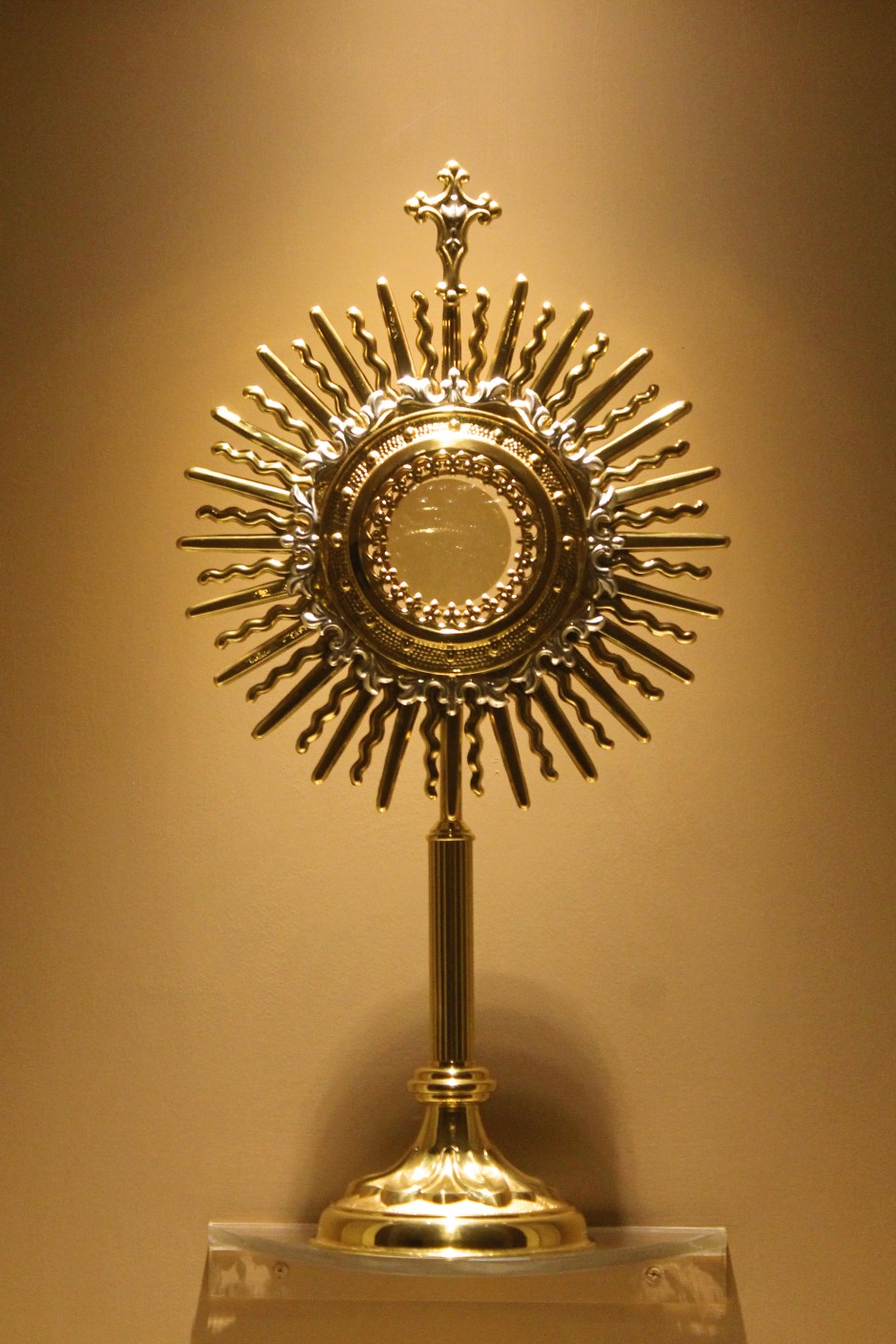
Though my childhood personality, at least as I remember it, was pretty calm, I have a distinct memory at twenty-one of raging against God. Just a month after suffering a stroke, and a year after my first profession of vows, I was silently before Jesus in the Eucharist one day in the chapel and from somewhere deep inside came words which surprised me, even shocked me. “I hate you,” I said to him. I had lost dreams and ambitions and physical abilities and, what seemed to me as a young adult, my future. And from somewhere within me, this anger and hatred at the one I felt was to blame came raging out. It took me by surprise, for, after all, I had been “well behaved” up to that point. Day after day, in a struggle that stretched to weeks and months and years, I submitted my heart to the transforming action of the Spirit at work in the Eucharist. Each day after receiving Jesus in Communion I prayed, “Help me, for I see now how poor I am, how in need I am of you, Jesus.”
In her diary, Elizabeth herself recorded how her first encounter with Jesus in the Eucharist was a moment of transformation. In fact, she said that it was decisive for the rest of her life. She began to take on from that moment the gentle self-control that would characterize her as an adult.
“In the depths of her soul, she heard his voice…. [The] Master took possession of her heart so completely that thenceforth her one desire was to give her life to Him” (The Spiritual Doctrine of Sister Elizabeth, pg 2)….
The most important truth to be convinced of is not that God loves you. As broken, wounded, wandering as we each may be, as desperately yearning to know that we matter and that we are worth someone’s attention, contrary to what we might think, we do not need most to know how much God loves us.
I almost cringe as I write these words. For almost 40 years this has been both my mantra and my misery, my hope against hope, the alphabet of my feelings of spiritual failure. I had not realized that I was seeking for something that was only half-true, a shabby imitation of the fierce and passionate, surprisingly disconcerting way of divine love.
In the first week of the spiritual exercises, St Ignatius draws the retreatant into love through the very narrow and demanding path of coming to grips with what is not loving in one’s life. The retreatant comes to Jesus in prayer, again and again, begging for the grace to acknowledge the mystery of iniquity which spins a web of deceit around them. Repeatedly I came before Jesus begging for the grace to become deeply aware of my personal sin history and my hidden disorders. I begged Jesus and Mary for interior knowledge of my sins, an awareness of the disorder of my actions, that I might hate them and allow God to bring order once again to my life.
The way of truth is the only foundation for the confidence of love. But ah! how hard is this truth!
Horizons of the Heart is a retreat-in-life inspired by the Spiritual Exercises of St Ignatius and my own notes from a thirty-day Ignatian retreat in 2022.See an index for the whole series.
The grace we are asking of God: an ever-increasing awareness of God’s love for me
The most important truth to be convinced of is not that God loves you. As broken, wounded, wandering as we each may be, as desperately yearning to know that we matter and that we are worth someone’s attention, contrary to what we might think, we do not need most to know how much God loves us.
I almost cringe as I write these words. For almost 40 years this has been both my mantra and my misery, my hope against hope, the alphabet of my feelings of spiritual failure. I had not realized that I was seeking for something that was only half-true, a shabby imitation of the fierce and passionate, surprisingly disconcerting way of divine love.
In the first week of the spiritual exercises, St Ignatius draws the retreatant into love through the very narrow and demanding path of coming to grips with what is not loving in one’s life. The retreatant comes to Jesus in prayer, again and again, begging for the grace to acknowledge the mystery of iniquity which spins a web of deceit around them. Repeatedly I came before Jesus begging for the grace to become deeply aware of my personal sin history and my hidden disorders. I begged Jesus and Mary for interior knowledge of my sins, an awareness of the disorder of my actions, that I might hate them and allow God to bring order once again to my life.
The way of truth is the only foundation for the confidence of love. But ah! how hard is this truth!
Let me tell you a story that tries to clarify this intertwining of truth and love.
There once was a king who lived in an immense palace. He was well beloved by his people. He served them with an inward goodness. The king enjoyed great wealth, sumptuous banquets, gemstones and royal diadems, everything he could ever want.
The king was not yet married and it was every young woman’s dream who lived in the kingdom that she might one day be his bride.
One day the king left his palace and traveled to the smallest and poorest town of his kingdom. At the end of an almost impassible road at the furthermost edge of this village, he sought out a young woman who had survived a fire. She had burns on over 80% of her body that had left her terribly disfigured. Her face was almost unrecognizable, her hair only a short stubble.
The king entered her hovel and inquired after her needs, sending his own servants to provide for her. Then he proposed to her. “Will you marry me?” he asked her quietly.
The king took his bride-to-be back to his palace. He introduced her to the most important persons in the realm who surrounded him and took her to the palace ball.
This young woman must have felt humiliated as she was introduced to the king’s friends as his fiancé. “You could have anyone in your realm as your bride. Why did you pick me? I am not beautiful. I have nothing to offer you. I am disfigured and deformed, hideous to behold.” As she stood before the king’s staff and servants she would have realized her inadequacy certainly. As each subsequent day passed, however, she would have felt more and more confused and ashamed before the beauty, wealth, intelligence, culture, and gifts of his friends and courtiers.
This sentiment exactly is part of what the First Week of the Exercises brings about in us, this deep and almost devastating awareness of the mystery of evil in which we are entangled. Before the purity of God, we realize how corrupt we are, sons and daughters of Adam and Eve whose refusal to obey the command of God has wrought such disastrous consequences on all of humanity. In his Ascent to Mount Carmel, Saint John of the Cross aptly describes what we their children experience: “So great is the harm that if we try to express how ugly and dirty is the imprint the appetites leave in the soul, we find nothing comparable to it—neither a place full of cobwebs and lizards near the unsightliness of a dead body nor the filthiest thing imaginable in this life […] The variety of filth caused in the soul is both inexplicable and unintelligible” (Book I, 9.3.).
Just as the new bride-to-be experienced at once her confusion and the love that had been showered upon her by the king, we too experience our humiliation at coming to grips with the web of evil woven around us and the absolute mercy of being forgiven, chosen, and beloved.
On the shore of the Lake of Tiberias, after Peter’s astounding denial of Jesus on the night of his betrayal, Jesus asked the sorrowing apostle just one question: Do you love me? Jesus didn’t jump in to assure Peter that no matter what he did God still loved him. In his threefold questioning, Jesus brought Peter back to his greatest moment of humiliation: his threefold denial. There. In that place. In the dark and sorrowing truth of weakness and sham, Peter had to once again assert his love for Jesus. I could imagine that Peter felt humiliated before the other apostles, particularly John who alone among them had walked with Jesus the way to Calvary and stood beneath the cross of the Master. In Peter’s threefold attestation of love in the very wound of his humiliation, he began to interiorly know in a way that could never be erased from his soul, that he himself was forgiven, chosen, and beloved.
This love of God poured anew into Peter’s humbled heart that now could become a vessel of grace.
What are the shame-filled memories of past betrayals that still haunt your soul? Do not flee from them. Return to them with Jesus, the king who has sought you out as his chosen beloved one. Ignatius would have us experience the shame we’d feel if we stood hand in hand with Jesus before all of humanity, we with all the mystery of iniquity burning within us, disfiguring our lives and distorting our hearts. Imagine yourself, hand in hand with Jesus the King, standing before all the angels and saints, before your guardian angel, before Mary, before the eternal Father. As they look at you they see, they understand the sorrowing and the inner confusion at being so loved by the King who holds your hand, yet being so unworthy, so very unworthy. They have been there.
In this place of experiencing the effects of sin you have suffered and for which you are to some extent also responsible, marvel at God who in his mercy forgives you, preserves you, and…truly forever and ever loves you. Look into the eyes of your Savior and King. Let him show you that you are his choice. He would go to the ends of his kingdom to find you and to bring you to his mansion in heaven. Let him love you. Be confident in this love he has for you. You may find Psalm 139 a helpful guide for this prayer:
Lord, you know everything there is to know about me. You perceive every movement of my heart and soul, and you understand my every thought before it even enters my mind. You are so intimately aware of me, Lord. You read my heart like an open book and you know all the words I’m about to speak before I even start a sentence! You know every step I will take before my journey even begins. You’ve gone into my future to prepare the way, and in kindness you follow behind me to spare me from the harm of my past. You have laid your hand on me! This is just too wonderful, deep, and incomprehensible! Your understanding of me brings me wonder and strength. Every single moment you are thinking of me! How precious and wonderful to consider that you cherish me constantly in your every thought! O God, your desires toward me are more than the grains of sand on every shore! When I awake each morning, you’re still with me (Psalm 139: 1-6, 17-18).
Read prayerfully the story of the raising of Lazarus in the Gospel of John (11:38-44). Imagine yourself as Lazarus emerging from his tomb at the command of Jesus.
Giovanni di Paolo, Public domain, via Wikimedia Commons
What has been your tomb? What feels dead right now in your life? Where do you feel trapped, confined, sightless, stifled?
Right there in that place, imagine Jesus calling you forth from what has become your tomb, the place that smells like death, the place that seems like a final “no” to who you could have been.
As you walk out of the tomb toward the voice, into the light, hear the exclamations and twittering whispers of the crowd gathered in mourning.
What does the voice that is calling you to arise to new life sound like? Does it remind you of some other loved person’s voice? How does it reverberate within you? Does it make your heart leap? If so, in what way? What would you compare it to? A fountain? An earthquake? What are you thinking as you walk toward the voice? What are you fearing? Hoping? Desiring?
Begin to remove the strips of cloth that were wrapped around you during your burial. Let each piece of cloth represent something that you need to be freed from. As you let each one of them go, look again into the face of Jesus who is calling you by name to come out of your tomb. Notice how he looks at you. What is he saying with his eyes? Does he tell you anything else?
Finally, approach Jesus. Follow your heart as it leads you to worship, love, and gratitude.
“Praise be to the God and Father of our Lord Jesus Christ, who has blessed us in the heavenly realms with every spiritual blessing in Christ. For he chose us in him before the creation of the world to be holy and blameless in his sight. In love, he predestined us for adoption to sonship through Jesus Christ, in accordance with his pleasure and will— to the praise of his glorious grace, which he has freely given us in the One he loves. In him we have redemption through his blood, the forgiveness of sins, in accordance with the riches of God’s grace that he lavished on us” (Eph. 1:3-8).
Lord, remember not only men and women of good will, but also those of ill will. But do not remember all the suffering they inflicted on us. Remember the fruits we have borne thanks to this suffering: our comradeship, our humility, our courage, our generosity, the greatness of heart which has grown out of this; and when they come to judgment let all the fruits that we have borne be their forgiveness.”
~ Written on a piece of wrapping paper found near the body of a dead child in Ravensbruck, the second largest concentration camp for women in the German Reich, where 92,000 women and children died in the Holocaust.
How, O my God, could a woman in this death camp write these words?
How did she find the courage to keep her heart open? To care about the eternal salvation of those at whose hands she suffered and very likely died?
Friends, today we also are living through turbulent and violent times. As we watch the social fabric of our nation disintegrate with mass shootings and watch with horrified anger at what Russia is inflicting on the Ukrainian people and the world, we may find our hearts closing. It could be that our hearts are hardening in fear or anger without our even realizing it. Whatever we are feeling, it is okay. We might feel overwhelmed at the prospect of the future for our children and grandchildren. It is okay. We might feel lost in the midst of everything that is going on around us. It is all okay.
How difficult are you finding it to love and believe in the power of love in these days?
The news cycle overwhelms and incites the fires of anger and fear and hatred in our minds and hearts. It all can feel so righteous, so right. After all, there is a clear bad guy in these incidents, and our hearts immediately take the side of the innocent victims. Today only the bravest can keep lit in their hearts the flame of charity.
Recently I spent an hour with one of my dear friends. The room was quiet as we spoke together. Now in her eighties, she is no longer able to walk about freely and falls are frequent. She told me that her memory is going, making it difficult to carry on a conversation for very long since the topic quickly vanishes from her mind.
Together we gazed out of her large window at the beautiful trees that grew in the front yard. With a sigh we both realized that Jesus was beginning to take her into the wilderness of his Heart, that place of unknowing where we all are eventually invited to restfully trust in him as he leads us to glory.
“But as it is written:
‘What eye has not seen, and ear has not heard, and what has not entered the human heart, what God has prepared for those who love him’” (1 Corinthians 2:9 NABRE).
Questions about life’s meaninglessness, about the way in which our days pass like vapor, about how all that we do and accomplish seems to vanish without a trace as we age, these burden not just the heart of Qoheleth in today’s first reading, but at certain points in our lives these questions haunt us too. I once heard that the book of Ecclesiastes identifies the question to which the whole of Revelation is the answer. In this quickly changing world, all that our life has been seems to slip through our fingers, and our heart longs for life, true life, life that is a treasure that neither moth nor rust can destroy.
“You will show me the path to life, abounding joy in your presence, the delights at your right hand forever” (Psalm 16:11).
Both Paul in his First Letter to the Corinthians and the Psalmist see life as a great river rushing toward a goal prepared for us by God where we will find joy and delight at his right hand forever. How different is this message from the distressing observations of Ecclesiastes in our First Reading today:
“One generation passes and another comes, but the world forever stays. The sun rises and the sun goes down; then it presses on to the place where it rises. Blowing now toward the south, then toward the north, the wind turns again and again, resuming its rounds. All rivers go to the sea, yet never does the sea become full. To the place where they go, the rivers keep on going” (Eccl 1:4-7)
There is something cyclical in this description of continual, unending, “coming and going” of things. In this reading there is no sense of the enduring, of divine gift and guidance and mission, of an end which has been ordained for all things by God. Instead, the more things change, as the saying goes, the more things stay the same, endlessly repeating to seemingly no purpose.
Today many experience life in this way. Not being grounded in the fertile soil of God’s action and love, much of what constitutes activity in our world seems to have no real meaning. I believe that during the pandemic many began to feel this way. The tasks they had been doing in their jobs were now no longer satisfying to them, no longer seemed purposeful, no longer worth devoting their whole life to. They began to seek something more meaningful to do with their careers.
It is ultimately only God who truly defines us and the purpose of our lives, their unending purpose.
This discouraged sigh of Qoheleth whose voice we hear in Ecclesiastes may escape also now and then from your heart. However, Saint Paul encourages you not to give in to this sense of futility and hopelessness. Instead, take on Paul’s own strength, faith, and hope when he cries out, “I am confident of this, that the one who began a good work in you will continue to complete it until the day of Christ Jesus” (Phil 1:6 NABRE).
Praying with this passage of Scripture
Lectio Divina is a way of listening to God as he speaks in his Word. It is a practice of communicating with God through Scripture and attending to God’s presence and what he wishes to tell us. In this slow and prayerful reading of the Word of God, we allow ourselves to be transformed by the Spirit who forms us into the image of Christ. There are four movements in Lectio Divina: Read (lectio), Meditate (meditation), Pray (oratio), Contemplate (contemplation).
Begin by finding a still space to pray. Breathe deeply and become quieter within. Abandon any agenda, worries or thoughts you bring to this prayer and entrust these things to the merciful care of God. Ask for the grace to be receptive to what God will speak to you through this Scripture reading. Grant me, Jesus Divine Master, to be able to know the mysteries of the kingdom of God and your unfathomable riches. Grant that your word penetrate my soul; guide my steps, and brighten my way till the day dawns and darkness dissipates, you who live and reign forever and ever Amen
Read (lectio) Begin by slowly and meditatively reading your Scripture passage out loud. Listen for a particular word or phrase that speaks to you at this moment and sit with it for a time
I said to myself, “Come now, I will test you with pleasure to find out what is good.” But that also proved to be meaningless. “Laughter,” I said, “is madness. And what does pleasure accomplish?” I tried cheering myself with wine, and embracing folly—my mind still guiding me with wisdom. I wanted to see what was good for people to do under the heavens during the few days of their lives.
I undertook great projects: I built houses for myself and planted vineyards. I made gardens and parks and planted all kinds of fruit trees in them. I made reservoirs to water groves of flourishing trees. I bought male and female slaves and had other slaves who were born in my house. I also owned more herds and flocks than anyone in Jerusalem before me. I amassed silver and gold for myself, and the treasure of kings and provinces. I acquired male and female singers, and a harem as well—the delights of a man’s heart. I became greater by far than anyone in Jerusalem before me. In all this my wisdom stayed with me
I denied myself nothing my eyes desired; I refused my heart no pleasure. My heart took delight in all my labor, and this was the reward for all my toil. Yet when I surveyed all that my hands had done and what I had toiled to achieve, everything was meaningless, a chasing after the wind; nothing was gained under the sun. (Eccl 2:1-11
“You will show me the path to life, abounding joy in your presence, the delights at your right hand forever” (Psalm 16:11)
Meditate (meditatio) – Read the same passage a second time. As you re-engage the text, let the word or phrase that stood out become your invitation to speak from your heart with God who wishes to share his heart with you. Allow this word or phrase to wash over you and permeate your thoughts and feelings. You may wish to repeat this phrase quietly and gently for a period of time
Pray (oratio) – Read the text a third time. Listen for what God is saying to you. Speak heart to heart with God. Notice the feelings that this conversation with God raises up within you. Share with God what you notice about your response to this conversation. You may wish to return to repeating the phrase quietly and gently, allowing it to permeate you more and more deeply.
Contemplate (contemplatio) Read the text a final time. Now be still and rest in God’s embrace. Ask God to give you a gift to take with you from this prayer. You might ask God if he is inviting you to do some action, for instance, make some change in your thoughts, attitudes or reactions, in the way you speak or how you treat others. Thank God for this gift and invitation as you conclude your prayer.









 Touching the Sunrise