The image that has drawn me in my ministry is Touching the Sunrise. I believe each person, no matter where they are and what they have lived, is a temple of the Trinity and can, indeed, taste the presence of God within. You can find resources for healing and prayer and follow me at touchingthesunrise.com.
I’ve been thinking about patterns lately. How easy it is to fall into rhythms, habits, mental ruts, ideological stagnation. Patterns of living too small, too tight, too cold. Patterns of living too loud, too dispersed, too dissipated. We easily fall into emotional patterns that become so ingrained we forget that often what our emotions tell us about ourselves and about God just isn’t true. Truth is found in God’s eyes as we look at him, and no pattern—mental or emotional or behavioral—can match what we see in God’s love for us.
Lent is about getting out of some patterns that have us trapped in being smaller than God has made us to be. The Apostle Paul wrote: “Do not conform to the pattern of this world…”
Other translations of this verse are: Don’t let the world around you squeeze you into its own mold. Do not fashion yourselves after this world.
Paul continues, “…but be transformed by the renewing of your mind.”
Interesting.
Paul didn’t say: Be transformed by improving your behavior. Be transformed by switching your desires to better things. Be transformed through super Lenten resolutions. Be transformed by giving up chocolate.
No.
Paul said: Be transformed by the renewing of your mind. So what does Paul mean by his use of “mind”? The Greek word used by Paul is noûs.
the mind, comprising alike the faculties of perceiving and understanding and those of feeling, judging, determining
the intellectual faculty, the understanding
reason in the narrower sense, as the capacity for spiritual truth, the higher powers of the soul, the faculty of perceiving divine things, of recognising goodness and of hating evil
the power of considering and judging soberly, calmly and impartially
a particular mode of thinking and judging, i.e thoughts, feelings, purposes, desires
The Apostle Paul wasn’t thinking about our everyday patterns of thinking. By his use of noûs he was considering the intellect, the higher faculties of our soul: perceiving and understanding, as well as faculties that have more to do with our will: judging, determining, recognizing goodness and hating evil.
Lent is a perfect time to look at the patterns we’ve fallen into in our lives. Are we being molded by the fashion, enticements, pleasures, of the world around us? By what we see in the media? By our friends? Our fears?
Now is the time to sharpen our capacity for spiritual truth, to strengthen our habit of perceiving divine things, to call forth the will to recognize and choose the good and to despise and reject what is evil.
“No, you will not die!” hisses the serpent in the Garden of Eden, but its human inhabitants do not understand and are seduced.
Beginning with the first pages of Genesis, that demonic hissing has never ceased to tempt our human nature. As if not dying is the solution to the longing for life that we all carry within us, as if avoiding death is the way to find the happiness we so diligently seek. Even the Gospel reading is Jesus’ response to the very human temptation to escape death. A temptation multiplied endlessly in the realms of possession, religion, power–seductive answers to the fear of dying.
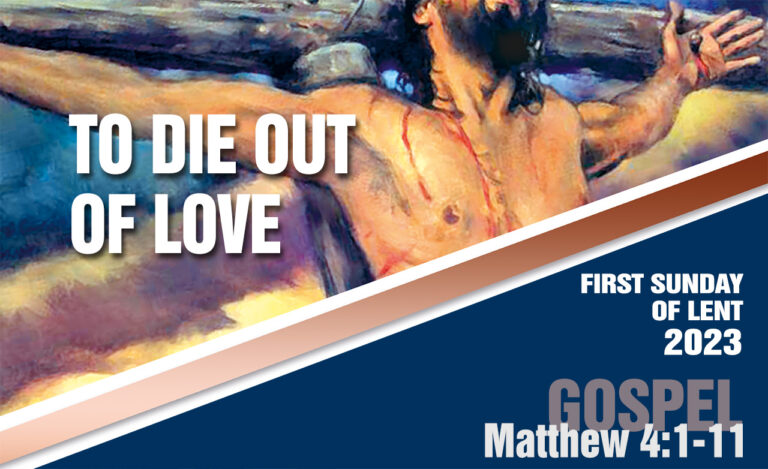
But when faced with death, Jesus does not try to protect himself. He dies naked, exposed, defenseless. He is not ashamed of dying, not even on the infamous wood of the cross, because if you love, you strip yourself and give yourself. The macabre dance of Calvary is also a dance of love: blood and passion, pierced hearts and tears, labored breathing and self-surrender: the grammar of love is the same as the grammar of death.
“No, you will not die!” hisses the serpent. “You are all dying even now,” replies the Master. The centurion guarding Jesus declares, “Truly this man was the Son of God!”
Human beings are born anew when they recognize death as an opportunity to perpetuate love. Are we dying out of love for someone? May this be the primary question we ask ourselves as we cross the desert of Lent.
Since I was a kid Lenten resolutions were a big thing. I remember giving up chocolate in 7th grade. A friend of mine threw a party for her birthday on Holy Saturday. I told my parents I couldn’t go because I had given up chocolate. They told me that Lent was over and that Holy Saturday was looking forward to Easter, and so off I went…. Needless to say, I’m still a chocoholic.
So now that we’ve almost finished the regular run of blog posts and comments and conversations about Lenten resolutions for this year, I wanted to offer some thoughts about Lenten practices (not resolutions).
When I was a little girl I played piano. One of the important things I had to do every day was “practice” scales. Every. Day. When I was assigned this by my piano teacher, she didn’t say, “Well you just need to do this for a month or two then you can stop. Maybe the following year you could try it again if you felt like it.” No. Practicing scales is important because it makes you a top-notch pianist. Practicing every day forms you as a musician. There never is an end to it, unless of course you give up piano playing (which I did do as an adult). And I bet concert pianists, just like Olympian athletes practice many hours a day. Every. Day.
So what does this have to do with Lent?
This year I was thinking about how making Lenten resolutions at least sometimes, if not often, backfires. We give up chocolate every day for forty days and then we make up for it the first week of Easter. Or we give up our favorite TV program and then binge on it during the Easter Season.
Practices are meant to form you, perfect you, shape you, transform you from a so-so pianist, athlete or Christian to an outstanding one. And in this case, into a saint!
How to Start
So my thoughts about this are simple:
Ask Jesus what he would like to give you this Lent. How do you want me to be more like you, Lord? In what area of my life? With which person? In what situation?
Think about what aspects of your Christian living disappoint you the most. What are you at least slightly hiding or ashamed of. What do you wish were different.
Then make a strategy of practices that you can BEGIN in Lent and then CONTINUE for the rest of your life. (Don’t get worried, you can modify them, perfect them, make them work better for you, but practice daily you must. After all, becoming holy and living in Christ is the most important thing in your life!)
Make a Strategy
Here are some elements you make part of your strategy. (This list is not for you to choose one thing, but to create a wholistic, integrated strategy that touches all aspects of your life.)
Choose a book to read that addresses the area you most want to see lifted up to the Face of the Lord. Read a little bit of it every day and reflect on it. If you already have one in mind, go through and mark about 10 places in that book that you can focus on during the season of Lent so that you create a habit in those areas. (I found an old book I had greatly highlighted several years back. I located about 10 pages in it to focus on that embrace different aspects of living in holiness, and every day I choose one of these to read and reflect on. It’s not something to DO. It is rather something to take to meditation, to become convinced of, to more clearly understand how it works, what it means for you, what your resistances are, what your desires are, what you need in order to succeed.)
Think about a couple of prayer forms or guides you could use throughout the season of Lent to make your prayer more focused, more intense.
Identify one habit/addiction you have that is standing in your way to a deeper relationship with God. Determine something else you can do, say, eat, or have instead that will promote your holiness and which is attractive enough for you to consider it a reasonable and preferable life-change you’ll really want to keep. (For instance, I love butterscotch. For health reasons, I need to let go of chocolate completely. This Lent I’m making a conscious transition away from sugar and chocolate to peanut butter and sugar-free butterscotch pudding. Letting go of some things that are highly addictive and destructive to my health is a health decision on one level. On another level, however, it is a choice for a more intentional temperate relationship with food that is socially conscious. The fact that neither of my new choices is highly addictive will help me keep it up as well as open up the spiritual space within that sugar and chocolate is closing down.)
Is there one person you can give your life for, in the spirit of Jesus who gave his life for you? What are some concrete things you can do to serve them, pray for them, support them?
Choose one quote from the bible and one quote from a saint as your tagline for Lent 2023, your rallying cry to keep you coming back to the cross to beg Jesus for his grace that you might love him more truly.
After 40 days of practicing, probably rearranging and perfecting your strategy, and even possibly changing mid-stream, you should have a spiritual sense of what God is doing in your life through your commitment and perseverance. On Holy Saturday, Lent may be over, but the Easter Season begins that evening with the Easter Vigil. So you actually have 50 more days of practicing, but now in a spirit of joy!
You’ll be pleasantly surprised after 100 days of practicing that what was once an obstacle or a struggle has now become integrated into who you are in Jesus. It will be so wonderful, that you won’t ever want to stop practicing. You’ll just expand your practices, like a pianist who has moved beyond the basic scales and now has made even practicing a work of art!
The grace we are asking of God: a deeply felt awareness of how God draws us into the unfolding of the mystery of the Word made flesh and how in doing this we enter into a process of healing that we might love Jesus and follow him more intentionally
Horizons of the Heart is inspired by the Spiritual Exercises of St Ignatius and my own notes from my thirty-day Ignatian retreat in 2022.See an index for the whole series.
Entering Prayer
Offer your prayer to God, desiring that in every way it will give him glory. I pour myself out in worship. You could use a few lines from the following Psalms if this helps you enter into prayer:
Ask of God what you think you need. (It could be later that God will show what you truly need and what you should be asking for, but begin now where you are.)
Giovanni Bellini, Public domain, via Wikimedia Commons
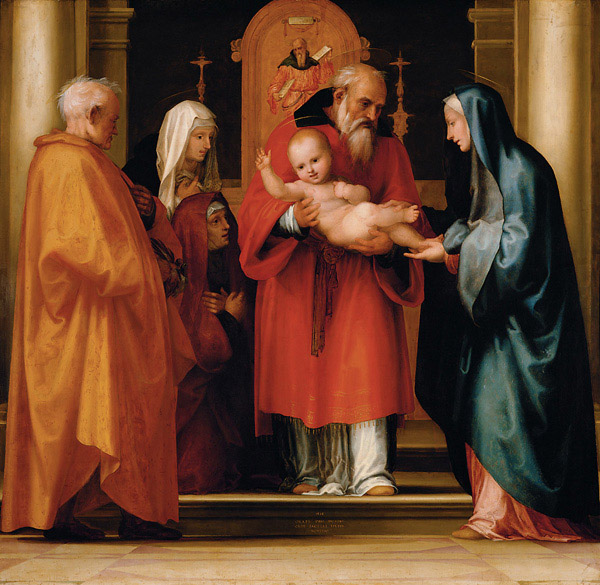
The Circumcision and the Presentation of Jesus in the Temple
Over several periods of prayer, linger imaginatively over the events narrated in Luke 2:21-38.
In the second chapter of Saint Luke’s Gospel, beginning from verse 21, the evangelist tells us about the Circumcision and Presentation of Jesus in the Temple. Circumcision was performed eight days after the birth. The Presentation of Jesus and the Purification of the Virgin was held forty days after Jesus’ birth.
At the Circumcision, Jesus was incorporated into the people of Israel. At this family ceremony, he received the name Jesus, indicating that he was to be the Savior of mankind. In the Circumcision, we encounter the true scandal of the Incarnation: God really became human. God really took up all that human life entails, including the suffering that would culminate one day on the cross.
The circumcision constituted Jesus a member of the old covenant, but his presentation in the temple was his formal dedication to the service of the Lord. According to the Law, every woman who gives birth to a son must wait forty days before entering the temple, and then “she shall take two turtles, or two young pigeons, one for a holocaust, and another for sin: and the priest shall pray for her, and so she shall be cleansed” (Lev 12:8).
This feast also celebrates the coming of the Lord into his temple. As the prophet Malachi proclaims, “presently the Lord, whom you seek, and the angel of the testament, whom you desire, shall come to his temple” (Mal 3:1). In the Presentation of the Lord, we see the long-expected fulfillment of God’s promises. For more than a millennium, the Jewish people waited for the Messiah. Generation after generation endured hardship and suffering—evil kings, idolatrous neighbors, exile—yet still, they waited. This patient expectance is typified in Simeon and Anna, two faithful Jews who greet the baby Jesus in the Temple, recognizing at last the One who is to come.
Imagining Yourself Present
Over several days, spend some time imagining yourself at the family celebration of Jesus’ circumcision and later in the temple with Mary and Joseph, Simeon and Anna.
In Gospel contemplation you attempt to grasp something of Jesus’ human existence and as you do this, the Spirit begins to grasp you in your existence. This prayer gives us contact with Jesus, the risen Lord, who is present now, influencing my life now. The historical events of Jesus’ life, death and resurrection, his healing and his preaching, transcend time and place. The THEN of Jesus’ life becomes NOW. It is important to allow oneself to become part of the story-event.
This is a perfect time also to place in Jesus’ heart your own birth and childhood, early family situations and your relationship with parents, your religious upbringing in the first half of your life, encounters with the elders in your own family… Memories… Gratitude… Regrets… Hurt…
Fra Bartolomeo, Public domain, via Wikimedia Commons
Are you carried in Mary’s arms? Does aged Anna lift you to her heart? Do you regret that there was no baptism, or no real religious sense in your home? Were you a young mother like Mary?
Where are you in these scenes? Speak to the people that populate them. Allow your affective imagination to lead you closer to them, to give you a sense of this felt-closeness that you so desire. You can imagine with your mind’s eye, with your sense of hearing or touch.
Imagining the Gospel events in the present
Over time, allow these stories in the gospel of Luke to become current as if Mary and Joseph are walking into your house with your friends and family. What do you feel as they enter into your space.
In Gospel Contemplation, Ignatius takes advantage of the way in which spiritual growth, like so many other aspects of maturing that we experience, takes place primarily when our affectivity is engaged. It is the shift in one’s deeper emotions and feelings that leads to a change in one’s behavior. We reach these deeper levels through metaphor, image, and symbol—the work of the imagination.
Observing attractions and resistance
Notice any interior reactions that you experience: comfort, discomfort, being lifted up, struggle, joy, sadness….
Observe the actions, words, emotions, sensitivities, attitudes of Mary, Joseph, and Jesus and to which of them you feel more attracted. Which of them arouse more negative feelings or resistance? Return to aspects of these meditations that seem more personally meaningful.
Entering the Mystery of the story
As you begin to enter the mystery of the story more deeply, you will begin to see or hear or touch. You will enter into the event and interact more deeply. Little by little you will become more present to the mystery and the mystery will be present to you.
As you become more and more involved in the event of Jesus’ mystery that you are contemplating, your life and your choices are affected. You find yourself changing and desiring to change.
Conversing as with a friend
Read the following verses from the prophet Isaiah (62:11-12) in relation to Jesus coming to the temple. Read this slowly, several times, allowing some moments of rest between your reading.
The Lord has made proclamation to the ends of the earth: “Say to Daughter Zion, ‘See, your Savior comes! See, his reward is with him, and his recompense accompanies him.’” They will be called the Holy People, the Redeemed of the Lord; and you will be called Sought After, the City No Longer Deserted.
Is there some new awareness coming forward as you consider these words? Do they shed some unexpected or new light on your own birth and childhood?
Continue in quiet—or even silent—intimate conversation with Mary, Joseph and Jesus. Ask them what is the grace that you should be praying for. Beg this grace of the Father. Then beg this grace of the Son, your Savior and Shepherd. Finally, beg for this grace from the Holy Spirit who is the source of all holiness.
If you wholly lived this grace that you are begging for, what would your life look like? Your relationships? Your prayer? The way you work? The way you love? The way you serve? What about you would make you the most happy?
Ask Mary, Joseph and Jesus to show you one specific gift they wish to give you. Receive it and remain in stillness and quietly relaxed presence under the influence of the Holy Spirit.
Reviewing the graces of prayer
When you finish praying, write down the main gifts and discoveries from this time of intimate contemplation. What is one concrete thing you can do to solidify these gifts in your life.
Offer your prayer to God, desiring that in every way it will give him glory. I pour myself out in worship. You could use a few lines from the following Psalms if this helps you enter into prayer:
Ask of God what you think you need. (It could be later that God will show what you truly need and what should be asking for, but begin now where you are.)
Imagining Yourself Present
Over several periods of prayer, linger imaginatively over one of the the events of the life of Jesus or Mary. Offer yourself to Mary and Jesus, imagining yourself present to these events of our salvation. Put yourself at their service, reflecting on what they are going through and how they are experiencing these events. Be present to them with, as Ignatius says, “the whole affective power of your mind, with loving care, with lingering delight, thus laying aside all other worries and cares.”
Note regarding praying with your imagination: Everyone can imaginatively be present somehow to a past event through memory in various ways. Imagining doesn’t necessary mean making images, that is, creating a little movie about the events we are contemplating. Some people imagine through their feelings, simply having a sense of what is happening, others visually through picturing, others through hearing. Entering imaginatively into these mysteries of our salvation will gradually give one an experiential and deeply felt understanding, rather than a notional knowledge.
Why is this important? This deep-felt knowledge implies an intimate caring, an attentive closeness that is aware of even the inner movements of thought and emotion in oneself and the other. We follow Jesus here and now through the work of the Spirit who weaves together our own history with salvation history. This happens through symbol and imagination. When we become part of the gospel story we allow our whole life to be affected by the Spirit.
Image Cathopic
Imagining the Gospel events in the present
Re-read in the scriptures these events or simply reflect on them as though they were happening now. Bring them up to your mind’s eye with “lingering delight” as though they were occurring right in your neighborhood so to speak. Notice which aspects of these mysteries begin to involve you a little more deeply.
Notice: In Gospel Contemplation, Ignatius takes advantage of the way in which spiritual growth, like so many other aspects of maturing that we experience, takes place primarily when our affectivity is engaged. It is the shift in one’s deeper emotions and feelings that leads to a change in one’s behavior. We reach these deeper levels through metaphor, image, and symbol—the work of the imagination.
In Gospel contemplation you attempt to grasp something of Jesus’ human existence and as you do this, the Spirit begins to grasp you in your existence. This prayer gives us contact with Jesus, the risen Lord, who is present now, influencing my life now. The historical events of Jesus’ life, death and resurrection, his healing and his preaching, transcend time and place. The THEN of Jesus’ life becomes NOW. It is important to allow oneself to become part of the story-event.
Observing attractions and resistance
Observe the actions, words, emotions, sensitivities, attitudes of the various persons present in the Gospel passage and to which of them you feel more attracted. Which of them arouse more negative feelings or resistance? Return to aspects of these meditations that seem more personally meaningful.
Notice: How are you entering the story? Are you your present age or another age? How are you taking part in the mystery? What are you noticing about your emotions as you interact with Mary, Joseph, and Jesus? What happens when you interact with the persons in the story? Are you just thinking about them or are you speaking with them? Are you watching or are you a participant? Are you allowing yourself to be moved, surprised, touched, even angered by what happens or are you keeping everything under control?
Entering the Mystery of the story
As you begin to enter the mystery of the story more deeply, you will begin to see or hear or touch. You will enter into the event and interact more deeply. Little by little you will become more present to the mystery and the mystery will be present to you.
Image Cathopic
Moving through deepening levels of stillness
As your contemplative prayer deepens, you will be open to being affected deeply by Jesus’ Spirit at both conscious and less-than-conscious levels of your being.
It may move you gradually through deepening levels to stillness. You may find yourself just there, totally involved—seeing, hearing, touching, smelling, tasting. It is almost as if the experience has gone into slow motion, and time passes as one is present to the Beloved and the Beloved to oneself. One is there; Jesus is there. The mystery is there. No words are necessary and no great thoughts need to surface. This is the experience of “O taste and see the goodness of the Lord.”
Desiring to follow Jesus
As I become more and more involved in the event of Jesus’ mystery that I am contemplating, my life and my choices are affected. I find myself changing and desiring to change. I begin to follow Jesus in a particular way.
As you contemplate more deeply, as you soak in these mysteries of Jesus’ life, where do you observe emotions or reactions like fear, guilt, resistance? Do any memories become more present to your awareness? How do you feel drawn toward something new? Speak to Jesus about what you observe and experience. What do you begin to learn about your following of Jesus?
You may wish to journal about this.
Conversing as with a friend
Continue in quiet—or even silent—intimate conversation with Jesus and Mary. Ask them what is the grace that you should be praying for. Beg this grace of the Father. Then beg this grace of the Son, your Savior and Shepherd. Finally, beg for this grace from the Holy Spirit who is the source of all holiness.
If you wholly lived this grace that you are begging for, what would your life look like? Your relationships? Your prayer? The way you work? The way you love? The way you serve? What about you would make you the most happy?
Ask Mary, Joseph and Jesus to show you one specific gift they wish to give you. Receive it and remain in stillness and quietly relaxed presence under the influence of the Holy Spirit.
Reviewing the graces of prayer
When you finish praying, write down the main gifts and discoveries from this time of intimate contemplation. What is one concrete thing you can do to solidify these gifts in your life.








 Touching the Sunrise