The image that has drawn me in my ministry is Touching the Sunrise. I believe each person, no matter where they are and what they have lived, is a temple of the Trinity and can, indeed, taste the presence of God within. You can find resources for healing and prayer and follow me at touchingthesunrise.com.
The grace we are asking of God: a deeply felt awareness of how God in all of history and most powerfully in the Word made flesh draws us into the unfolding of the mystery of his love which always is extravagant and which is always seeking to save us. We desire that in doing this we enter into a process of healing that we might love Jesus and follow him more intentionally, completely, and wholeheartedly.
Horizons of the Heart is inspired by the Spiritual Exercises of St Ignatius and my own notes from my thirty-day Ignatian retreat in 2022.See an index for the whole series.
Looming large in my 30-day retreat was a decision that was in a certain sense, due to forces outside myself, forced upon me.
Nothing strange there!
Doesn’t this happen to just about every one of us?
Even if we think we can control ourselves and mastermind our success, either materially or spiritually, we soon find out that we can’t control others, we can’t control the forces of nature, and we can’t control the randomness of incidents that could affect, break, and change the direction of our lives.
But still, when we need to do an unexpected about turn, when we are blocked and forced into a right or a left hand change of direction at what turned out to be a dead end, we at times suffer indescribable pain.
I remember standing at the end of the outdoor Stations of the Cross at the retreat house and reading the inscription taken from the second chapter of Paul’s letter to the Philippians: “Jesus did you deem equality with God something to be grasped at, but rather humbled himself taking the form of a slave.” Every injustice I had ever received, little ones and big ones, came back with powerful force and left me breathless… and angry.
How ashamed I felt, but there it was. Who Jesus was and what he invited me to, I was not, and at that moment I clearly refused to follow him. It was just too hard…by myself. I needed God’s help, a lot of help.
The natural reaction to injustice is hurt or rage or bitterness because something we deemed to be our own or somehow necessary to our living and thriving is suddenly changed and taken away.
As we enter into the next mystery of Jesus’ life, the flight into Egypt, we are entering into this sacred mystery of why bad things happen to good people. We certainly won’t be answering this age-old question, but instead offering the wisdom of Ignatius and the Scriptures to help us enter reverently ever deeper into the mystery of God’s loving us even in times that are difficult.
I randomly opened my notes from the retreat and discovered something that was pivotal to my finding peace:
God decides which alternative in our life is of value to me and my life in the world, what will make me more loving towards other people and more open to God’s love flooding my heart. God is the one who know which of two alternatives will ultimately make me more selfish and which will make me more selfless. Which ultimately will make me unhappy and which will result in my unending happiness which may or may not begin on this earth.
God knows….
I don’t really ultimately know which of two alternatives before me will give God the most glory and bring me and others true joy and peace. If I have fixed my attention on one alternative, and stick with that no matter what, unwilling to see or try what God is making apparent to me right before my eyes, if I try to force God to agree with me, what will I ultimately lose? And really what is it that I would gain in the end?
I can only live true to myself if I live true to who I am as I am in God’s plan and to all that he hopes in me.
This reminds me of another great quote from St. Paul, this time from his letter to the Romans:
If God is for us, who can ever be against us? Since he did not spare even his own Son but gave him up for us all, won’t he also give us everything else? Who dares accuse us whom God has chosen for his own? No one—for God himself has given us right standing with himself. Who then will condemn us? No one—for Christ Jesus died for us and was raised to life for us, and he is sitting in the place of honor at God’s right hand, pleading for us.
Can anything ever separate us from Christ’s love? Does it mean he no longer loves us if we have trouble or calamity, or are persecuted, or hungry, or destitute, or in danger, or threatened with death? As the Scriptures say, “For your sake we are killed every day; we are being slaughtered like sheep.”) No, despite all these things, overwhelming victory is ours through Christ, who loved us.
And I am convinced that nothing can ever separate us from God’s love. Neither death nor life, neither angels nor demons, neither our fears for today nor our worries about tomorrow—not even the powers of hell can separate us from God’s love. No power in the sky above or in the earth below—indeed, nothing in all creation will ever be able to separate us from the love of God that is revealed in Christ Jesus our Lord. (Romans 8:33-39 NLT)
Our desire in these next meditations is to enter courageously into life as it is and to discover right there the unfolding of the mystery of God’s love which always is extravagant and which always is seeking to save us. How healing will be this discovery when we are embraced by Love. How we will desire out of sheer gratitude to follow Jesus more intentionally, completely, and wholeheartedly.
Blessed Dina Bélanger, a heavenly friend I found while on retreat, leads the way here, “My only pleasure is to let you have your way. I have abandoned myself completely to Your action, so that, without hindrance, You may be able to fulfill your designs in me, poor as I am, to act freely, always, and in everything.”
You mean God sees this big hole I have in my heart? He knows that I can’t sleep for the worry that is nagging at my thoughts? He cares about how tired I feel from the endless responsibilities that keep me scurrying through my day?
Yes. When God looks at you he sees his daughter, his son. He also sees how often you—as children so often do—try to take care of things yourself without relying on your Father.
I’ve read about God’s love. I’ve heard people talk about it. But I don’t feel it so how can I know it is true? How can I know I mean anything to God?
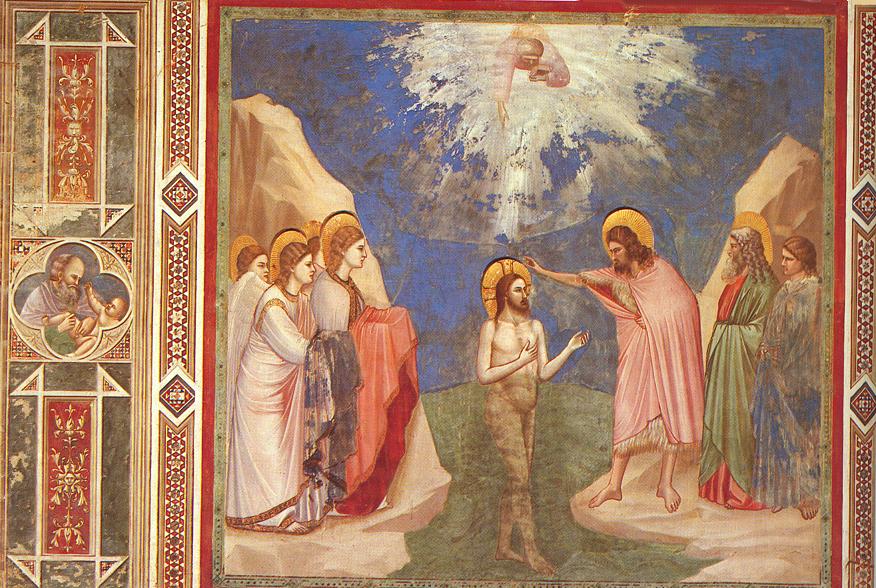
In the beginning of the public life of Jesus, when he was around thirty years old, there is recorded a mysterious event. Jesus had gone down to the River Jordan where his cousin John was baptizing in the water. All Judea was flocking to him to be baptized by him and to learn what they needed to do to return to God.
Jesus not only watched, he got in line to be baptized himself.
John is baptising when Jesus draws near. Perhaps he comes to sanctify his baptiser; certainly he comes to bury sinful humanity in the waters. He comes to sanctify the Jordan for our sake and in readiness for us; he who is spirit and flesh comes to begin a new creation through the Spirit and water. From a Sermon by Saint Gregory of Nazianzus, bishop (Oratio 39 in Sancta Lumina, 14-16, 20: PG 36, 350-351, 354, 358-359)
But John tried to deter him, saying, “I need to be baptized by you, and do you come to me?”
Jesus replied, “Let it be so now; it is proper for us to do this to fulfill all righteousness.” Then John consented.
As soon as Jesus was baptized, he went up out of the water. At that moment heaven was opened, and he saw the Spirit of God descending like a dove and alighting on him. And a voice from heaven said, “This is my Son, whom I love; with him I am well pleased.”
Jesus knows what it is like for his Father to look at him, to hear the love that is in his Father’s voice as he spoke to him, calling him Son, the Son in whom he was well pleased, his beloved Son.
When someone talks about a child or friend as their “beloved,” they mean to say, “I have a real special liking for this person. I prefer them. I love being around them. I give them gifts to show them my love. I take them into my confidence. They are closer to me than all others. I can’t live without them.”
The baptism of Jesus has everything to do with your baptism and mine. It has everything to do with our becoming God’s beloved one.
Saint Maximus of Turin tells us: “Christ is baptized, not to be made holy by the water, but to make the water holy, and by his cleansing to purify the waters which he touched. For the consecration of Christ involves a more significant consecration of the water.”
Christ is bathed in light; let us also be bathed in light. Christ is baptised; let us also go down with him, and rise with him. (From a Sermon by Saint Gregory of Nazianzus, bishop, Oratio 39 in Sancta Lumina)
I have spent so many decades of my life wondering if God saw me, if God cared about me, if God was going to be there for me. Isn’t it true that so often we measure the gift of God by what our feelings are telling us? We don’t “feel” God’s presence, so he must not be here. We don’t “feel” lovable to ourselves and we project that on to the way we think God must feel about us. We “feel” alone and isolated and we act as though God has no power or interest to help us.
Notice that at the baptism of Jesus, we are not told about Jesus’ feelings. We witness an event. Jesus goes down into the water, is baptized by John, emerges from the water, and hears his Father’s voice calling him Son.
Jesus rises from the waters; the world rises with him. The heavens like Paradise with its flaming sword, closed by Adam for himself and his descendants, are rent open. The Spirit comes to him as to an equal, bearing witness to his Godhead. A voice bears witness to him from heaven, his place of origin. The Spirit descends in bodily form like the dove that so long ago announced the ending of the flood and so gives honour to the body that is one with God. (From a Sermon by Saint Gregory of Nazianzus, bishop, Oratio 39 in Sancta Lumina)
The Baptism of Jesus is the moment in which the Lord sanctified the waters. By immersing his holy body in them, Jesus made them fitting for conveying the grace of the sacrament of Christian baptism. Jesus makes it possible for us to be reborn to new life through the sacrament of baptism. Saint Maximus of Turn in the fifth century explains: “Christ is baptized, not to be made holy by the water, but to make the water holy, and by his cleansing to purify the waters which he touched. … For when the Savior is washed all water for our baptism is made clean, purified at its source for the dispensing of baptismal grace to the people of future ages. Christ is the first to be baptized, then, so that Christians will follow after him with confidence” (Sermo 8: De sancta Ephiphania, 2).
It was in Christ’s own baptism by John the Baptist in the river Jordan that this sacrament of initiation was instituted to enable us to share in the Divine Life of the Trinity.
Most of us probably don’t remember our baptism if we were baptized as infants. Our “feelings” at the moment were probably surprise or discomfort as water was poured on our heads three times while the priest called us by name and said the words: “I baptize you in the name of the Father, and of the Son, and of the Holy Spirit.”
Directions for your prayer this Easter:
Underline in this article every reference to a gift God has given you through your baptism. Notice how your soul responds to this litany of love. When you hold your experiences of sorrow and loss and doubt together with God’s action to bring you to the “pure and dazzling light of the Trinity,” what new things do you notice?
Early in the morning on October 2, 2006 in Dacula, Georgia, twenty-year-old Matt Swatzell was driving home from a twenty-four-hour shift as a firefighter and EMS and had had only 30 minutes of sleep. Less than four miles from his home he fell asleep at the wheel and collided with another car, killing thirty-year-old June who was driving and injuring her nineteen-month-old daughter, Faith.
It was in the hospital that Matt learned that June was pregnant and that both she and the baby did not make it.
June’s husband Erik Fitzgerald was heartbroken. He was a full-time pastor. Close family and friends stood with him as he grieved his wife’s death and that of his unborn child. One day, one of his students said that she couldn’t help but think of how the driver of the car was feeling. Eric immediately asked the group to pray for the driver of the car. With this simple prayer began a journey of forgiveness that has inspired hundreds of thousands. Their story was recounted in Today and People among other outlets.
In the face of the tragedy, Erik recalled a message he heard in a sermon: “In moments where tragedy happens or even hurt, there’s opportunities to demonstrate grace or to exact vengeance. Here was an opportunity where I could do that. And I chose to demonstrate grace.”
To start, Erik attended Matt’s sentencing and extended his forgiveness. As a county officer, Matt was facing a felony and harsh time. But Fitzgerald pleaded for a lesser sentence.
“I didn’t see why this accident and tragedy needed to ruin any more lives,” said the pastor. Matt paid a fine and did community service.
Although Matt wanted to thank Erik for all he had done, he couldn’t legally speak with him during the two-year criminal investigation.
The day before the two-year anniversary of the accident, however, Matt went to the grocery store to purchase a card to send to Erik. When he returned to his car in the parking lot he was just about to turn on the engine when he saw Erik walking into the same store. Not sure what to expect, Matt approached Erik and introduced himself. Matt burst into tears and Erik told him that he forgave him.
“That was the biggest relief I’d ever felt. He just said from the start that he forgives me,” Matt recalled. “Just hearing him say those words, it just impacted my life completely.”
Then Erik told him, “I have a desire to want to be in your life.”
“You forgive as you’ve been forgiven. It wasn’t an option. If you’ve been forgiven, then you need to extend that forgiveness.”
Erik Fitzgerald
The men stayed connected by meeting at least once every two weeks, attending church together and eating meals at the Waffle House and other restaurants, just the two of them.
“We recognized that when we first started meeting it was unusual. We knew it was God,” said Erik. “You forgive as you’ve been forgiven. It wasn’t an option. If you’ve been forgiven, then you need to extend that forgiveness.”
“Part of the draw I felt to befriend Matthew was he was a good guy. He wasn’t a convict or on drugs. He was just a guy who got off a shift,” said Erik. “I felt it was my responsibility to encourage him and see the big picture.”
So Erik was there for Matt when he married and at the birth of their first child, who shares a birthday with Erik’s own daughter. Matt’s anxiety and guilt were still so overwhelming that he feared something would happen to his wife and child. After many meetings with Erik and a counsellor, Matt was able to move past the hurt.
“I can honestly say that without this friendship I don’t know where I’d be,” said Matt. “I can’t say, ‘This is a beautiful story and it’s got a great ending.’ It doesn’t,” he told Today in an interview. “It’s nasty, it’s real, and it’s something that I’m going to struggle with for the rest of my life.”
A Process for Forgiveness
Forgiveness can be difficult, particularly when our inner resources are depleted. It’s difficult for anyone to rise above the pain of being hurt by another or the guilt we feel when we have hurt someone else. We feel we were justified. Or perhaps we can’t admit that we were responsible and that hanging on to being in the right is somehow hanging on to the last shred of our sense of self. Unforgiveness creates a tremendous weight of bitterness, rejection, and broken relationships.
When I am hurt I have trouble being near the person until I have worked through my anger and released them from my demands that they be different than who they are at this time. Forgiveness doesn’t mean forgetting or even pardoning an offense. It means changing our response to the offense. Some ways to practice what I call “everyday forgiveness” are: forgive yourself, forgive the “stupid stuff” that happens every day, forgive the people and institutions that have hurt us, forgive the unmerited suffering that seems so unfair like an illness or failure. Instead of bitterness, choose to offer compassion and empathy to the person or institution or event that wronged you.
People who forgive tend to be more satisfied with their lives and to have less depression, anxiety, stress, anger, and hostility. People who hang onto grudges, however, are more likely to experience severe depression and post-traumatic stress disorder, as well as other health conditions. That doesn’t mean that they can’t train themselves to act in healthier ways. Here is a method of forgiveness that you might try:
1.) Reflect and remember the event that has wronged you. How did you react? How did you feel? How has your anger and hurt affected you since?
2.) Empathize with the other person. Try to understand what could have led the other person to do what they did to hurt you. You may begin to realize that the one they are truly hurting is themselves. How much they must be suffering from their own negative behavior.
3.) Forgive deeply. We are not talking here about behavior that is abusive and destructive. Ultimately no one is perfect. In this exercise we are addressing how annoying, hurtful, broken people hurt us all the time. The choice to forgive is ultimately the choice to love and to release the other from the obligation to pay you back because of what they have done. It is a choice for your own happiness, when you let your grievances go.
4.) Let go of expectations. An apology may not change your relationship with the other person or elicit an apology from him or her. Forgiveness needs to be offered with no strings attached. It is a gift of compassion, offered because it is the right thing to do, because God has invited us to live in forgiveness, and because it makes us happy. If you don’t expect apologies or changed behavior, you won’t be disappointed.
5.) Decide to forgive. Once you make that choice, seal it with an action. If you don’t feel you can talk to the person who wronged you, write about your forgiveness in a journal or even talk about it to someone else in your life that you trust.
6.) Forgive God and forgive yourself. The act of forgiving includes forgiving God if you are angry with him for what happened and how your life has turned out because of the offense. We often need to forgive ourselves also for any way in which the wrong we have received has affected us or our other relationships.
As I listened to the chanting of the Easter Proclamation at the Easter Vigil this year, my heart heard as if for the first time the words:
O wonder of your humble care for us! O love, Ocharity beyond all telling, to ransom a slave you gave away your Son!
Most of us can’t even imagine a love that would give away a precious treasure for the sake of someone that hated them. Yet Christ shed his blood that we, the daughters and sons of Adam and Eve, might live forever.
St. John Chrysostom explained it this way in Homily 15 on First Timothy:
”It is not in this way only that I have shown My love to thee, but by what I have suffered. For thee I was spit upon, I was scourged. I emptied myself of glory, I left My Father and came to thee, who dost hate Me, and turn from Me, and art loath to hear My Name. I pursued thee, I ran after thee, that I might overtake thee. I united and joined thee to myself, ‘eat Me, drink Me,’ I said. Above I hold thee, and below I embrace thee.”
O charity beyond all telling!
Have you noticed that when we purchase or receive something that we really want, it captures all our attention, not just at the moment we first have it, but for hours, or days and weeks afterwards. Depending on what it is, it may change the way we organize our time or our stuff (both digital and physical stuff!), or the way we entertain ourselves or even our appearance. We may discover we work better, make different decisions, feel differently about ourselves.
And then there is the unavoidable moment when we lose interest, we look for the next release, upgrade, improved version. Something different. Something more striking, more “us,” more useful. In a commercial world, we keep something only as long as it serves us and keeps our interest. Then we move on.
The Church, as a good Mother, knows that we are like this, and that our hearts which tire so easily and our attention which wanders so quickly need to re-fascinated with Jesus and the Eucharist for which there will be no upgrade or improved version.
The Easter Season—all 50 days of it—is for this reawakening of our hearts. We could find ourselves at times in something similar to a boring friendship, where we’ve lost interest in Jesus and his love in the Eucharist. Our “hearts move on” to things of earth, rather than things of heaven. We find ourselves searching for something more shiny and useful to us.
In the seven weeks of Easter, following the liturgical celebrations of Holy Week in which we experienced anew the “charity beyond all telling,” the Church invites us to immerse ourselves into what it is to believe, celebrate, live and pray as Catholics within the larger community of the Church. In the same way as our gadgets and toys make remarkable shifts in the way we live our lives, the death and resurrection of Christ celebrated at Easter is also the time when we learn to live as Christ in new ways, to think as Christ, to speak as Christ, to engage the world as Christ, to love as Christ. We ourselves become in the world this “charity beyond all telling!”
Again, in the words of St. John Chrysostom, our eyes need to be opened to the power of the blood poured out for us on Calvary:
This Blood, poured forth, washed clean all the world. This Blood is the salvation of our souls. By it the soul is washed, is made beautiful, and is set on fire. It causes our understanding to be brighter than fire and our soul more sparkling than gold. This Blood was poured forth and made heaven accessible.
Easter morning we arrived at the church for Mass 30 minutes early and barely found a parking place! We were seated in one of the last empty pews. What would the world be like if every Sunday most Catholics flocked to the Mass with the same urgency they congregate at restaurants and malls and athletic events….
What would the world be like if we spontaneously broke out in grateful praise during the day, announcing what Christ has done for all humanity in his death and resurrection, and the grace available to us today through the sacraments….
What if we ran to Mass because it was only there that we felt totally satisfied by the Eucharist, nourished, loved, and supported there by God himself and by the community….
Next: Easter Mystagogy 2: Baptism: becoming God’s beloved one
The grace we are asking of God: a deeply felt awareness of how God draws us into the unfolding of the mystery of the Word made flesh and how in doing this we enter into a process of healing that we might love Jesus and follow him more intentionally, completely, and wholeheartedly.
Horizons of the Heart is inspired by the Spiritual Exercises of St Ignatius and my own notes from my thirty-day Ignatian retreat in 2022.See an index for the whole series.
Entering Prayer
Offer your prayer to God, desiring that in every way it will give him glory. I pour myself out in worship. You could use a few lines from the following passage from the prophet Isaiah if this helps you enter into prayer:
Isaiah 60:1-6
Ask of God what you think you need. (It could be later that God will show what you truly need and what should be asking for, but begin now where you are.)
Imagining Yourself Present
Over several periods of prayer, linger imaginatively over the events narrated in Matthew 2:1-12.
These men who studied the stars came from the east in search of the newborn king of the Jews. They came because they saw in the sky a star that indicated to them that a new king had been born, and it went before them into the land of Judea. The wise men, as we popularly call them today, went first to Herod’s palace in Jerusalem, and after inquiring where the child would be born, they journeyed on to Bethlehem where the star stopped over the place where the child lay.
These visitors from the East were people of great wealth and power. They are called Magi in the Greek, which was a term that referred to a kind of subclass of Persian priests. Looking to a star was very much in keeping with the religious tradition of this place in which they looked to the heavens, the stars, and the planets for information about the gods’ wishes and doings. Interestingly, according to Time (December 13, 2004) “Secrets of the Nativity,” when the actual Persians came marauding Judea in 614, the only place of worship they didn’t touch was the Church of the Nativity in Palestine, whose golden entry mosaic featured the Magi dressed as Persians.
According to a calculation by German astronomer Johannes Kepler in the 16th century, an extremely rare conjunction between Jupiter and Saturn occurred three times in the constellation Pisces in 7 B.C., appearing to observers as a single luminous star. This would coincide with St. Matthew’s description of the celestial body appearing, disappearing and then reappearing to the Magi.
This theory gained more credibility in 1925, when German orientalist Paul Schnabel deciphered ancient cuneiform tablets from the astronomical school of the Babylonian city of Sippar, which described the exact same astronomical conjunction in 7 B.C.
The Magi from the East brought gifts of gold (a gift for a king), frankincense (an incense and symbol of deity), and myrrh (an embalming oil and symbol of death).
publicdomainpictures.net
There are various calculations about how long this journey was and how many people would have been in the entourage that arrived in Jerusalem and Bethlehem. The length of their journey is estimated by the distance they travelled and the fact that Herod, who had heard the story of the star directly from the Magi, killed all baby boys in Bethlehem and the environs who were two years old and younger. We could say then that the Magi perhaps travelled 5 to 9 months to reach Bethlehem. They would have had to spend several months preparing for such a long journey and would have spent the same amount of time making their journey home. That’s quite a length of time, definitely a major commitment on their part.
In one Bible translation’s footnote regarding the passage in Matthew 2 that recounts the arrival of the Magi in Jerusalem, it is speculated that there may have been a hundred people in their entourage. Three persons arriving in Jerusalem would not have created such a stir as is recounted by Matthew. Whether it was a hundred people or not, the Magi would have needed to bring along servants, cooks (there weren’t restaurants in the desert), security, persons to put up tents and take care of animals for a journey that could potentially last almost two years.
We know that the Magi did not arrive in Bethlehem while Jesus was in the manger because Matthew reports that they found Jesus in a “house.” Additionally, Mary and Joseph offered the gifts of the poor when they brought Jesus to the temple. They would not have done so if they had gold, frankincense and myrrh stashed away in Bethlehem where they had been staying since the birth of Jesus.
This is a perfect time to imagine who you are on this journey. One of the Magi? A servant? The cook? Just someone tagging along? Or following them from a distance?
Imagine the length of time you would have had to commit to in order to follow the star with them. What you would have had to leave behind for potentially a year and a half or more of travel to an unknown destination? We know now where the Magi ended their journey, where they found what they were looking for, but they set out on a journey to follow a star wherever it went and however long it took.
Where are you in this story? Speak to the people that are with you along the way. Allow your affective imagination to lead you closer to them, to give you a sense of this felt-closeness that you so desire. You can imagine with your mind’s eye, with your sense of hearing or touch.
Over time, allow these stories in the gospel of Matthew to become current as if the Magi (and you along with their whole entourage) are travelling to some unknown destination in the world today. Somewhere out of your comfort zone. Perhaps into the territory of a government you would consider an enemy or a threat.
What keeps you going? What do you fear? Anticipate? Hope for? Expect?
Watch the Magi. What are their feelings associated with seeing the star?
“Where is the one who has been born king of the Jews? We saw his star when it rose and have come to worship him” (Matthew 2:2 NIV). “We’ve come to bow before him in worship” (TPT).
“After their audience with the king they set out. And behold, the star that they had seen at its rising preceded them, until it came and stopped over the place where the child was. They were overjoyed at seeing the star” (Matthew 2:9-10 NABRE).
“And on their way to Bethlehem, the same star they had seen in the East suddenly reappeared! Amazed, they watched as it went ahead of them and stopped directly over the place where the child was. And when they saw the star, they were so ecstatic that they shouted and celebrated with unrestrained joy (TPT).
Duane R. Hurst (Public Domain)
The footnote in The Passion Translation states that “the Greek here is hard to translate since it contains so many redundant words for joy in this one verse. It is literally, ‘They rejoiced with a great joy exceedingly.’ They were ecstatic!”
“When they saw the star, they rejoiced exceedingly with great joy” (Matthew 2:10 AMP).
Observe how the Magi express these feelings. Usually we picture them kneeling in the stable as we see at Christmas. We aren’t as reflective about what it meant for them to be led by a star to the one who had just been born before whom they would bow down in worship. Listen to their conversations among themselves. Ask them why they are so happy.
In Gospel Contemplation, Ignatius takes advantage of the way in which spiritual growth, like so many other aspects of maturing that we experience, takes place primarily when our affectivity is engaged. It is the shift in one’s deeper emotions and feelings that leads to a change in one’s behavior. We reach these deeper levels through metaphor, image, and symbol—the work of the imagination.
Observing attractions and resistance
Notice any interior reactions that you experience: comfort, discomfort, being lifted up, struggle, joy, sadness….
Observe the actions, words, emotions, sensitivities, attitudes of the Magi, Herod, the people in Jerusalem. To which of them do you feel more attracted? Which of them arouse more negative feelings or resistance? Return to aspects of these meditations that seem more personally meaningful.
Entering the Mystery of the story
As you begin to enter the mystery of the story more deeply, you will begin to see or hear or touch. As you see the glory of the star, you may be drawn to “see” the faith of the Magi. As you walk in the “dark” and shudder in the “cold,” you may realize that what is truly dark and cold is the lack of faith, the refusal of faith, the way the others did not go along to worship. After all we are talking about a six-mile journey from Jerusalem to Bethlehem.
You will enter into the event and interact more deeply. Little by little you will become more present to the mystery and the mystery will be present to you.
As you become more and more involved in the event of Jesus’ mystery that you are contemplating, your life and your choices are affected.
Watching the Magi’s exceeding joy may open your heart to the Holy Spirit as your life and heart are lifted up along with these men who travelled so far and so long to bow in worship.
You may also sense the tension in the story as one group devotes themselves to following the “star” that leads them to Jesus (at great cost to themselves) and another group doesn’t seem to notice or care, or rejects him all together. After all, it was clear to the chief priests and scribes that they knew that from Bethlehem a “ruler” would come “who will shepherd my people Israel” (v. 6). They told Herod so when he requested anxiously to know where the Messiah was to be born. But they did not go themselves to Bethlehem. They did not bother to even be curious about whether this was the Messiah. And Herod tried to kill him in a move of political expediency.
As you continue playing out your part in the story of the Magi, you find yourself changing and desiring to change.
Conversing as with a friend
Read the following verses from Psalm 72 and the prophet Isaiah (62:11-12) in relation to the visit of the Magi. Both of these passages are read in the liturgy on the feast of the Epiphany. Read this slowly, several times, allowing some moments of rest between your reading.
“May the kings of Tarshish and the islands bring tribute, the kings of Sheba and Seba offer gifts. May all kings bow before him, all nations serve him” (Psalm 72:10-11).
“Arise! Shine, for your light has come, the glory of the Lord has dawned upon you . . . Nations shall walk by your light, kings by the radiance of your dawning Raise your eyes and look about; they all gather and come to you — Your sons from afar . . . Then you shall see and be radiant . . . For the riches of the sea shall be poured out before you, the wealth of nations shall come to you. Caravans of camels shall cover you, dromedaries of Midian and Ephah; All from Sheba shall come bearing gold and frankincense and heralding the praises of the Lord” (Isaiah 60:1-6).
Is there some new awareness coming forward as you consider these words? Do they shed some unexpected or new light on your own following of Jesus?
Continue in quiet—or even silent—intimate conversation with the Magi and with Jesus. Ask them what is the grace that you should be praying for. Beg this grace of the Father. Then beg this grace of the Son, your Savior and Shepherd. Finally, beg for this grace from the Holy Spirit who is the source of all holiness.
If you wholly lived this grace that you are begging for, what would your life look like? Your relationships? Your prayer? The way you work? The way you love? The way you serve? What about you would make you the most happy?
Ask the Magi and Jesus to show you one specific gift they wish to give you. Receive it and remain in stillness and quietly relaxed presence under the influence of the Holy Spirit.
Reviewing the graces of prayer
When you finish praying, write down the main gifts and discoveries from this time of intimate contemplation. What is one concrete thing you can do to solidify these gifts in your life.
Image Credit: Edward Burne-Jones, Public domain, via Wikimedia Commons
Every once in a while people will ask me, “Sister, what is your favorite book of the Bible?” I actually smile as I think to myself, “Well, if you had asked me this question a few years ago, I would have absolutely responded: ‘Isaiah, because he is like a fifth Evangelist for me.’” In fact, some of the early Fathers regarded the book of Isaiah as ‘a Fifth Gospel,” because Isaiah’s poetry and prophecy speak so powerfully to a coming King, a royal figure who would be the Suffering Servant for his people, and the victory of the Anointed One over all the dark forces in the world. (1)
Recently, however, when I am asked about my favorite book of the Bible, I have to be honest. It is still Isaiah, but now there is Matthew and Genesis. Of course, there is also the book of Psalms which we pray daily at morning and evening prayer. And I absolutely can’t forget my other favorite prophets, Daniel, Ezekiel and Jeremiah. In fact, I talk to them as I reflect on their prophecies, their lives, and the prophetic call they received from God. They really are friends to me, so I call them by nicknames: Dan (Daniel), Ezy (Ezekiel) and Jerry (Jeremiah). (Let me explain: as an extrovert I’m famous for talking aloud to the people in the seats next to me at movies, the actors on the screen, or even to the characters in the Bible, as well as anyone else within earshot! It’s my way of connecting.)
Actually, when it comes down to it, I love the whole Bible. Truly every word is of the Holy Spirit!
The Holy Spirit is our guarantor to understanding Holy Scripture. He enlightens our souls with just a word from Holy Scripture, and allows us to walk with our Creator who humbly resides within our souls. “My Father and I will come to you,” Jesus said, “and make our home with you” (cf. John 14:23). There is no greater joy or peace than to have God in our hearts, in our minds, and in our wills. And this prayerful union exhilarates our souls and allows us to bathe in God’s grace and love, filling us with healing and peace.
“You have made us for yourself, O Lord, and our hearts are restless until they rest in You.”
Saint Augustine
By giving us a mind, will, and heart, God made us in his own image and likeness. Saint Augustine writes in his Confessions the famous prayer, “You have made us for yourself, O Lord, and our hearts are restless until they rest in You.” How we need this rest every day!
With the Holy Spirit, we can take even just a word or phrase from Holy Scripture and do a “deep dive,” finding the God who loves us immutably. In this way, we discover how the story of Salvation continues even in our own lives.
So what is your favorite book of the Bible? Which book gives you the springboard to make a “deep dive” into God’s love so that you can journey with him for another day? Let me know in the comments below.





 Touching the Sunrise