The image that has drawn me in my ministry is Touching the Sunrise. I believe each person, no matter where they are and what they have lived, is a temple of the Trinity and can, indeed, taste the presence of God within. You can find resources for healing and prayer and follow me at touchingthesunrise.com.
As a young sister, I remember being deeply impressed by the prayer of Saint Elizabeth of the Trinity which was shared with us during a community retreat. I had no familiarity with the writings of this Carmelite saint who had lived in Dijon France in the early 20th century, but this most beautiful of prayers became a building block of my own spirituality from that moment to this day.
Elizabeth of the Trinity grounded her spiritual life and teaching in intimacy with the presence of the Divine Persons who live in the innermost part of our soul. God is present in us, she learned because he creates us at every moment. Through baptismal grace we become a spiritual temple in which the Holy Spirit, along with the Father and the Son, come and make their abode in us.
She wrote to a friend:
Did I tell you my name in the Carmel is Marie-Elizabeth of the Trinity? To me, this name means a special vocation. I love this mystery of the Trinity so much. It is an abyss in which I am lost. I am Elizabeth of the Trinity, that is, Elizabeth fading away, losing herself, letting herself be seized by the Three (Souvenirs, p. 70).
This special vocation became the whole meaning of her life:
This presence of God is so good! It is there, in my deepest self, in the heaven of my soul, that I love to find him, since he never leaves me. God in me, I in him, that is my life (Souvenirs, p. 69).
Have you ever wondered what to say when you pray to God? Does the idea of making an hour of Eucharistic adoration seem far beyond you? Do you wish you had a simple way of praying even in the midst of your busy day?
If we could speak with Elizabeth of the Trinity she would teach us to withdraw into the center of our soul and rest there. To simply say a few words to the Holy Spirit, such as, “Lord, the one you love is sick,” which were the words that Mary and Martha addressed to Jesus when Lazarus was dying. To quietly allow the Divine Persons to communicate with one another right there in your soul, not intruding with your own words and ideas and petitions. To bow before God who abides within you as Moses took off his shoes and knelt before the burning bush from which God spoke.
She wrote so many letters helping her friends and her mother to enter into the treasured abiding place of God within. “Make my soul…Your cherished dwelling place, Your home of rest. Let me never leave You there alone, but keep me there all absorbed in You, in living faith, adoring You.”
It belongs to the gift of wisdom to contemplate the divine. Through a special instinct and movement of the Spirit we penetrate the very life of the Trinity, as Elizabeth of the Trinity helps us understand. Those who experience the power of the gift of wisdom understand the words of the psalmist, “Taste and see how good the Lord is” (Ps 34: 9). The word taste means that there is a certain delight that is more than just feeling or excitement. There is an impulse that is truly divine that gives our hearts an ineffable joy that seems to be from heaven itself. Indeed, the gift of wisdom is surpassed only by the beatific vision which will be ours in eternity.
Souls that are under the Holy Spirit’s gift of wisdom love God because he is infinitely good and loveable. They love God for his own sake, not for any human motive of self-interest. Because they see God within them, they see God also in all things, in the smallest detail of their life, and in a special way in their neighbor. It is the gift of wisdom that allows us to see Christ in the poor, in those who suffer, in the heart even of the “enemy.” They are happy to deprive themselves, putting the interests of others before them.
When the Spirit actively operates within us with the gift of wisdom, we do not judge things from a purely natural and human point of view. When things don’t develop the way people want them to, it is not surprising that they accuse others for deliberately or inadvertently being the cause of their problems. Truly spiritual people, wise people, evaluate things, even unfortunate or contrary events, from God’s point of view and in a supernatural light, with a spirit of equanimity.
Here are two things you can do to dispose yourself for the activation of the gift of wisdom:
Make a habit of asking God to show you where he is at work in all the events of your life. Even if you cannot understand what is happening, make an act of faith that God, who is within you, holds you safe in his hands.
Make God the center of your life. Minimize things in your life that you don’t need anymore and refocus on what God wants to do with you and in you. Through acts of love for God and service to others, fan into flame a more intentional charity.
The prayer to the Trinity of St Elizabeth of the Trinity
O my God, Trinity whom I adore, help me to become utterly forgetful of myself so that I may establish myself in you, as changeless and calm as though my soul were already in eternity. Let nothing disturb my peace nor draw me forth f from you, O my unchanging God, but at every moment may I penetrate more deeply into the depths of your mystery. Give peace to my soul; make it your heaven, your cherished dwelling-place and the place of your repose. Let me never leave you there alone, but keep me there, wholly attentive, wholly alert in my faith, wholly adoring and fully given up to your creative action.
O my beloved Christ, crucified for love, I long to be the bride of your heart. I long to cover you with glory, to love you even unto death! Yet I sense my powerlessness and beg you to clothe me with yourself. Identify my soul with all the movements of your soul, submerge me, overwhelm me, substitute yourself for me, so that my life may become a reflection of your life. Come into me as Adorer, as Redeemer and as Savior.
O Eternal Word, utterance of my God, I want to spend my life listening to you, to become totally teachable so that I might learn all from you. Through all darkness, all emptiness, all powerlessness, I want to keep my eyes fixed on you and to remain under your great light. O my Beloved Star, so fascinate me that I may never be able to leave your radiance.
O Consuming Fire, Spirit of Love, overshadow me so that the Word may be, as it were incarnate again in my soul. May I be for him a new humanity in which he can renew all his mystery.
And you, O Father, bend down towards your poor little creature. Cover her with your shadow, see in her only your beloved son in who you are well pleased
O my `Three’, my All, my Beatitude, infinite Solitude, Immensity in which I lose myself, I surrender myself to you as your prey. Immerse yourself in me so that I may be immersed in you until I go to contemplate in your light the abyss of your splendor!
What would it be like to encounter Jesus face to face? To witness the moment of the annunciation of the angel Gabriel to Mary? To see him walking on the water in the midst of a storm? To feel the joy of Mary Magdalene at the Resurrection?
Ignatian contemplation is a method of prayer that involves using our imagination to bring scripture to life. The Word of God comes alive when we pray in such a way that we feel ourselves to be present at an event that is occurring before our very eyes, seeing what is happening, observing how people are engaging with each other, hearing what they are saying. When we pray this way we deeply enter into the person Jesus (or Mary or St Joseph or one of the apostles), so much so that a word or a gesture from them can affect us personally, touching us in a way that changes us from this point forward. “It is through our senses that we feel the ‘touch’ within the heart (Exx 335), and then the heart expands in feelings of happiness, peace and serenity, and in a renewal of spiritual strength, along with desires to ‘move forward’ (Exx 315, 329). St. Ignatius mentors retreatants in this form of prayer in his Spiritual Exercises.
Preparing for Prayer
Begin by relaxing. Take a deep breath, hold it, and then let it out with a sigh. As you do this several more times, intentionally relax the muscles in your face, your shoulders, your arms, your legs. Offer a quiet prayer of gratitude. Rest in your Father’s arms.
As we begin our contemplative prayer today we are going to focus on the way awareness of our senses and sense perceptions can be a powerful way to quiet our whole being before God. As you pray with this guide, lead longer and longer pauses for silence, stretching the outer limits of your comfort zone just a little each time.
Begin by noticing what you hear around you…. Then notice what you hear within you…. What two things are you grateful for?
Next, notice what you see around you…. When you look within you what do you see…. What two things are you grateful for.
Become aware of where you are sitting. Any physical feelings. Anything you are touching such as the arms of a chair. You might reach out and touch a flower or plant, put your hands around a cup of coffee or glass of wine. What feelings accompany these actions. Physical feelings of touch. Emotions. Connection. What two things are you grateful for.
Observe your thoughts. Do not judge them or follow them. Just observe that you are thinking. Imagine that you see Jesus on the other side of your thoughts. Or that the Father is reaching his arms out to you, as he stands on the other side of the curtains created by your thinking. As if you could turn a key and turn off the generator, just let your thoughts stop for a moment. Notice the silence, if even only for an instant.
Settling into Prayer
Ask Jesus that every aspect of this prayer will please him and will give glory to God.
Slowly read the passage for your meditation once. Leave some moments of silence and then read it again with the intention of entering into the story, of observing the details of what is happening. Take some time to set the stage and picture the environment in which the story takes place.
Let the story expand from the few verses that are recounted in Scripture to what that would have been like for Jesus or Mary, what they would have experienced or needed or felt, how they lived these events interiorly, how they expressed themselves. With your senses immerse yourself into the event. Is there any way you can be of help to them. If so, imagine yourself entering the story through these actions.
Look around for a particular moment that seems to be of greater importance to you, to catch your attention. Perhaps it is a look on Jesus’ face, an attitude of Mary or Joseph, the feel of the touch of the Master as he heals, the compassion you see in Jesus’ eyes as he looks out over the crowds or the joy he feels when he watches them eating after he has multiplied the loaves, the reaction of the apostles when they hear Jesus tell them to take up their cross and follow him.
Ask for the grace “to know Jesus intimately, to love him more intensely, and so to follow him more closely.”
Entering into the Mystery
This deeper contemplation of Jesus in the Gospels is an apprenticeship of our feelings and senses in which we are formed in such a way that we feel with Jesus, that our feelings becomes those of Jesus, and our spontaneous reactions of personal promotion and self-protection are gradually curbed and re-invented so that we spontaneously react as Jesus does.
For example, we know that Jesus calls us to take up the cross and follow him. We want to take up our cross and follow after him. But when faced with the cross our spontaneous feelings say, “Absolutely not!” and we end up running the other way, even though we desire to follow Jesus even to Calvary. This Gospel prayer affects us more deeply than our knowledge and what we want to do to follow Jesus. It begins to engulf us with the sentiments and spontaneous reactions of Jesus himself so that we are transformed into Jesus from the inside out. When our thoughts, our desires, and our spontaneous feelings all want the same thing, we will truly imitate Jesus at every moment of our life.
Entering into the mystery of what we contemplate, we humbly allow Jesus to be our Master, to educate our senses and feelings according to the pattern of his own life and teachings. It is a matter of becoming saturated with Jesus’ own way of being and feeling. It is learning how to resonate with everything Jesus resonates with, as we gain this felt understanding through our contemplation, and of rejecting whatever Jesus rejects.
As you begin to enter more deeply the mystery of the event you are contemplating, gently consider in turn with your senses of sight, hearing, tasting, and touching, the images, sounds, smells, flavors and physical feelings associated with what is occuring. You may notice that one of your senses may dominate the way that you imagine a moment in your prayer, so allow this sense to “lead” you into the events of your prayer — and toward other sense memories.
Amor Santo via Cathopic
Allow these sense images to surface in your consciousness without trying to control or interpret them as they emerge. Simply find pleasure as these images and feelings come to you and you quietly soak in the range of memories and meaningful impressions.
Entering still deeper into the mystery of Christ, allow your heart to taste, to smell, to touch the infinite gentleness and sweetness of Jesus or Mary. Wonder at the mercy of God as you see it pouring itself out on this earth in Christ. Deeply feel how infinitely sweet it his kindness. Ignatius would have us even use our sense of touch, ‘embracing and kissing the place where these persons tread and sit’ (Exx 124–125). Allow your spirit to soak up what has been felt and known in this contemplative prayer.
As you do this your mind’s activity will fade into the background, and the mystery you are intuitively contemplating will begin to take over and engulf you, planting within your spirit an inner knowledge of the Lord.
Gradually you will begin to intuitively sense and affectively taste God. Even your bodily senses will take on the image of Christ himself as he teaches you how to feel as he feels in different situations, to gaze on others with the dispositions of his heart, to touch the presence of God radiating even in the most difficult situations of your life, to taste the sweetness of his grace moving within you.
You will at some point begin to intuitively sense the difference between the way Jesus spontaneously feels, speaks, and acts in a situation and the way you yourself feel, speak, and act in similar situations in your own life.
Rest in that awareness as Jesus helps you to resonate with what he resonates with. As you enter into his feelings and the way he uses his senses, you will gradually lose interest in your own spontaneous reactions, defenses, and self-promotions. Jesus will bring you to his way by attraction, sweetness, and beauty. He will make you feel safety, belonging, and hope.
Colloquy
Allow an image or object that encapsulates all these experiences to form in your mind. Take some time to speak with God about the meaning or significance of this object.
Ask Mary, Joseph and Jesus to show you one specific gift they wish to give you. Receive it and remain in stillness and quietly relaxed presence under the influence of the Holy Spirit.
Reviewing the Graces of Prayer
When you finish praying, write down the main gifts and discoveries from this time of intimate contemplation. What is one concrete thing you can do to solidify these gifts in your life.
hen we’ve been hurt by others we may struggle with feelings of anger at being treated unjustly, fear of what will happen next, guilt over our part in what may have happened, and the seeming impossibility of reconciliation. And yet, as we stay up at night replaying what has happened, we may wonder at the cost of not reconciling:
The relationships broken. The difficulty of the situations we will be put in. Losing love, support, companionship, opportunity.
Have you been there? I know you have. And so have I. Many times.
In this series on forgiveness let’s find a way through the pain, learning how to navigate the swirl of inner chaos with the help of the saints, Scripture, and some spiritual activities that will make taking the leap into forgiving seem more desirable and possible.
The grace we are asking of God: a deeply felt awareness of how God in all of history and most powerfully in the Word made flesh draws us into the unfolding of the mystery of his love which always is extravagant and which is ever seeking to save us. We desire that in doing this we enter into a process of healing and conversion that we might love Jesus and follow him more intentionally, completely, and wholeheartedly.
Horizons of the Heart is inspired by the Spiritual Exercises of St Ignatius and my own notes from my thirty-day Ignatian retreat in 2022.See an index for the whole series.
Prayer is often characterized as a conversation. A dialogue. A meeting of hearts. I believe that Ignatius, however, is hoping that as we experience the contemplative power of the Spiritual Exercises we will come to know—with a deeply felt, an affective understanding, a deep experience—how we are drawn into the unfolding of the mystery of God’s love in Christ.
A conversation or dialogue or encounter or meeting…. These are important and helpful images so that we remember that prayer is two-sided. Through them we learn that in our relationship with God we must speak and we must listen. We must give and we must receive. We must bring our lives to the table with God, so to speak, and allow him to have his way with our life. We don’t run the meeting or set the terms for the encounter. We are brought into something surprising. We discover the love we have tried to “think” ourselves into understanding when God gets into the driver seat of our relationship.
Experiencing within myself how Jesus is sensing and feeling during a situation recorded in the Gospels, shows me a new way of feeling.
Ignatius also has an image for the prayer he is hoping that we grow into as we make the Spiritual Exercises. It is called Application of the Senses. So far we have encountered this in one respect. We enter into the meditations using our five senses: we see ourselves in the mystery we are contemplating. We hear what is happening. We taste and savor the mystery that is unfolding before us. We touch and are touched.
The goal for Ignatius is not that we pray with this method, or any method, correctly. The purpose of our encounter with God in contemplation is that the text we are meditating touches us deeply, comes alive, and affects us personally so that we will choose to love and serve God more. In prayer we are transformed by God in the deepest point of our being into a more clear and perfect reflection of his own Son, the Word made Flesh, Jesus. Antonio Guillen describes it this way:
One has to bear in mind that any ‘contemplation’ already has an element of feeling that is much more prominent than in a ‘meditation.’ Whenever we take to ourselves a gospel text in such a way that we feel ourselves to be present at an event that is occurring before our eyes, ‘seeing the persons, hearing what they say and watching what they are doing’ (e.g. Exx 194), then the text becomes alive, so much so that we hear a word and see a gesture as if it affected us personally. It is through our senses that we feel the ‘touch’ within the heart (Exx 335), and then the heart expands in feelings of happiness, peace and serenity, and in a renewal of spiritual strength, along with desires to ‘move forward’ (Exx 315, 329). (Imitating Christ our Lord with the Senses: Sensing and Feeling in the Exercises: Antonio Guillen (The Way, 47/1-2 (Jan/April 2008), 225-241).
This clearly opens up for us a new dimension to what we desire in Gospel contemplation. “The Exercises are grounded in what Ignatius calls ‘sensing and tasting things interiorly.’” This tasting of spiritual things renews our strength and shows us more deeply how to imitate Christ our Lord.
“In week two of the Exercises especially, the senses are seen as an instrument of prayer and discernment. Being present to Jesus as he acts through his own bodily senses we come to share more deeply in his human experience and self-understanding.”
I have begun to see Gospel contemplation as a time when my senses and feelings are being mentored by the Word of God. Interacting with Jesus and Mary, Joseph, Peter, Paul, experiencing within myself how they are sensing and feeling during a situation recorded in the Gospels, shows me a new way of feeling, one different from the feeling informed by my egoism or selfishness. I gradually take on Jesus’ way of feeling, Mary’s way of sensing, or Joseph’s way of experiencing challenging situations.
Image Credit: The Incredulity of Saint Thomas, Caravaggio (1571-1610), public domain
The grace we are asking of God: a deeply felt awareness of how God in all of history and most powerfully in the Word made flesh draws us into the unfolding of the mystery of his love which always is extravagant and which is always seeking to save us. We desire that in doing this we enter into a process of healing that we might love Jesus and follow him more intentionally, completely, and wholeheartedly.
Horizons of the Heart is inspired by the Spiritual Exercises of St Ignatius and my own notes from my thirty-day Ignatian retreat in 2022.See an index for the whole series.
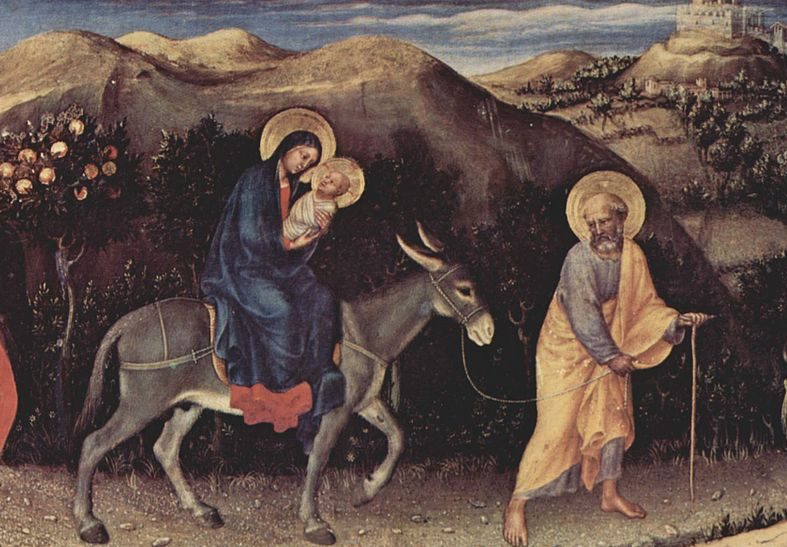
This is a Lectio Divina or “sacred reading” of the account of the flight into Egypt found in the Gospel of Matthew.
Preparation:
Whenever we come together to listen to the Word of God, what we are seeking at bottom is not mental information or moral instruction or even a sentimental influence that will make us “feel” the presence and goodness of God. What we seek with all our soul, rather, is the possibility of opening ourselves up in prayer to God’s transforming action. Whether we are fully conscious of it or not, in other words, we desire a change of life, a conversion from what we presently are to a more precise embodiment of the likeness of Christ at the center of our being, radiating out from us through all our thoughts, words, and actions.
This is why the life of contemplation is the boldest and most adventuresome of undertakings, for what could be more radical, more truly earth-shattering, than the willingness to be dismantled and created anew, not once or twice in a lifetime, but day after day? “If anyone is in Christ, he is a new creation.” (2 Cor 5:17) But being created in this sense is not a passive work. Our “clay” is the spiritual stuff of our will and freedom and thoughts and feelings and desires, and all of these have to be surrendered every day anew to God’s power. We cannot become new creations without actively participating in our remaking by the Holy Spirit. (Erasmo Leiva-Merikakis, The Way of the Disciple p. 18).
Credit: Cathopic
Leisurely reading – lectio
Lectio divina is a deep, leisurely, and penetrating ruminating on the Word of God. Picture a placid cow lying out in a field in the spring, chewing its cud. There is no sense of being rushed, of having to get anywhere. It requires that we cut ourselves off from the crowd of noises that overstimulate our senses, creating a world of pseudo-needs and desires. Simone Weil calls this attention. “Attention consists in suspending one’s thought, in making oneself available, empty, and penetrable to the object contemplated” (This quote is taken from The Way of the Disciple page 33, but can be found in Réflexions sur le bon usage des études scolaires en vue de l’Amour de Dieu, in Attente de Dieu. ).
From the second chapter of the Gospel of Matthew:
After Jesus was born in Bethlehem in Judea, during the time of King Herod, Magi from the east came to Jerusalem 2 and asked, “Where is the one who has been born king of the Jews? We saw his star when it rose and have come to worship him.”
3 When King Herod heard this he was disturbed, and all Jerusalem with him….
6 “‘But you, Bethlehem, in the land of Judah, are by no means least among the rulers of Judah; for out of you will come a ruler who will shepherd my people Israel.’”…
12 And having been warned in a dream not to go back to Herod, they returned to their country by another route.
13 When they had gone, an angel of the Lord appeared to Joseph in a dream. “Get up,” he said, “take the child and his mother and escape to Egypt. Stay there until I tell you, for Herod is going to search for the child to kill him.”
14 So he got up, took the child and his mother during the night and left for Egypt, 15 where he stayed until the death of Herod. And so was fulfilled what the Lord had said through the prophet: “Out of Egypt I called my son.”
16 When Herod realized that he had been outwitted by the Magi, he was furious, and he gave orders to kill all the boys in Bethlehem and its vicinity who were two years old and under, in accordance with the time he had learned from the Magi. 17 Then what was said through the prophet Jeremiah was fulfilled:
18 “A voice is heard in Ramah, weeping and great mourning, Rachel weeping for her children and refusing to be comforted, because they are no more.”
19 After Herod died, an angel of the Lord appeared in a dream to Joseph in Egypt 20 and said, “Get up, take the child and his mother and go to the land of Israel, for those who were trying to take the child’s life are dead.”
Pexels
Contemplative deepening of the Word – meditatio
Lectio Divina is a contemplative deepening of the Word, by which the Spirit re-creates in us the world of God. Through the spiritual attitudes of a listening heart, receptivity of spirit, and openness of the imagination, we follow the logic of the heart without pressure to produce resolutions or reach goals.
After Jesus was born in Bethlehem in Judea, during the time of King Herod, Magi from the east came to Jerusalem 2 and asked, “Where is the one who has been born king of the Jews? We saw his star when it rose and have come to worship him.”
In the first two verses of the second chapter of Matthew we are introduced to three main characters that will play out their drama until the end of time:
Jesus, the power of God
Herod, the power of the world that seeks to determine on its own terms who lives and who dies, who is right and who is wrong, who has the power and who doesn’t
The Magi, who leave their own worlds to enter the world of Jesus and worship him
There are two other historical characters mentioned in this reading from Matthew:
16 When Herod realized that he had been outwitted by the Magi, he was furious, and he gave orders to kill all the boys in Bethlehem and its vicinity who were two years old and under, in accordance with the time he had learned from the Magi.17 Then what was said through the prophet Jeremiah was fulfilled:
18 “A voice is heard in Ramah, weeping and great mourning, Rachel weeping for her children and refusing to be comforted, because they are no more.”
Those who are killed as witness to Jesus
Those who mourn the lost and bear the sorrows created by those who wield the power of the world.
The second chapter of Matthew lays out the story line that will be told again and again until the end of time as the designs of God are woven into the designs of the world, as the Kingdom takes root in the values of time.
Notice the very last verses of the Gospel of Matthew (chapter 28):
16 Then the eleven disciples went to Galilee, to the mountain where Jesus had told them to go. 17 When they saw him, they worshiped him; but some doubted. 18 Then Jesus came to them and said, “All authority in heaven and on earth has been given to me. 19 Therefore go and make disciples of all nations, baptizing them in the name of the Father and of the Son and of the Holy Spirit, 20 and teaching them to obey everything I have commanded you. And surely I am with you always, to the very end of the age.”
Now the disciples worship.
Jesus claims all authority in heaven and on earth. It is an authority that is not desperately clung to. Jesus doesn’t need to eliminate anyone who could take his throne as Herod had done, even to the killing of one of his wives and three of his sons. Jesus’ authority is given to him by God.
Jesus words about his authority are peaceful and sure. All authority is his. Herod, representative of the power of the world, is described as anxious, desperate, paranoid. His is a power he is trying to keep for himself as long as he is alive. Jesus’ authority will last on this earth and in heaven, on the other hand, to the very end of the age. He maintains his authority even after his death on Calvary. Herod died a painful and gruesome death a few short years after he had ordered the murder of the innocent boys of Bethlehem.
To maintain his authority, Herod set up a spy network among the people and regularly eliminated anyone suspected of revolt. From the historian Josephus:
Herod was crowned “King of the Jews” by the Roman Senate in 40 BC in Rome. He was, however, a king without a kingdom. Upon his return to the Land of Israel, he was given a Roman army and was eventually able to capture Jerusalem. The first order of business was to eliminate his Hasmonean predecessors. Mattathias Antigonus was executed with the help of Mark Antony and Herod killed 45 leading men of Antigonus’ party in 37 BC (Antiquities 15:5-10; LCL 8:5-7). He had the elderly John Hyrcanus II strangled over an alleged plot to overthrow Herod in 30 BC (Antiquities 15:173-178; LCL 8:83-85).
Herod continued to purge the Hasmonean family. He eliminated his brother-in-law, Aristobulus, who was at the time an 18 year old High Priest. He was drowned in 35 BC by Herod’s men in the swimming pool of the winter palace in Jericho because Herod thought the Romans would favor Aristobulus as ruler of Judea instead of him (Antiquities 15:50-56; LCL 8:25-29; Netzer 2001:21-25). He also had his Hasmonean mother-in-law, Alexandra (the mother of Mariamme) executed in 28 BC (Antiquities 15:247-251; LCL 8:117-119). He even killed his second wife Miriamme in 29 BC. She was his beloved Hasmonean bride whom he loved to death [literally, no pun intended] (Antiquities 15:222-236; LCL 8:107-113).
Around 20 BC, Herod remitted one third of the people’s taxes in order to curry favor with them, however, he did set up an internal spy network and eliminated people suspected of revolt, most being taken to Hyrcania, a fortress in the Judean Desert (Antiquities 15:365-372; LCL 8:177-181).
Herod also had three of his sons killed. The first two, Alexander and Aristobulus, the sons of Mariamme, were strangled in Sebaste (Samaria) in 7 BC and buried at the Alexandrium (Antiquities 16:392-394; LCL 8:365-367; Netzer 2001:68-70). The last, only five days before Herod’s own death, was Antipater who was buried without ceremony at Hyrcania (Antiquities 17:182-187; LCL 8:457-459; Netzer 2001:75; Gutfeld 2006:46-61).
Herod the Great became extremely paranoid during the last four years of his life (8-4 BC). On one occasion, in 7 BC, he had 300 military leaders executed (Antiquities 16:393-394; LCL 8:365). On another, he had a number of Pharisees executed in the same year after it was revealed that they predicted to Pheroras’ wife [Pheroras was Herod’s youngest brother and tetrarch of Perea] “that by God’s decree Herod’s throne would be taken from him, both from himself and his descendents, and the royal power would fall to her and Pheroras and to any children they might have” (Antiquities 17:42-45; LCL 8:393). With prophecies like these circulating within his kingdom, is it any wonder Herod wanted to eliminate Jesus when the wise men revealed the new “king of the Jews” had been born (Matt. 2:1-2)?
Jesus, just moments before ascending to heaven, gives his disciples a share in his authority:
Go
Make disciples
Baptize
Teach
Probably the one most deserving of feeling anxious in this first episode of Jesus’ life is Joseph.
13 When they had gone, an angel of the Lord appeared to Joseph in a dream. “Get up,” he said, “take the child and his mother and escape to Egypt. Stay there until I tell you, for Herod is going to search for the child to kill him.”
14 So he got up, took the child and his mother during the night and left for Egypt.
Joseph shakes Mary awake, tells her quickly that they have to take off that very moment, in the middle of the night, across the desert to the land of Egypt, with a young child. No preparation. No provisions. No map. No information about what they are to do when they get there, how long they will stay, how they will know when to return. All their possessions and Joseph’s tools are left in Nazareth. They are totally dispossessed even of their country as they move through the streets of Bethlehem under cover of night to escape the decree of Herod.
While the power of the world seeks to accumulate, to determine who is in and who is out, who is right and who is wrong, who deserves to live and who doesn’t, the Word of God enters into poverty, powerlessness, and homelessness.
The Scripture simply says: Joseph got up, took the child and his mother that night and left for Egypt. No drama. No complaints. No demands for explanations or security. Simple obedience. The world of God.
Finally, we focus our eyes on the Magi.
12 And having been warned in a dream not to go back to Herod, they returned to their country by another route.
13 When they had gone…
We know nothing of the Magi before these few verses, this appearance in the story of Jesus’ birth, their few weeks on the stage of salvation history. And we know nothing of what happened in their lives after this short period of time. We don’t know because we don’t need to know. It is only tradition that gives us their number, their names, their places of origin. The Word, instead, is silent. The Magi leave Bethlehem and the stage is empty. They return to their regular life.
Biblical stories never tell the biographies of even pivotal characters. We read quietly the line, the phrase, the words they are meant to offer in the greater story of salvation. We do not know the biography of Jeremiah, Hosea, Abraham, Isaiah, beyond their part in the drama of God’s love for humankind. We do not know their ending, nor their beginning. It is similar to an orchestra in which each instrument plays their part in the overall piece of music and then falls silent. The Magi have only one thing to teach us: to worship in overwhelming joy and delight as they follow the star. Having done this they disappear from the Scriptural account, so that we remember the one thing we are to receive from their encounter with God.
ilragazzoconmoltafede-Apostolada de la Palabra-cathopic
Being with Jesus—oratio
Erasmo Leiva-Merikakis asserted that one cannot truly respond to God’s plea without being attentive and willing to persevere in listening, from the center of one’s being, to what God communicates to each of us personally (Erasmo Leiva-Merikakis The Way of the Disciple. Ignatius Press, 2003, p. 33). The most precious things must be waited for. Reading the Word should never be “smooth sailing.” God ever calls us out of our comfort zone. We should be ever ready to be jolted awake by God, almost to being shocked as the Spirit leads us in ever deepening realizations to put on the mind of Christ.
Through the spiritual attitudes of a listening heart, receptivity of spirit, and openness of the imagination, we follow the logic of the heart without pressure to produce resolutions or reach goals. Being with Jesus is the condition for receiving true life. Jesus makes demands on us to leave everything to be with him, pure and simple. Only a God-man can extend such an invitation to exclusive relationship with him, a relationship that lifts us out of the power plays of the world into the authority of God and the power of his love saving us.
What has been provoked by this Word? Allow time for the new and unexpected to become clear.
What new life is Jesus speaking into your heart? Allow time for your heart to receive it.
What small step of clarity is the Word bringing to your confusions? Concerns? Choices? Or is it a huge realization?
Be with Jesus in all this. What is your response to him?
The ongoing act of faith is a transformative experience of the whole person through the experience of rebirth in Christ.
From the fourth chapter of the book of Revelation:
In the center, around the throne, were four living creatures, and they were covered with eyes, in front and in back. 7 The first living creature was like a lion, the second was like an ox, the third had a face like a man, the fourth was like a flying eagle. 8 Each of the four living creatures had six wings and was covered with eyes all around, even under its wings. Day and night they never stop saying:
“‘Holy, holy, holy
is the Lord God Almighty,’
who was, and is, and is to come.”
9 Whenever the living creatures give glory, honor and thanks to him who sits on the throne and who lives for ever and ever, 10 the twenty-four elders fall down before him who sits on the throne and worship him who lives for ever and ever. They lay their crowns before the throne and say:
11 “You are worthy, our Lord and God, to receive glory and honor and power, for you created all things, and by your will they were created and have their being.”
Pexels
God communicates his attributes to us—contemplatio
Lectio divina concludes with extended contemplative prayer. As St. Elizabeth of the Trinity describes it: “The soul then…allows the divine Being to reflect himself in her, and all his attributes are communicated to her…” (Élisabeth de la Trinité, Écrits spirituels, ed. P. Philipo [Paris: Éditions du Seuil, 1948], 211).
St. Elizabeth of the Trinity wrote that the Creator passionately desires “to be able to contemplate himself in his creature to be able to see there all his own perfections and all his own beauty beaming forth as through a pure and flawless crystal. Is this, in a way, the extension of his own glory? The soul then…allows the divine Being to reflect himself in her, and all his attributes are communicated to her…” (Élisabeth de la Trinité, Écrits spirituels, ed. P. Philipon [Paris: Éditions du Seuil, 1948], 211).
God seeks us out so he can delight in us, so that he could see his own beauty reflected in us as in a mirror, as “the extension of his glory.” As Walker Percy wrote: “Life is a mystery, love is a delight. Therefore I take it as axiomatic that one should settle for nothing less than the infinite mystery and the infinite delight, i.e. God” (“Questions They Never Asked Me,” in Humanities, 10, 3 (May/June 1989); 12).
Turn your interior vision, now, and behold Jesus. As Erasmo Leiva-Merikakis once wrote: Convert your interior vision from “its instinctual manner of viewing the world so that the person of the Savior becomes the point of convergence around which all other realities are ordered” (Communio 18, Spring 1991).
From Fire of Mercy, Heart of the World 3:
“Behold, I am with you always, to the close of the age” (Matthew 28:20)
The absolute manner in which this I am with you—in the emphatic present tense and coming from Jesus’ own mouth—imposes its promise without restrictions or exceptions constitutes the very core of the Good News, the literal fulfillment, through Jesus’ free commitment, of the symbolism behind his name Emmanuel (“God with us”, 1:23 = Is 7:14). The one to whom Isaiah and Gabriel referred in the distant future and in the third person has now become a burning presence who says of himself: Behold, I am with you always. Such an affirmation of presence, using the limitless verbal expression ἐγώ εἰμι (I AM), carries with it a pledge of absolute transtemporal and transspatial presence that only God himself can make. With Christ’s presence, eternity itself has invaded our world, since “eternity” is not an endless extension of time but, rather, God’s very own interior life poured out over his creatures. By referring to himself with such solemn assurance, Jesus is pledging his whole person to his listeners as only God can.
Erasmo Leiva-Merikakis, Fire of Mercy, Heart of the Word: Meditations on the Gospel according to Saint Matthew, Chapters 1–25, vol. 3 (San Francisco: Ignatius Press, 1996–2012), page 681–682.
Image Credit: Gentile da Fabriano, Public domain, via Wikimedia Commons
God loves you. But how could God love me when I’ve messed up?
God loves you. But how can I know God loves me? Really know for certain?
God loves you. But how could God say he loves me when he didn’t help me when I most needed him?
Sound familiar?
God loves us and yet we are so fearful. So insecure. We insist God needs to prove his love to us beyond a shadow of a doubt.
For many years, many more than I’d care to admit, I doubted God could love me. Why did he let me have a stroke at twenty-one? What about this weakness and that disordered attachment? How could he love me when I’m not all that I should be? How could God love me when I can’t even love myself?
I’ve also listened to the hearts of others whispering their secret fear that they were ultimately unlovable or unloved by their Father in heaven.
When I was praying with today’s Gospel passage, I was overwhelmed with how Jesus loves us. Loves me.
Pause right now and read this passage from the Gospel of John, replacing every “them” with your name. Read it slowly. Read it several times. As you eavesdrop on Jesus’ prayer to his Father, listen to what he thinks about you. What he desires for you. What he feels for you.“I pray not only for Sr Kathryn, but also for those who will believe in me through her word…. And I have given her the glory you gave me, so that she may be one [with us], as we are one, I in Sr Kathryn and you in me,…that the world may know that you sent me, and that you loved her even as you loved me. Father, she is your gift to me….
God loves me, we each can say it. We may not feel his love because our emotions are caught up and “bent out of shape” by the turmoil of our inner world and the situations in which we live. The Father’s love is deeper. He loves you so much he has made of you a gift to his Son Jesus.
God loves me, we each can say it. In this passage from the Gospel of John, Jesus is praying about his apostles who had certainly messed up many times during their three years with him and were about to fail miserably as Jesus was arrested, put on trial, and crucified. Jesus knew these dear friends of his through and through. Yet Jesus prays to his Father with confidence that even as the Father loves his Son, so the Father loves them. He doesn’t say the Father loves them a little bit. Be certain that the Father loves you as he loves his own Son.
God loves me, we each can say it. You are the Father’s gift to Jesus, his beloved Son. Anyone on earth who professes love for another can be trusted more or less. Some more. Some persons less. We all know the countless reasons why we may decide that we can’t trust someone who tells us they love us. And at times we may have good reason to be wary of entrusting ourselves to them. God, however, is not a creature. He does not love us to get something from us for himself. He created, saved, and sanctifies us so that we may be one, as the Father and Jesus are one, that we may be brought to perfection as one.
God loves me, we each can say it. God’s love is not diminished when unfortunate or tragic things happen. After many years and many sorrows it is clear to me that these are the times when God’s love is multiplied and overflows in a tender compassion that far exceeds what even the most loving of mothers could show. God is so good, so great, so beautiful, so true that he can take any and every tragic moment in our life and use it to advance our ultimate glory: that the love with which the Father loved Jesus may be in you and Jesus in you.”
This may be a bit of a stretch in reading this passage of John in this way, for it is clearly addressed to all the apostles and all Jesus’ followers throughout the ages together. I can imagine, however, that each of those who heard these words from the Master’s lips heard them spoken to himself personally and to all of them together as they became a community, as they became one, immersed in the love the Father and the Son had for each other, in the confidence of their mutual love. They knew God’s love not because they felt it, deserved it, could prove it, or had evidence of it. They knew this dynamic and living love because Jesus said it was so. And so it is.
This love of God for us exists, and in that, we can put our trust more than in anything else in the world. In his extravagant forever love, Jesus has given you the glory the Father has given him from the foundation of the world.
Praying with this passage of Scripture
Lectio Divina is a way of listening to God as he speaks in his Word. It is a practice of communicating with God through Scripture and attending to God’s presence and what he wishes to tell us. In this slow and prayerful reading of the Word of God, we allow ourselves to be transformed by the Spirit who forms us into the image of Christ. There are four movement in Lectio Divina: Read (lectio), Meditate (meditation), Pray (oratio), Contemplate (contemplation).
Begin by finding a still space to pray. Breathe deeply and become quieter within. Abandon any agenda, worries or thoughts you bring to this prayer and entrust these things to the merciful care of God. Ask for the grace to be receptive to what God will speak to you through this Scripture reading. Grant me, Jesus Divine Master, to be able to know the mysteries of the kingdom of God and your unfathomable riches. Grant that your word penetrate my soul; guide my steps, and brighten my way till the day dawns and darkness dissipates, you who live and reign forever and ever Amen.
Read (lectio) Begin by slowly and meditatively reading your Scripture passage out loud. Listen for a particular word or phrase that speaks to you at this moment and sit with it for a time.
All I have is yours, and all you have is mine. And glory has come to me through them. I will remain in the world no longer, but they are still in the world, and I am coming to you. Holy Father, protect them by the power of your name, the name you gave me, so that they may be one as we are one. While I was with them, I protected them and kept them safe by that name you gave me. None has been lost except the one doomed to destruction so that Scripture would be fulfilled.
“I am coming to you now, but I say these things while I am still in the world, so that they may have the full measure of my joy within them. I have given them your word and the world has hated them, for they are not of the world any more than I am of the world. My prayer is not that you take them out of the world but that you protect them from the evil one. They are not of the world, even as I am not of it. Sanctify them by the truth; your word is truth. As you sent me into the world, I have sent them into the world. For them I sanctify myself, that they too may be truly sanctified.
“My prayer is not for them alone. I pray also for those who will believe in me through their message, that all of them may be one, Father, just as you are in me and I am in you. May they also be in us so that the world may believe that you have sent me. I have given them the glory that you gave me, that they may be one as we are one— I in them and you in me—so that they may be brought to complete unity. Then the world will know that you sent me and have loved them even as you have loved me.
“Father, I want those you have given me to be with me where I am, and to see my glory, the glory you have given me because you loved me before the creation of the world.
“Righteous Father, though the world does not know you, I know you, and they know that you have sent me. I have made you known to them, and will continue to make you known in order that the love you have for me may be in them and that I myself may be in them.”
Meditate (meditatio) Read the passage a second time. As you re-engage the text, let the word or phrase that stood out become your invitation to speak from your heart with God who wishes to share his heart with you. Allow this word or phrase to wash over you and permeate your thoughts and feelings. You may wish to repeat this phrase quietly and gently for a period of time.
Pray (oratio) Read the text a third time. Listen for what God is saying to you. Speak heart to heart with God. Notice the feelings that this conversation with God raises up within you. Share with God what you notice about your response to this conversation. You may wish to return to repeating the phrase quietly and gently, allowing it to permeate you more and more deeply.
Contemplate (contemplatio) Read the text a final time. Now be still and rest in God’s embrace. Ask God to give you a gift to take with you from this prayer. You might ask God if he is inviting you to do some action, for instance, make some change in your thoughts, attitudes or reactions, in the way you speak or how you treat others. Thank God for this gift and invitation as you conclude your prayer.
Photo by Earth Minister Coke’lat “Brown” Commander via Pexels











 Touching the Sunrise