
Sitting on the front step with St. Joseph (Horizons of the Heart 25)

The grace we are asking of God: a deeply felt awareness of how God in all of history and most powerfully in the Word made flesh draws us into the unfolding of the mystery of his love which always is extravagant and which is ever seeking to save us. We desire that in doing this we enter into a process of healing and conversion that we might love Jesus and follow him more intentionally, completely, and wholeheartedly.

Horizons of the Heart is inspired by the Spiritual Exercises of St Ignatius and my own notes from my thirty-day Ignatian retreat in 2022. See an index for the whole series.

It is through our senses that we feel the ‘touch’ within the heart (Exx 335), and then the heart expands in feelings of happiness, peace and serenity, and in a renewal of spiritual strength, along with desires to ‘move forward’ (Exx 315, 329) (Imitating Christ our Lord with the Senses: Sensing and Feeling in the Exercises: Antonio Guillen (The Way, 47/1-2 (Jan/April 2008), 225-241). St. Ignatius mentors retreatants in this form of prayer in his Spiritual Exercises.

Preparing for Prayer

Begin by relaxing. Take a deep breath, hold it, and then let it out with a sigh. As you do this several more times, intentionally relax the muscles in your face, your shoulders, your arms, your legs. Offer a quiet prayer of gratitude. Rest in your Father’s arms. 

As we begin our contemplative prayer today we are going to focus on the way awareness of our senses and sense perceptions can be a powerful way to quiet our whole being before God. As you pray with this guide, lead longer and longer pauses for silence, stretching the outer limits of your comfort zone just a little each time. 

Begin by noticing what you hear around you…. Then notice what you hear within you…. What two things are you grateful for? 

Next, notice what you see around you…. When you look within you what do you see…. What two things are you grateful for. 

Become aware of where you are sitting. Any physical feelings. Anything you are touching such as the arms of a chair. You might reach out and touch a flower or plant, put your hands around a cup of coffee or glass of wine. What feelings accompany these actions. Physical feelings of touch. Emotions. Connection. What two things are you grateful for. 

Observe your thoughts. Do not judge them or follow them. Just observe that you are thinking. Imagine that you see Jesus on the other side of your thoughts. Or that the Father is reaching his arms out to you, as he stands on the other side of the curtains created by your thinking. As if you could turn a key and turn off the generator, just let your thoughts stop for a moment. Notice the silence, if even only for an instant. 

Settling into Prayer

Ask Jesus that every aspect of this prayer will please him and will give glory to God.

When they had gone, an angel of the Lord appeared to Joseph in a dream. “Get up,” he said, “take the child and his mother and escape to Egypt. Stay there until I tell you, for Herod is going to search for the child to kill him.”

So he got up, took the child and his mother during the night and left for Egypt, where he stayed until the death of Herod. (Mt 2:13-14)

Slowly read the passage for your meditation once. Leave some moments of silence and then read it again with the intention of entering into the story, of observing the details of what is happening. Take some time to set the stage and picture the environment in which the story takes place.

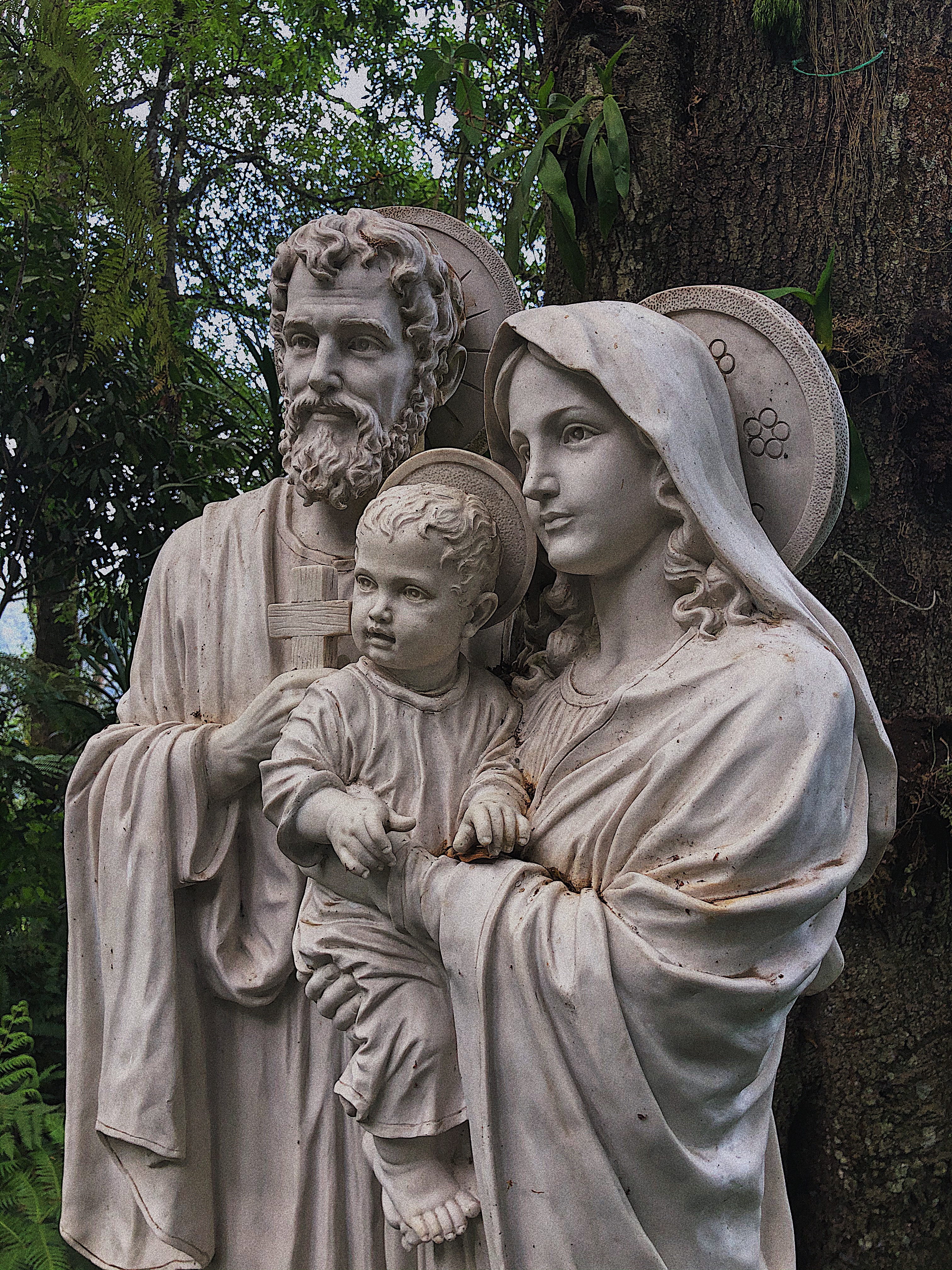
When praying with this passage from the Gospel of Matthew my attention was drawn to the dwelling of the Holy Family in Egypt. I noticed a few things about it.

First, it was very quiet and peaceful compared to the noisy bustle outside on the street.
Danna Segura from Cathopic

Second, I noticed St Joseph come back from the market with food for the family. I immediately sensed a lightness, even a joy about him. There was no heavy worrying about whether he would be there a long time, if he might miss the sign to go back, whether he might mess up his vocation as the foster-father of Jesus. There was no regret that he and Mary were no far from their family for an undetermined length of time. There was just peace, a peace that radiated from him and gave him a sense of strength. He was someone I could lean on.

Let the story expand from the few verses that are recounted in Scripture to what that would have been like for Jesus or Mary, what they would have experienced or needed or felt, how they lived these events interiorly, how they expressed themselves. With your senses immerse yourself into the event. Is there any way you can be of help to them. If so, imagine yourself entering the story through these actions. Look around for a particular moment that seems to be of greater importance to you, to catch your attention.

The “particular moment” that attracted my attention was in the evening when Mary and Joseph were sitting on the “front doorstep” (whatever that might have looked like back then!). She was leaning her head on his shoulder as they looked out at the stars. I was a little girl and a slipped down beside them on the other side of Joseph. He looked down and then pulled me close, putting his arm around me.

Ask for the grace “to know Jesus intimately, to love him more intensely, and so to follow him more closely.”

Entering into the Mystery

This deeper contemplation of Jesus in the Gospels is an apprenticeship of our feelings and senses in which we are formed in such a way that we feel with Jesus, that our feelings becomes those of Jesus, and our spontaneous reactions of personal promotion and self-protection are gradually curbed and re-invented so that we spontaneously react as Jesus does.

Entering into the mystery of what we contemplate, we humbly allow Jesus to be our Master, to educate our senses and feelings according to the pattern of his own life and teachings. It is a matter of becoming saturated with Jesus’ own way of being and feeling. It is learning how to resonate with everything Jesus resonates with, as we gain this felt understanding through our contemplation, and of rejecting whatever Jesus rejects.

I sensed to the very depths of my being how Joseph and Mary were at peace. They had no fear, no anger at their plans being changed by the Almighty, no worry about getting back to life as it was in Nazareth. They weren’t wondering when they would return, what that would look like, how to prepare. They were simply at peace.

Entering still deeper into the mystery of Christ, allow your heart to taste, to smell, to touch the infinite gentleness and sweetness of Jesus or Mary. Allow your spirit to soak up what has been felt and known in this contemplative prayer.

As you do this your mind’s activity will fade into the background, and the mystery you are intuitively contemplating will begin to take over and engulf you, planting within your spirit an inner knowledge of the Lord.

You will at some point begin to intuitively sense the difference between the way Jesus spontaneously feels, speaks, and acts in a situation and the way you yourself feel, speak, and act in similar situations in your own life.

As I sat beside them I could feel the “non-peace” within me. I’m always two steps of myself and at least three ahead of God. I have contingency plans in motion just in case. I need to be at an appointment or the airport two hours in advance to feel calm. I agonize over what is going to happen and what I should be doing…. People tell me how peaceful I am. I guess I hide it well, but next to Joseph and Mary, I see that my heart does not rest in God, in trust, in stillness.

I allowed memories to arise about how this has been a part of my life in a particular way these past three years. I compare the way I am feeling with  the way I sense Mary and Joseph feeling as we all three look up at the stars.

Image by Pexels from Pixabay

I see Joseph look down on me, hug me closer, then say, “Everywhere the Lord himself leads us is good.” Just that. One sentence. Then we all went back to looking into the heavens, so vast, and still, and beautiful. There was a sweetness there on the front doorstep. I soaked it in with great pleasure, seeing how beautiful Mary and Joseph are, so pliant and trusting in God’s hands. I could sense the delight God had in them. I soaked in their absolute childlike certainty that God was leading them. I liked these feelings more than my worried inner harassment.

I entered into the way Mary and Joseph used their eyes, their ears, their touch to take in the sweetness and power of a loving Father.

Rest in that awareness as Jesus helps you to resonate with what he resonates with. As you enter into his feelings and the way he uses his senses, you will gradually lose interest in your own spontaneous reactions, defenses, and self-promotions. Jesus will bring you to his way by attraction, sweetness, and beauty. He will make you feel safety, belonging, and hope.

Image by alba1970 from Pixabay

Colloquy

Allow an image or object that encapsulates all these experiences to form in your mind. Take some time to speak with God about the meaning or significance of this object.

As I allowed the experiences of this meditation to soak into me, washing away my own spontaneous reactions with the attractive loveliness of those of St. Joseph, the image that encapsulated them all was that of a feather. A feather has no weight and thus floats gently wherever the wind takes it.

“The wind blows wherever it pleases. You hear its sound, but you cannot tell where it comes from or where it is going. So it is with everyone born of the Spirit,” said Jesus to Nicodemus (Jn. 3:8).

I spoke with Jesus about the meaning of this image given to me in prayer. As I discerned whether to accept a request or write an article or propose an idea, I stopped and reflected on that image of the feather. How would St Joseph go about these decisions? How would he take part in meetings? What would be different if I adopted the lightness of a feather in the way I expressed myself? …

Ask Mary, Joseph and Jesus to show you one specific gift they wish to give you. Receive it and remain in stillness and quietly relaxed presence under the influence of the Holy Spirit.

Reviewing the Graces of Prayer

When you finish praying, write down the main gifts and discoveries from this time of intimate contemplation. What is one concrete thing you can do to solidify these gifts in your life.

Image credit: Thilipen Rave Kumar from Pexels
Listening to the Word of God: Will we risk being changed forever? (Luke 12:54-59)

https://www.podbean.com/media/share/pb-4skqk-140ee74

Highlights:

It’s not that the people couldn’t figure out that Jesus was the Messiah, that all the prophesies pointed to him, that he spoke with an authority that even the religious leaders didn’t have. Instead, Jesus called them “hypocrites.” We call someone a hypocrite who knows what is right or true but lives in denial of what they know to be right and true. Jesus was saying to them that just as they could interpret the signs of the earth and sky and forecast the weather, they did understand that he had come from God (so much so that the leaders determined very quickly they needed to kill him). They understood, but they were not willing to acknowledge and to accept he had been sent by God. To accept Jesus as the Messiah, to sit at his feet as Mary, to follow him closely as the Twelve, to be personally transformed by his parables and teachings and invitations to conversion like Zacchaeus would change them forever. This they could not accept.

I don’t believe Jesus spoke these words to the crowd with harshness or anger. The heart of the Master was too great, his love for them and for us is a love that led him eventually to the cross for our salvation. I hear in his words a determined effort to make them see what is right before their eyes. How many times Jesus has to shake us up, remind us of what we know, and then prod us  forward to accept what he is revealing to us that we might allow our life to be changed.

I hope you stay in touch. Sign-up for my newsletter: https://touchingthesunrise.com/newsletter/


The Gift of Fear of the Lord – To fear God takes a daring heart…

It should have been a happy day, but tears flowed down my cheeks. I tried to stop them, to compose myself, to put on the expected reverent posture, but as I processed in for my 25th Jubilee of religious profession, the tears would not be stopped.

They spilled out of a heart that was transfixed with wonder at 25 years of religious life. They had not been easy. A stroke, subsequent collapses, depression, TLE…. Feeling set aside because of illness in those very early years in your twenties when I wanted to throw myself into the apostolate…. Spiritual combat on every front against my own pride and anger and….

But here I was at the culmination of all that and so many more memories both positive and difficult…weeping…tears dripping from a heart that was suddenly, unexpectedly, transported out of our Motherhouse chapel in Boston to…amazement at the beauty of  my life and the God of wonder who was wrapping me in his presence and smothering me with a love that washed away the struggles so that only the morning dew of awe remained.

In Scripture “to fear God” is to be in awe of his power and knowledge. To fear God requires a daring heart!

Only a heart that fears God dares to believe that God created each one of us on this earth at this moment in time to know, love, and serve him in this life and to be happy with him forever. Can you dare to believe this about your family? Your enemy? The other both near and on the other side of the planet?

Only a heart that fears God can be joyful. Fear is a word that we typically interpret as referring to a state of emotional distress in the face of some danger to our personal safety. The term “fear of the Lord” appears over 100 times in the Old Testament. For example: And now, Israel, what does the Lord, your God ask of you but to fear the Lord, your God, and follow his ways exactly, to love and serve the Lord your God with all your heart and all your soul (Deuteronomy 10:12). However, in the New Testament, the term is only mentioned two times and has been transformed into a sense of awe that is joyful rather than horrified. It is the gift of fear that gives us an unmistakable and irrefutable sense of God’s closeness and his ultimate victory over all evil in the world.

The gift of fear of the Lord gives us a greater sense of the greatness of God that should spark in our hearts a sense of amazement and awe that could bring us down to our knees. If we abandon astonishment we are left with a mediocre piousness.

To fear Him is to bow before mysteries we can never comprehend, like our freedom to choose, even though our free choices often have dire consequences for others, and another’s freedom to choose may have dire consequences for ourselves or one we love.

To St. Bonaventure fear of the Lord was “the most beautiful tree planted in the heart of a holy man which God waters continuously”  [II.6].  This “most beautiful tree” bears the precious fruit of love and reverence for God. Fear of the Lord for St. Bonaventure was the sort of trembling before experiences of God’s majesty that we hear perfectly encapsulated in the hymn:

Let all mortal flesh keep silence,
And with fear and trembling stand;
Ponder nothing earthly minded,
For with blessing in His hand,
Christ our God to earth descendeth
Our full homage to demand.

The fear that St. Bonaventure had in mind is sort of a continuum that spans a certain range—depending upon one’s perfection in the life of grace—from “servile fear” to “filial fear” to a fear cast out by love which has taken over one’s whole heart (cf. 1 John 4:17-18).

Fear of the Lord is the beginning of wisdom (Prov 1:7) because it puts our mindset in its correct location with respect to God: we are finite, dependent creatures, and He is the infinite, all-powerful Creator.

Here are two things you can do to prepare your heart for the activation of the gift of the fear of the Lord:

  • Give yourself amazing experiences. People who contemplate the grandeur of nature (even on the TV set or Youtube or in their backyard if necessary) are more likely to emerge from their own utilitarian mind-set of duty and obedience and open up to the awe and grandeur of the God whom we worship and whose closeness can be deeply treasured.
  • Use Ignatius’ prayer method in praying with Scripture to more personally experience it. Rather than simple reading about the birth of Jesus in Bethlehem, for example, a person could imagine the details of the sights, sounds, and smells of personally being there. Stanford University Anthropology Professor Tanya Luhrmann has found that individuals randomly assigned to go through Ignatian prayer exercises in which they engage in this kind of imaginative prayer are more likely to report awe-inspiring mystical experiences than those assigned to listen to lectures on the Gospels.


Prayer

“My Lord and my God, all my good consists in being united to you and placing all my hope in You. If my soul were left to itself, it would be like a puff of wind…. Without You I can do no good, nor can I remain steadfast.  Without You I cannot love You, please You. Therefore, I take refuge in You, I abandon myself to You, that You may sustain me by Your power, hold me by Your strength, and never permit to become separated from You” (St Bernard).

We all receive more than we deserve (Matthew 20:1-16a)

The parable of the landowner and the laborers hired to work in his vineyard is, on one level, about abundance. The landowner had a large enough vineyard that he needed to hire laborers repeatedly throughout the day to get the work done. As evening approached and the men lined up for their pay, the landowner paid all of them a denarius each. A “denarius” was a silver Roman coin used as payment for a full day’s wage. The owner of the vineyard didn’t need to scrimp and save. “Are you envious because I am generous?” he asked those who complained that all had been treated with equal generosity.

The landowner’s actions depict the endlessly loving heart of the Father that poured itself out onto his undeserving creation with the incarnation of his Son, the Word-made-flesh, God-with us. Jesus Christ became our brother, our Savior, our Friend, the Lamb of God, our Eucharistic Lord, generosity without limits. As he one day multiplied the loaves and the fish for a crowd of 5000, Jesus abundantly multiplies the gift of his presence to us in the Eucharist all over the world until the end of history. Generous abundance is a hallmark of the Kingdom. Jesus said: “I came so that they might have life and have it more abundantly” (Jn 10:10).

Against the backdrop of this image of this extravagant magnanimity the parable paints the stinginess and selfish demands of the workers of the first hour. They assumed that they would get more than what had been agreed upon because the landowner was doling out a full day’s wage to those who had come at the last hour and who had clearly done far less than they. As these tired laborers watched I can imagine them muttering among themselves that these latecomers were absolutely unworthy to be treated the same as they. The unexpected reversal of the parable is this: no matter how much or little we work, we are all equal recipients of God’s generous abundance, of the gifts of his forgiveness, holiness, mercy, salvation, eternal life.

How many times have I thought that I deserved more than the others because I had given more of my time, energy, and love than they. I have fallen into the trap that the others deserved less because of how little they worked or how selfish they had been. This parable frees us from thinking we need to win God’s endless love. This love is abundant and freely given to us all according to God’s own generous determination. Let us not be upset that others receive what we have been given, but rejoice that others have been gifted, included, loved, blessed as have we, for we all receive more than we could ever deserve.

Jesus, you surprise me by your love for me and your love for others who I sometimes feel don’t deserve that love. I am amazed at how you keep me in existence through your bounteous mercies, even when my love is so small and stingy compared to yours. Take my heart, O Lord, and make it just like yours. Amen.

Praying with this passage of Scripture

Lectio Divina is a way of listening to God as he speaks in his Word. It is a practice of communicating with God through Scripture and attending to God’s presence and what he wishes to tell us. In this slow and prayerful reading of the Word of God, we allow ourselves to be transformed by the Spirit who forms us into the image of Christ.
There are four movement in Lectio Divina: Read (lectio), Meditate (meditation), Pray (oratio), Contemplate (contemplation).

Begin by finding a still space to pray. Breathe deeply and become quieter within. Abandon any agenda, worries or thoughts you bring to this prayer and entrust these things to the merciful care of God. Ask for the grace to be receptive to what God will speak to you through this Scripture reading. Grant me, Jesus Divine Master, to be able to know the mysteries of the kingdom of God and your unfathomable riches. Grant that your word penetrate my soul; guide my steps, and brighten my way till the day dawns and darkness dissipates, you who live and reign forever and ever Amen.

Read (lectio)
Begin by slowly and meditatively reading your Scripture passage out loud. Listen for a particular word or phrase that speaks to you at this moment and sit with it for a time.

“For the kingdom of heaven is like a landowner who went out early in the morning to hire workers for his vineyard. He agreed to pay them a denarius for the day and sent them into his vineyard.

“About nine in the morning he went out and saw others standing in the marketplace doing nothing. He told them, ‘You also go and work in my vineyard, and I will pay you whatever is right.’ So they went.

“He went out again about noon and about three in the afternoon and did the same thing. About five in the afternoon he went out and found still others standing around. He asked them, ‘Why have you been standing here all day long doing nothing?’

“‘Because no one has hired us,’ they answered.

“He said to them, ‘You also go and work in my vineyard.’

“When evening came, the owner of the vineyard said to his foreman, ‘Call the workers and pay them their wages, beginning with the last ones hired and going on to the first.’

“The workers who were hired about five in the afternoon came and each received a denarius. So when those came who were hired first, they expected to receive more. But each one of them also received a denarius. When they received it, they began to grumble against the landowner. ‘These who were hired last worked only one hour,’ they said, ‘and you have made them equal to us who have borne the burden of the work and the heat of the day.’

“But he answered one of them, ‘I am not being unfair to you, friend. Didn’t you agree to work for a denarius? Take your pay and go. I want to give the one who was hired last the same as I gave you. Don’t I have the right to do what I want with my own money? Or are you envious because I am generous?’

“So the last will be first, and the first will be last.”


Meditate (meditatio) – Read the same passage a second time. As you re-engage the text, let the word or phrase that stood out become your invitation to speak from your heart with God who wishes to share his heart with you. Allow this word or phrase to wash over you and permeate your thoughts and feelings. You may wish to repeat this phrase quietly and gently for a period of time.

Pray (oratio) – Read the text a third time. Listen for what God is saying to you. Speak heart to heart with God. Notice the feelings that this conversation with God raises up within you. Share with God what you notice about your response to this conversation. You may wish to return to repeating the phrase quietly and gently, allowing it to permeate you more and more deeply.

Contemplate (contemplatio)
Read the text a final time. Now be still and rest in God’s embrace. Ask God to give you a gift to take with you from this prayer. You might ask God if he is inviting you to do some action, for instance, make some change in your thoughts, attitudes or reactions, in the way you speak or how you treat others. Thank God for this gift and invitation as you conclude your prayer.

Image Credit: Photo by Cristina Gottardi on Unsplash

The Gift of Piety – I know God will take care of everything… I hope….

The sign went up one morning in the front yard of my parents’ house: For Sale. There was a finality about that moment as a young girl in a pick-up truck pounded the wooden sign into the ground and took a picture to send to the real estate agent. It was the same sign I’d seen all over our town. But now it was in front of the home my parents had been in for the past 50 years. The house was officially for sale. My parents were moving.

It seemed surreal as we prepared to support my parents as they moved from their home into a much smaller apartment. So much loss. None of us realized how much would need to be given away or thrown away in order to make the move. With every item that couldn’t go with them, a part of me died…. That part of me that had grown up there as a child, loved to listen to the birds, had run down the hallways and learned to cook in the kitchen, loved and been loved…. Connections, security, past roots…

Now with the sign hanging ominously in the front yard, the unknown was closer and the leap into the future imminent. A lot of fear flowed through our family in those final days…. My siblings wanted the best. We tried to do the best thing for them.

I often say that I have infinite trust in divine Providence…but when it is your own parents’ happiness at stake it suddenly seems a flimsy hope. If I could just be sure. If I could control the outcome. If I could know the future…. But we can’t. We have to do our best. The best we can with what we have at the moment. Then it sometimes feels we have nothing left but to hope against hope that it all works out.

The Holy Spirit moves within our souls at times such as this, activating in us the gift of piety. The gift of piety is a supernatural habit infused in our souls in Baptism. When this gift within us is weak, we try to convince ourselves that God is good, to believe that God will take care of us. But under the influence of the gift of piety, we change our outlook completely. Jordan Aumann in his book Spiritual Theology states: “For those who are governed by the gift of piety, the world and all creation are considered as the house of the Father, and everything in the universe becomes a testimony of his infinite goodness. Such persons are able to discover the religious meaning hidden in all things.”

It is the gift of piety that surprises us with an affection for God as our beloved Father and an absolute child-like love. As we go through the situations of our life that could make us tremble, we walk instead with a filial confidence in the heavenly Father from whom all things come. Aumann states: “Intimately penetrated with the sentiment of its adoptive divine filiation, the soul abandons itself calmly and confidently to the heavenly Father. it is not preoccupied with any care, and nothing is capable of disturbing its unalterable peace, even for an instant. The soul asks nothing and rejects nothing. It is not concerned about health or sickness, a long life or a short life, consolations or aridity, persecution or praise, activity or idleness. It is completely submissive to the will of God and seeks only to glorify God with all its powers…. These souls run to God as a child runs to its Father.”

Here are two ways you can dispose yourself for the activity of the Holy Spirit related to the gift of piety:

1) Consider all things, even material things, as belonging to the house of God. St Francis of Assisi, for example, saw and judged all things in this visible world as belonging in some way to the heavenly Father. The created universe and everything about our lives is truly the Father’s domain. All things belong to him. By treating all things and every situation as somehow belonging also to God, we grow in union, respect and reverence for the Almighty and tender Father.

2) Practice daily a spirit of surrender and trust in God. We can try to do what we can, as I did as I faced the losses connected with my parents’ move. Even though our trust in God won’t be perfect until the gift of piety is intensely activated in us, the practice of striving for an evenness of spirit because we know for certain that God loves us as a father and cares for us in our daily needs will dispose us for the action of the Holy Spirit’s power.

A Prayer

O Holy Spirit, create in me the heart of a child toward its heavenly Father, a heart that seeks him always, loving and serving him with good will. Create in me a heart to my brothers and sisters that is kind, gentle, and meek with all. Amen.


Listening to the Word of God: The Bread of Life (John 6:22-29)

https://www.podbean.com/media/share/pb-qkjcf-140ee21

Highlights:

In order to live, we need to nourish ourselves, we need dignity and peace. The hearts of the people in this crowd were hoping against hope that things could change for them on a temporal level. They just didn’t realize that things had already changed. With the radical newness of the incarnation of the Son of God, everything had already become new. A greater hope of a more eternal promise was being fulfilled before their very eyes. Yet they could not recognize it. They were enamored still of the loaves of bread they had eaten. They were still looking for the food that perishes. Their imagination was too small.

When we have found him, when we have let ourselves be seen by him, when we have allowed ourselves to be saved by him, we will no longer be absorbed by what we can get for ourselves, but in how we can tell others about Jesus.

I hope you stay in touch. Sign up for my newsletter here: https://touchingthesunrise.com/newsletter/

Image: Gabriel Manjarres