The image that has drawn me in my ministry is Touching the Sunrise. I believe each person, no matter where they are and what they have lived, is a temple of the Trinity and can, indeed, taste the presence of God within. You can find resources for healing and prayer and follow me at touchingthesunrise.com.
Two words in this Gospel are almost terrifying. Jesus “touched him.”
So far removed are we from what leprosy signified in biblical times, that this image of Jesus stretching out his hand to touch a person whose body was consumed by the disease has no affect on us.
Lepers were the walking dead who were banished to live outside towns in caves, tents, or garbage dumps. Even breathing the same air as a leper was thought to be dangerous, since leprosy was considered highly contagious. Leprosy consumed a person’s body, leaving stumps where fingers, hands, feet, or noses had once been. The laws dictated that lepers were to maintain twelve steps distance from others, cover their mouths with a cloth, and cry out “unclean, unclean” to announce their presence.
Most of us still have lingering in our memories the fear we experienced with COVID-19, when even being within six feet of another or breathing the same air as they, conjured up the possibility of a painful death. We learned to stay from others to protect ourselves and those we love.
Jesus, instead, “touched” the leper.
Jesus stepped over the imaginary line of demarcation, entering into the dangerous zone of closeness with the leper.
Jesus got close enough to this man to smell the putrid smell of his decaying flesh. He could feel the man’s foul breath on his face.
Jesus got closer still in order to touch the body of the leper, putting his fingers into the wounds of oozing sores.
Jesus conveyed to this man that he wanted so much that he would be healed that he himself was willing to risk his life, to give his life.
Jesus was close enough to look directly into the face of a person whose face was horrifically disfigured and perhaps even unrecognizable.
And Jesus touched him.
Sometimes we may feel that we have become disfigured, unrecognizable, because of the wounds we have received in our life and the brokenness of our own sin.
And Jesus touches us.
There are certain others in our life that we consider “lepers” in the sense that they think, speak, or act in ways that threaten us or that walk outside the path of discipleship of the Lord Jesus.
And Jesus touches them.
There is no leprosy that frightens Jesus away, no disfigurement that makes him draw back. One day, when thinking of certain others in my life, wondering how they could be at peace with what they were doing, I heard God say to me this: “I know. Only I know.”
Jesus touches each of us in the places of our leprosy. We are each of us known intimately and lovingly by a God unafraid to enter into our misery and travel with us the journey to the Kingdom.
Today you might ask yourself in a moment of prayer: “Jesus, what does this say about you and about me?”
Praying with this Passage of Scripture
Lectio Divina is a way of listening to God as he speaks in his Word. It is a practice of communicating with God through Scripture and attending to God’s presence and what he wishes to tell us. In this slow and prayerful reading of the Word of God, we allow ourselves to be transformed by the Spirit who forms us into the image of Christ. There are four movements in Lectio Divina: Read (lectio), Meditate (meditation), Pray (oratio), Contemplate (contemplation).
Begin by finding a still space to pray. Breathe deeply and become quieter within. Abandon any agenda, worries or thoughts you bring to this prayer and entrust these things to the merciful care of God. Ask for the grace to be receptive to what God will speak to you through this Scripture reading. Grant me, Jesus Divine Master, to be able to know the mysteries of the kingdom of God and your unfathomable riches. Grant that your word penetrate my soul; guide my steps, and brighten my way till the day dawns and darkness dissipates, you who live and reign forever and ever Ame
Read (lectio) Begin by slowly and meditatively reading your Scripture passage out loud. Listen for a particular word or phrase that speaks to you at this moment and sit with it for a time.
A leper came to Jesus and kneeling down begged him and said, “If you wish, you can make me clean.” Moved with pity, he stretched out his hand, touched him, and said to him, “I do will it. Be made clean.” The leprosy left him immediately, and he was made clean. Then, warning him sternly, he dismissed him at once. He said to him, “See that you tell no one anything, but go, show yourself to the priest and offer for your cleansing what Moses prescribed; that will be proof for them.” The man went away and began to publicize the whole matter. He spread the report abroad so that it was impossible for Jesus to enter a town openly. He remained outside in deserted places, and people kept coming to him from everywhere. (Mark 1:40-45)
Meditate (meditatio) Read the same passage a second time. As you re-engage the text, let the word or phrase that stood out become your invitation to speak from your heart with God who wishes to share his heart with you. Allow this word or phrase to wash over you and permeate your thoughts and feelings. You may wish to repeat this phrase quietly and gently for a period of time
Pray (oratio) Read the text a third time. Listen for what God is saying to you. Speak heart to heart with God. Notice the feelings that this conversation with God raises up within you. Share with God what you notice about your response to this conversation. You may wish to return to repeating the phrase quietly and gently, allowing it to permeate you more and more deeply.
Contemplate (contemplatio) Read the text a final time. Now be still and rest in God’s embrace. Ask God to give you a gift to take with you from this prayer. You might ask God if he is inviting you to do some action, for instance, make some change in your thoughts, attitudes or reactions, in the way you speak or how you treat others. Thank God for this gift and invitation as you conclude your prayer.
I will be the first to admit I don’t have a “green thumb.” My forays into gardening and planting are very limited. Perhaps for this very reason, I am still in awe when some green thing under my care actually flourishes. A few months ago I rescued two leaves which had been unceremoniously cut off from a plant so that it would have more room to grow. I place them in a small dish of water “just to see what would happen.” Maybe I can grow another plant, I thought. Then I promptly left on retreat for two weeks.
Imagine my excitement upon my return when I noticed that each leaf had the tiniest white almost transparent roots at their base! Clearly, I couldn’t take the glory for this gardening miracle. I hadn’t even been home. But there it was. The water almost evaporated in the dish that had become their home, and yet these leaves rescued from the garbage two weeks earlier were now beginning to become new plants in their own right.
“This is how it is with the Kingdom of God; it is as if a man were to scatter seed on the land and would sleep and rise night and day and the seed would sprout and grow, he knows not how.”
The Kingdom of God begins in the quietest of ways, in a word of encouragement, an offer to pick up something at the grocery store for a housebound neighbor, a prayer for the world as it suffers the disharmony caused by war and falsehood, a decision to use the media responsibly. We might feel that in the face of the needs of others, our contribution is small. But isn’t that just the point? It is not our contribution at all, it is the Kingdom of God. We take the next good step in the important and more insignificant moments of our life, and God is the one who gives the growth.
Timothy and Titus were disciples of the great apostle Paul. They learned from him the power of the Word, that it is not our actions and proclamations that make the difference, but the power of God in Christ who does all things. So have great courage that your work in the Lord’s field, whatever it may be, will bear God’s great fruit.
Praying with this Passage of Scripture
Lectio Divina is a way of listening to God as he speaks in his Word. It is a practice of communicating with God through Scripture and attending to God’s presence and what he wishes to tell us. In this slow and prayerful reading of the Word of God, we allow ourselves to be transformed by the Spirit who forms us into the image of Christ. There are four movements in Lectio Divina: Read (lectio), Meditate (meditation), Pray (oratio), Contemplate (contemplation).
Begin by finding a still space to pray. Breathe deeply and become quieter within. Abandon any agenda, worries or thoughts you bring to this prayer and entrust these things to the merciful care of God. Ask for the grace to be receptive to what God will speak to you through this Scripture reading. Grant me, Jesus Divine Master, to be able to know the mysteries of the kingdom of God and your unfathomable riches. Grant that your word penetrate my soul; guide my steps, and brighten my way till the day dawns and darkness dissipates, you who live and reign forever and ever Ame
Read (lectio) Begin by slowly and meditatively reading your Scripture passage out loud. Listen for a particular word or phrase that speaks to you at this moment and sit with it for a time.
The Parable of the Growing Seed
He also said, “This is what the kingdom of God is like. A man scatters seed on the ground. Night and day, whether he sleeps or gets up, the seed sprouts and grows, though he does not know how. All by itself the soil produces grain—first the stalk, then the head, then the full kernel in the head. As soon as the grain is ripe, he puts the sickle to it, because the harvest has come.”
The Parable of the Mustard Seed
Again he said, “What shall we say the kingdom of God is like, or what parable shall we use to describe it? It is like a mustard seed, which is the smallest of all seeds on earth. Yet when planted, it grows and becomes the largest of all garden plants, with such big branches that the birds can perch in its shade.”
With many similar parables Jesus spoke the word to them, as much as they could understand. He did not say anything to them without using a parable. But when he was alone with his own disciples, he explained everything. (Mark 4:26-34)
Meditate (meditatio) Read the same passage a second time. As you re-engage the text, let the word or phrase that stood out become your invitation to speak from your heart with God who wishes to share his heart with you. Allow this word or phrase to wash over you and permeate your thoughts and feelings. You may wish to repeat this phrase quietly and gently for a period of time
Pray (oratio) Read the text a third time. Listen for what God is saying to you. Speak heart to heart with God. Notice the feelings that this conversation with God raises up within you. Share with God what you notice about your response to this conversation. You may wish to return to repeating the phrase quietly and gently, allowing it to permeate you more and more deeply.
Contemplate (contemplatio) Read the text a final time. Now be still and rest in God’s embrace. Ask God to give you a gift to take with you from this prayer. You might ask God if he is inviting you to do some action, for instance, make some change in your thoughts, attitudes or reactions, in the way you speak or how you treat others. Thank God for this gift and invitation as you conclude your prayer.
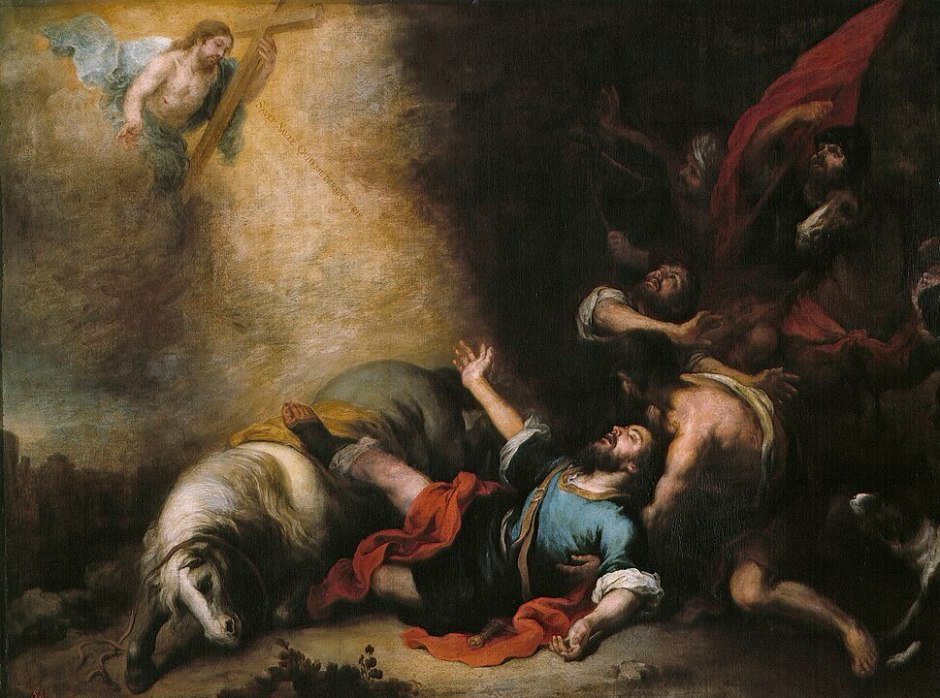
Paul had no way of knowing when he awoke on the day he planned to descend on Damascus and take the followers of Jesus captive in order to put them into prison, that he himself stood on a threshold….
No way of knowing that he himself that day would be taken captive, that he would be captured and captivated by the One for whom he would live the rest of his life….
There in the dust on the outskirts of Damascus, radiant light all around him, his eyes in darkness, confusion swirling in his heart, he was uprooted from one life and planted in another. His response, “Lord, what would you have me do?” closed one era of his life and ushered in another.
Transition moments are rarely neat. They aren’t pretty. Sometimes they don’t even make sense. Paul’s conversion which we celebrate in the liturgy on January 25 appears quite dramatic and immensely important in hindsight. We’ve witnessed for 2000 years how the life and teaching of this greatest of apostles has transformed the Church and powerfully influenced the world.
I am sure, however, that as Paul reached out for help as he stumbled to stand up and as he was led by hand just like a child into the very city his arrival had been a day earlier such a cause for alarm, it was far from glorious. With every humiliating and faltering step into the city of Damascus, Paul was no doubt met with the comments and astonished jeers of bystanders.
When we are done with being captivated by our great plans and our stunning ideas and surrender to the Lord who takes us captive through similar not-so-pretty situations, we also are at a threshold in our lives. And this moment can seem equally inglorious. It can be difficult to cherish the hope that the closing of a door is offering the hope of a future ripe with new possibilities.
At these moments, remember this: You like Paul have been made for a purpose greater than anything you could think of. You like Paul have been made for something far more than this world. After that meeting with Jesus on his way to Damascus, Paul didn’t just change his behavior, or his goals, or his way of behaving, or what he was doing. Paul allowed God to pull him up into his own mighty mystery and unfolding selfless loving of the world.
After his “conversion” Paul belonged entirely to God, but he also finally belonged most truly to himself. He now knew deeply the reason for which he had been born. His joy grew from strength to strength, even in suffering and weakness, as he discovered every day how glorious it is to be remade in the image of Christ for the glory of God the Father. This is the promise held out to each of us as we celebrate this feast in the Church.
Praying with this Passage of Scripture
Lectio Divina is a way of listening to God as he speaks in his Word. It is a practice of communicating with God through Scripture and attending to God’s presence and what he wishes to tell us. In this slow and prayerful reading of the Word of God, we allow ourselves to be transformed by the Spirit who forms us into the image of Christ. There are four movements in Lectio Divina: Read (lectio), Meditate (meditation), Pray (oratio), Contemplate (contemplation).
Begin by finding a still space to pray. Breathe deeply and become quieter within. Abandon any agenda, worries or thoughts you bring to this prayer and entrust these things to the merciful care of God. Ask for the grace to be receptive to what God will speak to you through this Scripture reading. Grant me, Jesus Divine Master, to be able to know the mysteries of the kingdom of God and your unfathomable riches. Grant that your word penetrate my soul; guide my steps, and brighten my way till the day dawns and darkness dissipates, you who live and reign forever and ever Ame
Read (lectio) Begin by slowly and meditatively reading your Scripture passage out loud. Listen for a particular word or phrase that speaks to you at this moment and sit with it for a time.
Meanwhile, Saul was still breathing out murderous threats against the Lord’s disciples. He went to the high priest and asked him for letters to the synagogues in Damascus, so that if he found any there who belonged to the Way, whether men or women, he might take them as prisoners to Jerusalem. As he neared Damascus on his journey, suddenly a light from heaven flashed around him. He fell to the ground and heard a voice say to him, “Saul, Saul, why do you persecute me?”
“Who are you, Lord?” Saul asked.
“I am Jesus, whom you are persecuting,” he replied. “Now get up and go into the city, and you will be told what you must do.”
The men traveling with Saul stood there speechless; they heard the sound but did not see anyone. Saul got up from the ground, but when he opened his eyes he could see nothing. So they led him by the hand into Damascus. For three days he was blind, and did not eat or drink anything. (Acts 9)
Meditate (meditatio) Read the same passage a second time. As you re-engage the text, let the word or phrase that stood out become your invitation to speak from your heart with God who wishes to share his heart with you. Allow this word or phrase to wash over you and permeate your thoughts and feelings. You may wish to repeat this phrase quietly and gently for a period of time
Pray (oratio) Read the text a third time. Listen for what God is saying to you. Speak heart to heart with God. Notice the feelings that this conversation with God raises up within you. Share with God what you notice about your response to this conversation. You may wish to return to repeating the phrase quietly and gently, allowing it to permeate you more and more deeply.
Contemplate (contemplatio) Read the text a final time. Now be still and rest in God’s embrace. Ask God to give you a gift to take with you from this prayer. You might ask God if he is inviting you to do some action, for instance, make some change in your thoughts, attitudes or reactions, in the way you speak or how you treat others. Thank God for this gift and invitation as you conclude your prayer.
Image: Bartolomé Esteban Murillo, Public domain, via Wikimedia Commons
Celebrating the Magi who followed a star in their search for the newly born King is a great opportunity to reflect on the stars we follow, the searches we have made during our life, what we have found, where we are, and where we are going.
The grace we are asking of God: to discover Jesus in my own personal story so that my personal myth may be transformed in Jesus, as was that of Ignatius, that I will be disposed to hear God’s call and follow it wholeheartedly
Horizons of the Heart is inspired by the Spiritual Exercises of St Ignatius and my own notes from my thirty-day Ignatian retreat in 2022.See an index for the whole series.
In the Kingdom Meditation found in the Spiritual Exercises at the beginning of the second week, we encounter Ignatius’ transformation, that is, we enter into the way the personal “this-world” myth of his life was transformed and purified and exalted by Jesus.
What do we mean by one’s personal myth? We each have a personal myth created by energies that give direction, potency and meaning to our lives. They are created from stories we listened to as children, role models who influenced us in powerful ways, songs we sang, images from movies, games we played, stories we read, historical events we lived through. All these coalesce in our psyches and imaginations into powerful imagery and archetypes that express the desires and dreams we have for our lives. The images and stories that express these dreams we can call a “myth.” So there are personal myths, but from this description we can easily see that there are also national myths, myths for the community we associate with, religious myths.
Ignatius of Loyola was born into a Spain on the verge of being united under one king. The nation was galvanized by the dream of finally experiencing itself under one flag, one king under God. The dream that the whole world would be Christian gave energy to explorers who would venture to new lands to claim them for Spain and for Christ. Ignatius of Loyola’s personal “this-world” myth was created from these experiences, stories, and images that galvanized him as a soldier. He embodied the culture of chivalry and fought with his liege lord to conquer lands for his king and God.
In the Kingdom Meditation, as it is presented in the Spiritual Exercises, Ignatius presents us with a soldier’s story or dream of “myth,” because that was what was an understandable way of envisioning one’s life at that time. It would be an outrage for a soldier to refuse to join a temporal king, to fight alongside him, eat what he eats, suffer what he suffers, and share in his triumph, for the sake of the country and of God. This was the myth that at the moment of Ignatius’ conversion was transformed and gave him energy to devote himself now to Jesus as the Eternal King whose dream was to conquer the world with love. This dream of Jesus conquered his heart and soul, so that no longer was he mesmerized by dreams of chivalry and military success, but was taken up by dreams and desires of doing great deeds for the Lord Jesus Christ in service of the Divine Majesty.
We each have a personal myth that Jesus desires to transform so that we too are drawn into his dream and desires for the loving salvation of the world. Myths are usually unconscious, yet they express a set of values, energies, dreams, meanings, insights that give energy and focus to our lives.
Ignatius’ myth rooted in the imagery of a soldier—or analogously a hero, or a queen, or a lover—may not speak to you and I, but it is a profound example of the powerful things that can happen in our life when we allow our own personal myth to be transformed by Jesus. The life and writings of Saint Ignatius of Loyola have influenced and led to the transformation of hundreds of thousands of lives. The meditation on the Baptism of Jesus can be that space in which we discover for ourselves how Jesus reveals God’s dream for the world and where we fit into that dream: “Behold my Son in whom I delight. Listen to him.” In other words, meditating on the Baptism of the Lord can help us raise to consciousness our own myth so that it can be transformed by Jesus. In the Baptism of Jesus we see Jesus revealing to us God’s dream for the world.
Exploring One’s Deepest Dreams
In this meditation we are going to take some prayerful time to explore our deepest dreams and hopes about ourselves in the form of an image or a story or an insight. You might begin by praying with these questions:
What images give me life? Are the images that have given me life up to this point in some way no longer sufficient or meaningful as I look at the future of my life as it is unfolding now?
When I think of what I want to be remembered for in life, what is the image or story that encapsulates this?
What dreams for myself capture what I wish I could be in the next decade of my life?
If I could take my deepest desire and vision for the world and draw a picture of it or express it in a quote or insight, what would it be?
When I look out at the world today what to me would be an absolutely wonderful change I’d like to see?
Personal Myths May Be Transformed Over Time
In times of transition in our life, such as a change of career, mid-life changes such as children leaving home or retirement, moving to a new location, or a shift in our personal values as we enter a new stage of life, our personal myth may undergo a transformation. So myths are flexible, open to the movement of the Holy Spirit and of grace. We could consider, for example, how the dreams of Mary and Joseph for the birth and early childhood years of Jesus had to be refashioned by the political situation in which they lived. Or how the image Jesus had of his life at Nazareth where it was just his mother and himself may have shifted at age thirty with his Baptism and the beginning of his public ministry. Jesus himself didn’t pivot to something new, but as he entered a new stage of his life and ministry as Savior and Redeemer, the images, dreams, and values shifted in a certain sense, giving him the impetus to enter into public ministry with all that this would entail. In what way has your sense of meaning, your dreams or myth shifted through the different eras of your life? Do you feel the Spirit prompting you to something new or to deepening something old?
Some examples: As I look out on the world today I have been inspired by this quote from Scripture: “”The banquet is ready. Go and tell everything that ALL IS READY” (see Mt. 22) Of course, this speaks to the ministry of a Daughter of St Paul, however while in my earlier years I lived my mission through the stance of teaching, now I live it through love. I stand, in an image given to me by our Founder, along the highways and byways of the world pointing out the way to heaven, where the banquet is ready, and the Eucharist, where the banquet can be tasted even now, while blocking the way to perdition with my whole being: through a contemplative way of life immersed in God, in dipping into the heart of Jesus the Savior the “pen” with which I write, living the urgency of love in my mission on my knees.
Others I know have found their myth embodied in the image of a sunflower which turns so that it constantly faces the sun, an image in the spiritual life of dependence on God and obedience to his will. Early on in religious life the focus could be on the virtue and vow of obedience. Later the emphasis may be on living prophetically and contemplatively God’s dream for the salvation of all.
Take some time to attend to your own personal myth.
Who Will Join Me?
Your myth, the image or story that will give energy and desire to your choices in life are a call to join Jesus, to be his companion for the sake of the world. At his Baptism in the Jordan, Jesus made holy the waters of all the baptismal fonts in every church till the end of time. He began at that moment in a particular way to reclaim us as the Father’s children, as his brothers and sisters and co-heirs. He began his journey that would culminate with his giving himself to us at the Last Supper in the Eucharist, his passion and death, and his resurrection and ascension. We too in Baptism would die and rise with him, would live in him and he in us.
Giotto Scrovegni Baptism of Christ, public domain.
Jesus stands at the Jordan, we could say, looking at each of us and asking, “Who will join me? Who will live as I live, struggle as I struggle, give as I give, love as I love, suffer as I suffer, and triumph as I triumph?”
Allow yourself to enter into the mystery of Jesus’ Baptism. What of the reflections in this article have touched you most deeply?
Jesus’ invitation is about helping you become more aware of the need for a great and generous spirit as he brings us into a mission that is greater than ourselves. Jesus is willing to sacrifice everything for the good of the people he loves and has come to save. He reaches out for others who will be willing to be with him in this mission. Jesus doesn’t ask if you are smart, if you are prepared, if you are holy. He simply asks: “Will you join me?”
This deeper contemplation of Jesus in the Gospels is an apprenticeship of our feelings and senses in which we are formed in such a way that we feel with Jesus, that our feelings becomes those of Jesus, and our spontaneous reactions of personal promotion and self-protection are gradually curbed and re-invented so that we spontaneously react as Jesus does.
Entering into the mystery of what we contemplate, we humbly allow Jesus to be our Master, to educate our senses and feelings according to the pattern of his own life and teachings. It is a matter of becoming saturated with Jesus’ own way of being and feeling. It is learning how to resonate with everything Jesus resonates with, as we gain this felt understanding through our contemplation, and of rejecting whatever Jesus rejects.
To stand with Jesus and to respond to his invitation to join him in will place a person squarely in the midst of the battle for the Kingdom of God against the forces of evil present in the history of the world. Suffering and struggle and hard labor will precede the fullness of God’s glory and Jesus’ triumph over all his enemies.
To follow Jesus is to take seriously his teaching, his example, and the powerful gift of his life and grace in us. Joining Jesus is a commitment to his plan for our own lives but also for the salvation of the world.
Talk with Jesus about this invitation and what you realize it will demand of you. Talk to him about what you are feeling, fearing, desiring.
Ignatius proposes an even deeper expression of commitment for those who feel a greater sense of identification with Jesus and wish to commit themselves even more in joining him. These are his words:
“Those who wish to give greater proof of their love, and to distinguish themselves in whatever concerns the service of the eternal King and Lord of all, will not only offer themselves entirely for the work, but will act against their sensuality and carnal and worldly love, and make offerings of greater value and of more importance in words such as these:
“Eternal Lord of all things, in the presence of your infinite goodness, and of your glorious mother, and of all the saints of your heavenly court, this is the offering which I make with your favor and help. I protest that it is my earnest desire and my deliberate choice, provided only that it is for your greater service and praise, to imitate you in bearing all wrongs and all abuse and all poverty, both actual and spiritual, should your most holy majesty deign to choose and admit me to such a state and way of life” (L.J. Puhl, The Spiritual Exercises of St. Ignatius (Chicago: Loyola University Press, 1951), Sections 97-98).
As you kneel before Jesus what is the commitment you wish to make to him at this time.
Reviewing the Graces of Prayer
When you finish praying, write down the main gifts and discoveries from this time of intimate contemplation. What is one concrete thing you can do to solidify these gifts in your life.
Featured image: ilragazzoconmoltafede-Apostolada de la Palabra from Cathopic
“In your life you have also given me birth. I am grateful to you for that.” Words heard in my heart during the Christmas Octave.
Me? Really? I asked. When? How? You? My Infant King?
Jesus’ words, his gaze, it was piercing, sweet, simple.
Is it true?
Imagine the angels bowing to you in gratitude for the way you extend Jesus’ Incarnation even now.
Name 3 moments in your life when you have loved, given, rescued, been a refuge for someone, or brought light that gave another freedom or relief or joy… Moments when you have shed on someone’s path light, hope, peace, delight….
Only Jesus knows what that gift of yours led to… how Jesus was born in someone’s soul because of the perhaps ever-so-small gesture of presence that you once offered another….
A smile through tears, a flash of hope, a first prayer, conversion, return to the practice of the Faith, a whispered prayer moments before meeting their Maker… We never know, but Jesus remembers how you have made him present to someone he was eager to encounter, how you gave him birth in the world today.
Receive now this gratitude of his Heart: “You also have given me birth on earth. I am grateful to you for that…” Taste the thoughts, movements of your heart, memories, desires… Hold them close to your own heart. Remember that in the heart of Jesus, this is how you are seen, this is how you are loved.