
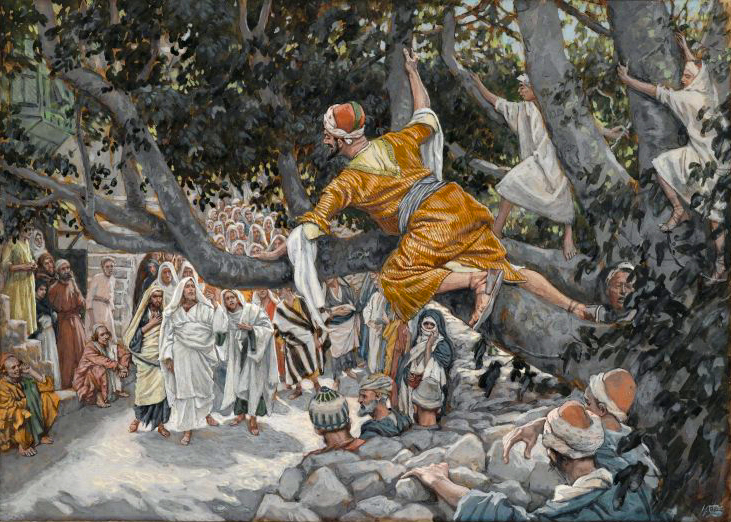
Jesus entered Jericho and was passing through it. A man was there named Zacchaeus; he was a chief tax collector and was rich. He was trying to see who Jesus was, but on account of the crowd he could not, because he was short in stature. So he ran ahead and climbed a sycamore tree to see him, because he was going to pass that way. When Jesus came to the place, he looked up and said to him, “Zacchaeus, hurry and come down; for I must stay at your house today.” So he hurried down and was happy to welcome him. All who saw it began to grumble and said, “He has gone to be the guest of one who is a sinner.” Zacchaeus stood there and said to the Lord, “Look, half of my possessions, Lord, I will give to the poor; and if I have defrauded anyone of anything, I will pay back four times as much.” Then Jesus said to him, “Today salvation has come to this house, because he too is a son of Abraham.
Luke 19:1-9
It was, it is true, a simple out-patient procedure: metatarsal surgery. It was simple, that is, until I had a stroke the evening of the surgery. Eleven days later I was still in the hospital—struggling to walk, to eat, to talk. That was forty years ago, and I can say that “most” of my life has been lived post-stroke. The confusion of those first weeks and months opened up into the quiet desperation of years of rehabilitation…, flowing into a mighty struggle to uncover my fear of God’s power over my life…, surrendering into the trust that this was and still is a moment of a grace for me through which God gathered the direction of my life toward himself forever.
With the stroke, God took me from the outside to the inside, from the surface to the deep, from the visible to the invisible, from ambition to powerlessness, from earth to heaven, from complacency to a wrestling with him, from healing to more healing to more brokenness to even deeper healing. It is kind of like Zacchaeus. Let me explain.
The little man we call Zacchaeus had his life all figured out. He knew who he thought he was. He knew what he was about. He knew what he wanted, what he had, what he could get when he needed it. On the surface, in what was visible, he was settled in a complacency that isolated him from the others in the village charged that day with the electric excitement of the arrival of Jesus.
Around the passing of Jesus through their town swirled stories of people freed from demonic possession, the lame and the blind and the mute and the deaf and the lepers suddenly released from the captivity of illness, sinners casting themselves down before him in sorrow and repentance and love only to become one of his traveling companions. There was something more to Jesus than the ordinary roving teacher who passed through their village of Jericho now and then. But Zacchaeus didn’t need any of that. He was fine the way he was. But he was just a little bit, just the tiniest bit, curious. And that curiosity sent him up the tree to stake out a spot as an observer, and an observer only.
That was me. No, I’m not short and I certainly don’t climb trees. But I thought, at twenty-one, I had my life all figured out, the externals of my vocation mastered. I didn’t know that I needed healing, that I needed Jesus to make an intervention so decisive in my life that it would bring me face to face with him, that I needed my expectations and strategies upended and the rug ripped out from under me, as Jesus so mercifully did for Zacchaeus.
“I mean to come to your house for dinner today.”
Friends, when Jesus calls you out of the tree, when he moves you from the efficiency of life-all-planed-out, when he intervenes in your plans with a graced but often painful stroke of mercy, climb out of that tree with Zacchaeus. Stand with your head held high. Commit yourself to this new and deepening relationship that Jesus is initiating, and bring the Master within to the areas of your life that are the most broken, and let him change you forever.
Saint Paul points to the truth of these “Zacchaeus moments” in this way: “So we do not lose heart. Even though our outer nature is wasting away, our inner nature is being renewed day by day. For this slight momentary affliction is preparing us for an eternal weight of glory beyond all measure” (2 Cor 4:16-17 NRSVCE).
Image credit: James Tissot, Public domain, via Wikimedia Commons

Praying with this Passage of Scripture
Lectio Divina is a way of listening to God as he speaks in his Word. It is a practice of communicating with God through Scripture and attending to God’s presence and what he wishes to tell us. In this slow and prayerful reading of the Word of God, we allow ourselves to be transformed by the Spirit who forms us into the image of Christ. There are four movements in Lectio Divina: Read (lectio), Meditate (meditation), Pray (oratio), Contemplate (contemplation).
Begin by finding a still space to pray. Breathe deeply and become quieter within. Abandon any agenda, worries or thoughts you bring to this prayer and entrust these things to the merciful care of God. Ask for the grace to be receptive to what God will speak to you through this Scripture reading. Grant me, Jesus Divine Master, to be able to know the mysteries of the kingdom of God and your unfathomable riches. Grant that your word penetrate my soul; guide my steps, and brighten my way till the day dawns and darkness dissipates, you who live and reign forever and ever Amen.
Read (lectio)
Begin by slowly and meditatively reading your Scripture passage out loud. Listen for a particular word or phrase that speaks to you at this moment and sit with it for a time.
Pray (oratio)
Read the text a third time. Listen for what God is saying to you. Speak heart to heart with God. Notice the feelings that this conversation with God raises up within you. Share with God what you notice about your response to this conversation. You may wish to return to repeating the phrase quietly and gently, allowing it to permeate you more and more deeply.
Contemplate (contemplatio)
Read the text a final time. Now be still and rest in God’s embrace. Ask God to give you a gift to take with you from this prayer. You might ask God if he is inviting you to do some action, for instance, make some change in your thoughts, attitudes or reactions, in the way you speak or how you treat others. Thank God for this gift and invitation as you conclude your prayer.
Image: Myriams-Fotos; pixabay.com
 Touching the Sunrise
I was just reflecting earlier on our “physical ” brokenness. I have had more bouts with my health lately. But I thought it odd, that the more my body falls apart, my soul is full of hope and peace! Yes, aging hang ups will happen as we get older. They are not fun. But they are reminders of “where is my focus?” What “ailments” can I turn into a prayer? For the redemption of sinners? the world? Those closest to me, yet farthest from our Lord? Suffering can be so fruitful in this regard. Jesus did it for us! As St. Paul says, our inner nature is being renewed! Amen! St Paul, pray for us! Thank you, Sr. Kathryn! Great reflection!
LikeLike