
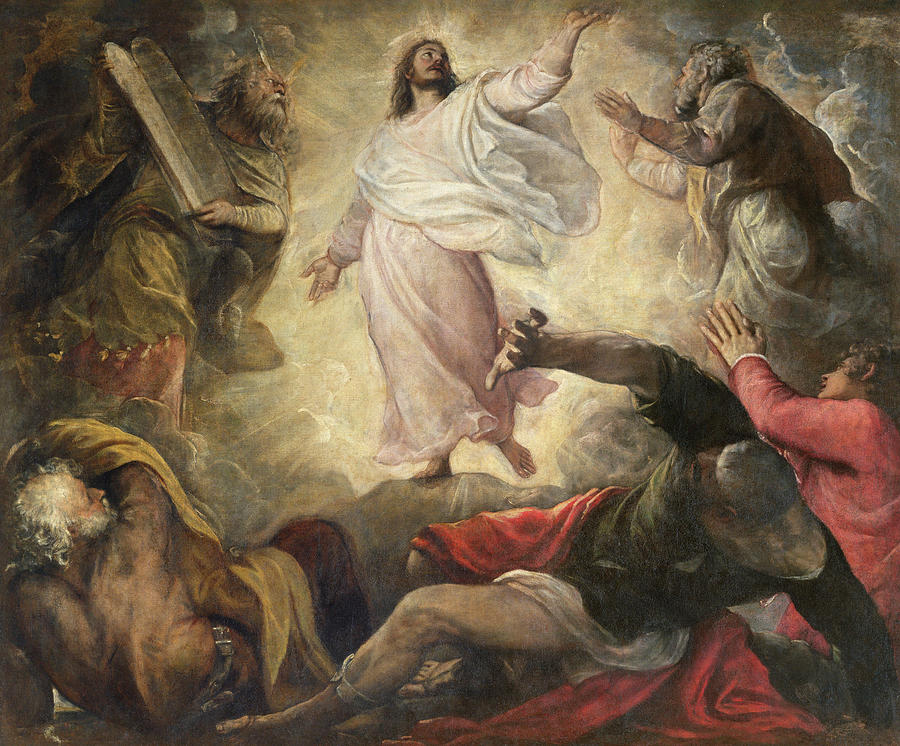
Now about eight days after these sayings Jesus took with him Peter and John and James, and went up on the mountain to pray. And while he was praying, the appearance of his face changed, and his clothes became dazzling white. Suddenly they saw two men, Moses and Elijah, talking to him. They appeared in glory and were speaking of his departure, which he was about to accomplish at Jerusalem. Now Peter and his companions were weighed down with sleep; but since they had stayed awake, they saw his glory and the two men who stood with him. Just as they were leaving him, Peter said to Jesus, “Master, it is good for us to be here; let us make three dwellings, one for you, one for Moses, and one for Elijah”—not knowing what he said. While he was saying this, a cloud came and overshadowed them; and they were terrified as they entered the cloud. Then from the cloud came a voice that said, “This is my Son, my Chosen; listen to him!” When the voice had spoken, Jesus was found alone. And they kept silent and in those days told no one any of the things they had seen.
Luke 9:28b-36
The nearest experience I have had of “transfiguration” was the first evening at the Eucharistic Congress last year in Indianapolis, Indiana in the US. I was one of the last ones to arrive at Lucas Oil Stadium and slipped into a seat on an upper level just as exposition of the Blessed Sacrament was beginning. The entire stadium was in darkness, and silence had settled on the minds and hearts of everyone as we turned our gaze to the altar. The only lights in the stadium were directed to the center of the stadium where Jesus was exposed in the Blessed Sacrament. 50,000 voices quietly began to sing reverently, O Salutaris Hostia.
All of us that night felt surrounded by the hosts of heaven as we adored the King of kings and the Lord of the universe. On our knees, like Peter, James, and John, we were overwhelmed by God’s glory. (Although I certainly had no inclination to build a tent there in the Stadium!)
That night I was given just the tiniest of glimpses of the potential for the restoration and transfiguration of the entire world in Christ. I can’t remember that evening, or re-live it by watching it on YouTube, or re-enter it as I receive Holy Communion at Mass on any given day without tears of joy.
In the Transfiguration on Mount Tabor, we see Christ’s human nature filled with splendor. What has happened to the human nature in Christ can happen also to our human nature as his followers. The glory that shown on the face of Christ shows us the glory which, by God’s grace, will transform our fallen human nature, restoring its original glory. As Christ’s disciples, we have the potential of participating in the glory of Christ’s Transfiguration.
Each time we participate in the Mass, we enter into the dimension of glory. Each sacramental encounter continues the mystery of the Transfiguration. Through the sacraments we venture into eternity. We discover ourselves and our world transformed by the gift of Jesus’ love and mercy. Through baptism we are radically transformed into a new creation. Through the sacrament of Reconciliation we are restored to life when we have been wounded by sin. Through the Eucharist we are united to Christ, take our place at the banquet of the Lamb, and get a glimpse of what awaits us in the life to come.
Every day, as we behold the Transfigured Christ in prayer and sacrament, we are gradually transformed, as Saint Paul said, “All of us, gazing with unveiled face on the glory of the Lord, are being transformed into the same image from glory to glory” (2 Cor 3:18).
Image Credit: Titian, Public domain, via Wikimedia Commons

Praying with this Passage of Scripture
Lectio Divina is a way of listening to God as he speaks in his Word. It is a practice of communicating with God through Scripture and attending to God’s presence and what he wishes to tell us. In this slow and prayerful reading of the Word of God, we allow ourselves to be transformed by the Spirit who forms us into the image of Christ. There are four movements in Lectio Divina: Read (lectio), Meditate (meditation), Pray (oratio), Contemplate (contemplation).
Begin by finding a still space to pray. Breathe deeply and become quieter within. Abandon any agenda, worries or thoughts you bring to this prayer and entrust these things to the merciful care of God. Ask for the grace to be receptive to what God will speak to you through this Scripture reading. Grant me, Jesus Divine Master, to be able to know the mysteries of the kingdom of God and your unfathomable riches. Grant that your word penetrate my soul; guide my steps, and brighten my way till the day dawns and darkness dissipates, you who live and reign forever and ever Amen.
Read (lectio)
Begin by slowly and meditatively reading your Scripture passage out loud. Listen for a particular word or phrase that speaks to you at this moment and sit with it for a time.
Pray (oratio)
Read the text a third time. Listen for what God is saying to you. Speak heart to heart with God. Notice the feelings that this conversation with God raises up within you. Share with God what you notice about your response to this conversation. You may wish to return to repeating the phrase quietly and gently, allowing it to permeate you more and more deeply.
Contemplate (contemplatio)
Read the text a final time. Now be still and rest in God’s embrace. Ask God to give you a gift to take with you from this prayer. You might ask God if he is inviting you to do some action, for instance, make some change in your thoughts, attitudes or reactions, in the way you speak or how you treat others. Thank God for this gift and invitation as you conclude your prayer.
Image: Myriams-Fotos; pixabay.com
 Touching the Sunrise