
Gifts from the Eucharistic Congress

Friends,

I wanted to share just a bit of my experience of the Eucharistic Congress held in Indianapolis.

It has been two weeks since I have returned with my sisters from the Eucharistic Congress. Since then I have found myself often on my knees before the Tabernacle in our tiny chapel here in Alexandria, VA. I was one of almost 60,000 adorers in the evening Revival Sessions at the Congress. Here I am one of six, as my sisters and I pray before Jesus in the Eucharist,  the Master who teaches us, heals us, and transforms us by his life-giving love. I think I’m still contemplating how all the magnificence of the liturgies at the Congress is no more amazing than the liturgy and prayer in our little chapel or nearby parish.
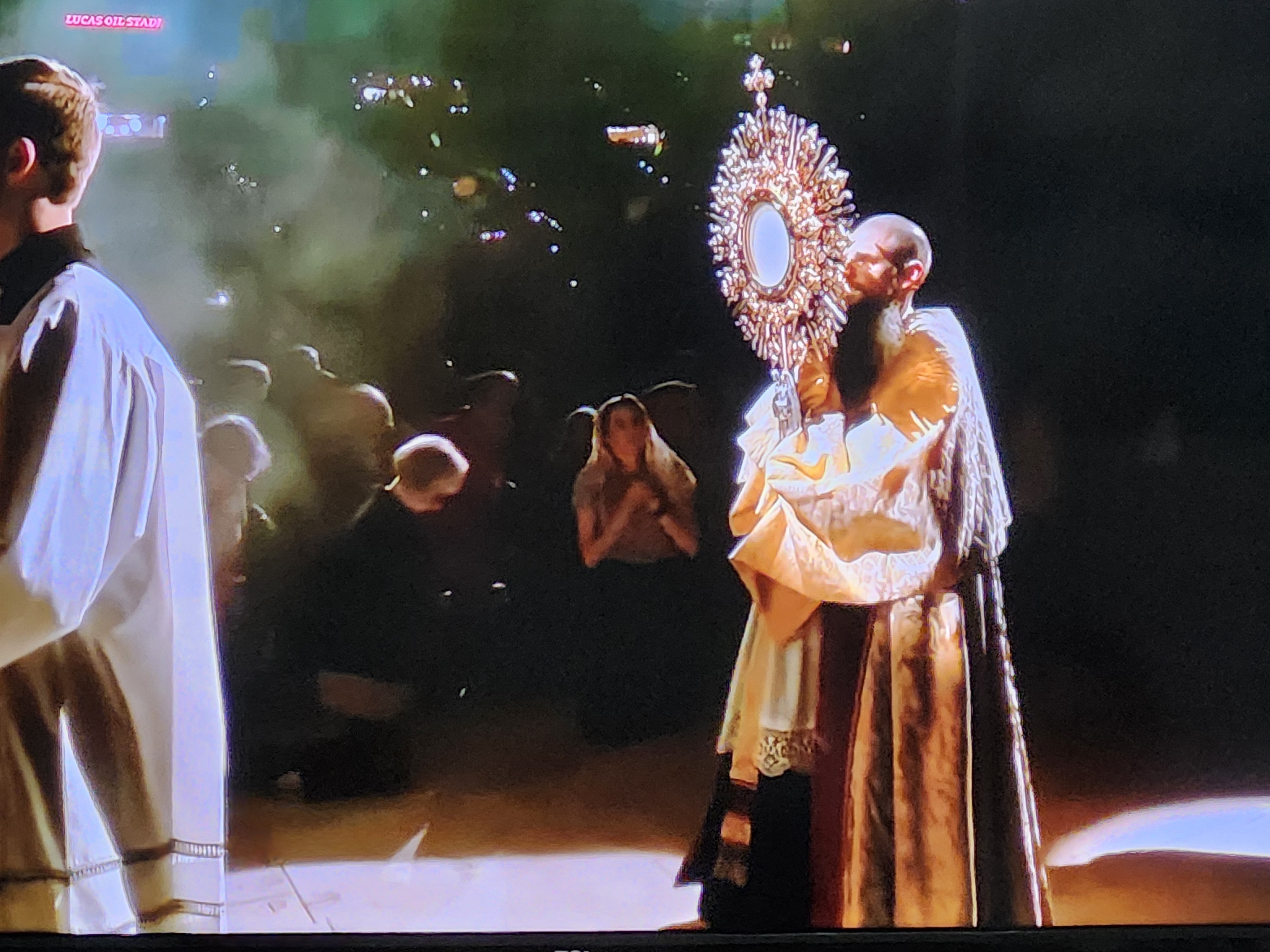
Fr. Boniface Hicks in the evening for Reconciliation and Healing.

One of the speakers asked us to think of a song that speaks to the deepest moment of our relationship with Jesus. I immediately thought of Twila Paris’ “How Beautiful.”

How beautiful the hands that served
The wine and the bread and the sons of the earth
How beautiful the feet that walked
The long dusty roads and the hill to the cross
How beautiful, how beautiful, how beautiful
Is the body of Christ…

Looked around Lucas Oil Stadium filled with priests, religious, moms and dads, kids, grandparents, teens…
all truly falling in love with Jesus again…
all worshiping the Lord of Glory and the King of the Universe…

How this revival sessions and liturgies renewed my love for the Bride of Christ. Jesus is beautiful, and his bride the Church is truly beautiful…
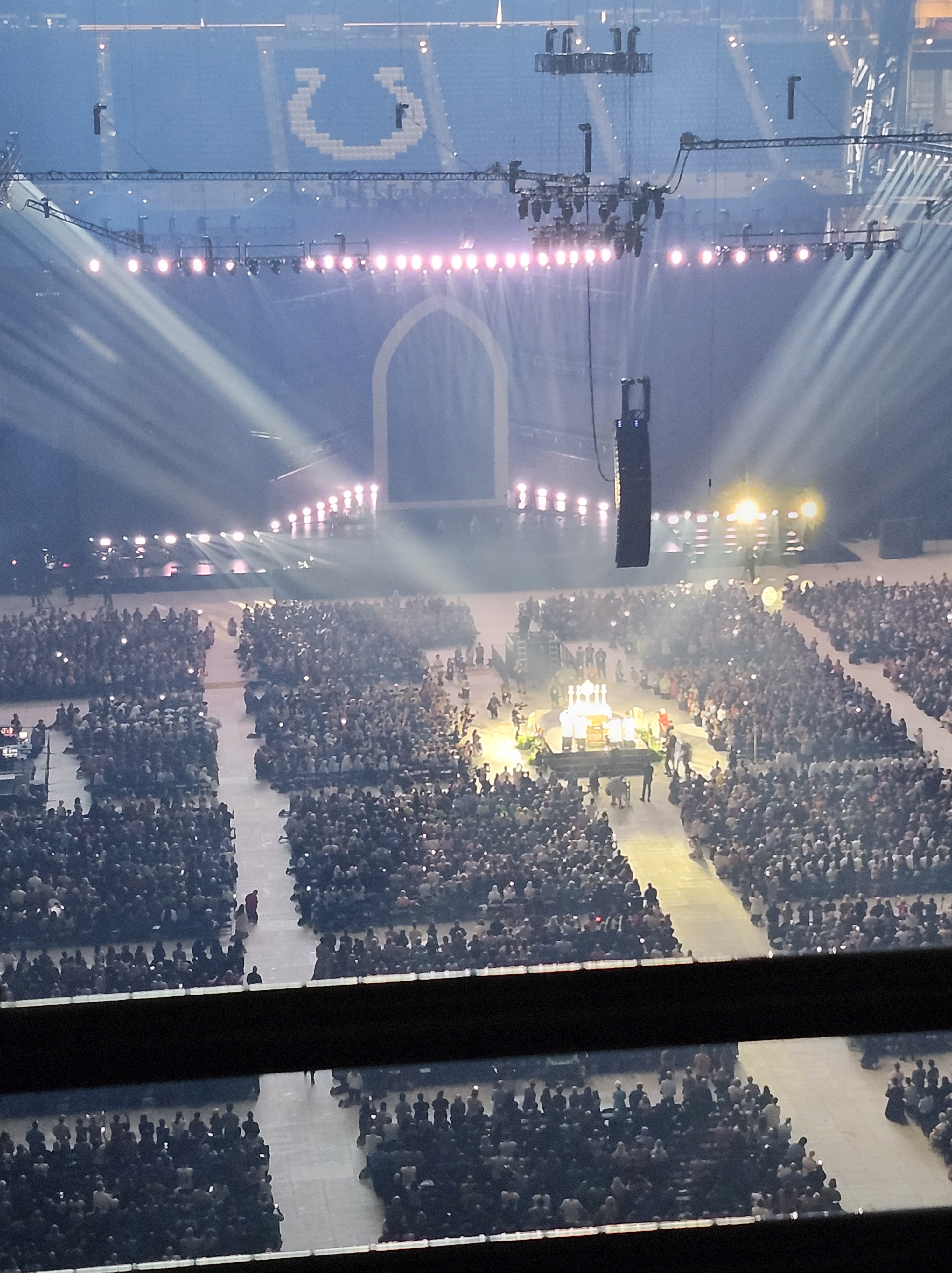
The first Revival Evening Session, where all 50,000 of us silently adored Jesus, giving him the first word…

I’m discovering a new appreciation for our Eucharistic spirit. Blessed James Alberione said that our role before the tabernacle is to be:

“living lamps before Jesus in the Eucharist…
handmaids of honor of the tabernacle and of its Divine Dweller;
angels of the Eucharist who receive and who give;
souls who hunger and thirst for the bread of the Eucharist and the water of his grace;
hearts that share with their Spouse in the Eucharist his desires, his goals, his self-sacrifice for all;
the intimate confidants of Jesus in the Host, listening to every word of life and meditating on it in your heart, as did Mary.”

And in another place Alberione helped us grasp the disappointment of Jesus who so often  waits for someone to be with him in empty churches: “If Jesus is continually present in the Holy Tabernacle, it means we have the duty to visit him. He awaits us. But our God has to always wait in vain for people who are busy with a thousand things and forget the One who is the Supreme Good, the One who said: ‘I will be with you.’ Jesus waits for us.”

I left renewed, refreshed, and with something very deep that had shifted in the way I now look at the world. Jesus is the Lord of history and nothing that happens really is outside of his love and his mercy.

This is the entrance procession of the final liturgy. It took 40 minutes for 2000 deacons, priests and bishops to process in. I was overwhelmed by the sheer magnitude of the goodness of the Bride of Christ all around me and prayed for each person there.

Some beautiful things:

Our Founder Blessed James Alberione told us that only in heaven would we know the good we had done, since our apostolate mainly is about scattering the seed, broadcasting the Word as far as we can. We really don’t know who is on the other side reading, listening, watching…being touched and transformed by God’s grace.

Our exhibit.

Well, in this one instance he was wrong. People were constantly coming up to our tables in the exhibit hall or approaching us in the hallways to thank us for the way in which their experience of God’s grace through the Pauline mission had made them who they are today. I met a woman who had read My Friend magazine (I had been the managing editor of the magazine for kids many moons ago). Proudly she introduced her kids to us. A sister had known Sr Augustine while she was in Kenya and at that time still an Anglican. She wanted a selfie just to show Sr Augustine where she was now. Another sister had attended our Baby Jesus parties in Culver City, California until she was twelve and now serves the homeless as a religious sister.
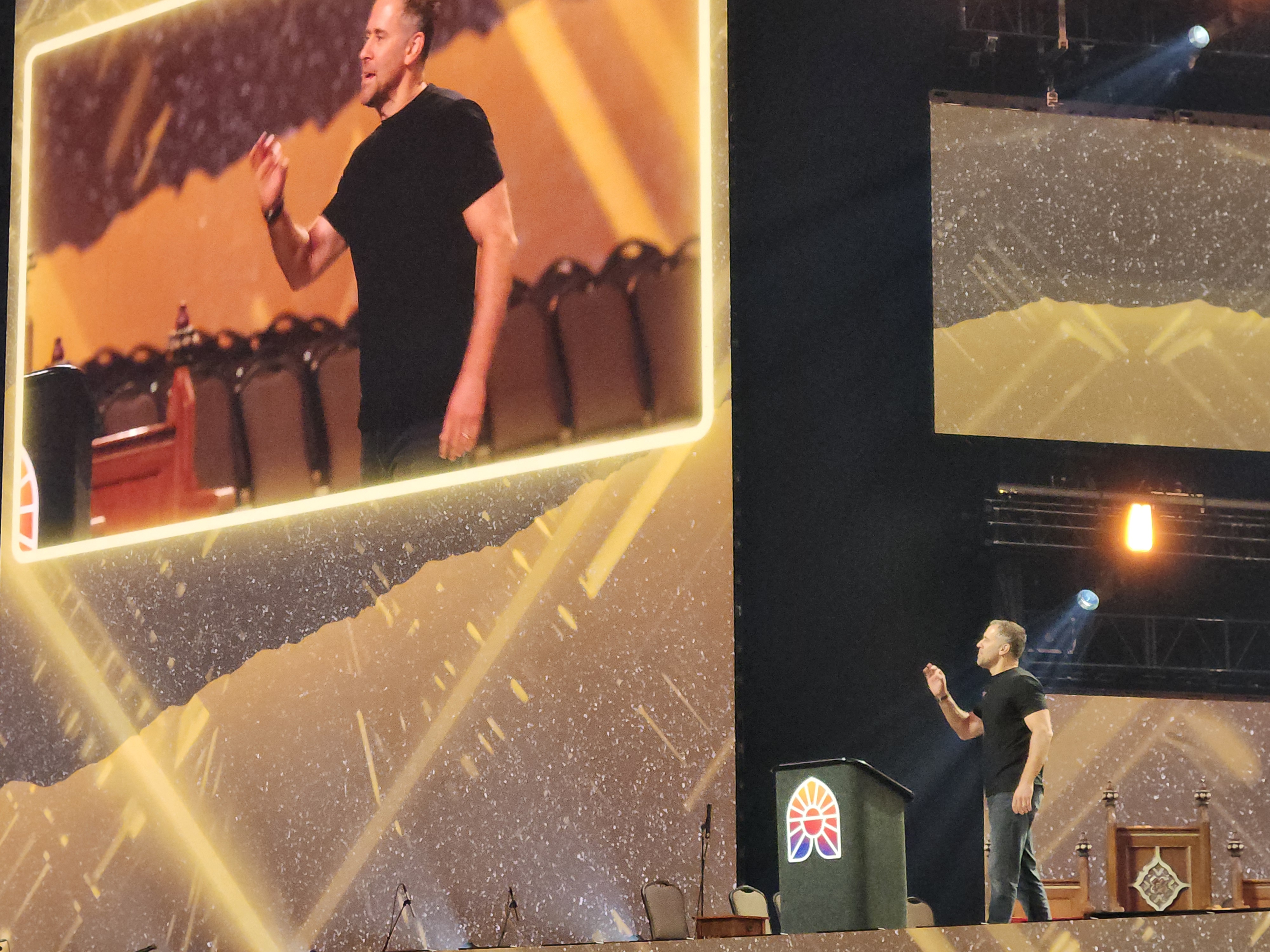
Chris Stefanick gave an inspiring presentation on the last day. He reminded us that we pray too small. God created the universe so ask BIG THINGS from the Almighty!

There were epiphanies all throughout the five days of the Encounter, moments when God was opening up something deeper in me. For example, I was struck by Chris Stefanick who said about sharing the Gospel of Jesus Christ: “If God opens a door, you open your mouth, that’s it, you’ll figure it out as you start talking.” They were words I needed to hear, and God gave me an opportunity on the plane heading home to practice by sharing Jesus with a seven-year-old girl. (I’m a writer and not comfortable with thinking and speaking on me feet.) But there were other “epiphanies,” as I call them: how God is changing my prayer and my selfishness. By holding on to these experiences in prayer, the graces of the Congress are being planted deeply within.
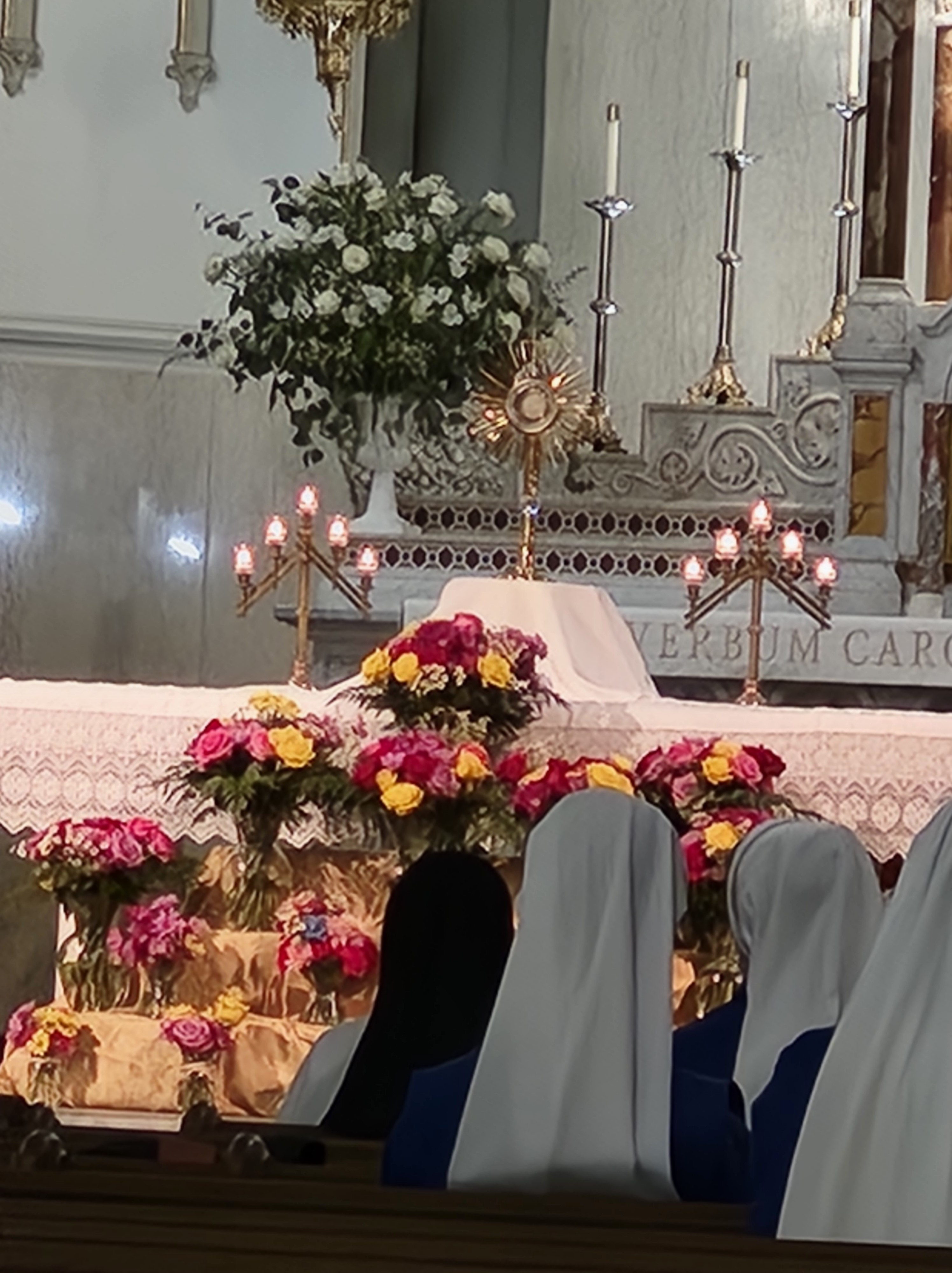
Sisters made sure that Jesus was accompanied 24/7 during the entire Congress in the Church across the street from the convention center. All day it was filled with people quietly praying before Jesus.

At the Congress we were immersed in what was most real and most true. As I watched the almost 2000 priests, deacons, and bishops process into the Stadium at the opening of the Concluding Mass, a full 40 minutes, I was deeply moved by goodness and hope, and I prayed for each of them and for the whole church in the US. Sometimes I get weighed down by what is broken and difficult and tragic in our church community, so much so that I can forget what is true, and good, and beautiful. We can hold on to what Bishop Cozzens prayed in the first evening’s Revival Session: “We know that we are broken, and our world is broken, but we know that you have conquered sin and death and have given us yourself as a foretaste of heaven. We know, God, that you are able to accomplish far more than we ask or imagine by the power of the Eucharist.” As you reinsert yourself into “real” life, keep the eyes of your heart on Jesus who “sacrificed himself in order to give us life, who loved us to the end.”
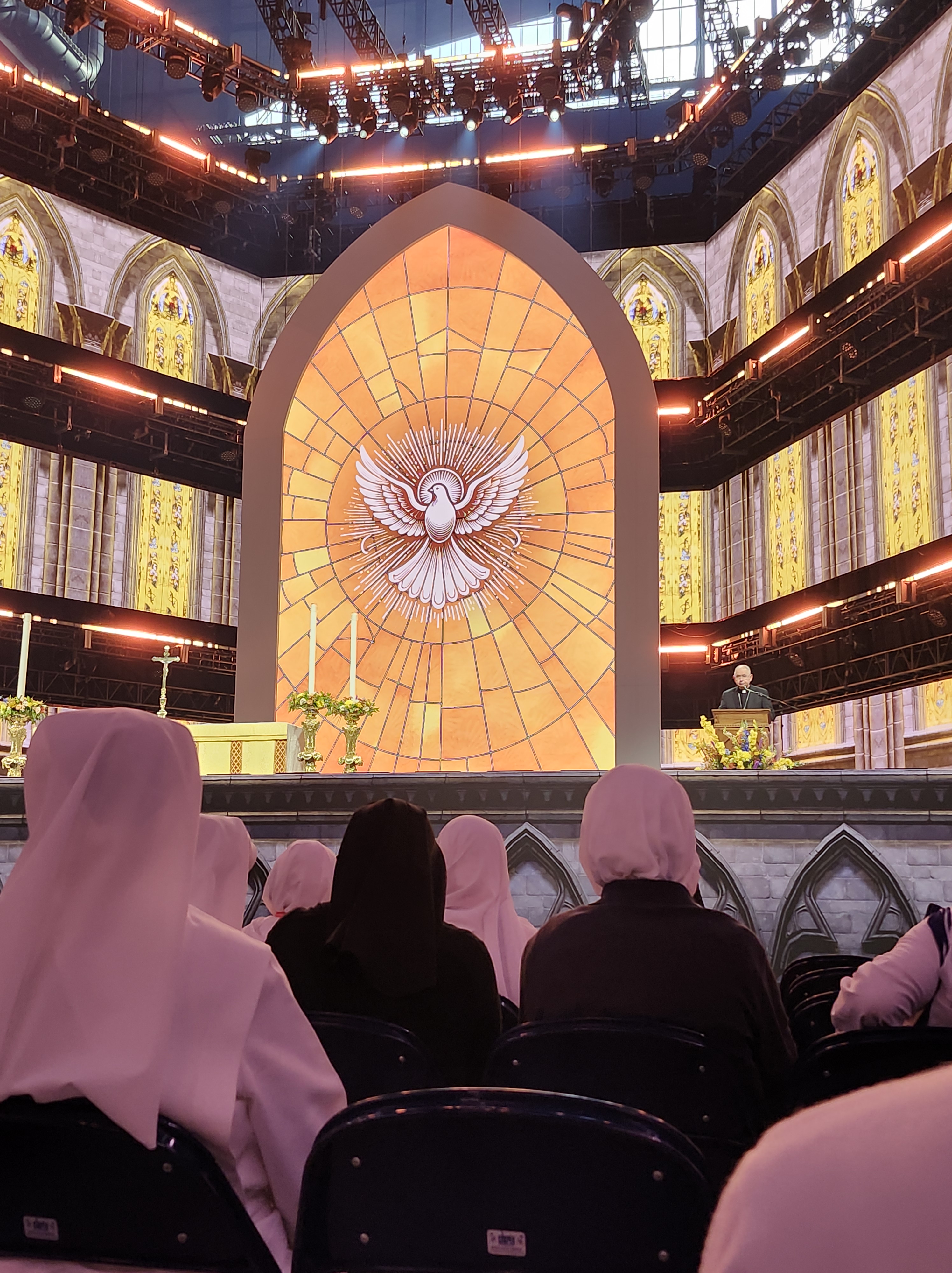
The Revival was meant to be a new Pentecost for the Church in the U.S. We certainly felt that in Indy.

As we were sent out from the Congress in the final liturgy, we were told to GO! GO! GO! “Go” is two-thirds of God’s name. We were sent like the first Christians just to tell our story, and to walk with someone back to Jesus.

There is someone in your life right now whom Jesus longs to call to himself. He wants to spark a relationship with them and bless them with his sacraments. In this Year of Mission, Catholics across the U.S. are saying “yes” to a special form of heart-to-heart accompaniment called the Walk With One initiative. You too can share in this by telling your story to someone who still needs to hear Jesus’ love for them. Take some time to download and understand the simple process for Spirit-led accompaniment.
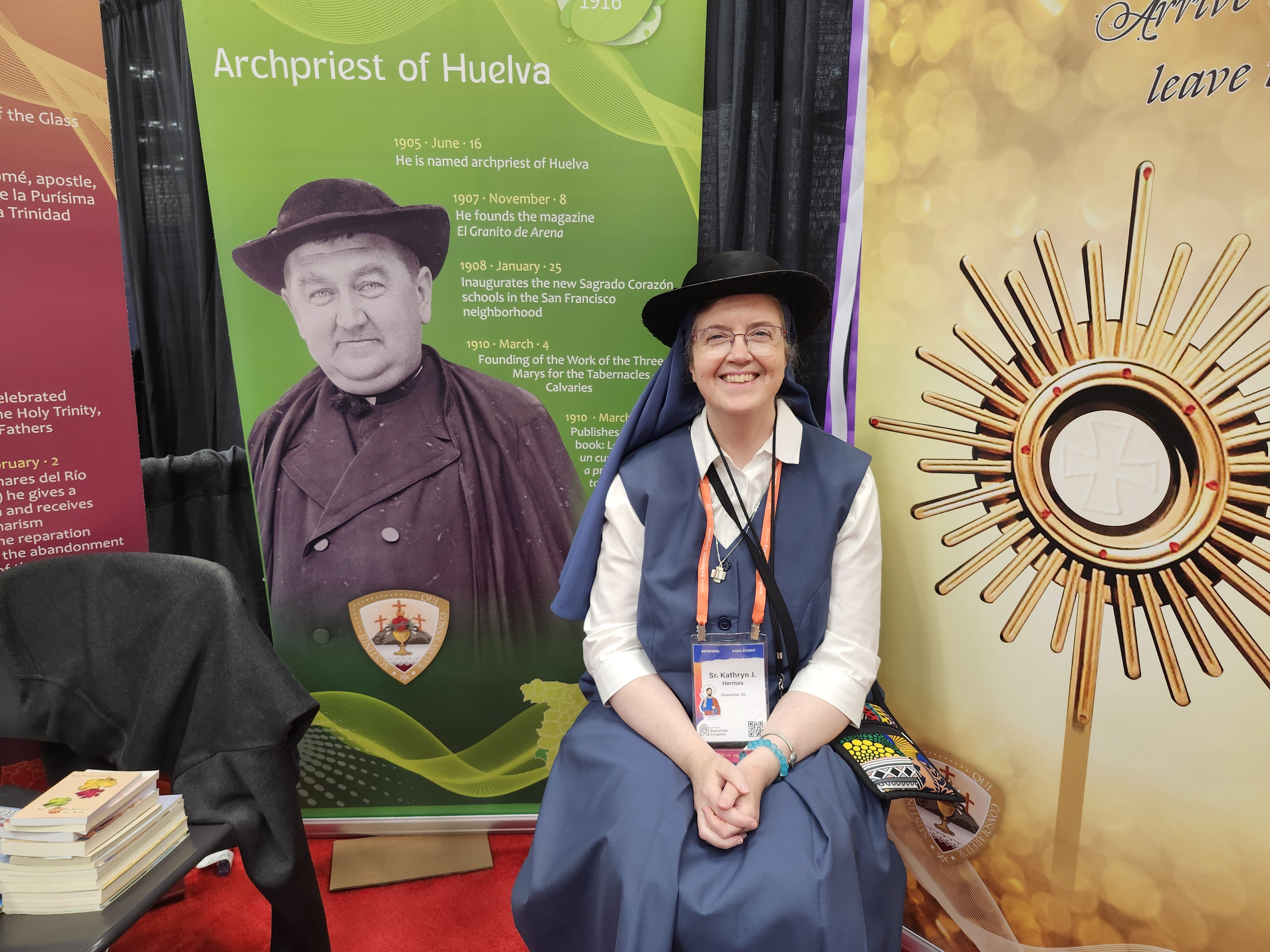
Here I am wearing the hat of Saint Manuel Gonzalez Garcia, the bishop of the abandoned tabernacle. It is a second-class relic. After praying for the grace to love Jesus as Saint Manuel did, someone was kind enough to take my picture.

These first days and weeks after the Congress are the beginning of the rest of my life and yours as a disciple of Jesus Christ. For all of us, something profound has shifted whether we were there or praying from afar, whether we are aware of the transformation that Jesus is bringing about or waiting to see what will emerge in our life. Now is the time to intentionally listen to how God will now be loving you and sending you to others, for the life of the world.

How to Be Good Soil (Matthew 13:18-23)

Jesus said to his disciples:
“Hear the parable of the sower.
The seed sown on the path is the one who hears the word of the Kingdom
without understanding it,
and the Evil One comes and steals away
what was sown in his heart.
The seed sown on rocky ground
is the one who hears the word and receives it at once with joy.
But he has no root and lasts only for a time.
When some tribulation or persecution comes because of the word,
he immediately falls away.
The seed sown among thorns is the one who hears the word,
but then worldly anxiety and the lure of riches choke the word
and it bears no fruit.
But the seed sown on rich soil
is the one who hears the word and understands it,
who indeed bears fruit and yields a hundred or sixty or thirtyfold.”

Matthew 13:18-23

Jesus is the divine Sower who sows the seed of his word in the community of followers he is calling apart from the world. It is in hearing the word of God that the seed takes root in us.

To hear, to really hear, to absolutely hear the voice of God and not the myriad other distracting voices that call out for our attention, we must do something that is very difficult. We must cultivate silence.

Most retreatants discover on the first day or so of a retreat, in the quiet of the retreat house with nothing to do except listen to God’s voice, that a thousand other voices—strident and loud—all of a sudden appear, clamoring for attention. Listening to their stories and letting them go can be an essential first step to creating the silent soil that can receive God’s word.

We don’t need to be on a retreat to enter into this ambient of silent recollection. It is possible to spend a short period every day as a mini-retreat to cultivate the soil of our heart. We can start by disconnecting from social media and our phones.

At first it may seem frightening to be cut off from the torrent of words and images that flood our media-saturated consciousness. We might feel nervous as we wait in silence for the work of the divine Sower. Our soul may feel fragmented and untilled and unprepared for the seed. In patience we will acquire the stillness that longs to receive the fullness of God’s word.

It is a spiritual art and discipline to be able to distinguish the harmony of God’s voice from the discord of worries, temptations, desires, and ambitions. This discernment comes precisely from the experience of entering into silence.

Pope Benedict XVI said, “‘Only in silence can the word of God find a home in us, as it did in Mary, woman of the word and, inseparably, woman of silence’ (Verbum Domini, n. 66). This principle — that without silence one does not hear, does not listen, does not receive a word — applies especially to personal prayer as well as to our liturgies: to facilitate authentic listening, they must also be rich in moments of silence and of non-verbal reception” (General Audience, March 7, 2012).

How does God desire you to open wide your heart in silence? Ask the Lord what practical steps he desires you to take to recover this contemplative dimension of life.

Image: ThePixelman via Pixabay.

Praying with this Passage of Scripture

Lectio Divina is a way of listening to God as he speaks in his Word. It is a practice of communicating with God through Scripture and attending to God’s presence and what he wishes to tell us. In this slow and prayerful reading of the Word of God, we allow ourselves to be transformed by the Spirit who forms us into the image of Christ. There are four movements in Lectio Divina: Read (lectio), Meditate (meditation), Pray (oratio), Contemplate (contemplation).

Begin by finding a still space to pray. Breathe deeply and become quieter within. Abandon any agenda, worries or thoughts you bring to this prayer and entrust these things to the merciful care of God. Ask for the grace to be receptive to what God will speak to you through this Scripture reading. Grant me, Jesus Divine Master, to be able to know the mysteries of the kingdom of God and your unfathomable riches. Grant that your word penetrate my soul; guide my steps, and brighten my way till the day dawns and darkness dissipates, you who live and reign forever and ever Amen.

Read (lectio)
Begin by slowly and meditatively reading your Scripture passage out loud. Listen for a particular word or phrase that speaks to you at this moment and sit with it for a time.

Pray (oratio)
Read the text a third time. Listen for what God is saying to you. Speak heart to heart with God. Notice the feelings that this conversation with God raises up within you. Share with God what you notice about your response to this conversation. You may wish to return to repeating the phrase quietly and gently, allowing it to permeate you more and more deeply.

Contemplate (contemplatio)
Read the text a final time. Now be still and rest in God’s embrace. Ask God to give you a gift to take with you from this prayer. You might ask God if he is inviting you to do some action, for instance, make some change in your thoughts, attitudes or reactions, in the way you speak or how you treat others. Thank God for this gift and invitation as you conclude your prayer.

Image: Myriams-Fotos; pixabay.com

Jesus asks, “Will you come to me?” (Matthew 11:28-30)

Jesus said:
“Come to me, all you who labor and are burdened,
and I will give you rest.
Take my yoke upon you and learn from me,
for I am meek and humble of heart;
and you will find rest for yourselves.
For my yoke is easy, and my burden light.”

Matthew 11:28-30

“Come to me.” The words of a lover. Powerless words. Vulnerable words. The one who says these words must wait upon the response of the one to whom they are addressed.

“Will you come to me?”

The loved one must answer yes or no.

If he or she answers “Yes,” than this love of Jesus has triumphed, and Jesus can open his heart completely to pour out on the loved one that fullness of the life he shares with the Father. If the answer is “No,” a love refused, then the gift of love has met with a tragic end.

Ultimately, the invitation of the Father and the Son to the world, inviting  each person into their eternal loving and living and giving is, in fact, limited only by human refusal.

As soon as we say our “Yes” to Jesus, we discover that the pressures that weigh upon us from both the world and our own selves begin to fade away. We are let in on the “secret,” so to speak, of the mystery Jesus came to reveal to us.

We begin to see how we receive all from the Father, every last thing that we are and have and accomplish. In Jesus we see the way to live in relation to the Father: in blessing and thanksgiving, wasting our time in worship and wonder. We make the astounding discovery that in truth the world has no power over us when we make our home in God.

Jesus asks you today and every day, in situations of joy and in pain, in laughter and in tears, in circumstances that demand outstanding courage and those that require a humble peace, “Come to me!”

Jesus stands at the door of our hearts as a beggar, but—oh!—how much joy fills his heart when we reach out our hand to take his that we might go with him wherever he leads. Image: Leiloeira São Domingos, Public domain, via Wikimedia Commons

Praying with this Passage of Scripture

Lectio Divina is a way of listening to God as he speaks in his Word. It is a practice of communicating with God through Scripture and attending to God’s presence and what he wishes to tell us. In this slow and prayerful reading of the Word of God, we allow ourselves to be transformed by the Spirit who forms us into the image of Christ. There are four movements in Lectio Divina: Read (lectio), Meditate (meditation), Pray (oratio), Contemplate (contemplation).

Begin by finding a still space to pray. Breathe deeply and become quieter within. Abandon any agenda, worries or thoughts you bring to this prayer and entrust these things to the merciful care of God. Ask for the grace to be receptive to what God will speak to you through this Scripture reading. Grant me, Jesus Divine Master, to be able to know the mysteries of the kingdom of God and your unfathomable riches. Grant that your word penetrate my soul; guide my steps, and brighten my way till the day dawns and darkness dissipates, you who live and reign forever and ever Amen.

Read (lectio)
Begin by slowly and meditatively reading your Scripture passage out loud. Listen for a particular word or phrase that speaks to you at this moment and sit with it for a time.

Pray (oratio)
Read the text a third time. Listen for what God is saying to you. Speak heart to heart with God. Notice the feelings that this conversation with God raises up within you. Share with God what you notice about your response to this conversation. You may wish to return to repeating the phrase quietly and gently, allowing it to permeate you more and more deeply.

Contemplate (contemplatio)
Read the text a final time. Now be still and rest in God’s embrace. Ask God to give you a gift to take with you from this prayer. You might ask God if he is inviting you to do some action, for instance, make some change in your thoughts, attitudes or reactions, in the way you speak or how you treat others. Thank God for this gift and invitation as you conclude your prayer.

Image: Myriams-Fotos; pixabay.com

Jesus Preaches in Nazareth – Spiritual Consolation (Horizons of the Heart 37)

The grace we are asking of God: to discover Jesus in my own personal story so that my personal myth may be transformed in Jesus, as was that of Ignatius, that I will be disposed to hear God’s call and follow it wholeheartedly

Horizons of the Heart is inspired by the Spiritual Exercises of St Ignatius and my own notes from my thirty-day Ignatian retreat in 2022. See an index for the whole series.

Begin by relaxing your body, your mind, letting go of anxieties and ambitions and expectations and plans… Lay all that you notice and all that you are bare and exposed before the Father who welcomes you with a gaze that is gently loving. Settle into the silence that runs deeper than emotional turbulence… Move beyond imagination where you wait upon the stirring of the soul and the movement of the heart. Return to Jesus to find the Rest he offers…to welcome the gift…to become a child held in safe arms….

Making Space for the Word

Ask Jesus that every aspect of this prayer will please him and will give glory to God.

“He has sent me … to proclaim the year of the Lord’s favor.”

Then Jesus rolled up the scroll, gave it back to the attendant and sat down. The eyes of everyone in the synagogue were fastened on him. He began by saying to them, “Today this scripture is fulfilled in your hearing.”

All spoke well of him and were amazed at the gracious words that came from his lips. “Isn’t this Joseph’s son?” they asked.

The last part of Jesus’ proclamation stated that he was sent to proclaim a year of the Lord’s favor or grace that had been announced by Isaiah. Luke uses this same phrase in the Acts of the Apostles as a reference to the gospel proclamation.

The Greek verb μαρτυρέω (martureo) translated often as “speak well of” means simply to “testify” or to “bear witness.”  Daniel Hoffman explains that translated literally, the statement reads like this: “And all were bearing witness about him and were marveling at the words of grace coming from his mouth; and they were saying, “Is this not the son of Joseph?”

“They were not impressed with his words, they were amazed (in the skeptical sense) that he was telling them that the time of the Lord’s favor was now. They doubted it, and their question confirms this—Asking ‘Is not this Joseph’s son?’ is not a compliment, but a scoff. “

They only became angrier as Jesus continued:

Jesus said to them, “Surely you will quote this proverb to me: ‘Physician, heal yourself!’ And you will tell me, ‘Do here in your hometown what we have heard that you did in Capernaum.’”

“Truly I tell you,” he continued, “no prophet is accepted in his hometown. I assure you that there were many widows in Israel in Elijah’s time, when the sky was shut for three and a half years and there was a severe famine throughout the land. Yet Elijah was not sent to any of them, but to a widow in Zarephath in the region of Sidon. And there were many in Israel with leprosy in the time of Elisha the prophet, yet not one of them was cleansed—only Naaman the Syrian.” (Luke 4:20-27)

Pause and enter into the drama of these words of Jesus and the consternation with which they must have been received…. Noticing the way in which the sunny skies of excitement and pride over Jesus were quickly turning to bafflement, confusion, and aggression.

Be present to the way Jesus “senses” the situation. As Gemma Simmonds reminds us, in Ignatian prayer, to “sense” includes mental thoughts, intuition, emotions, as well as bodily processes (our emotions often generate strong bodily reactions as when our cheeks become flushed when we are embarrassed or our fists clench when we are angry).

Be present to all the intensity in Jesus who has come as the ambassador of the Lord’s love and compassion and faithful loyalty to his people. And instead of welcoming and receiving that love, they respond by scoffing at him.

Entering still deeper into the mystery of Christ, allow your heart to taste, to smell, to touch the infinite gentleness and sweetness of Jesus. Allow your spirit to soak up what has been felt and known in this contemplative prayer.

As you do this your mind’s activity will fade into the background, and the mystery you are intuitively contemplating will begin to take over and engulf you, planting within your spirit an inner knowledge of the Lord.

You will at some point begin to intuitively sense the difference between the way Jesus spontaneously feels, speaks, and acts in a situation and the way you yourself feel, speak, and act in similar situations in your own life.

As you stay within Jesus, he will reveal to you how he is experiencing the rejection of his offer of love, freedom, good news, grace and salvation.

What is it that you notice?

What in Jesus is drawing you?

What in Jesus is speaking to your life’s story right now?

Let the mystery of Christ’s life become present to you. Take much time with this. Let your senses and his be tuned together by the action of the Holy Spirit. Let them play in harmony. Let Jesus’ interior life absorb your inner life so that you become “connatural” with him and your inner world is “taken over” at an intuitive level, being established firmly in the “inner knowledge of the Lord.”

This experience of feeling with Jesus, or enjoying this inner knowledge of the Lord, is a window into what Ignatius called “spiritual consolation.” Ignatius said consolation is when, “Some interior movement in the souls causes the soul to become inflamed with love of its Creator and Lord.” This prayer changes the way we perceive and experience reality. We learn how to be in Jesus and to imitate him in the way he experienced every aspect of human need and desire.

We reach greater understanding when we take quality time to feel with Jesus, as he reveals himself, looking and hearing, touching and tasting, in the Gospel Word. Contemplation of Jesus becomes the path to imitate Jesus.

Rest in that awareness as Jesus helps you to resonate with what he resonates with.

A gift to take with you

Allow an image or object that encapsulates all these experiences to form in your mind. Take some time to speak with God about the meaning or significance of this object.

Ask Mary, Joseph and Jesus to show you one specific gift they wish to give you. Receive it and remain in stillness and quietly relaxed presence under the influence of the Holy Spirit.

Reviewing the Graces of Prayer

When you finish praying, write down the main gifts and discoveries from this time of intimate contemplation. What is one concrete thing you can do to solidify these gifts in your life.