
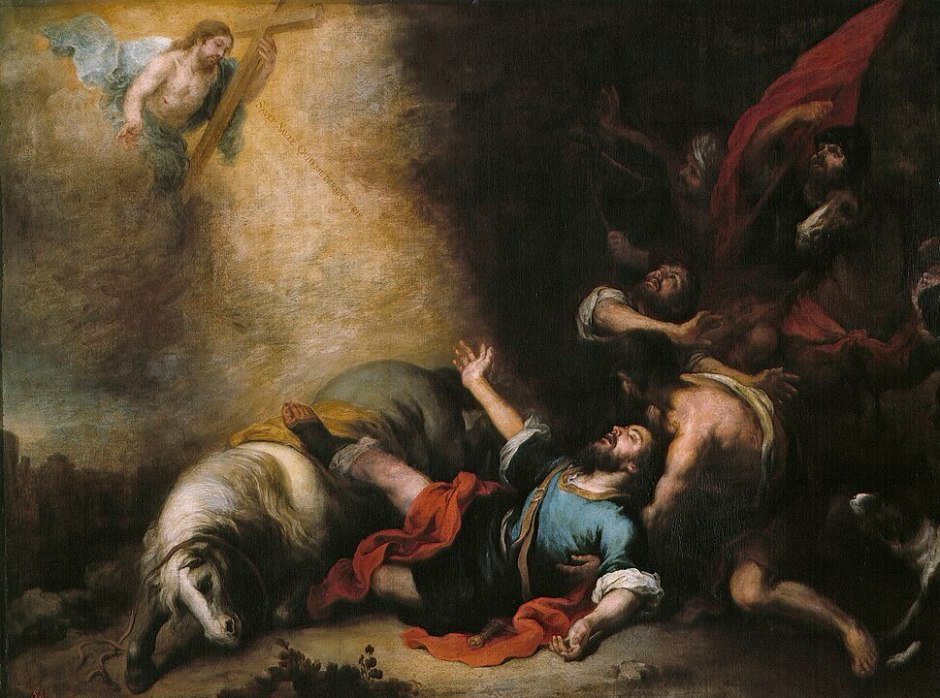
Paul had no way of knowing when he awoke on the day he planned to descend on Damascus and take the followers of Jesus captive in order to put them into prison, that he himself stood on a threshold….
No way of knowing that he himself that day would be taken captive, that he would be captured and captivated by the One for whom he would live the rest of his life….
There in the dust on the outskirts of Damascus, radiant light all around him, his eyes in darkness, confusion swirling in his heart, he was uprooted from one life and planted in another. His response, “Lord, what would you have me do?” closed one era of his life and ushered in another.
Transition moments are rarely neat. They aren’t pretty. Sometimes they don’t even make sense. Paul’s conversion which we celebrate in the liturgy on January 25 appears quite dramatic and immensely important in hindsight. We’ve witnessed for 2000 years how the life and teaching of this greatest of apostles has transformed the Church and powerfully influenced the world.
I am sure, however, that as Paul reached out for help as he stumbled to stand up and as he was led by hand just like a child into the very city his arrival had been a day earlier such a cause for alarm, it was far from glorious. With every humiliating and faltering step into the city of Damascus, Paul was no doubt met with the comments and astonished jeers of bystanders.
When we are done with being captivated by our great plans and our stunning ideas and surrender to the Lord who takes us captive through similar not-so-pretty situations, we also are at a threshold in our lives. And this moment can seem equally inglorious. It can be difficult to cherish the hope that the closing of a door is offering the hope of a future ripe with new possibilities.
At these moments, remember this: You like Paul have been made for a purpose greater than anything you could think of. You like Paul have been made for something far more than this world. After that meeting with Jesus on his way to Damascus, Paul didn’t just change his behavior, or his goals, or his way of behaving, or what he was doing. Paul allowed God to pull him up into his own mighty mystery and unfolding selfless loving of the world.
After his “conversion” Paul belonged entirely to God, but he also finally belonged most truly to himself. He now knew deeply the reason for which he had been born. His joy grew from strength to strength, even in suffering and weakness, as he discovered every day how glorious it is to be remade in the image of Christ for the glory of God the Father. This is the promise held out to each of us as we celebrate this feast in the Church.

Praying with this Passage of Scripture
Lectio Divina is a way of listening to God as he speaks in his Word. It is a practice of communicating with God through Scripture and attending to God’s presence and what he wishes to tell us. In this slow and prayerful reading of the Word of God, we allow ourselves to be transformed by the Spirit who forms us into the image of Christ. There are four movements in Lectio Divina: Read (lectio), Meditate (meditation), Pray (oratio), Contemplate (contemplation).
Begin by finding a still space to pray. Breathe deeply and become quieter within. Abandon any agenda, worries or thoughts you bring to this prayer and entrust these things to the merciful care of God. Ask for the grace to be receptive to what God will speak to you through this Scripture reading. Grant me, Jesus Divine Master, to be able to know the mysteries of the kingdom of God and your unfathomable riches. Grant that your word penetrate my soul; guide my steps, and brighten my way till the day dawns and darkness dissipates, you who live and reign forever and ever Ame
Read (lectio)
Begin by slowly and meditatively reading your Scripture passage out loud. Listen for a particular word or phrase that speaks to you at this moment and sit with it for a time.
Meanwhile, Saul was still breathing out murderous threats against the Lord’s disciples. He went to the high priest and asked him for letters to the synagogues in Damascus, so that if he found any there who belonged to the Way, whether men or women, he might take them as prisoners to Jerusalem. As he neared Damascus on his journey, suddenly a light from heaven flashed around him. He fell to the ground and heard a voice say to him, “Saul, Saul, why do you persecute me?”
“Who are you, Lord?” Saul asked.
“I am Jesus, whom you are persecuting,” he replied. “Now get up and go into the city, and you will be told what you must do.”
The men traveling with Saul stood there speechless; they heard the sound but did not see anyone. Saul got up from the ground, but when he opened his eyes he could see nothing. So they led him by the hand into Damascus. For three days he was blind, and did not eat or drink anything. (Acts 9)
Meditate (meditatio)
Read the same passage a second time. As you re-engage the text, let the word or phrase that stood out become your invitation to speak from your heart with God who wishes to share his heart with you. Allow this word or phrase to wash over you and permeate your thoughts and feelings. You may wish to repeat this phrase quietly and gently for a period of time
Pray (oratio)
Read the text a third time. Listen for what God is saying to you. Speak heart to heart with God. Notice the feelings that this conversation with God raises up within you. Share with God what you notice about your response to this conversation. You may wish to return to repeating the phrase quietly and gently, allowing it to permeate you more and more deeply.
Contemplate (contemplatio)
Read the text a final time. Now be still and rest in God’s embrace. Ask God to give you a gift to take with you from this prayer. You might ask God if he is inviting you to do some action, for instance, make some change in your thoughts, attitudes or reactions, in the way you speak or how you treat others. Thank God for this gift and invitation as you conclude your prayer.
Image: Bartolomé Esteban Murillo, Public domain, via Wikimedia Commons
 Touching the Sunrise