
The grace we are asking of God: a deeply felt awareness of how God in all of history and most powerfully in the Word made flesh draws us into the unfolding of the mystery of his love which always is extravagant and which is ever seeking to save us. We desire that in doing this we enter into a process of healing and conversion that we might love Jesus and follow him more intentionally, completely, and wholeheartedly.
Horizons of the Heart is inspired by the Spiritual Exercises of St Ignatius and my own notes from my thirty-day Ignatian retreat in 2022. See an index for the whole series.
Ignatius is a master as he leads us to become like unto Christ in the deepest manner possible. He understands human nature so well that like a surgeon he puts his finger precisely where we are deeply conflicted: what we know intellectually for our lives to change is opposed by the murky area of our feelings and desires.
If we were to remain at a simple explanation of Ignatius’ prayer method, it could seem that the point of Ignatian Contemplation is to simply imagine with our five senses, for example, to imagine ourselves using our senses in whatever Gospel passage we are praying with: smelling, tasting, and touching our way through the wedding feast of Cana, for instance, or smelling the Sea of Galilee and touching Peter’s boat at the call of Peter. The problem with this interpretation is that first, a person would need a vivid imagination to pray in this way, and second, this would not lend itself to the general goal of loving Jesus and following him more intentionally, completely, and wholeheartedly. Or, as Ignatius puts it, seeing more clearly, loving more dearly and following more nearly.
Ignatius was a master, instead, at a very contemporary focus on the body as a conduit for contemplation and discernment. This way of praying, as Gemma Simmonds, CJ has written, “can lead to the concretisation of whatever movements the Spirit is prompting, as we reach a deeper understanding of our own senses by experiencing and sharing how the embodied eternal Word uses his. Our imitation of Christ becomes more exact as we feel each sensation with and in him” (Thinking Faith, March 7, 2018).
We can use the senses as a means of prayer and discernment. In a deeply contemplative prayer we can be present to Jesus as he acts through his own bodily senses.
Gemma Simmonds helps us see the power of this contemplative presence:
“It helps to think how often we refer to bodily sensations in order to describe a powerful and instinctive reaction: ‘I had a gut feeling’, ‘I found that hard to swallow,’ ‘it took my breath away.’ We incarnate within our bodily sensations some of our strongest responses, and in the gospel we see Jesus doing the same. In the English translation of John’s Gospel, we find him deeply moved as Mary weeps for her dead brother Lazarus. The Greek verb indicates the snorting of a horse or the growling of an angry creature. It is a strong bodily reaction indicative of many possible emotions: grief, frustration, anger – a general sense of being overwhelmed by his own feelings and those of others.”
We can see from this that “to sense” means more than imagining with our five senses. Instead, when we pray, we are present to the way Jesus “senses” a situation. As we see in this quotation from Simmons, “to sense” includes mental as well as bodily processes, intuition and emotional feelings.
Just think of how a person responds when they are told that someone they love has died in an accident, or, conversely, when they receive into their arms a newborn child. More than noticing they see something, hear something, and touch something, their experience is visceral, intense, moving, transforming, emotional, deeply meaningful. We cannot remain coolly at their side, noticing what is happening through our five senses. No. We are drawn into their experience through sympathy and love. When we are present to Jesus as he “senses” a situation—with all the intensity in Jesus that we can see and hear and touch and taste and smell as he lives a deeply human experience viscerally, intensely, emotionally, intuitively—our feelings and desires attach themselves more closely to him, and we ultimately will make decisions based on Jesus’ values, desires, and demands.
The Spiritual Exercises certainly teach us to pray, but Ignatius says from the outset of the Exercises that their purpose is to rid us of disordered attachments and to “order our lives” (Spiritual Exercises, no 21). In this prayer we gain a deep inner knowledge of Jesus precisely in those areas that are for us the source of confusion and ambiguity: our feelings and desires. In this prayer we are present to the way Jesus’ senses the events in his life so that we gradually re-order our patterns of feelings and desires, our visceral responses and attitudes, our intuitions and emotions, on those of Jesus.
I invite you to a simple exercise I have found helpful in entering into Jesus and Mary “through sensing,” in the experiences of their life. To walk you through it I will use the passage from Scripture for the call of Peter. You can pray the same way with any event or action of Jesus recounted in the Scriptures.
Read the call of Peter as found in the Gospel of Luke:
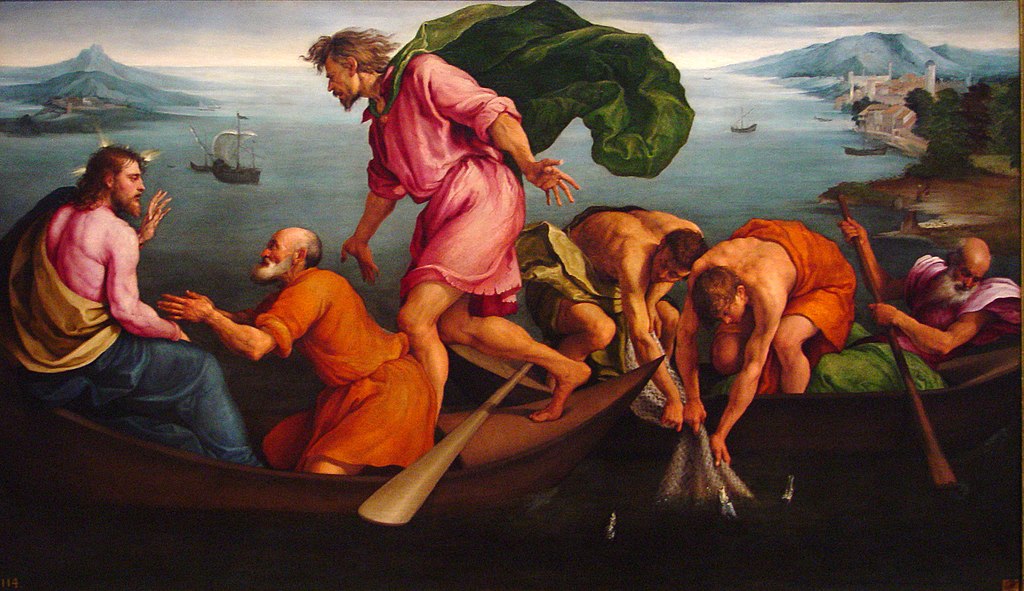
Once while Jesus was standing beside the lake of Gennesaret, and the crowd was pressing in on him to hear the word of God, he saw two boats there at the shore of the lake; the fishermen had gone out of them and were washing their nets. He got into one of the boats, the one belonging to Simon, and asked him to put out a little way from the shore. Then he sat down and taught the crowds from the boat. When he had finished speaking, he said to Simon, “Put out into the deep water and let down your nets for a catch.” Simon answered, “Master, we have worked all night long but have caught nothing. Yet if you say so, I will let down the nets.” When they had done this, they caught so many fish that their nets were beginning to break. So they signaled their partners in the other boat to come and help them. And they came and filled both boats, so that they began to sink. But when Simon Peter saw it, he fell down at Jesus’ knees, saying, “Go away from me, Lord, for I am a sinful man!” For he and all who were with him were amazed at the catch of fish that they had taken; and so also were James and John, sons of Zebedee, who were partners with Simon. Then Jesus said to Simon, “Do not be afraid; from now on you will be catching people.” When they had brought their boats to shore, they left everything and followed him (Luke 5:1-11).
Let’s choose one moment in this narrative: he saw two boats.
It would seem that Jesus had been watching the fishermen as they disembarked and were washing their nets. His attention was drawn to Peter. Yes, the crowds were there and the other fishermen, but he watched Peter. Maybe he watched for a couple hours. Maybe Jesus observed Peter over several days. What is Jesus’ gaze like? What does he see when he sees Peter?
What is Jesus thinking about Peter? What does he feel about Peter as he gets to know him from a distance? What does he begin to like about this burly fisherman? How are his feelings drawn into his Father’s pronouncement at creation: “It was very good.”
Jesus moves closer and now he can hear the conversation among the fishermen. How does Jesus listen to Peter? What does he notice? Is he listening with critical ears or with joy and esteem? Remember, the fisherman had been out all night and had caught no fish. What must that conversation among them have been like? Or was it sullen silence? Or was it exhausted banter back and forth? What was in Jesus’s heart as he listened to them? How did he viscerally react to their conversation, he who was the Word of God made flesh? Let Jesus, as he hears, reach deeply into the disordered way you yourself may listen to others, and let him re-order your life in that place.
Continue in this contemplation in this way, moment by moment.
Jesus watches Peter interact with the other fishermen. Notice what is in Jesus’ heart as he observes Peter. Notice the way he rests his eyes on Peter over a long period of time. Is he praying to his Father while he does so? Is he laughing along with their jokes? Is he sympathizing with their frustration? Is he praying for Peter? How does Jesus experience this moment on every level of his being? Emotionally? Intuitively? Spiritually? Mentally? How does he experience the wind, the sun, the waves on the Sea of Galilee? Let Jesus draw you into his experience so that you can “tune” your own experience to his. Is there a lightness to his spirit? What kind of a person is this Jesus? In time He will show you precisely those places of disorder within you, and by remaining with him he will put them in order.
Jesus walks up and talks to Peter for the first time….
Jesus takes Peter by the hand in a handshake….
Jesus walks with Peter apart from the others….
You could try praying in this way about the following subjects of meditation: how Mary rises and spends the first hours of her day; the house of Nazareth and Joseph’s workshop; the dinner table at Nazareth; the apostles around the campfire in the evening along with Jesus; the moment Mary says, Do whatever he tells you, at the wedding feast of Cana, etc.
Image by Günther Simmermacher from Pixabay
 Touching the Sunrise
One thought on “Guide for Contemplation II: A Deep Inner Knowledge of Jesus (Horizons of the Heart 26)”