
Every few years or so the discovery of lost treasure troves makes the news. As technology has improved it has become more common that gold coins, gemstones and priceless jewels worth millions of dollars are found in sunken ships that hundreds of years ago once sailed the seas. Using metal detectors people stumble upon hidden bags of coins, and buried religious artifacts and decorative items in fields, caves and excavations. Finding lost treasure requires a lot of persistence, technology, research, financial outlay, and luck.
In the Gospel, however, Jesus tells us that we don’t need special technology nor even a lot of planning and effort to find the Treasure of all treasures. We don’t need to dive to the bottom of the sea or scout out caves or investigate archaeological digs to find the kingdom of heaven.
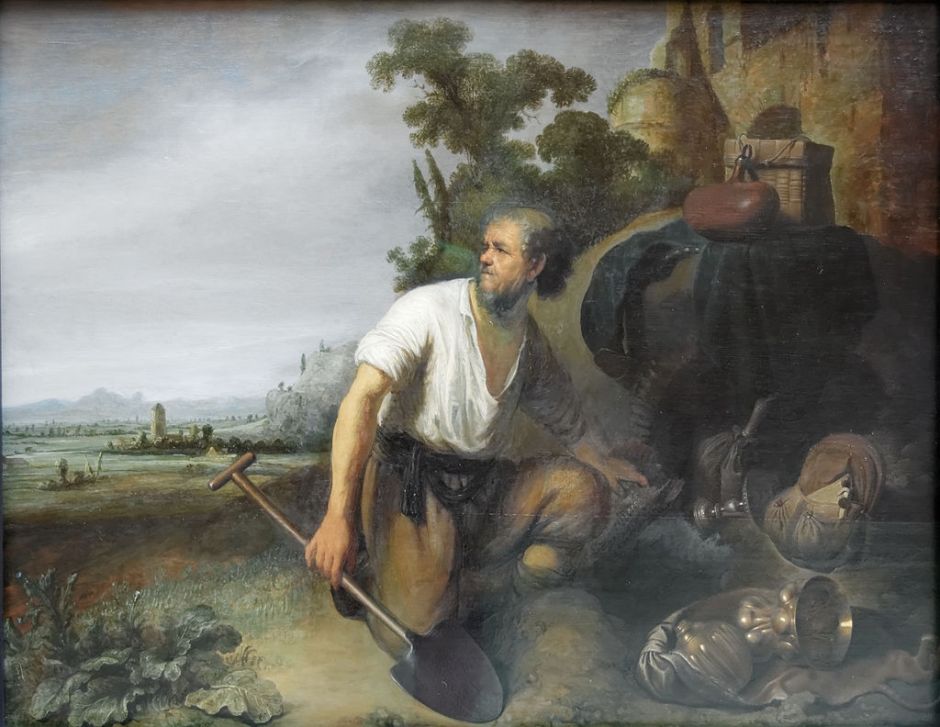
“The kingdom of heaven,” Jesus said, “is like a treasure buried in a field.”
I remember the day almost 20 years ago when I first heard Jesus’ voice in my heart—not an inspiration, but a quiet voice. I was monitoring the front desk of our motherhouse and was taking advantage of the time to read for a paper I had been assigned on the Gospel of John in the homilies of St. Augustine. There were a couple hundred pages to wade through, but that day, in one moment, one particular line shone out like a treasure and caught my attention. Years of struggling with powerful temptations had deadened my heart to hope that I could ever be good enough for God to love me. Just as Augustine was converted by reading one verse of Scripture, in one sentence I felt that God saw me, just as I was. That he knew me through and through with nothing hidden from him. I felt like there was someone else in the room looking at me, so I looked up to see who else was in the room. There was no one there. As I continued reading I felt again that there was someone gazing at me but now from within my soul, eyes that pierced and loved at the same time. Then I heard the voice: “It doesn’t matter. It doesn’t matter if you ever fix yourself and become perfect with regard to this temptation. Just keep looking at me, and letting me look at you. If you just allow us to look at each other, continually, trustfully, always, I will take care of it for you.” We all know when we’ve heard a voice by which we seem to touch the kingdom of heaven. We are pierced by the truth and often are given the gift of tears. We become attentive. We are filled with joy. We want more of what we have received. We would give everything to possess this treasure of treasures always.
“The kingdom of heaven,” Jesus said, “is like a treasure buried in a field.” This statement would have been very familiar to Jesus’ audience. Since at that time there were no banks as we know them, people would keep their “treasure” safe by burying their valuable possessions in the ground.
To the people listening to this parable, walking through fields was something they did every day. It was such an ordinary event that there would have been nothing special about a field. It would be as if Jesus said to us today: “The kingdom of heaven is a like finding a bag of a billion dollars accidentally along a sidewalk.”
I can imagine that Jesus sparked their attention with this parable and they would have had all kinds of questions: How do we know in which field the treasure has been stashed? What are the telltale signs that a treasure has been buried in a certain place? How can I be more attentive so I don’t miss the treasure? These questions turn the discovery of the kingdom into a plan.
Isn’t it true, however, that we often find the most precious things in life by accident? We stumble upon them, and they seize our imagination and steal our hearts!
The kingdom of heaven surprised me that day at the motherhouse when I heard his voice. The words of the Lord have become a touchstone in my life, a treasure by which I measure all other treasures.
“The kingdom of heaven is like a treasure buried in a field,
which a person finds and hides again,
and out of joy goes and sells all that he has and buys that field.”
In this parable, Jesus is telling us five things about the kingdom of heaven:
- the kingdom of heaven is the most valuable of treasures, the treasure of treasures
- the kingdom of heaven is hidden in our midst, we’ll find it in the ordinary places of our life where we often forget to look
- the kingdom of heaven will surprise us as we go about our daily life—it is a gift
- the kingdom of heaven is a treasure so wonderful that the joy of having discovered it makes every sacrifice to possess it well worth it
- the kingdom of heaven costs everything because it radically changes our lives and our loves.
The kingdom of heaven is here, right in our midst, ready to surprise you. If you find it, sell all you have to possess it. You will not be sorry.

Praying with this passage of Scripture
Lectio Divina is a way of listening to God as he speaks in his Word. It is a practice of communicating with God through Scripture and attending to God’s presence and what he wishes to tell us. In this slow and prayerful reading of the Word of God, we allow ourselves to be transformed by the Spirit who forms us into the image of Christ.
There are four movement in Lectio Divina: Read (lectio), Meditate (meditation), Pray (oratio), Contemplate (contemplation).
Begin by finding a still space to pray. Breathe deeply and become quieter within. Abandon any agenda, worries or thoughts you bring to this prayer and entrust these things to the merciful care of God. Ask for the grace to be receptive to what God will speak to you through this Scripture reading. Grant me, Jesus Divine Master, to be able to know the mysteries of the kingdom of God and your unfathomable riches. Grant that your word penetrate my soul; guide my steps, and brighten my way till the day dawns and darkness dissipates, you who live and reign forever and ever Amen.
Read (lectio)
Begin by slowly and meditatively reading your Scripture passage out loud. Listen for a particular word or phrase that speaks to you at this moment and sit with it for a time.
“The kingdom of heaven is like treasure hidden in a field. When a man found it, he hid it again, and then in his joy went and sold all he had and bought that field.
“Again, the kingdom of heaven is like a merchant looking for fine pearls. When he found one of great value, he went away and sold everything he had and bought it.
“Once again, the kingdom of heaven is like a net that was let down into the lake and caught all kinds of fish. When it was full, the fishermen pulled it up on the shore. Then they sat down and collected the good fish in baskets, but threw the bad away. This is how it will be at the end of the age. The angels will come and separate the wicked from the righteous and throw them into the blazing furnace, where there will be weeping and gnashing of teeth.
“Have you understood all these things?” Jesus asked.
“Yes,” they replied.
He said to them, “Therefore every teacher of the law who has become a disciple in the kingdom of heaven is like the owner of a house who brings out of his storeroom new treasures as well as old.”
Meditate (meditatio) – Read the same passage a second time. As you re-engage the text, let the word or phrase that stood out become your invitation to speak from your heart with God who wishes to share his heart with you. Allow this word or phrase to wash over you and permeate your thoughts and feelings. You may wish to repeat this phrase quietly and gently for a period of time.
Pray (oratio) – Read the text a third time. Listen for what God is saying to you. Speak heart to heart with God. Notice the feelings that this conversation with God raises up within you. Share with God what you notice about your response to this conversation. You may wish to return to repeating the phrase quietly and gently, allowing it to permeate you more and more deeply.
Contemplate (contemplatio)
Read the text a final time. Now be still and rest in God’s embrace. Ask God to give you a gift to take with you from this prayer. You might ask God if he is inviting you to do some action, for instance, make some change in your thoughts, attitudes or reactions, in the way you speak or how you treat others. Thank God for this gift and invitation as you conclude your prayer.
Image Credit: Possibly Rembrandt, CC BY-SA 3.0, via Wikimedia Commons
 Touching the Sunrise